
How to Use Waveguide Short Plate for Network Analyzer Calibration?






2026-01-25 23:11:57
Struggling with inaccurate measurements from your vector network analyzer when testing high-frequency waveguide components? Without proper calibration using a Waveguide Short Plate, your measurement results can be plagued by systematic errors that compromise system performance. This comprehensive guide reveals the step-by-step process for achieving precise VNA calibration at microwave and millimeter-wave frequencies, ensuring your measurements are reliable and accurate for critical RF applications from telecommunications to aerospace research.
Understanding Waveguide Short Plate Standards for VNA Calibration
The Waveguide Short Plate serves as one of the fundamental calibration standards in vector network analyzer calibration procedures, particularly crucial for high-frequency microwave measurements. Unlike coaxial systems where open circuit standards are readily achievable, waveguide calibration relies on precision-engineered short circuit plates that provide predictable reflection characteristics across wide frequency bands. When you connect a Waveguide Short Plate to your waveguide flange, it creates a near-perfect reflection boundary where electromagnetic waves are completely reflected back toward the source with minimal loss. This reflection standard is essential for characterizing the systematic errors inherent in VNA measurement systems.
Modern waveguide calibration employs several types of short circuit standards to establish accurate reference planes. Fixed Waveguide Short Plates provide flush terminations directly at the waveguide flange interface, creating a zero-length reflection standard. Sliding Waveguide Short Plates offer adjustable positioning typically ranging from ten to three hundred millimeters, enabling precise offset measurements. Bias Waveguide Short-Circuit configurations incorporate additional features for specialized applications. The selection between these types depends on your specific calibration methodology and frequency range requirements.
The electrical performance of a Waveguide Short Plate depends critically on its mechanical precision and surface finish. High-quality short plates achieve voltage standing wave ratio values exceeding sixty for fixed configurations and fifty for sliding variants across their specified frequency coverage from zero point three two gigahertz extending to one hundred twelve gigahertz. Materials selection plays a vital role in performance characteristics, with aluminum anodized surfaces preferred for lower frequency applications due to excellent conductivity and corrosion resistance, while copper with silver-plating or gold-plating treatments delivers superior performance at higher millimeter-wave frequencies where skin depth considerations become critical.

Waveguide Propagation Characteristics and Calibration Requirements
Waveguide structures support transverse electric and transverse magnetic propagation modes fundamentally different from the transverse electromagnetic mode found in coaxial transmission lines. Each waveguide mode exhibits a characteristic cutoff frequency below which electromagnetic energy cannot propagate through the structure. This cutoff frequency relates directly to the waveguide's physical dimensions, specifically the wider internal dimension which determines the lowest operational frequency. Understanding these propagation characteristics is essential because your VNA calibration routine must account for the dispersive nature of waveguide transmission, where the wavelength within the guide differs from free-space wavelength.
The phase velocity of electromagnetic waves traveling through rectangular waveguide varies with frequency, creating wavelength dispersion that affects calibration standard definitions. When you position an offset Waveguide Short Plate at a quarter-wavelength distance from a flush short, the combined structure creates a reflection coefficient approximately one hundred eighty degrees different in phase from the flush short alone. This phase relationship enables the VNA calibration algorithm to solve for systematic error terms mathematically. However, unlike coaxial calibration where phase relationships remain relatively constant, waveguide calibration must compensate for frequency-dependent phase variations across the operating band.
Step-by-Step Procedure for Network Analyzer Calibration Using Waveguide Short Plate
Successful VNA calibration with Waveguide Short Plate components requires systematic preparation and precise execution to achieve measurement accuracy. Begin by verifying that your vector network analyzer supports waveguide calibration capabilities and can accommodate the specific waveguide band you intend to measure. Configure the VNA frequency sweep parameters to cover your desired measurement range, ensuring the start frequency exceeds the waveguide cutoff frequency and the stop frequency remains within the upper operational limit. Most modern analyzers provide lookup tables or preset configurations for standard waveguide bands, simplifying this initial setup process.
Enter the calibration kit definition parameters into your VNA before beginning the physical calibration sequence. Critical parameters include the waveguide cutoff frequency calculated from the internal dimensions, the precise delay or physical length of any offset short circuit sections, and the relative permittivity of the medium filling the waveguide which is typically air. Many manufacturers including Huasen Microwave Technology provide detailed calibration coefficient data sheets with their Waveguide Short Plate products, containing pre-characterized electrical parameters compatible with major VNA platforms. These coefficient files can often be directly loaded into the analyzer, eliminating manual data entry errors and ensuring consistency.
Executing One-Port Reflection Calibration with Waveguide Short Plate
For single-port reflection measurements, the calibration procedure typically employs three distinct standards that provide sufficient mathematical information to solve the three-term error model characterizing directivity, source match, and reflection tracking errors. Select the one-port calibration routine in your VNA menu system and prepare to connect standards when prompted. Connect your waveguide-to-coaxial adapter or transition to the VNA test port, ensuring proper torque on RF connectors and secure mounting of the waveguide flange.
When the analyzer prompts for the first reflection standard, attach the flush Waveguide Short Plate directly to the waveguide flange using appropriate mounting hardware. Precision flanges such as FDP, FBP, or FUGP types ensure repeatable mechanical interfaces critical for measurement accuracy. Tighten the mounting screws with even torque in a cross pattern to prevent flange warping. Initiate the measurement by pressing the corresponding softkey or menu selection. The VNA will sweep across the configured frequency range, measuring the complex reflection coefficient of the short circuit standard. Wait for the measurement completion indicator before disconnecting the standard.
For the second reflection standard, create an offset short circuit by positioning a precision spacer section between the waveguide flange and the flush Waveguide Short Plate. This offset standard provides a phase-shifted reflection coefficient distinctly different from the flush short, enabling the calibration algorithm to separate error terms. Quarter-wavelength offset lengths are common, though specific lengths depend on your calibration kit design. Huasen Microwave's sliding Waveguide Short Plate configurations with adjustable distances from ten to three hundred millimeters offer enhanced flexibility for creating precisely characterized offset standards across multiple frequency bands.
The third reflection standard typically employs a precision matched load that absorbs incident energy with minimal reflection. Connect the waveguide load when prompted and complete the measurement. Unlike the short circuit standards which reflect all incident power, the ideal load exhibits zero reflection coefficient. Real-world loads achieve excellent performance with return loss values typically exceeding thirty decibels. Upon completing all three standard measurements, the VNA calculates error correction coefficients and stores them for subsequent device under test measurements.

Performing Two-Port Calibration with Through Connection
Two-port calibration extends the measurement capability to characterize transmission parameters alongside reflection measurements, essential for evaluating filters, amplifiers, attenuators, and other two-port waveguide devices. This calibration requires reflection standards at both ports plus a transmission standard connecting the ports. Begin by configuring your VNA for two-port calibration and prepare both test ports with appropriate waveguide adapters or transitions.
Repeat the one-port reflection calibration procedure described above at the first test port using the flush Waveguide Short Plate, offset short, and matched load. Then perform identical measurements at the second test port. Maintain consistent mounting torque and connector care throughout the process, as mechanical variations introduce measurement uncertainty. The waveguide flanges must mate with consistent alignment and pressure to ensure repeatable electrical characteristics.
After completing reflection calibration at both ports, establish the transmission standard by directly connecting the two waveguide ports together. For waveguide measurements, the "through" standard consists of simply bolting the two waveguide flanges together with no intermediate section, creating a zero-length transmission path. This differs from coaxial calibration where a physical adapter or connector defines the through standard. The VNA measures forward and reverse transmission coefficients with this configuration. Some advanced calibration routines also include isolation measurements, though these are often omitted for waveguide calibration as isolation between well-designed waveguide transitions is inherently excellent.
Verification and Quality Checks After Calibration
Following calibration completion, perform verification measurements to confirm the calibration quality before proceeding with device characterization. Re-measure one of the calibration standards, typically the flush Waveguide Short Plate, and examine the displayed reflection coefficient. A properly calibrated system should show the short circuit reflection magnitude very close to zero decibels indicating complete reflection, with phase near zero degrees or one hundred eighty degrees depending on reference plane definition. Deviations from ideal values indicate potential calibration errors requiring investigation.
Check the directivity specification by examining the calibrated reflection measurement of a high-quality load. The return loss displayed should significantly exceed the uncalibrated measurement, typically showing improvement of twenty to thirty decibels or more. Compare the calibration quality metrics reported by your VNA against manufacturer specifications for your waveguide band. Parameters such as effective directivity, source match, and load match quantify the measurement uncertainty achievable with your calibrated configuration.
Selecting the Right Waveguide Short Plate for Your Application
Material selection for Waveguide Short Plate components significantly impacts electrical performance and long-term reliability. Aluminum construction with anodized surface treatment provides excellent conductivity combined with corrosion resistance for lower frequency applications through Ku-band. The anodized coating creates a hard, durable surface protecting the base material while maintaining electrical properties. For applications extending into Ka-band, W-band, and beyond, copper construction with silver-plating or gold-plating delivers superior performance due to reduced surface resistance at these higher frequencies where skin effect concentrates current flow in thin surface layers.
Frequency coverage requirements determine the appropriate waveguide size and corresponding short plate dimensions. Waveguide bands are standardized with designations like WR-90, WR-62, or WR-28 indicating the internal width dimension in hundredths of an inch. Each waveguide size operates over a specific frequency range determined by its cutoff characteristics. Huasen Microwave Technology manufactures Waveguide Short Plate components covering the complete frequency spectrum from zero point three two gigahertz to one hundred twelve gigahertz, ensuring availability for applications spanning from UHF through millimeter-wave frequencies. Multi-frequency system development benefits from standardized flange interfaces allowing component interchange across different waveguide bands.
Customization Options for Research and Development
Advanced research applications often require specialized Waveguide Short Plate configurations beyond standard catalog offerings. Customizable designs accommodate unique frequency ranges, non-standard flange types, or special materials for extreme environments. Cryogenic research applications may specify materials compatible with liquid helium temperatures, while high-power systems require thermal management considerations. Huasen Microwave's engineering team provides expert consultation for tailored solutions meeting specific research requirements, backed by three decades of experience in RF and microwave component development.
Dimensional accuracy directly affects calibration precision, particularly at millimeter-wave frequencies where tolerances become increasingly critical. Ultra-high precision manufacturing achieves dimensional accuracy within plus or minus zero point zero one millimeter, essential for maintaining phase relationships across wide frequency spans. Precision CNC machining capabilities combined with rigorous quality control ensure consistent component performance. Manufacturing facilities equipped with advanced metrology instrumentation including coordinate measuring machines and optical inspection systems verify dimensional specifications before shipment.
Troubleshooting Common Calibration Issues with Waveguide Short Plate
Inconsistent measurement results after calibration often indicate mechanical interface problems at waveguide flanges. Contamination, damage, or improper torque on mounting hardware creates air gaps that disrupt the electrical boundary conditions. Inspect flange surfaces under magnification for scratches, dents, or corrosion that compromise the metal-to-metal contact. Clean mating surfaces with appropriate solvents and soft brushes, avoiding abrasive materials that might scratch precision-machined surfaces. When installing the Waveguide Short Plate, apply even torque across all mounting screws in a cross pattern, preventing flange warping that introduces mechanical stress and electrical discontinuities.
Frequency-dependent measurement anomalies may result from improper calibration kit definition in the VNA. Verify that cutoff frequency, offset delay values, and dielectric parameters match the actual calibration kit specifications provided by the manufacturer. Small errors in these parameters cause the VNA error correction algorithm to miscalculate systematic error terms, particularly affecting measurements near band edges where dispersion effects are strongest. Huasen Microwave provides comprehensive calibration coefficient documentation with each Waveguide Short Plate product, including data files compatible with major VNA platforms for direct loading.
Environmental factors influence calibration stability and measurement repeatability. Temperature variations cause dimensional changes in waveguide components and calibration standards through thermal expansion. Humidity affects surface conductivity and can promote corrosion on unprotected metallic surfaces. Mechanical vibration during calibration introduces positioning uncertainties. Establish stable laboratory conditions with controlled temperature and humidity for critical measurements. Allow equipment to thermally stabilize before calibrating, particularly after transporting components between different environmental conditions. Store Waveguide Short Plate standards in protective cases with anti-static packaging to prevent contamination and physical damage.
Advanced Calibration Techniques for Enhanced Accuracy
Thru-Reflect-Line calibration methodology offers advantages for certain waveguide applications, particularly when transmission standard characterization is critical. Instead of requiring precisely known impedance standards, TRL calibration determines the reflection coefficient and propagation characteristics mathematically from the measurements themselves. This technique requires a flush short or Waveguide Short Plate as the reflect standard, a zero-length through connection, and a precision transmission line section of known length. The line length should introduce approximately ninety degrees of phase shift at the center frequency of interest.
Unknown thru calibration techniques accommodate situations where the transmission standard characteristics cannot be precisely specified. This approach proves valuable when calibrating with custom transitions or non-standard waveguide interfaces. The VNA measures the through connection characteristics during calibration rather than relying on assumed specifications. Combined with precision Waveguide Short Plate reflection standards, this methodology achieves excellent calibration accuracy even with imperfectly characterized transmission paths.
Conclusion
Mastering Waveguide Short Plate calibration techniques ensures measurement accuracy essential for high-frequency microwave system development. Proper standard selection, meticulous calibration procedures, and attention to mechanical interfaces deliver reliable VNA performance across telecommunications, aerospace, defense, and research applications.
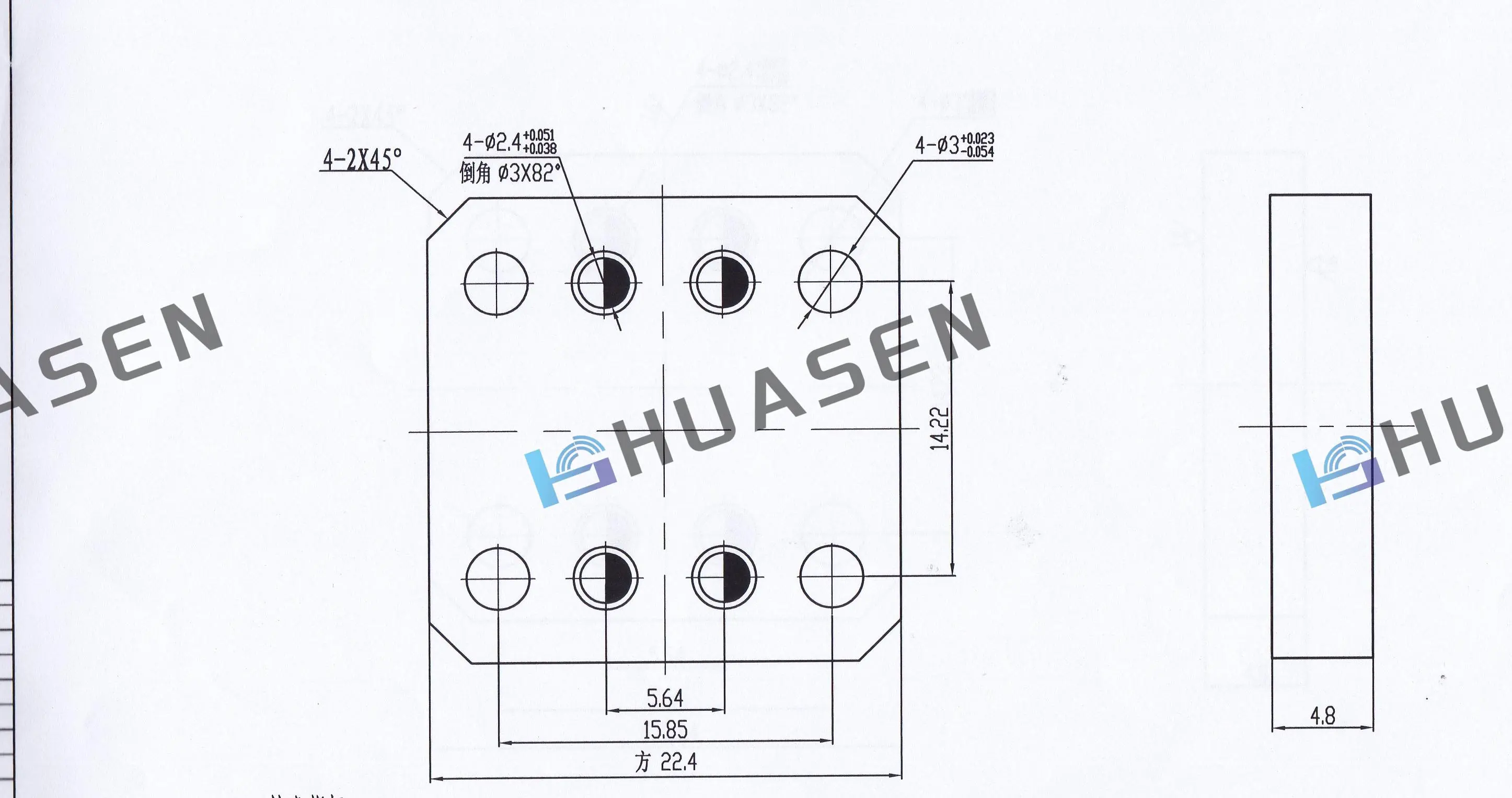
Cooperate with Huasen Microwave Technology Co., Ltd.
Founded in 1993, Huasen Microwave Technology Co., Ltd. stands as a leading China Waveguide Short Plate manufacturer and China Waveguide Short Plate supplier with over three decades of expertise in high-frequency microwave and millimeter-wave component development. Our comprehensive product portfolio includes precision waveguide components, millimeter-wave antennas, coaxial devices, and active products serving telecommunications, radar, aerospace, and defense industries worldwide. As a National High-Tech Enterprise operating a three-thousand-square-meter research and production facility, we deliver High Quality Waveguide Short Plate solutions with ultra-high precision achieving plus or minus zero point zero one millimeter dimensional accuracy.
Our China Waveguide Short Plate factory employs over two hundred skilled professionals supported by advanced CNC machining workshops, precision assembly capabilities, and comprehensive testing facilities including three microwave anechoic chambers covering frequencies from zero point five gigahertz to two hundred twenty gigahertz. We maintain ISO9001 certification, Environmental Management System compliance, and Occupational Health and Safety certifications ensuring consistent quality. Whether you need standard Waveguide Short Plate for sale or customized solutions for quantum computing research, 5G development, or millimeter-wave applications, our engineering team provides rapid prototyping with quick turnaround times accelerating your development timelines.
Our China Waveguide Short Plate wholesale offerings feature multi-frequency compatibility from zero point three two to one hundred twelve gigahertz with VSWR performance exceeding sixty for fixed types and fifty for sliding configurations. Choose from aluminum anodized surfaces for lower frequencies or copper silver-plated and gold-plated options for enhanced millimeter-wave performance. Standard FDP, FBP, and FUGP flange options ensure compatibility with major waveguide systems, while custom flange designs accommodate unique requirements. Competitive Waveguide Short Plate price structures combined with one-year warranties and dedicated technical support make Huasen your trusted partner for precision RF solutions. Contact us at sales@huasenmicrowave.com to discuss your specific requirements and discover how our Waveguide Short Plate components can elevate your measurement accuracy. Save this resource for future reference when calibration challenges arise in your high-frequency testing laboratory.
References
1. Blakey, Peter. "Waveguide Measurements and Calibration Techniques for Vector Network Analyzers." Anritsu Corporation Technical Publications.
2. Marks, Roger B. "A Multiline Method of Network Analyzer Calibration." IEEE Transactions on Microwave Theory and Techniques, Volume 39, Issue 7.
3. Rytting, Douglas K. "Network Analyzer Error Models and Calibration Methods." RF and Microwave Measurement Symposium and Exhibition, Hewlett-Packard Company.
4. Engen, Glenn F. and Hoer, Cletus A. "Thru-Reflect-Line: An Improved Technique for Calibrating the Dual Six-Port Automatic Network Analyzer." IEEE Transactions on Microwave Theory and Techniques.
5. Warner, Frank L. "Microwave Attenuation Measurement." Institution of Electrical Engineers Monograph Series, Peter Peregrinus Ltd.
Send Inquiry

Related Industry Knowledge
- How Does an Active Detector Work? Unveiling Its 4-Core Components & Signal Flow
- How Does a Waveguide Seal Window Achieve Air/Thermal Seal While Transmitting RF/Microwave Signals?
- What Are the Differences Between Manual and Automated Waveguide Elevating Platforms?
- What Are the Application Scenarios of Circular Waveguide to Coaxial Adapters in Satellite Communication Systems?
- How Does a Coplanar WG Perform in High-Speed Signal Transmission?
- How to Fabricate a High-Precision Mitered Bend Waveguide for Microwave/MMWave Applications?
- What Are the Application Scenarios of Waveguide Flex in Radar Systems?
- What Is a Dual Polarized Yagi Antenna?
