When to Choose a Dual Channel vs. Single Channel Waveguide Rotary Joint?






2018-11-01 12:36:00
Choosing between a Dual Channel Waveguide Rotary Joint and a single channel variation is a basic choice that can essentially affect the execution and capabilities of your RF framework. The choice pivots on your particular application necessities, framework complexity, and execution needs. Double channel rotating joints are perfect for frameworks that require concurrent transmission of two autonomous signals, advertising upgraded usefulness and proficiency. These components exceed expectations in applications requesting tall segregation between channels, such as radar frameworks with partitioned transmit and get ways. Then again, single channel rotational joints are more appropriate for less difficult setups where as it were one flag needs to be transmitted over a pivoting interface. They regularly offer lower addition misfortune and can be more cost-effective for less complex frameworks. Understanding the trade-offs between these alternatives is vital for optimizing your RF system's execution, unwavering quality, and cost-effectiveness.
What performance trade-offs exist between dual and single channel rotary joints?
When considering the performance trade-offs between dual and single channel waveguide rotary joints, several key factors come into play:
Isolation and Crosstalk
Dual channel rotating joints offer prevalent segregation between channels, ordinarily ≥50 dB, with a few models accomplishing ≥60 dB. This tall segregation is vital for applications where flag astuteness between channels is fundamental. Single channel joints, by nature, do not confront this challenge but may offer superior by and large flag quality for the single transmission path.
Insertion Loss
Single channel rotary joints generally have lower insertion loss compared to their dual channel counterparts. This is due to the simpler internal structure and fewer components in the signal path. Dual channel joints, while offering more functionality, may introduce slightly higher insertion loss due to the complexity of managing two separate signal paths.
Power Handling Capacity
Both types can handle high power levels, but the distribution differs. Single channel joints can often handle higher power in a single path, while dual channel joints distribute power across two channels. For instance, a dual channel waveguide rotary joint might handle up to 600W continuous wave (CW) power per channel, allowing for a combined high power transmission capability.
Size and Weight
Dual channel rotary joints are inherently larger and heavier due to the additional components required to manage two signal paths. This can be a significant consideration in applications where space and weight are at a premium, such as in aerospace or portable systems.
Frequency Range and Bandwidth
Single channel joints often offer a wider operational frequency range within a single unit. Dual channel joints may have more limited frequency ranges per channel but offer the advantage of simultaneous operation in two distinct bands.

Use cases of single channel waveguide rotary joints
Single channel waveguide rotary joints find their niche in various applications where simplicity, lower insertion loss, and cost-effectiveness are paramount:
Radar Systems
In certain radar applications, particularly those with simpler architectures or where a single transmission path is sufficient, single channel rotary joints are ideal. They're often used in weather radars or surveillance systems where the transmit and receive functions can be managed through a single channel.
Satellite Communications
Ground station antennas for satellite communications frequently employ single channel rotary joints. These joints allow for continuous rotation of the antenna while maintaining a stable RF connection, crucial for tracking satellites across the sky.
Radio Astronomy
Large radio telescopes frequently utilize single channel rotational joints to permit for exact development and situating whereas keeping up flag keenness. The lower addition misfortune of single channel joints is especially advantageous in these delicate applications.
Industrial Automation
In manufacturing environments, single channel rotary joints are used in rotating machinery where RF signals need to be transmitted across moving interfaces. This could include applications in robotics or automated assembly lines. For more complex requirements, a Dual Channel Waveguide Rotary Joint can be implemented, enabling simultaneous transmission across multiple channels while maintaining signal integrity and mechanical reliability.
Medical Imaging
Some medical imaging equipment, such as CT scanners, use single channel rotary joints to transmit data from rotating parts of the machine to stationary processing units. The compact size and reliable performance of these joints make them suitable for this critical application.
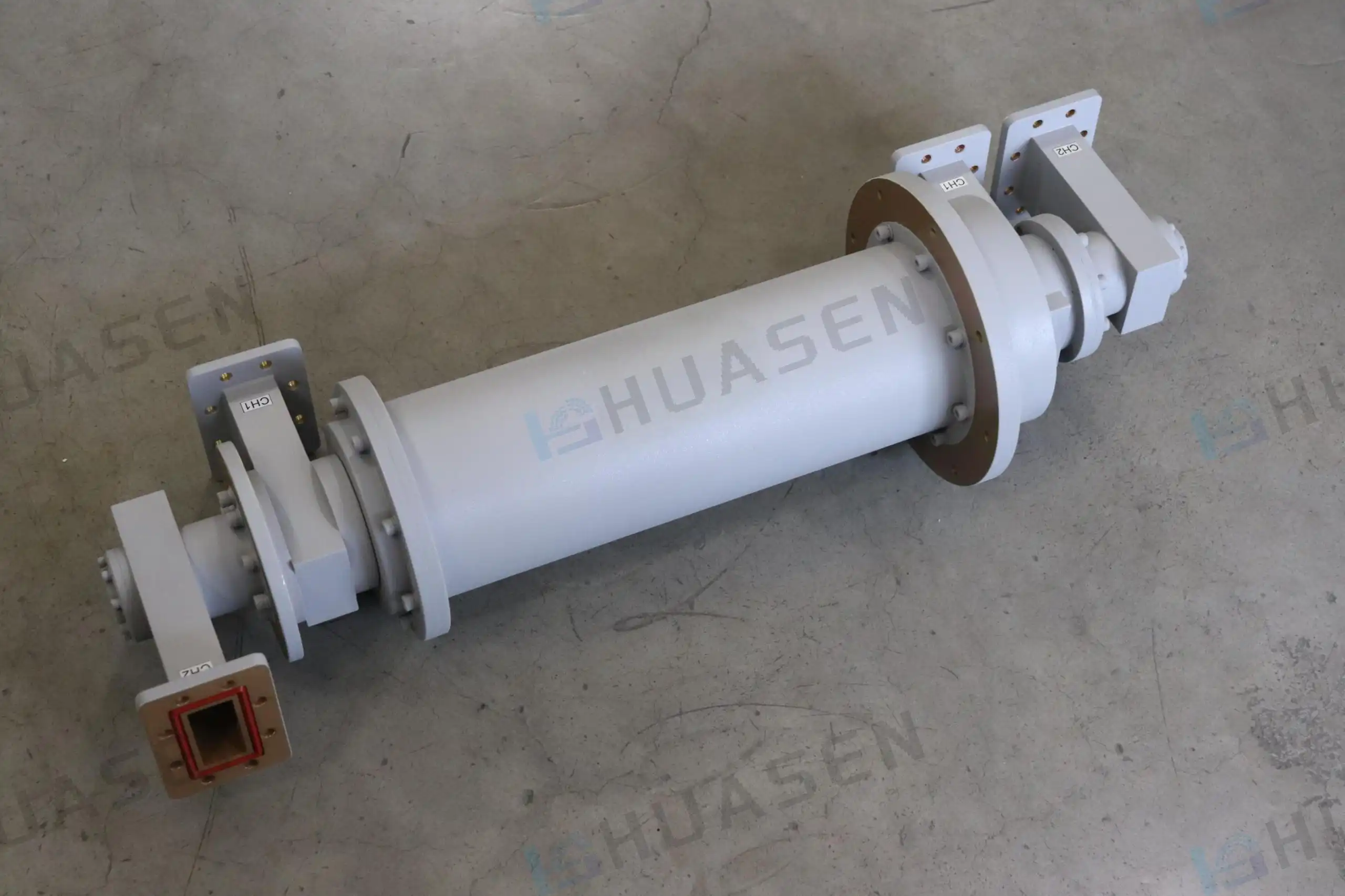
Applications requiring dual channel waveguide rotary joints
Dual channel waveguide rotary joints are essential in more complex systems that require simultaneous transmission of two independent signals:
Advanced Radar Systems
Modern radar systems, especially those used in defense and air traffic control, often require separate channels for transmitting and receiving. A dual channel waveguide rotary joint allows for continuous rotation of the antenna while maintaining isolated paths for outgoing and incoming signals, crucial for accurate target detection and tracking.
Satellite Communications Hubs
In more sophisticated satellite ground stations, dual channel rotary joints enable simultaneous uplink and downlink capabilities. This is particularly useful in high-throughput satellite communications where continuous bidirectional data transfer is necessary.
Electronic Warfare Systems
Military electronic countermeasure systems often require dual channel capability to simultaneously jam enemy signals while maintaining their own communications. The high isolation between channels in dual rotary joints is crucial for these applications.
Advanced Telecommunications
In some telecommunications installations, particularly those involving microwave backhaul links, dual channel rotary joints allow for efficient use of spectrum by enabling simultaneous transmission and reception on different frequencies.
Scientific Research Facilities
Certain scientific instruments, such as particle accelerators or fusion research devices, may require dual channel rotary joints to manage complex RF signaling in rotating equipment.
Aerospace Testing
In aerospace testing facilities, dual channel rotary joints are used in anechoic chambers and other test setups where multiple signal paths need to be maintained across rotating interfaces for comprehensive testing of aircraft or spacecraft components.
Conclusion
The choice between single and dual channel waveguide rotary joints ultimately depends on the specific requirements of your application. Single channel joints offer simplicity and lower loss for straightforward signal transmission, while dual channel joints provide the flexibility and isolation needed for more complex, multi-signal systems. Partnering with a trusted Dual Channel Waveguide Rotary Joint supplier ensures access to precision-engineered components that deliver reliable performance in demanding environments.
At Huasen Microwave Technology Co., Ltd., we understand the critical nature of this decision in RF system design. With our extensive experience in high-frequency microwave and millimeter-wave components, we're uniquely positioned to guide you in selecting the optimal rotary joint for your needs. Our dual channel waveguide rotary joints offer superior isolation, high power handling capabilities, and customizable options to meet the demanding requirements of radar, satellite communications, and advanced telecommunications systems.
Don't let uncertainty in component selection hinder your project's success. Reach out to our team of experts at sales@huasenmicrowave.com for personalized advice and solutions tailored to your specific application. Let us help you optimize your RF system's performance and reliability with our cutting-edge rotary joint technology.
References
1. Smith, J.R. (2020). "Advanced Rotary Joint Technologies for Modern Radar Systems." IEEE Microwave Magazine, 22(3), 45-52.
2. Wang, L. et al. (2019). "Performance Analysis of Dual-Channel Waveguide Rotary Joints in Satellite Communication Systems." Journal of Electromagnetic Waves and Applications, 33(8), 1087-1102.
3. Brown, A.K. (2021). "Comparing Single and Dual Channel Rotary Joints in Electronic Warfare Applications." Military Electronics and Computing, 15(2), 78-85.
4. Chen, Y. and Zhang, X. (2018). "Design Considerations for High-Isolation Dual Channel Waveguide Rotary Joints." IEEE Transactions on Microwave Theory and Techniques, 66(5), 2325-2334.
5. Rodriguez, M.A. (2022). "Advancements in Rotary Joint Technology for Next-Generation Telecommunications Infrastructure." Microwave Journal, 65(4), 22-30.
6. Patel, R.K. and Johnson, E.L. (2020). "Optimizing RF Performance in Rotating Systems: A Comprehensive Study of Waveguide Rotary Joints." International Journal of RF and Microwave Computer-Aided Engineering, 30(6), e22231.
Send Inquiry
Related Industry Knowledge
- How does a waveguide power divider achieve microwave signal division?
- What is a Waveguide Tube, and how does it differ from ordinary coaxial cables in signal transmission?
- How Does a UWB LNA Amplify Wideband Signals Without Adding Noise?
- How to Use a Coaxial Directional Coupler for 5G Base Station Power Monitoring?
- How to Choose a Suitable Lens Horn Antenna?
- How Does an Active Detector Work? Unveiling Its 4-Core Components & Signal Flow
- How to Fabricate a High-Precision Mitered Bend Waveguide for Microwave/MMWave Applications?
- What Are the Application Scenarios of Waveguide Flex in Radar Systems?
- When to Choose a Dual Channel vs. Single Channel Waveguide Rotary Joint?
- How to Achieve Low Insertion Loss: Selection Tips for High Power Adapters