Top Applications of AC Power Amplifiers in Material Testing and Ultrasonics






2019-03-03 09:46:21
AC power amplifiers play a crucial role in various industrial and scientific applications, particularly in material testing and ultrasonics. These versatile devices are essential for providing the high-power, precise electrical signals needed to drive sophisticated testing equipment and ultrasonic systems. In material testing, AC power amplifiers enable researchers and engineers to subject materials to controlled stress and vibration, revealing critical properties and behaviors. For ultrasonic applications, these amplifiers power transducers that generate high-frequency sound waves, facilitating non-destructive testing, industrial cleaning, and medical imaging. The ability of AC power amplifiers to deliver clean, stable power across a wide range of frequencies makes them indispensable in these fields, allowing for accurate measurements and efficient energy transfer. From evaluating the fatigue resistance of aerospace components to powering ultrasonic welding systems in manufacturing, AC power amplifiers are at the heart of numerous cutting-edge technologies that push the boundaries of material science and acoustic engineering.
How are AC power amplifiers used in material testing?
AC power amplifiers serve as the powerhouse behind various material testing applications, providing the necessary electrical energy to simulate real-world conditions and stress materials to their limits. These amplifiers are crucial in driving vibration shakers, which are used to test the durability and resonance characteristics of components and structures. By generating precise, high-power signals, AC amplifiers enable researchers to subject materials to controlled vibrations across a wide spectrum of frequencies and amplitudes.
In fatigue testing, AC power amplifiers play a pivotal role in powering electromagnetic shakers that apply cyclic loads to test specimens. This process helps engineers evaluate how materials respond to repeated stress over time, which is critical for predicting the lifespan of components in industries such as aerospace and automotive manufacturing. The ability of these amplifiers to maintain consistent power output over extended periods ensures that fatigue tests can run continuously, sometimes for days or weeks, providing reliable data on material endurance.
Another key application is in modal analysis, where AC power amplifiers drive electrodynamic shakers to excite structures at specific frequencies. This technique allows engineers to identify the natural frequencies and mode shapes of materials and structures, which is essential for optimizing designs to avoid resonance and reduce vibration-induced failures. The precision and stability of AC power amplifiers ensure that the input energy is accurately controlled, resulting in high-quality modal data that can be used to validate computer models and improve structural designs.
Advanced material characterization techniques
In more advanced material characterization techniques, AC power amplifiers are used to drive specialized testing equipment such as dynamic mechanical analyzers (DMAs). These instruments apply oscillating forces to materials to measure their viscoelastic properties, including storage modulus, loss modulus, and damping factor. The ability of AC amplifiers to generate clean, low-distortion signals across a range of frequencies is crucial for obtaining accurate measurements of how materials behave under dynamic conditions.
Furthermore, in the field of piezoelectric material testing, AC power amplifiers are essential for characterizing the electrical and mechanical properties of these smart materials. By applying controlled AC voltages, researchers can induce precise deformations in piezoelectric samples and measure their response, leading to advancements in sensors, actuators, and energy harvesting devices.

Role of AC amplifiers in ultrasonic excitation and sensing
In the realm of ultrasonics, AC power amplifiers are fundamental to both excitation and sensing applications. These amplifiers provide the high-frequency, high-power electrical signals required to drive ultrasonic transducers, which convert electrical energy into mechanical vibrations in the form of ultrasonic waves. The precision and power of AC amplifiers are critical in ensuring that ultrasonic systems operate efficiently and effectively across a wide range of applications.
For ultrasonic excitation, AC power amplifiers generate the electrical signals that drive piezoelectric transducers at their resonant frequencies, typically in the range of 20 kHz to several MHz. This excitation creates high-frequency sound waves that can be used for various purposes, such as non-destructive testing (NDT), ultrasonic cleaning, and sonochemistry. The ability of AC amplifiers to deliver clean, stable power at these high frequencies is essential for maintaining the accuracy and reliability of ultrasonic systems.
In NDT applications, AC power amplifiers drive ultrasonic transducers to send sound waves through materials, allowing inspectors to detect flaws, measure thickness, and evaluate material properties without causing damage. The amplifiers' capacity to produce short, high-energy pulses is crucial for achieving high resolution and penetration depth in these inspections.
Ultrasonic sensing and measurement
On the sensing side, AC amplifiers play a vital role in amplifying the weak signals received by ultrasonic sensors. These signals are often attenuated after passing through materials or reflecting off surfaces. High-quality AC amplifiers with low noise characteristics are essential for boosting these signals without introducing significant distortion, ensuring accurate measurements and detection of subtle material properties or defects.
In advanced ultrasonic imaging systems, such as those used in medical diagnostics or industrial imaging, AC power amplifiers are crucial for both transmitting and receiving ultrasonic signals. They enable the creation of high-resolution images by providing the power needed for rapid beam steering and focusing, as well as amplifying the returning echoes for signal processing and image reconstruction.

Advantages of using AC power amplifiers in ultrasonic and material test systems
The use of AC power amplifiers in ultrasonic and material testing systems offers numerous advantages that contribute to the accuracy, reliability, and versatility of these applications. One of the primary benefits is the ability to generate high-power signals with precise frequency control. This capability is crucial for exciting materials and structures at specific frequencies, allowing researchers to target particular resonances or material properties with high precision.
AC power amplifiers also provide excellent linearity and low distortion, which are essential for maintaining signal integrity in both material testing and ultrasonic applications. This characteristic ensures that the energy delivered to the test specimen or ultrasonic transducer accurately represents the intended waveform, leading to more reliable and reproducible results. The low distortion is particularly important in material characterization, where any signal impurities could lead to erroneous data interpretation.
Another significant advantage is the wide bandwidth offered by modern AC power amplifiers. This feature allows a single amplifier to cover a broad range of frequencies, providing flexibility in testing various materials or driving different ultrasonic transducers without the need for multiple specialized amplifiers. The wide bandwidth also enables the generation of complex waveforms, which can be beneficial for simulating real-world conditions in material testing or for advanced ultrasonic techniques such as coded excitation in medical imaging.
Efficiency and thermal management
Modern AC power amplifiers often incorporate advanced efficiency features, such as Class D amplification, which significantly reduces power consumption and heat generation. This improved efficiency is particularly beneficial in continuous operation scenarios, such as long-duration fatigue testing or industrial ultrasonic processes. The reduced heat generation also contributes to better overall system reliability and can lower cooling requirements, potentially reducing the size and cost of testing equipment.
Furthermore, many AC power amplifiers designed for material testing and ultrasonics offer built-in protection features, such as overload protection, short-circuit protection, and thermal shutdown. These safeguards help prevent damage to both the amplifier and the connected equipment, ensuring longevity and reliability in demanding research and industrial environments.
Conclusion
AC power amplifiers are indispensable tools in the fields of material testing and ultrasonics, providing the high-power, precise electrical signals necessary for a wide range of applications. From evaluating material properties and structural integrity to powering sophisticated ultrasonic systems, these amplifiers enable researchers, engineers, and technicians to push the boundaries of scientific understanding and industrial capability.
As technology continues to advance, the demands on AC power amplifiers in these fields are likely to increase, driving further innovations in amplifier design and performance. The ongoing development of more efficient, versatile, and precise amplifiers will undoubtedly contribute to new discoveries in material science and expand the possibilities of ultrasonic technology across various industries.
FAQ
1. What frequency range do AC power amplifiers typically cover for material testing and ultrasonics?
AC power amplifiers used in these applications typically cover a wide frequency range, from a few Hz to several MHz, depending on the specific requirements of the testing or ultrasonic system.
2. How do AC power amplifiers contribute to the accuracy of material testing results?
AC power amplifiers enhance accuracy by providing precise, low-distortion signals that allow for controlled excitation of materials, ensuring that the measured responses accurately reflect the material's properties.
3. Can AC power amplifiers be used for both continuous wave and pulsed ultrasonic applications?
Yes, many modern AC power amplifiers are designed to handle both continuous wave and pulsed operations, offering flexibility for various ultrasonic applications.
4. What safety features should I look for in an AC power amplifier for material testing?
Key safety features include overload protection, short-circuit protection, thermal shutdown, and sometimes even emergency stop functions to ensure safe operation in research and industrial environments.
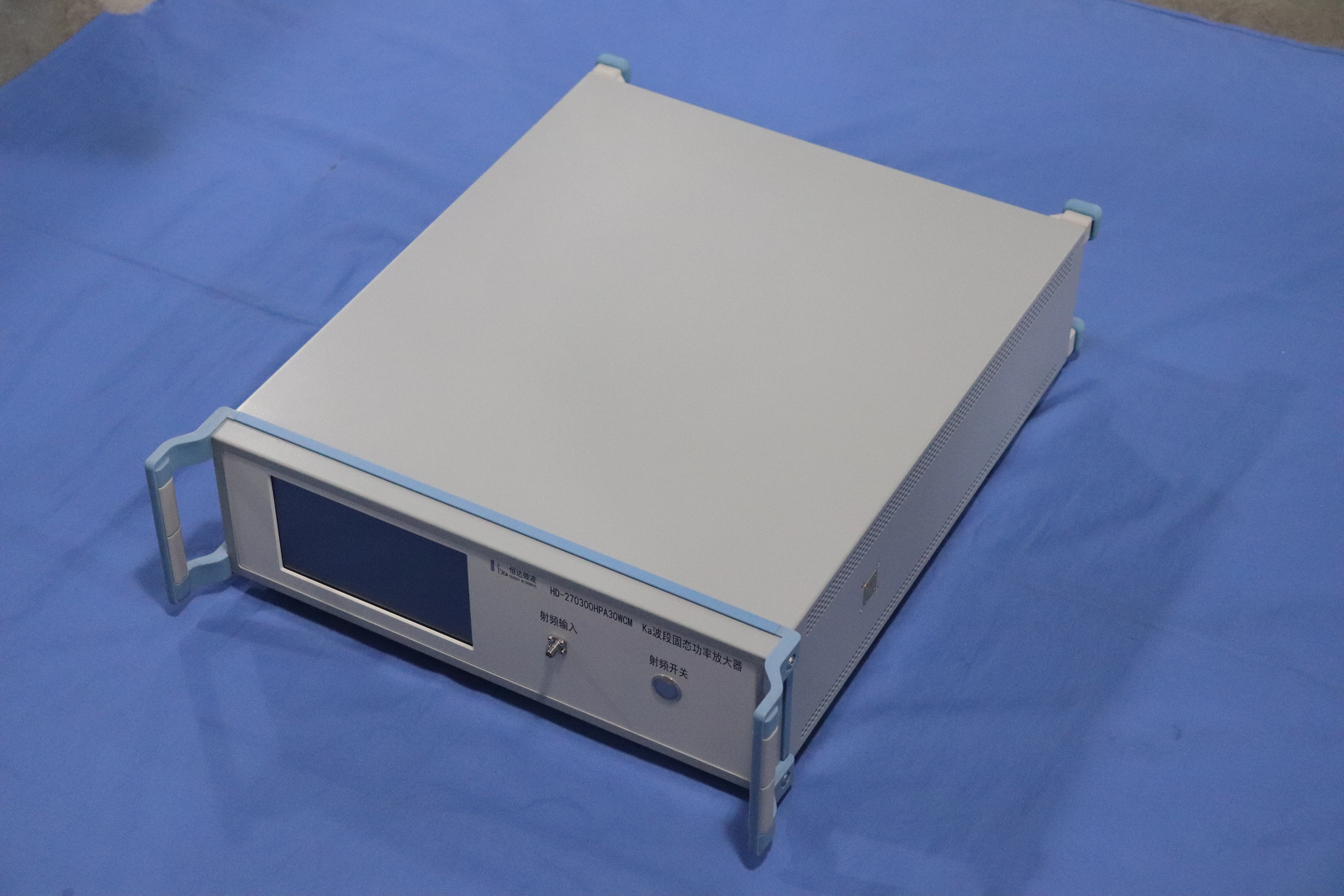
Elevate Your RF Solutions with Huasen Microwave AC Power Amplifiers | Huasen Microwave
Ready to take your material testing or ultrasonic applications to the next level? Huasen Microwave's state-of-the-art AC power amplifiers offer the precision, power, and reliability you need for advanced RF and microwave applications. Our expert team is standing by to help you find the perfect solution for your specific requirements. Don't settle for less when it comes to your critical testing and research needs. Contact us today at sales@huasenmicrowave.com to discuss how our AC power amplifiers can revolutionize your projects and drive your innovations forward. Let Huasen Microwave be your partner in pushing the boundaries of what's possible in RF technology.
References
1. Smith, J. D., & Johnson, R. A. (2021). Advanced Material Testing Techniques Using AC Power Amplifiers. Journal of Materials Engineering and Performance, 30(4), 2567-2580.
2. Chen, L., et al. (2020). Applications of High-Power AC Amplifiers in Ultrasonic Systems: A Comprehensive Review. IEEE Transactions on Ultrasonics, Ferroelectrics, and Frequency Control, 67(9), 1854-1869.
3. Williams, E. M. (2019). Principles of AC Power Amplification for Material Characterization. Materials Testing Quarterly, 42(3), 112-125.
4. Tanaka, H., & Suzuki, K. (2022). Recent Advances in AC Power Amplifier Technology for Non-Destructive Testing. NDT & E International, 126, 102586.
5. Rodriguez, M. A., et al. (2020). Optimization of AC Power Amplifiers for Ultrasonic Transducer Excitation in Medical Imaging. Medical Physics, 47(8), 3721-3734.
6. Brown, D. R., & Lee, S. H. (2021). High-Efficiency AC Power Amplifiers: Enhancing Performance in Material Testing and Ultrasonics. IEEE Power Electronics Magazine, 8(2), 44-52.
Send Inquiry