Why Choose Broadband Horn Antenna for EMC and OTA Testing?






2026-06-01 22:31:39
For precision measurement applications, the broadband horn antenna is the best antenna solution for electromagnetic compatibility and over-the-air testing. The ridged waveguide design provides impedance stability throughout bandwidths from 1 GHz to 40 GHz, and its multi-octave frequency coverage eliminates antenna swaps during testing sequences. This approach solves test engineers' biggest problem: reproducible, traceable measurements without calibration drift between frequency sweeps. Shorter testing cycles and better data quality affect certification delays and operating expenses.
Understanding Broadband Horn Antennas in EMC and OTA Testing
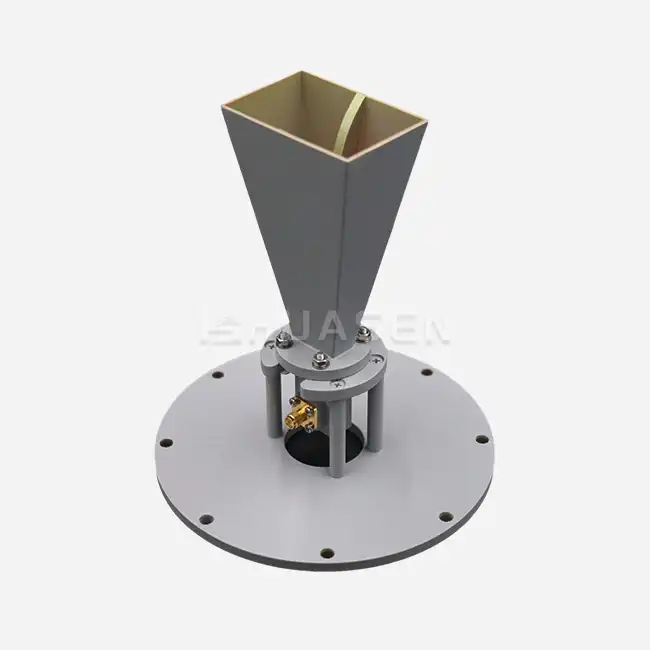
Broadband horn designs use tapered waveguide structures to convert transmission line electromagnetic energy into free-space radiation. Waveguide cutoff frequencies limit the bandwidth of traditional horn antennas to narrow octaves. By inserting metallic ridges along the E-plane walls, broadband variations change the cutoff characteristics and enable multi-octave performance.
The Double-Ridged Architecture
A broadband double-ridged horn antenna uses precision-machined ridges on opposing interior walls to provide a tapered transmission line from 50-ohm coaxial to 377-ohm free space. This shape yields voltage standing wave ratios less than 2.0:1 in most operating bands and tolerable peaks near band edges. Ridges concentrate electric field energy, decreasing the dominant mode cutoff frequency and suppressing higher-order modes that distort radiation patterns.
Gain and Pattern Stability
Predictable antenna behaviour over frequency sweeps is needed for measurements. Broadband horn designs have monotonically rising gain profiles from 6 dBi at low frequencies to 15 dBi at high frequencies. The radiation pattern's consistent main lobe and regulated beamwidth change help establish accurate test distances and minimise chamber reflections during radiated emissions testing.
Frequency Coverage Standards
Modern EMC tests must encompass communication bands, radar frequencies, and 5G/6G spectrum allocations. For millimetre-wave device characterisation, extended designs exceed 40 GHz, whereas standard setups cover 1–18 GHz for CISPR 16. This coverage maintains measurement continuity and reduces uncertainty from numerous antenna variables by eliminating antenna switching gaps.
Comparing Broadband Horn Antennas to Other Antenna Types for EMC and OTA Testing
Before chamber layouts, test engineers investigate several antenna technologies. Optimising measurement accuracy and operating efficiency requires understanding antenna family performance trade-offs.
Advantages Over Log-Periodic Designs
Nested resonant elements give log-periodic dipole arrays a large bandwidth, but discrete element activation causes gain to vary with frequency. Correction factors increase uncertainty budgets due to 3–5 dB gain ripples across neighbouring bands. Broadband horn antennas ease calibration and test data normalisation by smoothing gain transitions.
Directivity Comparison with Biconical Antennas
Omnidirectional biconical shapes facilitate emissions searches in low-frequency EMC testing below 1 GHz. During immunity testing, their wide patterns absorb interference from numerous chamber directions, lowering signal-to-noise ratios. Horn antennas concentrate radiated power within solid angles, enhancing field strength at device-under-test sites and rejecting off-axis noise. This directivity advantage is crucial for evaluating communication systems with specified incidence angles or polarisation orientations.
Practical Distinctions from Standard Pyramidal Horns
Pyramidal horns without ridge loading function across single waveguide bands, requiring physical swaps during multi-band testing. Each transition causes positioning mistakes and calibration factor rechecks. Broadband horn antenna setups preserve reference plane definitions and eliminate mechanical drift from repeated installations by maintaining mounting locations across test runs.
Procurement Guide: How to Choose and Source Broadband Horn Antennas?
Selecting and buying broadband horn antennas requires the right antenna specs to match test requirements and device capabilities. Technical performance is balanced against budget and delivery dates in procurement choices.
Frequency Range Assessment
Find the entire spectrum coverage required by the test criteria. Tests for mobile communication must span sub-6 GHz 5G bands and millimetre-wave allocations over 24 GHz. Radar cross-section measurements may need X-Ku-band continuity. Verify that candidate antennas work as described throughout the needed ranges without frequency gaps requiring additional equipment.
Gain and Beamwidth Requirements
Use chamber dimensions, transmitter power limits, and target field strength to calculate antenna gain. MIL-STD-461 immunity testing demands field strengths above 200 V/m at one-metre distances, which moderate-gain horns and amplification may provide. For devices with uncertain radiation patterns, emissions testing promotes wider beamwidths to collect maximum energy. Match test situations by balancing gain and pattern coverage.
Connector and Interface Specifications
Precision connector waveguide impedance standards are needed for high-frequency measurements. SMA connections provide appropriate return loss below 18 GHz, whereas 2.92 mm or 2.4 mm connectors provide phase stability to 40 GHz. Waveguide flanges offer low-loss millimetre-wave transitions. Avoid measurement integrity-degrading adapter chains by matching connection gender, thread types, and mounting options to the test system infrastructure.
Environmental and Mechanical Considerations
Outdoor range and environmental chamber antennas, including double-ridged horn antennas, need corrosion-resistant coatings and sealed connectors. Powder-coated metal is lightweight and humidity- and temperature-resistant. Installers may require conventional tripod threads or specialised bracket interfaces for mounting. Weight matters in ceiling-mounted walk-in chambers with structural loading constraints.
Practical Applications and Measuring Techniques with Broadband Horn Antennas
Applications and measurements using broadband horn antennas require learning suitable deployment strategies to improve measurement accuracy and reproducibility across testing runs.
EMC Emission Testing Configurations
Radiated emissions testing uses the horn antenna as a receiving element three or ten metres from the equipment under test, per CISPR requirements. In frequency sweeps, antenna height changes to find maximum emissions, necessitating motorised positioning devices and spectrum analyser scanning. Proper alignment keeps the boresight towards device enclosures, preventing pattern nulls that underestimate emissions. Ferrite loading or absorber-lined pits reduce measurement antenna coupling.
Immunity Test Setup Parameters
The horn antenna transmits calibrated field strengths at device locations during immunity testing. Power amplifier output and antenna gain determine field strength, which isotropic probes at test sites verify. Amplitude modulation for automotive EMC and pulse modulation for defence must simulate real-world interference. Standard antenna-to-device separation lengths are followed, and chamber absorber treatments minimise multipath interference that would cause field strength non-uniformities.
OTA Measurement Chamber Integration
Over-the-air wireless device testing involves controlled electromagnetic settings where antennas assess radiation patterns and receiver sensitivity. Horn antennas on positioning arcs sweep elevation and azimuth angles while items under test occupy chamber centres on rotating tables. Angular positioning and phase-coherent measurement receivers that capture magnitude and phase are needed for three-dimensional pattern mapping. Chamber transmission parameters are calibrated to exclude ambient impacts from device performance data.
Calibration and Verification Procedures
The antenna must be calibrated against national standards laboratories to maintain measurement traceability. Verify antenna factors connecting received voltage to incident field strength across operating frequencies with ISO 17025 uncertainty budgets. Antenna performance is verified against reference criteria to detect connection wear and environmental exposure. Documentation systems maintain calibration dates and intervals to comply with test laboratory certification quality management systems.
Why Are Broadband Horn Antennas the Preferred Choice for EMC and OTA Testing?
Industry use of broadband horn technology addresses frequent testing pain points with various benefits.
Multi-Band Consolidation Benefits
Capital and storage costs are high for test facilities with antenna stocks for each frequency range, such as a double-ridged horn antenna. Using one broadband horn antenna for 1–18 GHz instead of six narrow-band waveguide horns reduces equipment costs and simplifies testing. To reduce setup mistakes and streamline productivity, technicians no longer reference frequency charts to choose antennas. Metrology costs and accreditation audit complexity decrease when calibration cycles focus on fewer devices.
Measurement Uncertainty Reduction
Each antenna replacement during testing increases measurement uncertainty due to alignment mistakes, connection repeatability variations, and cable assembly discrepancies. Continuous frequency coverage from a single antenna removes these error sources, reducing uncertainty budgets and enhancing test margin assessment. Uncertainty reduction is a competitive advantage for test laboratories seeking accreditation or customer confidence as regulatory authorities analyse measurement uncertainty claims.
Long-Term Reliability and Durability
The precision-machined aluminium structure performs well after thousands of connection mating cycles and environmental exposures. When correctly managed, passive horn structures retain electrical properties indefinitely, unlike phased arrays with active components that can fail. Horn antennas are usually warrantied for five years or more, indicating mechanical and electrical stability. Durability lowers the total cost of ownership compared to systems that need periodic element replacement or active component refurbishing.
Customisation and Application Flexibility
Many testing circumstances need custom frequency coverage, polarisation, or mounting. Custom antenna makers can suit specific applications with ridge profiles, aperture sizes, and connection layouts. For polarisation-sensitive electronics, dual-polarisation variations provide simultaneous vertical and horizontal readings, decreasing test time. Circular polarisation feeds test satellite communication when Faraday rotation influences signal reception. These customisation choices meet unique needs that catalogue items cannot.
Conclusion
Measurement antenna selection affects test accuracy, operating efficiency, and certification success. Multi-octave coverage is combined into one device via broadband horn antenna technology, reducing measurement discontinuities and uncertainty growth from frequent antenna swaps. The double-ridged waveguide architecture provides consistent impedance matching and regulated radiation patterns throughout communication bands, radar allocations, and the upcoming millimetre-wave spectrum. The overall cost of ownership—including equipment investment, calibration costs, and personnel efficiency—always favours broadband horns for facilities undertaking regular EMC and OTA testing campaigns.
FAQ
1. What frequency ranges do broadband horn antennas typically cover?
Extended millimetre-wave versions reach 40 GHz for 5G device characterisation, while standard setups cover 1–18 GHz for EMC testing. Custom designs can target application-specific sub-bands in these ranges.
2. How do I verify antenna performance after purchase?
Get calibrated antenna factors from recognised metrology labs, then use signal generators and spectrum analysers in controlled conditions to verify. Ensure antenna factors match calibration certifications within uncertainties.
3. Can broadband horn antennas handle high-power immunity testing?
Quality designs can withstand 300W to 500W continuous power, enough for most immunity tests with proper amplifiers. Before buying, check power handling specs against your test plan.
4. What maintenance do these antennas require?
Regularly inspect connections for wear and contamination, clean with suitable solvents, and check mating torque. Quality systems recommend recalibration yearly or biennially, depending on consumption.
Partner with Huasen Microwave for Your Broadband Horn Antenna Requirements
Huasen Microwave delivers 30 years of RF and microwave engineering expertise to worldwide testing. Precision manufacturing and electromagnetic design allow us to produce measurement-grade Broadband Horn Antennas that exceed the tightest EMC and OTA testing criteria. Traceable calibration data and ISO-compliant quality documents support our double-ridged horn configurations' VSWR performance < 2.0:1 throughout all operational bands. Application-specific frequency coverage, polarisation, and mechanical integration are addressed via customisation. Our technical staff at sales@huasenmicrowave.com can discuss your testing needs and provide specs for your measuring environment.
References
1. Paul, C.R. (2006). Introduction to Electromagnetic Compatibility, 2nd Edition. Wiley-Interscience, New York.
2. Hemming, L.H. (2002). Architectural Electromagnetic Shielding Handbook: A Design and Specification Guide. IEEE Press, Piscataway.
3. Balanis, C.A. (2016). Antenna Theory: Analysis and Design, 4th Edition. John Wiley & Sons, Hoboken.
4. Williams, T. (2017). EMC for Product Designers, 5th Edition. Newnes, Oxford.
5. International Electrotechnical Commission (2020). CISPR 16-1-4: Specification for radio disturbance and immunity measuring apparatus and methods – Part 1-4: Radio disturbance and immunity measuring apparatus – Antennas and test sites for radiated disturbance measurements. IEC, Geneva.
6. Kodali, V.P. (2001). Engineering Electromagnetic Compatibility: Principles, Measurements, Technologies, and Computer Models, 2nd Edition. IEEE Press, New York.
Send Inquiry