What Is a Coaxial Variable Attenuator and How Does It Work?






2026-06-30 21:28:59
A Coaxial Variable Attenuator is a high-precision RF and microwave part made to actively control signal amplitude within a transmission line without changing the frequency content or causing waveform distortion. Unlike set attenuators, it lets you change the amount of signal loss on the fly, either all the time with mechanical dials or in small steps with electronic controls. These devices solve important problems, like keeping receivers from getting too full in sensitive measuring gear, letting you precisely control the gain in amplifier stages, and making it easier to do loss models that are measured while testing cellular base stations and radar systems.
Understanding Coaxial Variable Attenuators
Reliable RF systems depend on signal control parts to keep signals intact in a variety of situations. This is what affects the total performance. Coaxial Variable Attenuators are different from fixed attenuators because they can change their attenuation levels on the fly. This gives engineers a lot of freedom when testing and optimising systems.
Core Function and Design Elements
The main goal is to lower the signal power by a programmable amount while keeping the impedance matching constant across the change range. Internal resistive elements, which are often set up as T-pads or Pi-networks, take in energy in a way that depends on the attenuation setting that is chosen. The coaxial design protects against electromagnetic fields and keeps the 50-ohm resistance standard that is common in most RF uses.
In mechanical systems, rotary mechanisms are often linked to resistive cards or vanes that move in the signal line. Parts that are precisely made allow for easy change and consistent settings. Advanced models have helical fine-tuning mechanisms that let users control attenuation values down to the micron level. This lets users get the exact specs they need for sensitive measures.
Working Principles and Adjustment Mechanisms
The market is mostly made up of two types of tuning methods: continuously changeable and step attenuators. Continuous variable models have an endless resolution within their range, which makes them perfect for fine-tuning analogue circuits where smooth changes are important. When engineers turn a dial or knob, the resistance network's design changes, which changes the real-time signal loss.
Step attenuators change loss in clear steps, usually in 1 dB, 5 dB, or 10 dB amounts. This makes them more accurate and repeatable for preset testing. Electronic versions use PIN diodes or MEMS switches to change the internal paths, which lets software interfaces to be used for remote control. This feature is useful in automatic test equipment that does hundreds of readings without any help from a person.
Key Performance Parameters
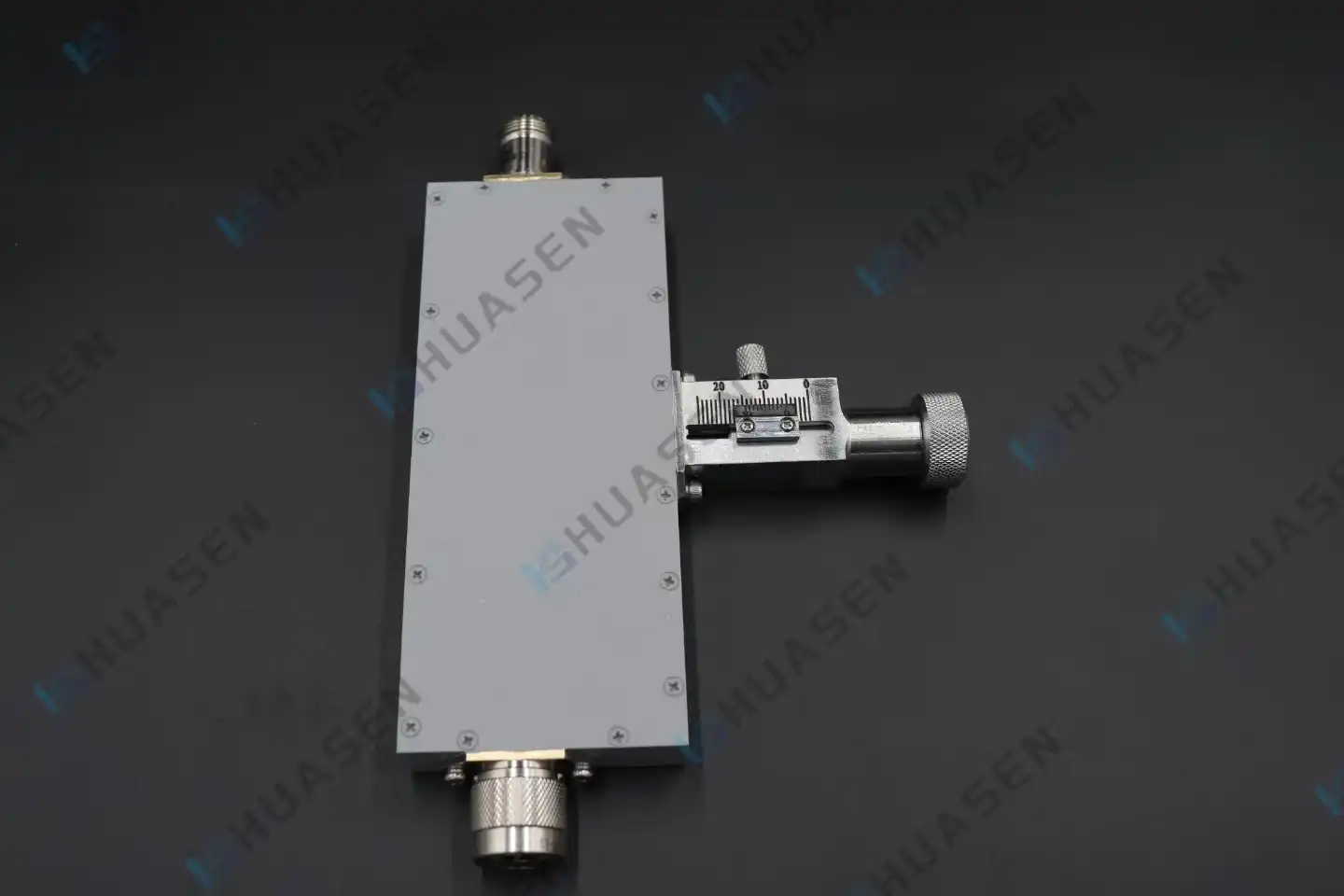
Frequency range determines working bandwidth. Depending on the type of connector and internal layout, current devices can work with frequencies from DC to 67 GHz. The Coaxial Variable Attenuator (CVA) from Huasen Microwave works from DC to 18GHz, so it can be used for most business and military communications needs. Most attenuators have a range of 0 to 30 dB, but some can go as high as 100 dB or more.
Insertion loss, which is the least amount of loss that happens at 0 dB, has a direct effect on how well the system works. Insertion loss should stay below 0.5 dB across the frequency range of a good unit. VSWR, or Voltage Standing Wave Ratio, measures how well two impedances fit. For best results, VSWR should be 1.30:1. Frequency flatness shows how accurately attenuation changes across a span, with ±1.0 dB indicating great performance at microwave frequencies.
Applications and Advantages of Coaxial Variable Attenuators
RF systems need precise signal level control in a wide range of settings, from lab benches to communication networks that are already in use. Coaxial Variable Attenuators give you the freedom that you can't get with set components. This means that a single device can be used for both tests and operations.
Critical Industry Applications
These attenuators make it seem like there are different distances between user devices and network infrastructure during tests of 5G and new 6G base stations. Engineers test the automatic gain control and receiver sensitivity on fading channels to make sure the devices meet performance standards before they are put into use. Massive MIMO arrays need to match the amplitude of dozens of antenna elements. Variable attenuators give the accuracy needed for this tuning.
These parts are needed for phased array tuning and receiver security in radar and electronic warfare systems. Attenuators keep the front end from burning out during high-power transmitter testing, which is done by engineers to make sure the system is straight. Defence uses need parts that meet MIL-DTL-3933 standards for shock and earthquake protection. This makes sure that parts work reliably in harsh conditions on ships, drones, and aeroplanes.
Ground stations for satellite communications use varying attenuators to keep uplink power constant and account for changes in air attenuation. Maritime communication methods also have problems, since signal levels change because of the weather and the state of the sea. Modern versions, like Huasen's CVA, are small and fully sealed, which makes them good for outdoor installations with limited room.
Advantages Over Fixed Attenuators
This is what changing attenuation technology does well:
- Dynamic Range Flexibility: multiple set attenuators can be replaced by a single flexible unit, which lowers inventory costs and makes system design easier. Component changing is no longer needed for testing situations that need different loss values. This saves time and keeps link wear to a minimum.
- Real-Time Adjustment Capability: Engineers can fine-tune signal levels while systems are running, which lets them fix problems and check performance in real time. This is very helpful when deploying to the area and making changes right away to keep service from being interrupted.
- Enhanced Measurement Accuracy: Continuous adjustment lets reference levels be perfectly matched, getting rid of the quantisation mistakes that come with step attenuators. Specific attenuation values can be reached with micron-precision helical tuning devices in a lab setting.
- Cost-Efficiency in Prototyping: Testing can be done across all attenuation ranges without having to buy a lot of set parts. This speeds up product development and lowers capital costs.
These benefits directly address customer concerns about keeping track of goods, checking quickly, and getting accurate measurements. Wide bandwidth operation is also possible with variable attenuators. Good models keep the frequency response flat from DC to 18 GHz, which makes designing a multi-band system easier.
Comparing Coaxial Variable Attenuators with Other Types
Knowing the differences between the different types of Coaxial Variable Attenuators helps sourcing workers choose the best parts for each job. Each design theory has its own strengths that work well with certain practical needs.
Variable vs. Fixed Attenuators
Fixed attenuators have fixed loss values, low insertion loss, and great power handling, so they can be used in permanent setups where the attenuation needs stay the same. Because they are simple, they are very reliable and cost less per unit. But they aren't very flexible when it comes to adjustments, so you need to keep a collection of different numbers to meet your testing needs.
Variable attenuators offer more control options in exchange for a slightly higher insertion loss. Fixed units work best in production settings where all the factors are known. On the other hand, changeable designs work best in testing and development settings where signal levels change all the time. When inventory savings and practical efficiency gains are taken into account, the gap in costs gets smaller.
Step and Digital Attenuators
Step attenuators offer precise attenuation changes that are very easy to repeat. They are usually handled electrically so that they can be used in automatic test systems. For digital versions, binary-weighted resistor networks are used to get wide dynamic ranges by combining switches. These work great for high-speed switching tasks that need to be controlled by software.
Continuously changeable attenuators give you better resolution without any quantisation mistakes, which is very important for fine-tuning analogue circuits and doing delicate calibration work. Because they usually have manual controls, they aren't as good for automatic settings, but are great for benchtop measures that need tactile input and slow adjustments.
Application Suitability and Trade-offs
Continuous variable models help communications testing labs get accurate signal conditioning results when they measure receiver sensitivity. Digital step attenuators are faster and easier to set, so production test sites like them. Field service workers like small, protected variable units that can handle being exposed to the elements and can be adjusted on-site.
Power handling ability varies a lot. For example, laboratory units can usually handle 2 watts of power on average, while high-power types can handle 100 watts or more. When the power level goes up, thermal management becomes very important. The design of the fan and the duty cycle limits affect the choice that is made.
How to Select and Calibrate a Coaxial Variable Attenuator
To pick the right attenuation options (Coaxial Attenuator), you have to weigh technical requirements against the needs of the application and your budget. Systematic review of key factors guarantees long-term happiness and the best possible system performance for a Coaxial Variable Attenuator.
Critical Selection Criteria
The most important thing to think about is frequency matching. The device has to be able to cover all operating frequencies with flatness standards that are good enough. The DC-18GHz range from Huasen Microwave covers most industrial radar, satellite, and wireless uses. For millimetre-wave systems to work, they need special connections with higher frequency ratings, such as 2.92mm or 2.4mm types.
Measurement precision is based on attenuation range and sharpness. Most tests can be done with a range of 0 to 30 dB, but some uses may need 60 dB or more. Adjustments can be made to within 0.1 dB of goal values thanks to helical fine-tuning devices that offer better resolution.
Power handling ability must be higher than the highest signal levels that can be predicted, with a safety margin that is just right. Average and peak power levels are very different. For pulse uses, it's important to pay attention to the peak specs to keep the resistance elements from getting damaged. As long as the VSWR is less than 1.30:1, there will be little signal bounce across the whole correction range.
In production settings, mechanical longevity is important. Cycle rates show how long something is expected to last, and good units are rated for thousands of tuning cycles. Fully sealed construction keeps out dust, water, and corrosive conditions, which makes outdoor installs last longer.
Calibration Procedures and Best Practices
As parts age, regular testing keeps measurements accurate. To do this, connect the attenuator to a regulated signal source and a power meter. Then, measure the attenuation and compare it to the settings on the dial at different frequency points. Deviations that are too big or too small mean that the drift needs to be fixed or replaced.
Changes in temperature, for example, can affect efficiency by changing the values of resistive elements and causing measurement mistakes. Quality attenuators list temperature factors that let you make up for problems in serious situations. Keeping units in controlled settings helps keep their tuning between uses.
Caring for connectors is necessary to keep standards. Before each link, check the threads and centre wires and clean them if needed with anhydrous alcohol. To keep from overtightening connections and lowering VSWR, use calibrated torque tools. For SMA connectors, this is usually 8 inch-pounds.
Datasheet Interpretation
By understanding technical specs, you can compare sellers in a smart way. Insertion loss numbers show how well the system works at the lowest attenuation levels. Frequency flatness measurements show that the accuracy stays the same across the whole bandwidth; ±1.0 dB at 18 GHz means that the performance is great.
The quality of impedance matching is measured by VSWR, and smaller numbers mean better performance. In tasks like beamforming, where keeping phase relationships is important, phase shift properties are important. Some makers make models that don't change phase much when the attenuation is changed.
Suppliers with a good reputation give a lot of information, like test data, mechanical models, and application notes. Leaders in the industry keep quality standards high and supply lines stable, which are important for long-term planning of purchases.
Procurement Guide and Supplier Insights
To successfully source components, you need to know how the market works, what the suppliers can do, and how to think about overall costs that go beyond unit prices. Strategic choices about buying a Coaxial Variable Attenuator weigh the needs of the present with the benefits of a long-term relationship.
Sourcing Options and Vendor Evaluation
B2B buyers can get what they need through a number of avenues, such as direct ties with manufacturers and authorised distributors. When you buy in bulk from makers like Huasen Microwave, you can get better prices, more customisation options, and better expert support. Distribution partners offer a wider range of products and can send smaller amounts more quickly.
Check out providers based on their technical know-how, quality certifications (Coaxial Attenuator), and how quickly they respond to customer service requests. Getting ISO 9001 approval means that your quality control systems are well-established. RoHS compliance makes sure that environmental rules are followed. Manufacturers that work with the defence and aircraft industries usually have to meet strict military standards, which gives customers trust in their dependability.
Lead times depend on how complicated the product is and how many orders are placed. Items from a standard catalogue usually ship within a few weeks, but unique designs take longer to make. By planning ahead and allocating resources more efficiently, forming strategic relationships with dependable providers lowers the risks in the supply chain.
Cost Optimisation Strategies
Pricing by volume cuts costs per unit by a large amount. Using economies of scale means combining purchases from different projects. But to find the right balance between product holding costs and unit price savings, you need to carefully look at how things are actually used.
When off-the-shelf goods don't meet certain needs, customisation adds value. By changing the frequency, connectors, and how power is handled, devices can be made to fit specific needs, possibly getting rid of the tradeoffs that come with standard goods. The tech team at Huasen Microwave works with customers to come up with custom solutions that work best for their specific needs.
The total cost of ownership is more than just the price of the car. Think about the need for calibration, the expected lifetime, and the guaranteed support. Even though they cost more at first, premium parts with better specs and longer lifecycles often provide better long-term value.
Building Strategic Partnerships
Long-term ties with suppliers have perks that go beyond just getting a good price. Preferred customers get first choice when there aren't enough resources, early access to new technologies, and special technical help. When people work together, they can come up with unique ideas that give them a competitive edge.
The level of communication has a big impact on the success of a project. Development risks are lower when suppliers offer support in multiple languages and quick tech help. Huasen Microwave was established in 1993 and has decades of experience in radio frequency (RF) technology. They offer full professional support during the entire product selection, integration, and rollout process.
Conclusion
In telecommunications, military, defence, and testing uses, Coaxial Variable Attenuators provide crucial signal control capabilities. Engineers and procurement workers can make choices that improve system performance by knowing how they work, how they measure performance, and how to choose them. Being able to change attenuation on the fly has big benefits over set components. It makes inventory simpler and improves measurement accuracy. Modern versions, like Huasen's DC-18GHz CVA, have a large bandwidth, precise helix tuning, and a strong sealed build to work in harsh environments. Long-term buying success depends on building strategic ties with suppliers and paying attention to total costs.
FAQ
1. What is the difference between continuously variable and step Coaxial Variable Attenuators?
When it comes to fine-tuning analogue circuits where smooth changes are important, continuously variable Coaxial Variable Attenuators are the best choice. Step attenuators change loss in discrete steps, like 1 dB or 10 dB. This gives better repeatability and numerical accuracy for testing settings that can be programmed and need to constantly copy exact values.
2. How does frequency impact the attenuation accuracy of a Coaxial Variable Attenuator?
Parasitic capacitance and inductance can make accuracy worse at higher frequencies, especially in the microwave and millimetre-wave bands. In specifications, this is called "frequency flatness." Good attenuators reduce this difference, but buyers need to check flatness specs (like 1.0 dB at 18 GHz) to make sure they meet error budgets for their specific uses.
3. Can I use a low-power Coaxial Variable Attenuator in a high-power transmitter line?
No, going over the average or peak power limit makes the internal resistive elements overheat, which changes their values forever or causes the device to fail completely. If the signal level is higher than the variable attenuator's grade, you should always use a fixed power attenuator before the variable unit, or you should choose a model that is made for high-power uses and has good thermal management.
Partner with Huasen Microwave for Your RF Attenuation Needs
Huasen Microwave adds more than 30 years of experience in RF and microwave engineering to every project. They make reliable parts that meet the strict needs of defence, aircraft, and telecommunications. Our line of Coaxial Variable Attenuators covers frequencies from DC to 18GHz, has small sizes, fully sealed construction for tough settings, and high-precision helical fine-tuning across 0-30 dB ranges. Whether you need regular catalogue items or solutions that are made to fit your special needs, our engineering team can help you with everything from the initial selection process to deployment.
We know how hard it is for procurement managers and system integrators to keep the supply chain reliable while also meeting performance standards and price limits. As a well-known company that makes Coaxial Variable Attenuators that meet worldwide quality standards, we can give you reasonable prices for large orders and quick technical support for the whole lifespan of your product. Email our team at sales@huasenmicrowave.com to talk about your unique needs, get datasheets, or set up trial units for samples. Find out how our tried-and-true parts and joint method can improve the performance of your system and make the buying process easier.
References
1. Pozar, David M. (2011). Microwave Engineering, 4th Edition. Hoboken: John Wiley & Sons.
2. Sayre, Charles W. (2013). Complete Wireless Design, 2nd Edition. New York: McGraw-Hill Education.
3. IEEE Standard 287-2007. IEEE Standard for Precision Coaxial Connectors at RF, Microwave and Millimeter-wave Frequencies. Institute of Electrical and Electronics Engineers.
4. Blanchard, J. L. & Renne, P. (2009). "Characterization of Variable Attenuators for Calibration Applications." IEEE Transactions on Instrumentation and Measurement, 58(4), 1156-1162.
5. Agilent Technologies. (2009). Fundamentals of RF and Microwave Power Measurements: Application Note. Palo Alto: Agilent Technologies.
6. Vendelin, George D., Pavio, Anthony M. & Rohde, Ulrich L. (2005). Microwave Circuit Design Using Linear and Nonlinear Techniques, 2nd Edition. Hoboken: John Wiley & Sons.
Send Inquiry