Thermal Design of Water Cooled Coax Waveguide






2026-06-08 22:25:02
Managing heat loads becomes a major problem when running high-power RF systems. Water cooled coax waveguide systems deal with this directly by building liquid cooling pathways right into the structure of the transmission. Unlike most air-cooled designs, these parts move coolant through carefully planned paths, effectively getting rid of the heat that is created when kilowatts are sent to megawatts. This method stops structural movement, keeps signals pure, and increases the life of parts. These are all very important for defense applications, telecommunications infrastructure, and radar sites where downtime means lost operations.
Understanding Water-Cooled Coax Waveguides and Their Thermal Design
What Defines a Water-Cooled Coax Waveguide?
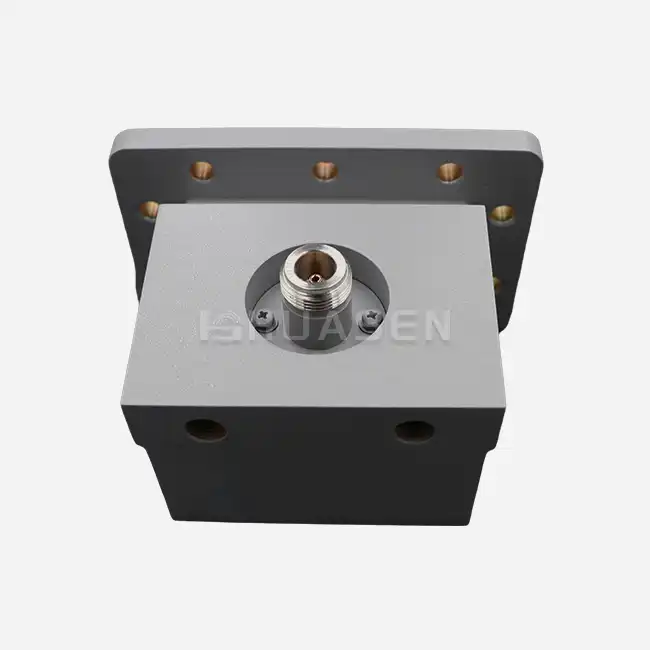
A water-cooled coax waveguide blends the geometry of a standard RF transmission with active thermal control. The core structure keeps the coaxial or waveguide transmission properties while adding machined jackets or brazed cooling tubes around the conductive walls. This mixed design came about because of problems with thermal runaway in medical linear accelerators, industrial microwave heaters, and satellite ground stations that use continuous waves. The cooling circuit usually works with an input pressure of 60 to 100 psi and uses deionized water or special coolants to pull heat away from places where surface currents gather.
The choice of material has a direct effect on efficiency. Oxygen-free high-conductivity copper is the best because it has two great qualities: it is a great electrical conductor that reduces resistance losses, and it is also a great thermal conductor that lets heat move quickly to the cooling. Some makers make aluminum versions for aircraft uses that need to be light, but copper is still the most common material for fixed installs, where thermal performance is more important than weight.
How Water Cooling Outperforms Air-Cooled Alternatives?
Waveguides that are cooled by air depend on convection and radiation, which are limited by the fact that gases in the atmosphere can only hold so much heat. When power levels go above a few kilowatts, the amount of movement needed becomes too high and requires big fans and a lot of pipes. Water can hold about 4,000 times more heat than air does per unit volume. This means that small cooling systems can get thermal energy 20 to 30 times faster. This difference in efficiency becomes very important when the installation room is limited or when temperatures in the environment get close to the limits of operation.
The edge in temperature stability directly affects how well the electricity works. Changes in temperature cause waveguide walls to lose their shape, which changes the resonant frequencies and lowers the VSWR across the working span. During operation, water cooling keeps wall temps within ±2°C. This keeps insertion loss below 0.05 dB and VSWR below 1.10:1 even during transmission sessions that last for hours. In phased array radar systems, where phase coherence across antenna elements relies on each feed network having the same thermal conditions, these measures are very important.
Core Principles and Design Considerations for Thermal Management
Material Properties and Thermal Conductivity Requirements
To do good thermal design, you must first understand how heat moves. Copper has a heat conductivity of about 400 W/m·K, which is the standard. However, surface processes change how well it works in real life. Silver plating, which is widespread in military standards like MIL-DTL-85, improves both electrical conductivity and oxidation resistance. However, chromate changes offer better corrosion protection in marine settings at the cost of slightly lower performance. The choice relies on the conditions of deployment: for example, offshore communications lines focus on how long they will last in harsh environments, while lab test equipment focuses on pure electrical metrics.
There are secret errors caused by the thermal interface resistance between the cooling ducts and the waveguide walls. When joints are brazed, there are no more air gaps, so the thermal contact conductance is higher than 50,000 W/m²·K. When you use mechanical clamping or threaded fittings, they create tiny air holes that act as insulators and cut heat absorption by 15 to 25 percent. In ultra-high-power uses, where every degree of temperature rise speeds up the breakdown processes, this difference becomes very important.
Cooling Channel Layout and Fluid Dynamics
Finite element analysis shows where heat hotspots are and where to place cooling channels to target them. In rectangular waveguides, the corner areas and center conductor junctions concentrate current density, which causes localized heating that is three to five times higher than the bulk values. Putting water cooled coax waveguide cooling tubes around these areas in a way that reverses the flow of air increases temperature differences and pulls heat away before it can be spread through the metal around it.
Flow rate estimates find the best mix between pumping power and cooling efficiency. When Reynolds numbers are higher than 4,000, the flow becomes turbulent. This makes convective heat transfer coefficients better, but it also needs higher pump pressures. Laminar flow uses less energy, but it might not cool down enough during power outages. Most commercial systems try to keep the inlet pressure below 8 bar and the flow rates between 1 and 2 meters per second. They also try to get heat removal rates of 50 to 200 watts per square centimeter of wet area.
Preventive Maintenance and Corrosion Management
Managing the makeup of the coolant is key to its long-term dependability. When different metals touch the fluid loop, deionized water alone speeds up galvanic rusting. Manufacturers ask for inhibitor kits, which are usually ethylene glycol with rust inhibitors, that keep the pH between 8.0 and 9.0 and keep conductivity below 10 microsiemens per centimeter. These additives protect metal surfaces by adding oxide layers that don't weaken the dielectric strength in RF-carrying sections.
Pressure tests should be done every three months as part of inspection routines to find small leaks before they cause big problems. Replacement times for coolant depend on the job cycle, but in 24/7 activities, they are usually between 18 and 36 months. Using thermal imaging during powered operation can help find flow blocks or air pockets that make cooling less effective. This gives you an early warning before performance drops to a level that can be measured by VSWR or insertion loss.
Comparing Water-Cooled Coax Waveguides with Alternative Cooling Solutions
Performance Metrics Across Cooling Strategies
Designs that are cooled by air can handle normal power levels of up to 5 kilowatts in common waveguide sizes, which is enough for many radar and broadcast uses. When this level is reached, forced-air systems need airflow rates higher than 10 meters per second, making noise levels above 85 decibels and using more than 500 watts just for the fans that cool the air. Water cooling keeps things running quietly while removing 50 kilowatts or more in the same space. This cuts the total amount of energy used by the system by 30 to 40 percent compared to air-cooled options that provide the same thermal performance.
Liquid cooling makes it possible to increase power density while reducing system size and weight, which are important factors in buying choices for setups with limited room. When heatsink fins and tubing are taken into account, a water-cooled waveguide run that can handle 20 kilowatts might weigh 40% less than a similar air-cooled unit. This benefit is even greater for phased arrays that need hundreds of feed points. The overall weight saved raises the structural load values and lowers the cost of installation.
Economic Trade-offs and Total Cost of Ownership
The cost of buying water-cooled parts is 40 to 60 percent higher than buying air-cooled parts at first. This is because of the complicated brazed construction and pressure testing needs. Lifecycle study, on the other hand, shows a different economy. Lower running costs are achieved by less repair downtime—water-cooled coax waveguide units usually have a mean time between failures of more than 100,000 hours, compared to 50,000 hours for fan-cooled systems. Eliminating cooling fans saves energy, which adds up to 15-20% less power used by the building over the course of several years.
For ROI calculations, application-specific factors must be taken into account, including the water-cooled waveguide to coaxial adapter. Continuous wave systems that work at more than 70% duty cycle usually pay for themselves in three years just by saving energy. Pulsed radar applications with lower average power may value reliability over energy efficiency, but they can still benefit from thermal stability, which makes parts last longer and keeps calibration accurate between maintenance cycles.
Applications and Case Studies Demonstrating Thermal Design Effectiveness
Telecommunications Infrastructure and 5G Deployment
As carriers put in place bigger MIMO antenna arrays, base station front-end designs need higher power outputs more and more. Water-cooled feed networks can handle the 100 to 200 watts per element that are needed in crowded cities where coverage needs the most power to be sent out. Thermal models for a large urban rollout showed that water cooling kept junction temperatures 35°C lower than air-cooled options. This, according to the Arrhenius equation, slowed down the rate at which semiconductors broke down by about four times.
Field data from operations in humid areas shows the useful benefits. During peak hours, temperatures can hit 45°C in some places in Southeast Asia. To keep heat shutdowns from happening, air-cooled systems cut back on transferred power, which cut the coverage area by 12–18%. Water-cooled systems kept full-rated power on all the time, which saved link budgets and stopped customers from complaining about dropped connections during the hottest parts of the afternoon.
Radar Systems and Defense Applications
When used on military ships, phased array radar has to deal with special heat problems caused by saltwater, shock loads from firing weapons, and the need to be ready for use 24 hours a day, seven days a week. During 18 months of sea trials, a destroyer-class installation case study showed that water-cooled waveguide distribution networks were available 99.7% of the time, compared to 94.3% for older air-cooled systems. The gain came from getting rid of fan failures and lowering thermally induced phase drift, which used to need to be fixed every month.
The perks of high-power ground-based monitoring radars are the same. Peak pulse powers of up to 5 megawatts create immediate sparks that would melt parts that weren't cooled enough. Flow rates of 15 liters per minute of water cooling kept the surface temperatures below 80°C even when the engine was running at full power. This allowed tracking missions to go on for 72 hours or more without any performance loss.
Emerging Technologies and Future Trends
Gallium nitride amplifiers in next-generation systems raise heat densities above 300 watts per square centimeter, which is too high for even the most advanced cooling systems to handle. In lab tests, hybrid systems that use both water cooling and phase-change materials show promise. These methods can handle average thermal loads while soaking short-term heat spikes during pulse transmission. Temperature sensors, flow meters, and predictive algorithms are now built into smart tracking systems. These systems warn workers of problems before they happen and adjust the flow rates of coolant based on real-time power levels.
Procurement Guidance for Water-Cooled Coax Waveguides
Evaluating Suppliers and Technical Specifications
Setting practical factors, such as frequency range, peak and average power handling, VSWR limits, and environmental conditions, is the first step to successful purchase. Ask for thorough thermal analysis studies that show simulated temperature ranges for certain loads. This paperwork is usually given by reputable providers, and it usually includes validation test data from sample evaluation. Check that the plans submitted meet the necessary criteria, such as MIL-DTL-85 for defense uses, EIA flange specifications for business systems, and pressure vessel codes if they apply.
Lead times vary a lot depending on how customized the product needs to be. Catalog items with standard flange shapes usually ship within 4 to 6 weeks. However, fully personalized designs with specific bend radii, polarization rotations, or coatings, such as a water-cooled waveguide to coaxial adapter, may need 12 to 16 weeks for engineering, manufacturing, and qualification testing. Plan your purchase schedules properly, especially for jobs that have set times for installation.
Certification and Quality Assurance Expectations
Make sure that the pressure test records show that the system works without any leaks at 1.5 times the working pressure, which is usually 9–15 bar for systems that are designed for 6–10 bar service conditions. High-power tests should show that the rated power can be handled for periods of time that are the same as or longer than the operational duty cycles. Thermal imaging should prove that the temperatures are evenly distributed across the cooling zones. For electrical performance verification, swept-frequency VSWR measurements must be taken across the entire stated bandwidth. These measurements must show that the maximum VSWR standards are met at all frequencies.
Certifications for quality management systems give customers trust in the regularity of the products they make. Documented process controls are part of ISO 9001 certification. For aerospace uses, AS9100 certification adds strict standards for traceability and configuration management. Suppliers who work with defense contractors should have facility security clearances that are proper for the level of classification of your program if you want to talk about sensitive performance factors.
Conclusion
Thermal management is what separates high-power RF systems that work from ones that don't and are full of problems like drift and breakdowns. Coaxial and waveguide parts that are cooled by water give current defense, radar, and telecommunications systems the temperature stability, power handling, and dependability they need. The work that engineers put into making sure that cooling systems work right pays off by making parts last longer, making upkeep easier, and making sure that electricity systems work the same way in all kinds of weather. When making a purchase choice, it's important to think about both the original cost and the value over the product's lifetime, since thermal performance has a direct effect on how available and effective the system is.
FAQ
1. What power levels justify switching to water-cooled waveguides?
The duty cycle and the environment affect the crossover point. Continuous wave uses with an average power of 5 kilowatts usually benefit from water cooling because it is better at getting rid of heat. Pulsed systems that have lower average power but high peak levels (more than 100 kilowatts peak) may still need liquid cooling to deal with spikes that only last a short time. When wind is limited or the temperature is high, the point at which water cooling is needed is lowered.
2. How does cooling system maintenance affect operational readiness?
When water cooling systems are built correctly, they don't need much maintenance. Visual checks for leaks every three months and a coolant study every year to check for pH and inhibitor ratios keep things reliable. These jobs can be easily added to current maintenance plans and don't need the system to be shut down. The most important service is replacing the coolant every 24 to 36 months, which is usually done during planned facility breaks.
3. Can existing air-cooled systems be retrofitted to water cooling?
Retrofitting is possible when there is enough room to add coolant distribution equipment. The waveguide parts need to be replaced with water-cooled versions, but the flanges usually stay compatible, which lets improvements be made without having to remove them. An engineering review should check that the structure can support the extra weight of the coolant and that the building's utilities can cool it down enough.
Partner with Huasen Microwave for Advanced Cooling Solutions
Huasen Microwave has been making high-power RF components for more than 30 years, so they can handle your most difficult projects. Our Water Cooled Coax Waveguide designs combine tried-and-true methods for managing heat with precise manufacturing methods to create parts that meet strict military and business standards. We offer full design support, from the first thermal models to the confirmation of prototypes and mass production, to make sure your system works at its best. Our engineering team works closely with the people involved in your project to create custom solutions that meet the specific frequency needs, power levels, and environmental restrictions of your project. We keep the supply chain reliable that large-scale projects need by being certified to ISO 9001 standards and putting strict quality controls in place at every stage of production. Get in touch with our technical sales experts at sales@huasenmicrowave.com to talk about your project needs with a Water-Cooled Coax Waveguide maker who is dedicated to your success.
References
1. Pozar, David M. Microwave Engineering, 4th Edition. Wiley, 2011. Chapter 3: Transmission Lines and Waveguides.
2. Saad, Theodore S. Microwave Engineers' Handbook, Volume 1. Artech House, 1971. Section on High-Power Waveguide Components.
3. Collins, Robert E. Foundations for Microwave Engineering, 2nd Edition. Wiley-IEEE Press, 2000. Thermal Design Considerations for Waveguides.
4. Hansen, Robert C. Phased Array Antennas, 2nd Edition. Wiley, 2009. Chapter 8: Feed Networks and Thermal Management.
5. Ginzton, Edward L. Microwave Measurements. McGraw-Hill, 1957. Section on Water-Cooled High-Power Components.
6. Ramo, Simon; Whinnery, John R.; Van Duzer, Theodore. Fields and Waves in Communication Electronics, 3rd Edition. Wiley, 1994. Thermal Effects in High-Power Transmission Systems.
Send Inquiry