Mitered Bend Waveguide Fabrication Methods






2026-06-22 23:01:12
To guarantee minimal signal reflection and best electromagnetic performance, Mitered Bend Waveguide fabrication requires precise engineering. The process of making something includes very precisely controlled grinding steps that make 45-degree cuts and keep tight tolerances on dimensions. Important factors like VSWR and insertion loss are directly affected by how well the device is made. Modern methods use CNC cutting and advanced plating methods to make waveguide parts that meet strict requirements for 5G infrastructure, satellite communication systems, and radar sites that can't risk dependability.
Understanding Mitered Bend Waveguides
Waveguide technology has changed a lot to meet the needs of modern RF devices in terms of efficiency and space. When signal paths need to change directions within small assemblies, mitered bend designs are useful options that balance electromagnetic integrity with space economy.
What Makes Mitered Bends Essential
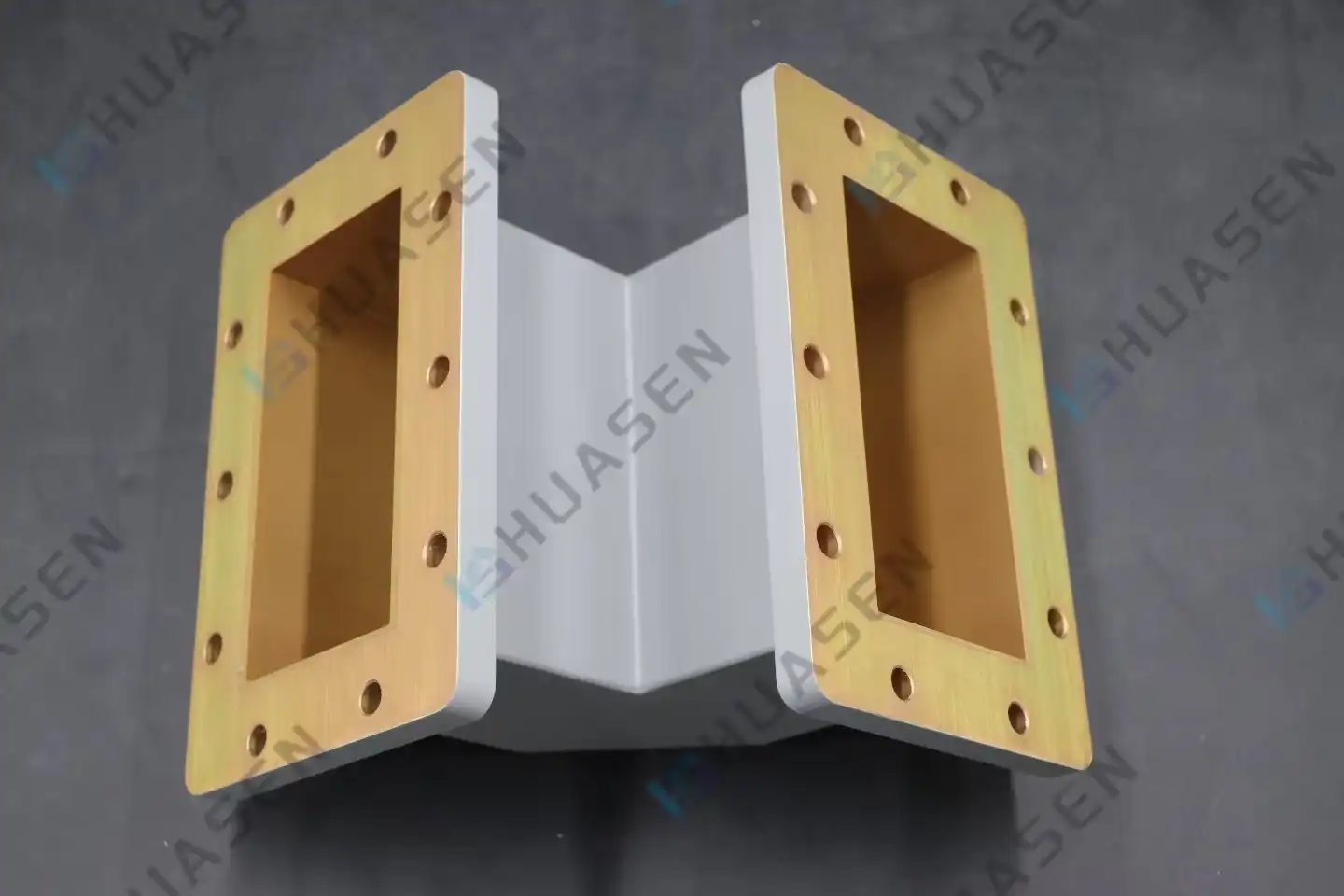
Instead of a smooth curve, a Mitered Bend Waveguide sends electromagnetic energy around a tight corner by using a reflective surface that is perfectly angled. When compared to swept bends, which need turning radii that are often wider than several waveguide widths, this design concept makes the actual size a lot smaller. The 45-degree miter plane matches the resistance of the two lines, making up for reactances that would cause signal echoes at the break.
In situations where every cubic inch counts, mitered designs work great. This small shape is good for radar systems in space, payloads on satellites, and packed base station arrays. While taking up a fraction of the space, the design gets performance levels similar to sweeping bends. This solves one of the most important problems in current communication architectures: limited space.
E-Plane Versus H-Plane Configurations
Mitered bends work in E-plane (WTEB) or H-plane (WTHB) mode depending on their location relative to the electric and magnetic fields. E-plane bends form curves in the narrow dimension, where electric fields are highest. Magnetic field vectors align with H-plane bends in the broad dimension.
Every arrangement has different electromagnetic behaviour and impedance correction demands. Although they offer higher bandwidth, e-plane bends need more intricate mitre geometry optimisation. H-plane systems are usually easier to build mechanically and have good VSWR over standard waveguide frequency ranges. Material selection is crucial. Oxidised aluminium alloys are lightweight, while silver plating on copper alloys improves electrical conductivity for high-frequency millimeter-wave applications.
Material and Flange Specifications
For the majority of telecoms uses, standard Mitered Bend Waveguides are made of aluminum with protective oxidation coatings, which offer great corrosion protection and weight economy. Copper construction with silver-plated ends is used in higher-frequency applications where the skin needs to be as conductive as possible with little depth. Both types of materials can handle normal 90-degree bends, and custom curves can still be made for unique system shapes.
Flange interoperability makes sure that the new waveguides work with current networks without any problems. FDP and FDM flange standards are used for lower frequency bands, while FBP and FBM designs are used for higher frequencies. These interface standards make sure that mechanical accuracy is maintained during assembly and that electromagnetic continuity is maintained across connecting surfaces.
Challenges in Fabrication of Mitered Bend Waveguides
There are many challenges in making precision waveguide components that have a direct effect on the end performance factors. Knowing about these problems with production helps buying teams set reasonable goals and choose manufacturing partners who can meet those goals.
Dimensional Tolerance Requirements
Dimensions must be checked throughout manufacture to fulfil VSWR standards. Mitre angles must be within a few hundredths of 45 degrees. Because even modest changes increase impedance errors and reflection coefficients. Internal cross-sectional measurements must be exact to maintain the working band's cutoff frequency and characteristic impedance.
Before parts are used, coordinate measuring equipment is used to verify these critical measures for deviations during quality control. A good part can become a terrible return loss part with 0.005-inch electromagnetic changes.
Surface Finish Impact
The interior surface hardness affects insertion loss by changing current flow along waveguide walls. Microwave currents penetrate just a thin conductor layer. This implies that pattern faults increase resistive losses by the same amount. Specifications normally require surface roughness below 63 micro-inches Ra to minimise deterioration.
CNC operators must carefully choose tools and optimise cutting settings for smooth output. Later plating procedures must maintain this surface quality and not add roughness that would impair the finishing job. Borescope examinations reveal interior surface faults that size checks overlook.
Material Consistency and Cost Constraints
Different raw materials complicate production. Differences in conductivity across batches can vary loss tangent values, and imperfections can make metal cling harder or generate hot patches when power is high. Although authorised materials with recognised electrical properties cost extra, their performance is known in advance.
Budget constraints lead manufacturers to adopt cheaper materials or reduce quality control. Compromising on field issues like changing parts or shutting down the system is rarely cost-effective. Finding the correct balance between procurement prices and long-term dependability demands is still difficult when sourcing components.
Key Fabrication Methods for Mitered Bend Waveguides
Precision waveguide parts can be made using both old-fashioned metalworking methods and cutting-edge additive manufacturing methods. Depending on the amount being made, the difficulty of the geometry, and the speed requirements, each method has its own benefits.
CNC Machining Approaches
This is the most common way to make waveguide components, using computer numerical control techniques. Programmable tool tracks on multi-axis milling centers make it possible to accurately create both external profiles and internal holes. This method works with a lot of different materials, like copper, brass, and aluminum, while still keeping the tight limits needed for the best electromagnetic performance.
The process starts with a solid piece of metal that goes through a series of steps that remove material. The waveguide channel is made with precise endmills, and the important 45-degree angle surface is made with specialized cuts. Fixture design is very important because the item has to stay in the same place during cutting so that the dimensions don't change. Programming has come a long way. For example, current CAM software automatically creates efficient tool paths that cut down on cycle times while keeping the quality of the surface finish.
Precision Forming and Welding
For some waveguide configurations, sheet metal forming methods can save you money, especially when you're making a lot of them. Progressive dies make flat designs that fold into the right cross-sectional shape. Later, welding is used to close the seams and join the pieces together. Compared to cutting from solid stock, this method reduces material waste and can speed up production once equipment development is done.
Any holes or partial melting creates electromagnetic gaps, so the quality of the welding is very important. TIG welding in inert atmospheres makes clean joints with little oxidation, but it is often still necessary to do post-weld grinding to get back to the important measurements that were changed by heat. For the miter joint in particular, the tool needs to be carefully designed so that it stays at a precise 45-degree angle during the welding process, especially in an E-plane Mitered Bend Waveguide (WTEB).
Advanced Manufacturing Technologies
It has become clear that additive manufacturing can be used to make prototypes and small amounts of unique shapes. Using selective laser melting to build waveguide parts from metal powder layer by layer makes it possible to make complex interior features that would be hard to machine any other way. This feature is especially useful when looking into new designs that use matched parts or multi-section assemblies that are built in.
Electroforming and electrical discharge cutting are the last two tools in the advanced manufacturing kit. By electroforming, metal is deposited onto perfectly shaped mandrels. This makes parts with great internal surface finishes that work well with millimeter-wave frequencies. EDM uses controlled electrical shocks to cut through very hard materials or make detailed parts, but because it works more slowly, it can only be used for specific tasks and not for regular production.
Design Considerations in Fabrication
For waveguide production to go well, the design engineering team and the factory team need to work together closely. The needs for electromagnetics must be turned into practical requirements that can always be met by production tools.
Critical Dimensional Parameters
The angle length and placement are the most sensitive design factors that affect how well electromagnetics work. Initial numbers are set by theoretical estimates, but in practice, manufacturing often requires multiple rounds of refinement. Simulation software figures out which measurements need the most careful attention by showing how manufacturing tolerances affect estimates of VSWR and insertion loss.
For internal cross-sections to stay true to their rectangular shapes, they can't taper or deform. Even wall thickness affects both how hard something is and how well it handles heat when it's running at high power. Corner angles at the miter joint need to be specified because abrupt changes can concentrate electric fields and lower the amount of power that can be handled. Each parameter affects the others, making a complicated optimization space that skilled designers work through simulation-based development methods.
Simulation-Driven Optimization
During the whole process of planning to manufacturing, electromagnetic simulation tools are now a must. Before actual modeling starts, finite element analysis predicts how the fields will be distributed within the waveguide structure. This shows any hot spots or impedance mismatches. These virtual studies quickly look at changes in design and see how sensitive they are to manufacturing errors and changes in material properties.
In modern simulation processes, fabrication facts are directly incorporated into estimates of performance. Engineers don't model perfect shapes; instead, they enter predicted dimensional tolerances and surface finish values to make performance ranges that are more realistic. This method matches what the designer wants with what the factory can make. This cuts down on the number of times prototypes need to be changed and speeds up the time it takes to get custom waveguide goods on the market.
Environmental and Mechanical Requirements
In addition to electromagnetic performance, the operating environment factors put extra limits on the manufacturing. Specialized plating or coating methods are needed to protect parts from rust when they are going to be used outside. Extreme temperatures require materials with matching thermal expansion coefficients to keep their shape and avoid mechanical stress over a wide range of operating temperatures.
To prevent vibration and shock, the mechanical design must be strong, with thick enough walls and strong attachment places for flanges. These structural concerns can sometimes clash with electromagnetic optimization goals, so solutions that meet the needs of both performance areas must be found. Design choices are backed up by strict qualification testing, and pilot samples are put through environmental stress testing before they can go into full production.
Choosing the Right Fabrication Partner and Procurement Tips
One of the most important choices in buying waveguide components is choosing a manufacturing provider. The skills of the chosen partner directly affect the quality of the product, the dependability of delivery, and the long-term security of the supply chain.
Evaluating Manufacturing Capabilities
Quality approvals are the first thing that sellers are checked for when they are being considered. Registration under ISO 9001 means that the quality management system is mature at a basic level, while registration under AS9100 means that the process is disciplined enough for aircraft use. For defense uses, MIL-STD compliance may be necessary, which means that things must be able to be tracked and tested according to specific rules.
In addition to certifications, the real capabilities of the tools should also be carefully looked into. Results are more reliable with new CNC machines that have thermal compensation and in-process measurement tools than with older machines that had to be run by hand. Instead of just depending on paperwork for certificates of compliance, having metrology equipment like CMM tools and vector network analyzers shows a real dedication to quality control.
Technical Support and RF Expertise
The level of technical help is what sets great providers apart from just-good ones. Having access to RF engineering experts during design reviews helps make sure that specs are optimized for ease of manufacture while still meeting performance standards. The supply organization's simulation tools let people work together to solve problems when unexpected problems come up during the development or production stages.
Understanding Lead Times and Customization
Standard catalog waveguide parts usually ship within a few weeks because makers keep popular versions in stock. Custom specs start engineering review cycles, which are followed by the creation of tools and the building of prototypes. Depending on the complexity of the design and the current production load, this can make lead times several months long.
Clear communication during the whole buying process boosts trust and allows for more realistic project planning. Suppliers you can trust give you thorough quotes that break down the costs by material, machining processes, plating, and testing. Instead of making unrealistic claims that can't be kept, they make it clear what the long-term issues and possible bottlenecks are. You can test the performance of a prototype before agreeing to mass production, which lowers the technical risk in serious situations.
Cost Factors and Volume Considerations
Unit prices for H-Mitered Bend Waveguide (WTHB) vary a lot depending on the number of items ordered, the material chosen, and the tolerance requirements. Small batches of prototypes have higher setup and programming costs, but large batches of production can save money by using specific tools and improving processes. The price is greatly affected by the material used. For example, silver-plated copper costs more than regular metal with a conversion covering.
The amount of tolerance has a direct effect on the cost of production because tighter tolerances require more cutting processes and more thorough quality checks. Costs can be kept low without losing function by specifying suitable tolerances instead of ones that are too tight. When providers get a lot of orders, they may be able to buy specialized fixtures or automation that lowers the cost per unit by a lot compared to one-time unique orders.
Conclusion
Modern RF and microwave systems rely on components made with Mitered Bend Waveguide fabrication, which blends mechanical accuracy with electromagnetic engineering. When engineers and buyers know about manufacturing methods, design considerations, and purchase factors, they can make choices that balance performance needs with budget and time limits. Paying close attention to dimensional tolerances and surface finish quality is still very important when choosing E-plane or H-plane setups, material specs, or manufacturing partners. As wireless communication systems get better at using higher frequencies and more components, the need for carefully made waveguide parts keeps growing in the defense, aircraft, and telecommunications industries.
FAQ
Q1: How does the VSWR performance of a mitered bend compare to a curved bend?
Because their shape is more gradual, swept turns naturally have smaller reflections across a wider range of frequencies. If you design compensated mitered bends correctly, they can match this performance, with VSWR values below 1.05 across normal waveguide bands and no-radius footprints. The choice relies on how much space is available and how much bandwidth is needed for different uses.
Q2: Can mitered bend waveguides handle high-power RF applications?
When standard sharp miters are used, they create electric field concentrations that can break the voltage when the power is very high. With double-miter or radiused-miter designs, field changes are spread out more evenly, which lets megawatt-class power be handled without arcing. Power capacity specs should be checked against real-world working conditions, such as pulse features and environmental factors.
Q3: What is the practical difference between E-plane and H-plane mitered bends?
E-plane bends follow the electric field vector through the narrow waveguide dimension. H-plane bends, on the other hand, follow the magnetic field vector through the wide dimension. There are big differences between the setups in the miter geometry and impedance adjustment formulas. The choice is based on the needs of the system structure and the electromagnetic performance goals for the application.
Partner With Huasen Microwave for Precision Waveguide Solutions
Huasen Microwave has been making high-frequency parts for over 30 years and works with defense systems, military projects, and telecommunications infrastructure all over the world. We can make Mitered Bend Waveguides that meet strict VSWR requirements—getting ≤1.15 for full-band uses or ≤1.1 for narrow-band ones—through approved quality control processes and precise CNC machining. We make E-plane (WTEB) and H-plane (WTHB) configurations with standard 90-degree angles or unique shapes that fit the needs of your system. You can use metal with a protective oxidation or copper with a silver coating, along with the right FDP/FDM or FBP/FBM flange standards. As an expert producer of mitered bend waveguides, we can help with everything from fast prototyping to large-scale production. We also offer full technical support during the whole procurement process. For 5G networks, satellite communications, or radar systems, please email our engineering team at sales@huasenmicrowave.com to talk about your unique needs for bandwidth, power handling, and integration.
References
1. Pozar, D. M. (2011). Microwave Engineering (4th ed.). Hoboken: John Wiley & Sons.
2. Marcuvitz, N. (1986). Waveguide Handbook. London: Peter Peregrinus Ltd.
3. Saad, T. S. (1971). Handbook of Microwave Transmission Measurements. Boston: Artech House.
4. Matthaei, G. L., Young, L., & Jones, E. M. T. (1980). Microwave Filters, Impedance-Matching Networks, and Coupling Structures. Dedham: Artech House.
5. Collin, R. E. (2001). Foundations for Microwave Engineering (2nd ed.). New York: IEEE Press.
6. Montgomery, C. G., Dicke, R. H., & Purcell, E. M. (1948). Principles of Microwave Circuits. New York: McGraw-Hill.
Send Inquiry