Multi Bend Waveguide for Complex Routing






2026-06-22 23:01:10
Engineers always have to figure out how to get microwave energy around hurdles without lowering performance when they have to send high-frequency messages through small radar systems, satellite transponders, or 5G base stations. Multi Bend Waveguide systems solve this issue by combining several precise bends into a single stiff structure. This gets rid of lossy connections and keeps the signal integrity even in the smallest installation areas. These unique parts give modern telecommunications and aircraft systems the routing freedom they need while keeping the low insertion loss and high power handling capabilities that are necessary for mission success.
Understanding Multi Bend Waveguides: Principles and Properties
At its core, a waveguide routing system with more than one turn is different from straight parts or simple elbow setups. A straight waveguide has very little loss, but it can't go around solid parts or fit into chassis shapes that aren't perfectly round. Directionality is taken care of by single-bend elbows, but complicated lines need multiple flanged connections, which add impedance mismatches and possible RF leakage points at every joint.
What Defines a Multi-Bend Configuration
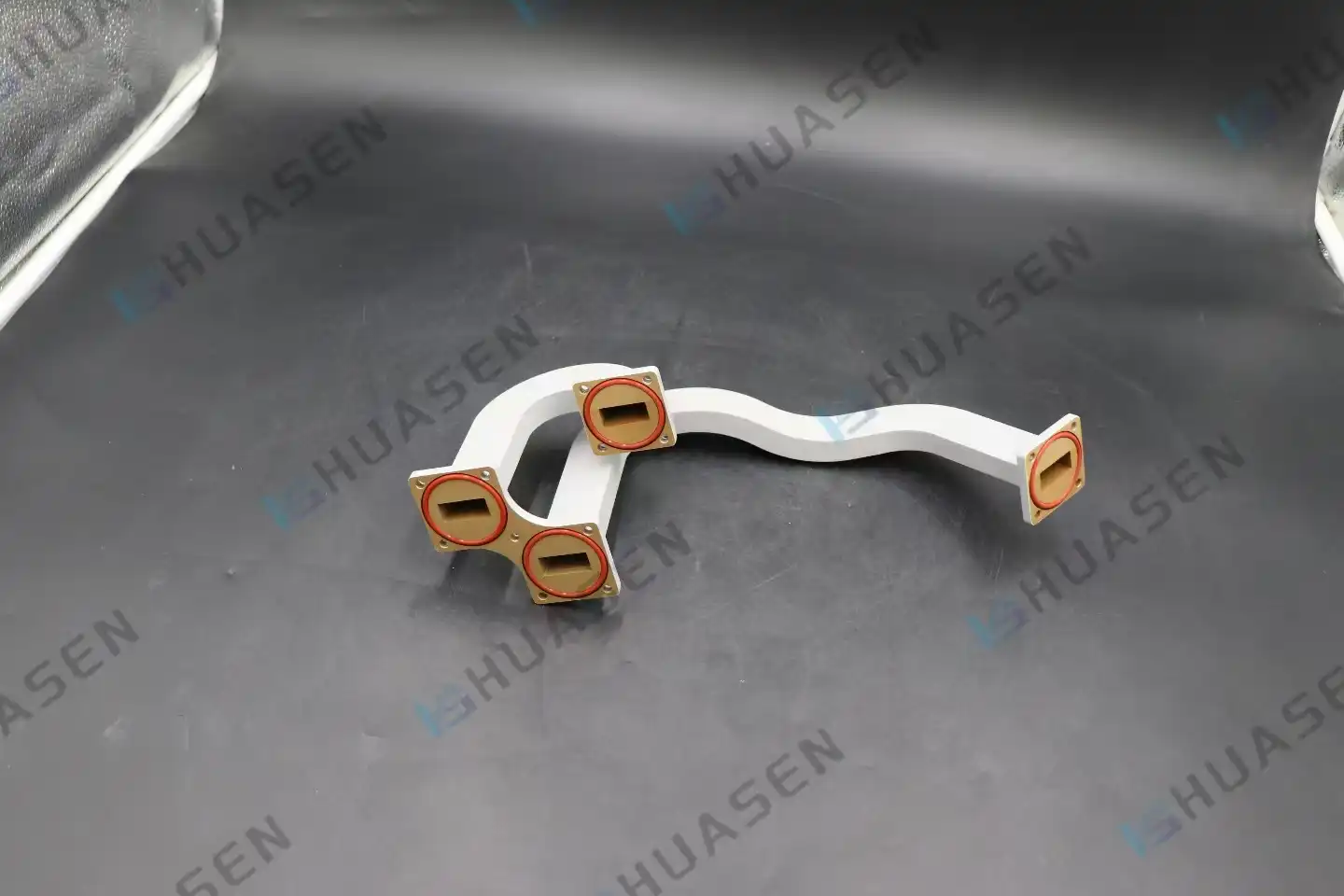
A Multi Bend Waveguide assembly is made by carefully CNC bending or electroforming parts that have both E-plane and H-plane bends in one continuous structure. When compared to bolted parts, this seamless design means that signs run into fewer breaks. Engineers choose these parts when the installation space doesn't allow for straight lines around bulkheads, through tight equipment racks, or along bent airframe surfaces where cable connections would cause too much phase instability.
Material Selection and Electrical Performance
Oxygen-Free High Conductivity copper is still the best base material for frequency bands from L to Ka because it is easy to work with and conducts heat well. Aluminum 6061 is used in aircraft applications that care about weight, but its higher resistive loss means that longer runs need to be carefully planned. Internal areas are plated with silver or gold to reduce skin-effect losses. This is an important step because microwave currents cluster just microns from the wall surface. When radius ratios follow engineering rules, VSWR should be less than 1.15:1 across full waveguide bandwidths, and insertion loss should stay below 0.1 dB per bend.
Design Principles for Optimal Signal Routing
The bend radius is what determines how pure the mode is and how much reflection there is. Tight radius bends create higher-order modes that either release energy or turn into heat, which lowers the efficiency of the system. Simulation tools that use finite element analysis check the shape of the bend before it is made by modeling how the fields are distributed through each turn. Design experts weigh how small something is against how well it works electrically, knowing that when the ratio of radius to wavelength falls below certain levels, mode conversion can happen. It's also important to pay attention to the specs for the surface finish, since internal roughness scatters millimeter-wave signals, especially above 40 GHz, where the skin depth drops to sub-micron levels.
Advantages of Multi Bend Waveguides in Complex Routing
Every cubic centimeter counts in businesses where space economy is important because it saves money. Designers of satellite payloads plan their mass down to the gram; aircraft radar systems fit transmit chains into stable gimbals; and medical linear accelerators send RF power through spinning gantries. Getting rid of bulky flange stacks and lowering the area needed for signal distribution is good for all of them.
Performance Comparison with Alternative Solutions
While flexible waveguides are easier to place, they have 3–5 times the insertion loss of rigid systems. Coaxial wire can handle smaller bends, but it can't handle the high power levels that radar and communications systems produce at their peak. When designed correctly, a Multi Bend Waveguide rigid assembly can handle 90-degree turns and complex angles with loss numbers that are close to those of a straight waveguide. This performance edge is very important in high-power transmit chains, where the actual emitted power depends on the tenth of a decibel.
Advanced Materials and Environmental Resilience
Coatings on the outside keep marine systems safe from salt fog rusting, and kilowatt-level arcing is stopped by pressurizing the inside with SF6 or dry nitrogen. Matching the thermal expansion of the waveguide to the mounting structures stops stress failures when the temperature changes from -40°C to +85°C, which is a standard condition in military specs. MIL-STD-810 shock and vibration testing confirms the mechanical stability of flying platforms that experience acceleration in more than one direction while moving.
Industry Applications Spanning Critical Sectors
These routing methods are important for telecommunications infrastructure because they connect diplexers to antennas in crowded tower-top assemblies. Multi Bend Waveguide feeds are used in phased array radar systems to spread power across hundreds of radiating elements while keeping phase coherence within very tight limits. Broadband receivers and jammers can fit into streamlined airframe fairings of electronic warfare pods with the help of compact wiring. Medical accelerator makers use vacuum-tight turns to move radio waves (RF) from klystrons to waveguides inside spinning treatment heads that speed them up. The main goal in all of these different uses is still the same: to provide the best RF performance in the smallest possible space.
How to Select and Procure Multi Bend Waveguides for Your Projects
Buying choices depend on how well technical specs match up with system needs and how well suppliers can do their jobs. There are more performance factors than just frequency range. Things like power handling, phase stability, and environmental approval are what set apart good components from mission-critical solutions.
Critical Technical Specifications to Evaluate
Start by setting an operating frequency with enough room for error. For example, a WR-90 waveguide is supposed to work from 8.2 to 12.4 GHz, but in practice, designs keep working from 8.0 to 13.0 GHz to account for filter roll-off and manufacturing errors. When you look at peak and average power values, you need to take modulation methods into account. For example, pulsed radar has different stress profiles than continuous-wave satellite links. Pay close attention to flange compatibility; mixing UG and CPR standards can lead to expensive repairs.
Supplier Assessment and Quality Indicators
As a minimum, established makers keep ISO 9001 certification, and defense companies need AS9100 for aerospace use. Ask for test data that shows the VNA runs across the whole band, not just certain frequencies. Coordinate measuring machine inspection records check that the places of the flanges match the GD&T callouts. This keeps installation problems from happening. Ask about production wait times. Depending on how complicated they are and how they need to be plated, custom Multi Bend Waveguide systems can take anywhere from four to eight weeks.
Cost Considerations and Customization Options
The unit price of Waveguide Bend Assembly takes into account the cost of materials, the difficulty of the cutting process, and the surface processes. Silver coating adds 15–25% more than copper alone, but at Ka-band, it cuts loss by 30%. When you buy more than 25 units, you can get big savings on the price, which makes buying production tools worth it. Customization options set fast providers apart from catalog-only sellers. Sizes, bend angles, arm lengths, and contact requirements can all be changed to meet the needs of each installation job, without affecting other parts of the system's design.
Installation, Maintenance, and Technical Support
Damage that lowers electricity performance can be avoided by handling things correctly during integration. To get the right VSWR, waveguide flanges need to have clean mating surfaces and torque patterns that are measured. Lossy films that weaken high-frequency transmission are introduced by fingerprints or cutting fluids.
Integration Best Practices
Carefully align the flanges before putting in the bolts. Cross-threading hurts precision threads and makes leaky paths. Follow the manufacturer's instructions, which are usually between 15 and 40 inch-pounds based on the size of the flange, when tightening the bolts in star designs. If you over-tighten the bolts, the lips will bend, and if you under-tighten them, microwaves will leak through. To avoid mechanical stress from overhanging loads, which can cause phase centers to shift over temperature cycles, make sure that parts are installed with enough support.
Troubleshooting Common Performance Issues
If VNA readings taken after installation show high VSWR, check the flange contacts for damage or contamination. When switching between types of connectors, add adapters slowly to separate the problematic areas. Power handling problems show up as thermal runaway. Infrared cameras find hot spots that mean mode switching or roughness on the surface. Helium mass spectrometers must be used to check for leaks in pressurized systems in order to keep the dielectric strength at rated power levels.
Quality Verification and Certification Standards
Testing with a network monitor shows that the return loss and insertion loss meet the requirements across the entire working bandwidth. Coordinate measure tools to make sure that important dimensions match up with installation holes. Hermetic closure for high-power uses is confirmed by tests to 30 PSI of pressure. Borescope check finds problems inside that can't be seen from the outside. Quality management systems and customer checks are met by documentation packages that have material certifications and test results.
Future Trends and Innovations in Waveguide Technology
New discoveries in material science point to formulas that will have lower resistance and better thermal qualities. Additive manufacturing methods make it possible to make shapes that can't be made by standard bending. However, at millimeter-wave frequencies, there are still problems with surface finish. When active parts are built directly into route structures in hybrid assemblies, the number of connectors and the complexity of the system are reduced.
Emerging Design Methodologies
Now, computational electromagnetics tools can model whole RF chains, including waveguide routing, and predict how well a system will work before the hardware is even made. Machine learning algorithms improve bend shapes based on multiple factors, such as loss, size, and ease of manufacture. These simulation features shorten development processes and cut down on prototype changes, which speeds up the time it takes for next-generation platforms to hit the market.
Market Drivers and Growth Sectors
T5G and new 6G networks need base station front-ends with more components, which is why small routing options are becoming more popular. Low Earth orbit satellite groups need parts that are light, reliable, and can handle the vibrations and temperature changes that happen during launch. Wideband systems that cover multiple danger bands are a top priority for defense development projects. This means that routing designs need to be flexible, and Multi Bend Waveguide is well-suited to meet these varied high-frequency application needs. For millimeter-wave wireless lines to work in data centers, the radio waves must be spread out accurately and steadily. In all of these cases, buying strategies focus on sources that can increase production while keeping quality high and adapting to changing technology needs.
Conclusion
Modern RF systems need to be able to route signals in a way that doesn't waste room or slow down performance. Multi Bend Waveguide assemblies provide this freedom. By combining several bends into a single stiff structure, these parts get rid of lossy connections while keeping the signal integrity in difficult situations like phased array radar and satellite communications. Picking the right material, the shape of the bend, and the treatment of the surface all have direct effects on insertion loss, power handling, and weather resistance. Professionals in procurement should rate providers based on their technical skills, quality systems, and ability to adapt to customer needs. As the aircraft and telecommunications industries move toward higher frequencies and tighter integration, these precise routing solutions will continue to be essential for meeting system performance goals.
FAQ
Q1: What advantages do multi-bend routing solutions provide compared to straight assemblies?
A straight waveguide has the least amount of loss, but it can't get around barriers or fit into oddly shaped areas. Multi Bend Waveguide setups send signals along complicated lines while keeping electrical performance close to that of straight parts. This is because they don't use flanged connections, which can cause VSWR spikes and potential leakage points in systems made up of multiple single-bend elbows.
Q2: How do I assess whether a multi-bend design suits my RF application?
Look at the working frequency, the amount of power that needs to be handled, and the fitting limitations. Make sure the bend radii are at least the minimum size requirements for your waveguide to stop mode conversion. Look at the test results from your provider that show VSWR and insertion loss for your whole working bandwidth. Think about things like the temperature range, vibration exposure, and the need for corrosion protection that affect the choice of material and covering.
Q3: What should I expect regarding supplier lead times and shipping?
Depending on the complexity of the shape and the surface treatment requirements, custom Multi Bend Waveguide systems usually take four to eight weeks to deliver from the time they are ordered. To keep things from getting damaged during shipping, they need to be carefully packed with flange protection and shock absorption. When buying things internationally for defense purposes, you may need to show proof that you follow export rules.
Contact Huasen Microwave for Custom Multi Bend Waveguide Solutions
Huasen Microwave Technology offers custom-designed routing options that are made to fit your toughest RF connectivity needs. Our Multi Bend Waveguide systems can be made to fit your needs in terms of size, bend angle, arm length, and contact requirements. For high-power uses, you can also choose to have them pressurized and sealed. With more than 30 years of experience in radio engineering, we help customers in defense, aircraft, and telecommunications by providing them with reliable parts that meet strict performance standards. Our expert team can help you with design, get you a quote quickly, and provide fast after-sales support, whether you need a Multi Bend Waveguide supplier for a prototype or large-scale production. Email our experts at sales@huasenmicrowave.com to talk about the details of your project and find out how our custom solutions can improve the performance of your system.
References
1. Marcuvitz, N. (1986). Waveguide Handbook. Institution of Engineering and Technology Press.
2. Pozar, D. M. (2011). Microwave Engineering (4th ed.). John Wiley & Sons.
3. Saad, T. S. (1971). "The Design of Rectangular Waveguide Bends." IEEE Transactions on Microwave Theory and Techniques, 19(5), 441-447.
4. Montgomery, C. G., Dicke, R. H., & Purcell, E. M. (1948). Principles of Microwave Circuits. McGraw-Hill.
5. Lewin, L. (1975). Theory of Waveguides: Techniques for the Solution of Waveguide Problems. John Wiley & Sons.
6. Collin, R. E. (1991). Field Theory of Guided Waves (2nd ed.). IEEE Press.
Send Inquiry