Coaxial Variable Attenuator: Attenuation Range & Accuracy






2026-07-27 10:02:15
When working with RF and microwave systems, precision matters. A Coaxial Variable Attenuator (CVA) provides the exact signal amplitude control engineers and procurement teams need for testing, calibration, and system optimization. The attenuation range defines how much signal reduction a device can deliver—typically from 0 dB to 30 dB or beyond—while accuracy determines how closely the actual attenuation matches the dial or digital setting. Together, these specifications ensure signal integrity across telecommunications, aerospace, defense, and laboratory environments where even a fraction of a decibel can affect performance.
Understanding Coaxial Variable Attenuators: Principles and Types
Attenuators that can be changed change the strength of an RF signal without blocking the path of transmission. Fixed attenuators give a single, unchangeable loss value. Variable models, on the other hand, can be changed in real time, which makes them essential for dynamic testing situations.
How Do Coaxial Variable Attenuators Work?
Resistive parts inside a CVA take in RF energy. When you turn the dial or change the settings on the control panel, mechanical or electronic parts change the layout of the resistive path, which changes the level of attenuation. The coaxial structure always has a 50-ohm impedance, which keeps the signal's purity and reduces echoes. This system works for uses from DC to millimeter waves, and the broadband version can handle DC to 18 GHz or higher.
Mechanical vs. Electronic Variable Attenuators
Attenuation can be changed on mechanical CVAs by turning knobs or micrometer drives by hand. That's why they're perfect for bench testing, where an engineer can fine-tune signal levels while checking the uniformity of an amplifier or the sensitivity of a receiver. A digital or electronic step attenuator, on the other hand, changes the level of reduction in clear steps, usually in 0.5 dB or 1 dB steps. These gadgets work well with automatic test equipment (ATE) and programmable systems, making them very repeatable and letting you handle them from afar.
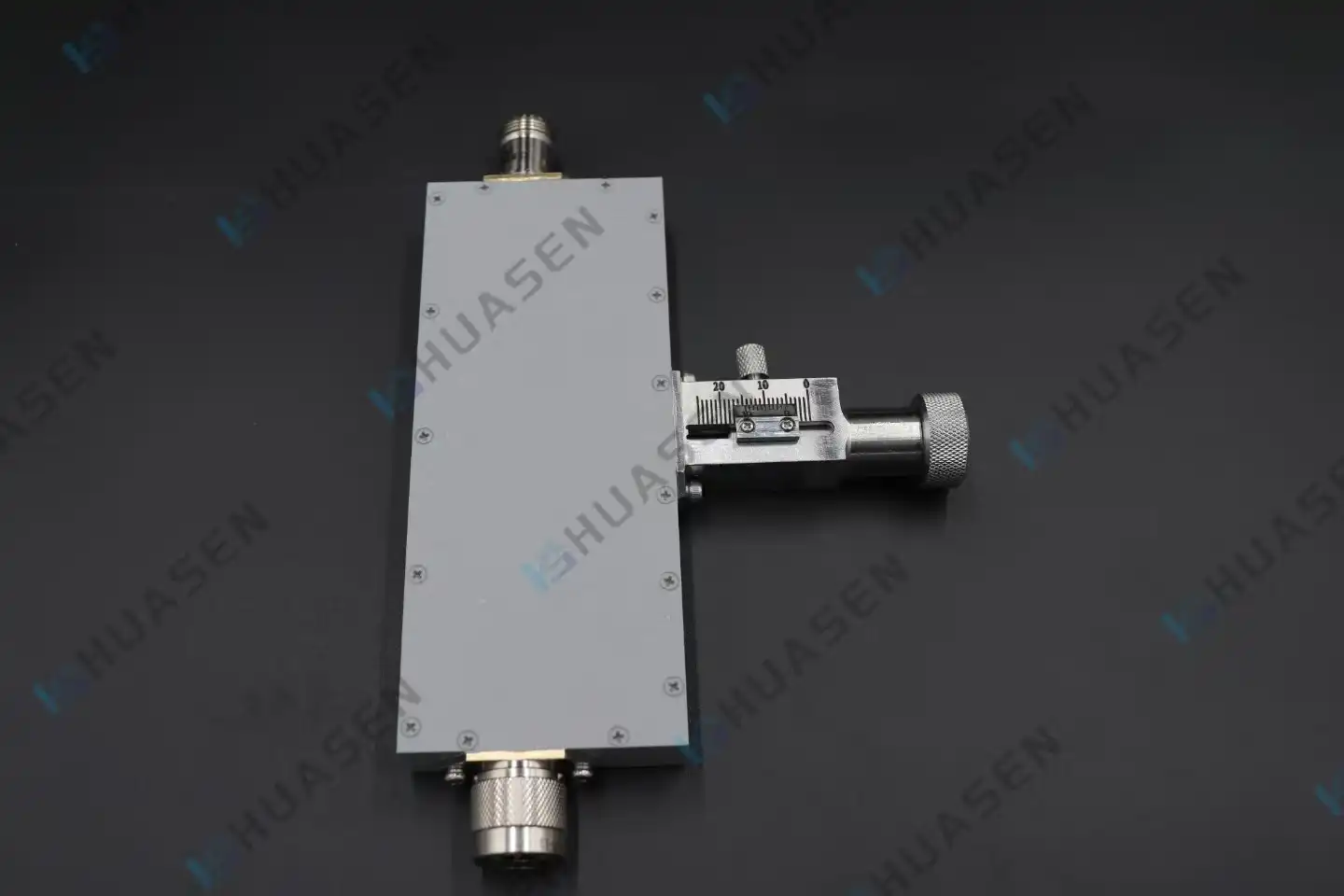
Adjustable, Step, and Digital Attenuators
Adjustable attenuators let you make changes to the reduction that are smooth and constant. It's easy for them to tune analog circuits and do manual calibration. Step attenuators change between set loss values, which provides better stability and numerical accuracy, which is very important when checking RF components against strict standards. Digital attenuators combine step functions with electronic control interfaces like USB, Ethernet, or GPIB, which makes it possible for them to be easily added to modern test benches. Manual models usually work in frequency ranges from DC to 18 GHz, while high-speed digital models can handle millimeter-wave bands up to 40 GHz and beyond.
Table 1: Comparison of Attenuator Types
| Type | Control Method | Resolution | Repeatability | Ideal Application |
|---|---|---|---|---|
| CVA for mechanics | Dial by hand | Keep going | Moderate | R&D labs and bench tests |
| Attenuator for steps | On/off switch | Separate (for example, 1 dB steps) | High | Calibration and testing for production |
| Digital Attenuator | USB and GPIB electronics | Separated (0.5 to 1 dB) | Very High | Remote devices and automated ATE |
System designers and procurement managers can better match the right device to their process by understanding these differences. This helps them find a balance between their needs for flexibility, accuracy, and automation.
Attenuation Range & Accuracy: Why They Matter in RF Testing and Communications?
The accuracy and range of attenuation have a direct effect on the reliability of measurements and the performance of the system. When a lot is at stake, like when testing 5G base stations, communicating via satellite, or calibrating radar, even small changes can throw off results or damage delicate gear.
Defining Attenuation Range
The range of signal loss that a device can provide is called its attenuation range. A normal CVA might have a range of 0 to 30 dB, which means it can lower the signal power by up to 30 decibels compared to the input. Broader bands, like 0–70 dB, work best for situations where signal loss needs to be very high, like keeping high-power transmitter leaks away from spectrum analyzers. the coaxial variable attenuator. In their working area, narrower ranges often offer better accuracy and finer resolution for the coaxial variable attenuator.
Why Accuracy Matters?
Accuracy tells you how close the real reduction is to the number that is shown. If a device says it is accurate to within 0.5 dB, it means that the actual attenuation could be up to that much different from what the dial says. This limit changes the pass/fail gaps in RF component characterization. If you test the gain flatness of a low-noise amplifier, a mistake of ±0.5 dB could hide a problem or mark a good unit as broken, which would waste time and money. Engineers can trust their readings because good CVAs have a tightness of ±0.5 dB or less across their whole range and frequency band.
Factors Influencing Accuracy
The effectiveness of CVA depends on a number of factors. During manufacturing, calibration procedures set the baseline performance. However, changes in temperature, humidity, and mechanical vibration can cause drift over time. Connector wear, especially on SMA or N-type connectors, causes impedance mismatches that make VSWR and flatness worse. At microwave and millimeter-wave frequencies, where parasitic capacitance and inductance can change attenuation, frequency flatness—the difference in accuracy across different frequencies—becomes very important. Manufacturers with a good reputation reduce these effects by using precise machining, airtight closing, and strict testing that meets MIL-DTL-3933 standards.
Comparing Variable, Fixed, and Step Attenuators
Fixed attenuators have a loss value that doesn't change, are very accurate, and have low insertion loss, making them perfect for long-term installations like base station antenna lines. Step attenuators let you set and repeat attenuation levels, which makes them great for automated testing in production. When it comes to manual tuning and real-time adjustments during R&D, variable attenuators are the most flexible option. The cost is that variable models are more difficult to maintain and calibrate, but they offer flexibility that fixed or step units can't match.
Think about a 5G OEM trying a very large MIMO setup. Engineers can test automatic gain control (AGC) circuits in fading channel conditions using variable attenuators that mimic changing path losses between the user devices and the base station. Because they can be used for active testing, high-precision CVAs are worth the extra money compared to easier options.
Selecting the Best Coaxial Variable Attenuator for Your Business Needs
To pick the best CVA, you need to think about the technical requirements, the reputation of the supplier, the customization options, and the total cost of ownership. Huasen Microwave has decades of experience as an engineer, so they know how to deal with these problems and can offer custom solutions.
Key Technical Specifications
When judging a CVA, pay close attention to these factors:
- Frequency Range: Make sure the gadget works with the frequencies you need. The CVA from Huasen Microwave covers DC to 18 GHz, which covers most commercial and defense uses.
- Attenuation Range: Make sure the range works for your needs. A 0-30 dB model is good for general tests, but a 0-70 dB model may be needed for more specific jobs.
- Accuracy: For accuracy, aim for ±0.5 dB or higher, especially when calibrating in the lab and making sure that parts work properly.
- Insertion Loss: Less insertion loss is better. Huasen's design keeps system link costs safe by minimizing leftover loss when set to 0 dB.
- VSWR: A low voltage standing wave ratio (usually 1.3:1) makes sure that signal reflection and impedance matching are kept to a minimum.
- Power Handling: Check the scores for both normal and peak power. When these limits are crossed, the resistance part fails.
- Connector Types: SMA, N-type, and 2.92 mm connectors are all good for different frequency ranges and mechanical needs.
Table 2: Huasen Microwave CVA Product Parameters
| Parameter | Specification |
|---|---|
| Range of Frequencies | DC-18 GHz |
| Range of Attenuation | 0 to 30 dB |
| Mechanism for Adjustment | Feintuning with helices |
| Accuracy | About 0.5 dB (normal) |
| Loss of Insertion | ≦0.5 dB at 0 dB setting |
| VSWR | 1.3:1 |
| Options for Connectors | N-Type and SMA |
| Size and shape | Small and saves room |
| Glueing up | Fully protected and rated IP65 |
| Temp for Use | -40°C to +85°C |
Comparing Leading Manufacturers
The CVA market is dominated by a few world providers. Mini Circuits has a large selection of ready-to-use coaxial variable attenuator models that can be delivered quickly and are good for common uses. Pasternack puts a lot of emphasis on unique connector combinations and fast prototyping. Keysight and Anritsu focus on high-end precise devices that work with their test tools. These devices offer the highest level of accuracy, but they cost more and take longer to get.
Huasen Microwave fills in these holes. The company was started in 1993 and has 30 years of experience in RF and radio technology. It also offers open customization options. If you need different frequency bands, special plugs, or ruggedized cases for harsh settings, the engineering team works closely with clients to make solutions that fit their needs. This flexibility shortens the time it takes to buy things and keeps inventory simple for system integrators who are working on multiple projects at once.
Customization and Bulk Purchasing Benefits
Standard CVAs can meet a lot of needs, but custom designs give you an edge over your competitors. When they are in charge of 5G rollouts or aircraft projects, procurement managers often need specific attenuation ranges, connector angles, or environmental ratings. The research and development (R&D) department at Huasen Microwave helps with these requests by giving design advice, testing samples, and calibration data to make sure the performance is good before starting full-scale production. When project deadlines are tight, bulk purchasing agreements are very important because they secure priority delivery slots and lower unit costs even more.
Streamlining Procurement Processes
Clear communication is the first step to efficient buying. When you call a coaxial variable attenuator provider, be sure to include your frequency range, attenuation needs, accuracy tolerance, power handling, and the customized surroundings. Ask for full datasheets, S-parameter files, and certificates of compliance like RoHS, ISO 9001, or MIL-STD. Find out about the warranty terms, repair services, and expert help that is available.
Calibration and Maintenance: Ensuring Long-Term Performance
Over time, even the best CVA moves around. Calibration and repair done on a regular basis keep things accurate, extend their life, and protect your investment.
Proper Calibration Procedures
Calibration checks that the attenuator's real loss is the same as its setting across the whole frequency range. To find the insertion loss, you should use an accurate vector network analyzer (VNA) and try it out at different frequencies and attenuation settings. Compare the results to the original manual for the gadget. If the deviations are bigger than the accuracy tolerance, the part needs to be fixed or replaced. ISO/IEC 17025-accredited labs usually calibrate once a year, but for mission-critical uses, checks may need to be done every three months.
Routine Maintenance Tasks
The most attention needs to be paid to connector interfaces. Before each use, check SMA or N-type connectors for broken pins, debris, or corrosion. Anhydrous alcohol and lint-free brushes can be used to clean contacts. To keep from overtightening, which bends the center wire and lowers VSWR, use a measured torque wrench (8 in-lbs for SMA connectors). When not in use, keep CVAs in protective boxes to keep them safe from dust, moisture, and mechanical shock. Fully sealed models, like Huasen's CVA, offer more protection, but it's still important to handle them properly.
Troubleshooting Performance Drift
If numbers don't seem to match up, check for these usual problems:
- Connector Wear: Mating processes that happen too often wear down plating and cause impedance problems. Replace any broken connections or, if the unit is built in, the whole thing.
- Environmental Stress: Extreme temperatures or high or low humidity can change the values of resistive elements. Check to see if the gadget worked in the conditions that were recommended for it.
- Power Overload: Going over the maximum or average power ratings changes the way attenuation works permanently. If this happens, you should get a new gadget.
When to Repair vs. Replace?
When troubleshooting shows that the damage is lasting, compare the costs of fixing the coaxial variable attenuator to those of replacing the coaxial variable attenuator. Some of the internal parts of modern CVAs, especially those with electrical functions, may not work. In this case, changing the unit cuts down on downtime and keeps the accuracy high. It is often cheaper to fix up mechanical CVAs with connectors or adjustment mechanisms that can be fixed than to buy a new one. Electronic models with broken control circuitry might need to be serviced at the factory. If a device keeps failing to calibrate even after being handled correctly, it is more cost-effective to get a new one. Huasen Microwave offers full support, including fix diagnostics, spare parts available, and ways to switch to newer models, which helps clients get the most out of their assets.
Conclusion
Coaxial variable attenuators are still very important in RF and microwave engineering because they allow precise signal control in research, defense, aerospace, and telecommunications. The accuracy and range of attenuation have a direct effect on the trustworthiness of measurements, the performance of the system, and the efficiency of operations. To choose the best CVA, you need to weigh the technical requirements, the supplier's skills, the customization choices, and the overall cost of ownership. Long-term accuracy is kept up by regular calibration and upkeep. New trends like digital control, wider frequency coverage, and smart supplier partnerships will shape the future of buying RF components. When engineering teams work with seasoned manufacturers like Huasen Microwave, they get reliable, high-performance solutions that are made to fit their changing needs.
FAQ
1. What is the difference between continuously variable and step-coaxial variable attenuators?
Continuously variable attenuators are great for fine-tuning analog circuits because they have endless precision within their range. Step Coaxial Variable Attenuators change loss in clear steps, like 1 dB or 10 dB, which makes them better for customizable testing because they are more repeatable and accurate with numbers.
2. How does frequency impact the attenuation accuracy of a coaxial variable attenuator?
When the frequency goes up, parasitic capacitance can make accuracy worse, which is also known as frequency flatness. Good attenuators reduce this difference as much as possible. Buyers need to look at the flatness standard, like ±1.0 dB at 18 GHz, to make sure it fits their mistake budget.
3. Can I use a low-power coaxial variable attenuator in a high-power transmitter line?
Not at all. If you use more power than the average or peak limit, the internal resistive elements will get too hot, change their value forever, or fail open. If the signal is stronger than the variable attenuator's grade, you should always use a set power attenuator before the variable unit.
4. Does adjusting the attenuation affect the phase of the signal?
Yes, every variable attenuator adds some phase shift when the attenuation changes. If phase linearity is important, like in beamforming, look for models that don't change phase or figure out how much phase shift there is per dB and fix it in software.
Partner with Huasen Microwave for Precision RF Solutions
To get reliable signal attenuation, you need parts that are designed to the best standards. Coaxial Variable Attenuators from Huasen Microwaves are made to be precise, long-lasting, and flexible from DC to 18 GHz. Our CVAs have helical fine-tuning for 0–30 dB attenuation, small sizes, and fully sealed construction, so they can handle the tough needs of 5G, aerospace, defense, and lab uses. We are a well-known company that has been making coaxial variable attenuators for over thirty years. We offer unique design help, fast testing, reasonable pricing, and reliable shipping all over the world. Email our team at sales@huasenmicrowave.com to talk about your unique needs, ask for samples, or get a full quote. Let us help you with your projects by giving you parts that will make sure your measurements are correct, your system works well, and it lasts a long time.
References
1. Rizzi, P. A. (1988). Microwave Engineering: Passive Circuits. Englewood Cliffs, NJ: Prentice Hall.
2. Pozar, D. M. (2011). Microwave Engineering (4th ed.). Hoboken, NJ: John Wiley & Sons.
3. Collin, R. E. (1992). Foundations for Microwave Engineering (2nd ed.). New York, NY: McGraw-Hill.
4. Vendelin, G. D., Pavio, A. M., & Rohde, U. L. (2005). Microwave Circuit Design Using Linear and Nonlinear Techniques (2nd ed.). Hoboken, NJ: John Wiley & Sons.
5. Harsany, S. C. (1997). Principles of Microwave Technology. Upper Saddle River, NJ: Prentice Hall.
6. MIL-DTL-3933 (2016). Detail Specification: Attenuators, Fixed and Variable, Radio Frequency, General Specification For. United States Department of Defense.
Send Inquiry