Active Detector Selection: Dynamic Range & Frequency Guide






2026-06-29 21:52:39
To choose the correct Active Detector for RF and microwave uses, you need to know a lot about its dynamic range and frequency range. We've been helping engineers and buying specialists make these technical decisions for more than 30 years at Huasen Microwave. High-frequency energy is transformed into usable power levels by an Active Detector, which acts as the vital link between RF signals and monitoring devices. When you need accurate demodulation over a wide frequency range (10 MHz to 44 GHz) while keeping excellent accuracy in harsh temperature conditions, dynamic range and frequency response become the most important factors in your selection process.
Introduction
Active detection technology has changed how businesses watch signals and measure power in defence systems, aerospace platforms, and telecommunications infrastructure. It's getting harder for procurement managers and system designers to choose parts that work reliably across more frequency assignments while keeping costs low and making sure the supply chain stays stable over the long term.
Understanding how dynamic range and frequency traits affect each other has a direct effect on the accuracy of measurements, the success of system integration, and the life of the system. The dynamic range tells you what kinds of sounds your detector can correctly pick up. In high-performance units, it ranges from -60 dBm to 0 dBm. Also, frequency range compatibility makes sure that your investment can change to new communication standards, such as 5G networks that work near 28 GHz and new 6G research that focuses on millimetre-wave bands. We made this guide to help B2B buyers who want both technical quality and business value from the companies they work with on RF components.
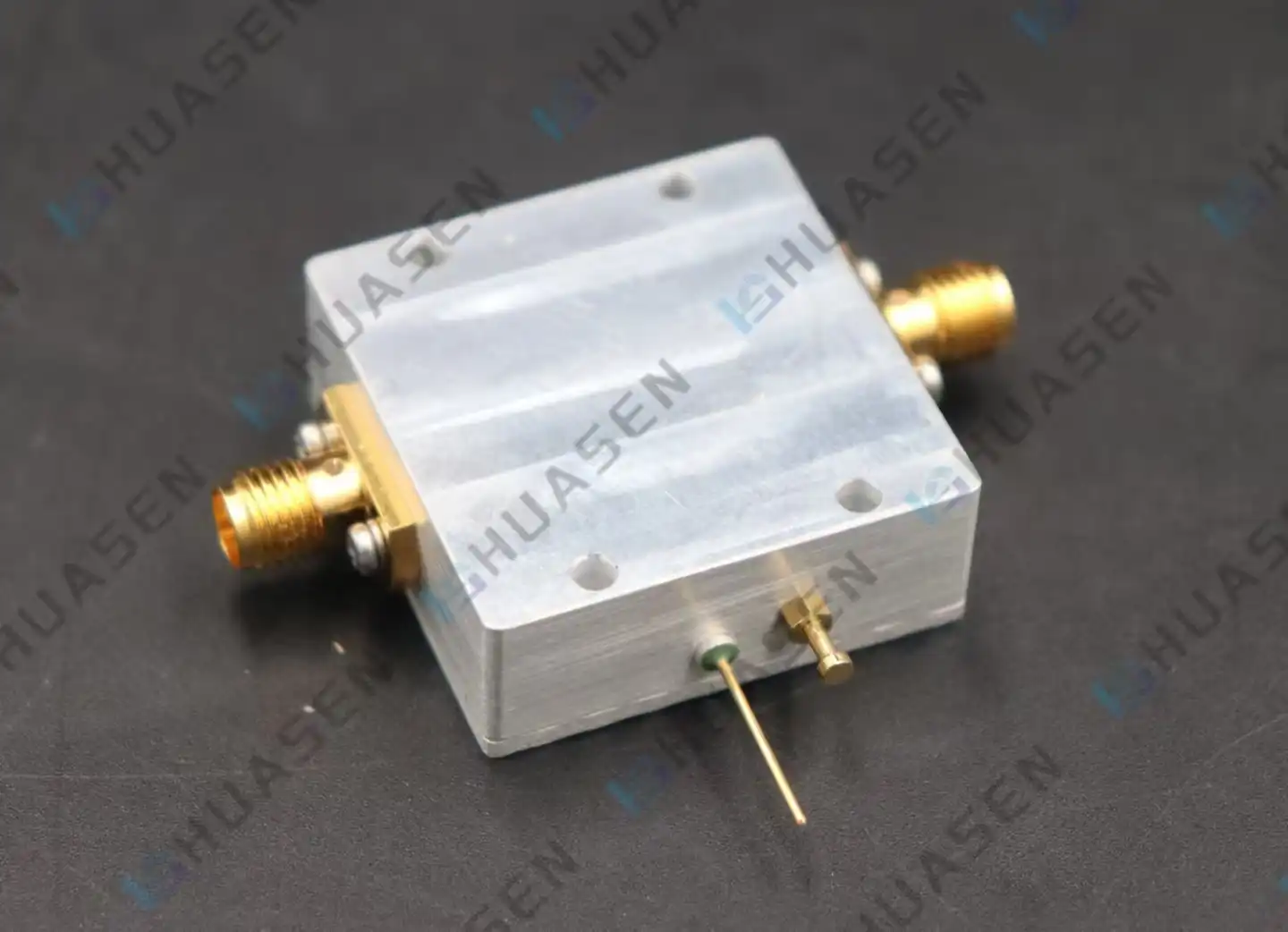
Understanding Active Detectors: Definitions and Core Concepts
What Makes Detection "Active" in RF Systems
An Active Detector in RF applications is a diode- or transistor-based component that transforms received electromagnetic signals into proportional DC voltage outputs, as opposed to passive devices, which only react to their surroundings. Depending on the amount of power they are given, these devices actively process the information through their own circuitry, giving either logarithmic or square-law reactions. This technology is very useful in situations where power needs to be monitored all the time, like when base station front-ends change transmission levels, satellite ground stations track changes in signal strength, or radar systems measure the volume of a return sound.
Core Performance Parameters That Define Quality
Exceptional devices are different from adequate ones in three main ways. Sensitivity tells you the weakest signal that can be picked up. Professional-grade units can hit -60 dBm, which is the same as 1 nanowatt of power. Frequency bandwidth determines how flexible an action can be. A broader range from 0.01 GHz to 44 GHz gets rid of the need for several specialised parts. Response time controls how quickly the receiver picks up changes in the signal. This is very important in pulsed radar uses, where 8-nanosecond rise/fall times pick up short-lived events that other devices miss.
Usually, Active Detector Schottky barrier diodes are used because they have better high-frequency response, and precision amplification steps keep the accuracy across the given dynamic range. With this combination, the device can do two things: measure power in lab equipment and watch for signals in real time in communication systems that are already in use.
Dynamic Range & Frequency: Critical Factors in Active Detector Selection
Decoding Dynamic Range Requirements
The dynamic range of a detector is the ratio of the highest and lowest signal levels that it can correctly measure. A 60 dB dynamic range, which goes from -60 dBm to 0 dBm, means that sounds with a power difference of one million can be handled. This feature is very important for testing base stations, where antenna inputs may pick up both strong nearby signals and weak broadcasts from far away at the same time.
When engineers don't have enough dynamic range, they have to use awkward solutions like attenuators for strong signals that lower the signal-to-noise ratio or amps for weak signals that cause distortion. The temperature stability standard of ±0.5 dB from -40°C to 85°C ensures that readings are accurate, whether your equipment is used in study stations in the Arctic or satellite earth terminals in the equatorial regions. Customers in marine communications really like this thermal stability, since electronics on ships have to deal with big changes in temperature.
Frequency Coverage as a Strategic Procurement Decision
The frequency range standard is closely linked to the flexibility of applications and the ability to work in the future. A device that works from 0.01 GHz to 44 GHz can handle cellular bands (0.6-6 GHz), Ka-band satellite links (26.5-40 GHz), and millimetre-wave 5G licenses (24–29 GHz) all in one piece. This combination makes managing supplies easier, lowers the cost of qualification, and speeds up the time it takes to integrate systems.
The ±1 dB accuracy standard at key frequencies is very important because accuracy requirements change with frequency. This limit makes sure that readings taken at popular cellular bands (1.9 GHz, 2.6 GHz) and satellite uplink frequencies (14 GHz, 30 GHz) stay within acceptable error ranges for checking compliance and confirming performance. This consistency is what labs that test RF components use to make calibration data that can stand up to regulatory scrutiny and customer checks.
How to Choose the Right Active Detector: A Decision Support Framework
Mapping Application Requirements to Technical Specifications
System designers should start by writing down their working environment and what kind of efficiency they expect in theActive Detector. Manufacturers of base stations that put uptime first need devices with proven MTBF rates and MIL-STD environmental qualifications. When researchers do wideband tests, they need devices that have a flat frequency response with little ripple across the whole range of 0.01-44 GHz.
As little as 0.5 mW of power is needed, which is very important for battery-powered platforms like robotic aerial vehicles or remote sensor nodes. Lower power use increases task length and simplifies thermal management in RF units that are closely packed together. Response time issues are different depending on the application. For example, communication testing can handle settling times on the millisecond scale, but radar pulse analysis needs 8-nanosecond performance that can record sub-microsecond transients without distortion.
Evaluating Suppliers Beyond the Datasheet
Teams in charge of buying things should look at a vendor's skills in a number of areas that aren't usually measured in datasheets. If you want to know if production units match characterised samples, you should ask providers about their process controls and statistical return data. Customisation options are important when normal goods almost meet the needs but need different types of connectors, different mounting brackets, or different frequency emphasis.
After recent shortages of parts, supply chain stability has become an important factor that cannot be ignored. Suppliers who keep strategic inventory gaps and use a variety of sources to get key subcomponents show that they are committed to delivering on time. Technical support quality can be seen by how quickly a vendor responds to questions before the sale. Vendors that offer thorough application notes, S-parameter files, and integration advice usually keep up that level of service after the sale.
Here are essential evaluation criteria for comprehensive supplier assessment:
- Certification and Standards Compliance: Make sure that the company follows the rules for ISO 9001 quality systems, RoHS environmental compliance, and application-specific standards like MIL-STD-202 for defence projects. The quality of the documentation shows how disciplined a company is; full test reports and traceability data show that quality processes are developed.
- Customisation and Engineering Support: Find out if the seller has in-house RF design skills that can be used to improve parameters. Genuine production partners are different from component dealers because they can change the frequency response, the dynamic range limits, or the mechanical interfaces.
- Warranty and Lifecycle Management: Look at insurance terms that show you trust the product will last, which, for industrial-grade devices, is usually two to three years. Lifecycle management policies make sure that parts are available for as long as your product is supported by providing early warnings of failure and smooth transitions to new models.
Installation, Calibration, and Maintenance Best Practices for Optimal Detector Performance
Site Assessment and Integration Planning
Characterising the electromagnetic surroundings is the first step in successfully deploying detectors. Spectrum analysis should be done at the installation site to find possible sources of interference, such as close emitters, switching power supplies, or digital circuits that produce harmonics. External sounds can mess up readings if shielding and grounding are not done correctly. This is especially important when working close to the -60 dBm sensitivity level.
Mechanical mounting factors affect how well the system handles heat and vibrations. Even detectors that don't make a lot of heat still need enough movement to keep localised temperature differences from happening. In places with a lot of shaking, like aeroplanes or ships, shock-mounted systems keep Schottky diode junctions safe. When choosing a connection, you need to find a mix between RF performance and mechanical durability. For example, precision 3.5mm connectors have better return loss but need to be carefully torqued to keep them from breaking.
Calibration Protocols for Measurement Integrity
Set the time between calibrations based on how often they will be used and how important they are in theActive Detector. Laboratory reference standards need to be recalibrated once a year using NIST-traceable sources. Field-deployed units in safe settings may be able to go up to every two years. The calibration process checks the accuracy over the whole dynamic range at a number of different frequency points. This finds drift before it affects the truth of the measurements.
Environmental compensation methods take into account the temperature difference of ±0.5 dB by keeping track of the conditions around the readings. Advanced systems use built-in temperature monitors and real-time correction algorithms to keep accuracy without any help from a user. Keeping calibration records shows that the quality system is working properly and helps meet the standards for measurement traceability in businesses that are controlled.
Comparison of Active Detectors: Market Trends and Solutions Overview
Performance Benchmarks in Current-Generation Products
In 2024, the RF detecting market will show rising integration density and wider frequency coverage. Premium options now usually cover DC to 50 GHz and have dynamic ranges above 70 dB, which covers millimetre-wave uses in satellite communications and car radar. Cheaper options focus on smaller bands, like sub-6 GHz cellular, giving up some flexibility in exchange for low prices that make them good for large-scale base station placement.
As more outdoor infrastructure is built, requirements for temperature stability have become stricter. Earlier detectors were supposed to have a ±1.5 dB drift across temperature. Newer versions get ±0.5 dB by better thermal adjustment and choosing higher-quality components. This improvement directly helps small cells that are outside and remote tracking apps that can't control the weather.
Real-World Implementation Success Stories
A top company that makes telecom equipment has recently decided to use only wideband detectors in all of its 5G huge MIMO base station products. The frequency range of 0.01-44 GHz got rid of the need for different parts for sub-6 GHz and millimetre-wave versions. This cut the number of SKUs by 40% and made field service operations easier. The dynamic range of -60 to 0 dBm meant that a single detector could pick up both pilot signals and full-power gearbox without having to switch between ranges.
A major military firm working on the next generation of phased array radar chose detectors based on how well they worked at different temperatures and how quickly they responded. With a ±0.5 dB drift from -40°C to 85°C, the calibration stayed the same during high-altitude flight profiles, and the 8-nanosecond response caught pulse features that are important for target classification algorithms. This choice about buying things made the system simpler by getting rid of the need for external signal conditioning that older devices had.
Conclusion
When choosing Active Detectors, you have to balance technical specs with practical buying issues. The basic things that tell you if a component can physically meet your measurement needs are its dynamic range and frequency coverage. Accuracy, temperature stability, and response time are the things that set good solutions apart from great ones that keep working at all temperatures. Looking beyond datasheets to judge a supplier's customisation options, supply chain resilience, and level of expert support turns choosing a component into building a strategic relationship. The specs we've talked about—60 dB dynamic range, 0.01-44 GHz coverage, and ±0.5 dB temperature stability—are the current industry standards for balancing performance and cost-effectiveness for tough B2B uses.
FAQ
1. What dynamic range do I need for base station testing applications?
For base station front-end tests, the range of -60 to +10 dBm is usually needed to measure both the receiver's sensitivity and the transmitter's output power. A detector with a dynamic range of -60 to 0 dBm can characterise the receiving side, but it might need to be attenuated to test the emitter side.
2. How does frequency range affect measurement accuracy?
When frequency coverage is wider, there are often small changes in accuracy across the span. Careful impedance matching and diode selection help high-quality detectors keep their ±1 dB accuracy at key bands. However, performance may be slightly worse at the edges of the bands.
3. Can I integrate these detectors with existing test automation systems?
These days, RF detectors give off analogue voltages that can be easily connected to data acquisition tools and network analysers. Before you buy, make sure that the output impedance and voltage range match the specs of your measuring tools.
4. What environmental qualifications matter for outdoor deployments?
Look for container materials that are rated IP65 or IP67 for entry protection, can withstand temperatures from -40°C to 85°C, and don't fade in UV light. Testing for salt fog according to MIL-STD-810 proves that it is suitable for use in ocean and seaside settings.
Partner With Huasen Microwave for Advanced RF Detection Solutions
Selecting an Active Detector can be hard, and you need both professional know-how and trusted manufacturing partnerships to help you. Huasen Microwave Technology has been working with high-frequency parts for 30 years and has helped leaders in telecommunications, defence companies, and aerospace projects all over the world. Our engineers work with your system developers to find the best detector specs, give you a full description of the S-parameters, and make custom solutions available when standard goods need to be changed.
As a well-known company that makes Active Detectors, we have strict quality controls that make sure every unit meets the stated specs for a wide range of frequencies and temperatures. Our detectors work with frequencies from 0.01 GHz to 44 GHz and have a dynamic range of -60 dBm to 0 dBm. They are used in 5G infrastructure and satellite ground terminals, and come with technical data that meets the strictest purchase standards. Email our sales team at sales@huasenmicrowave.com to talk about your specific needs, get sample trial units, or look into custom development for system limitations. Let us use our deep knowledge of RF to speed up the timeline for your project while protecting your business investments by making sure that all of the parts are reliable.
References
1. Razavi, Behzad. "RF Microelectronics, 2nd Edition." Prentice Hall, 2011. Chapters on mixer and detector design fundamentals.
2. Agilent Technologies. "Fundamentals of RF and Microwave Power Measurements." Application Note AN 64-1A, 2013.
3. IEEE Standard 1528-2013. "IEEE Recommended Practice for Determining the Peak Spatial-Average Specific Absorption Rate (SAR) in the Human Head from Wireless Communications Devices: Measurement Techniques."
4. Maas, Stephen A. "Microwave Mixers, 2nd Edition." Artech House, 1993. Detailed treatment of Schottky diode detector theory.
5. Collin, Robert E. "Foundations for Microwave Engineering, 2nd Edition." Wiley-IEEE Press, 2001. Coverage of transmission line theory relevant to detector integration.
6. Military Standard MIL-STD-202G. "Test Method Standard for Electronic and Electrical Component Parts." Department of Defence, 2002. Environmental testing protocols referenced in detector qualification.
Send Inquiry