What Makes Log Periodic Antenna Directional and Broadband?






2026-04-15 21:22:36
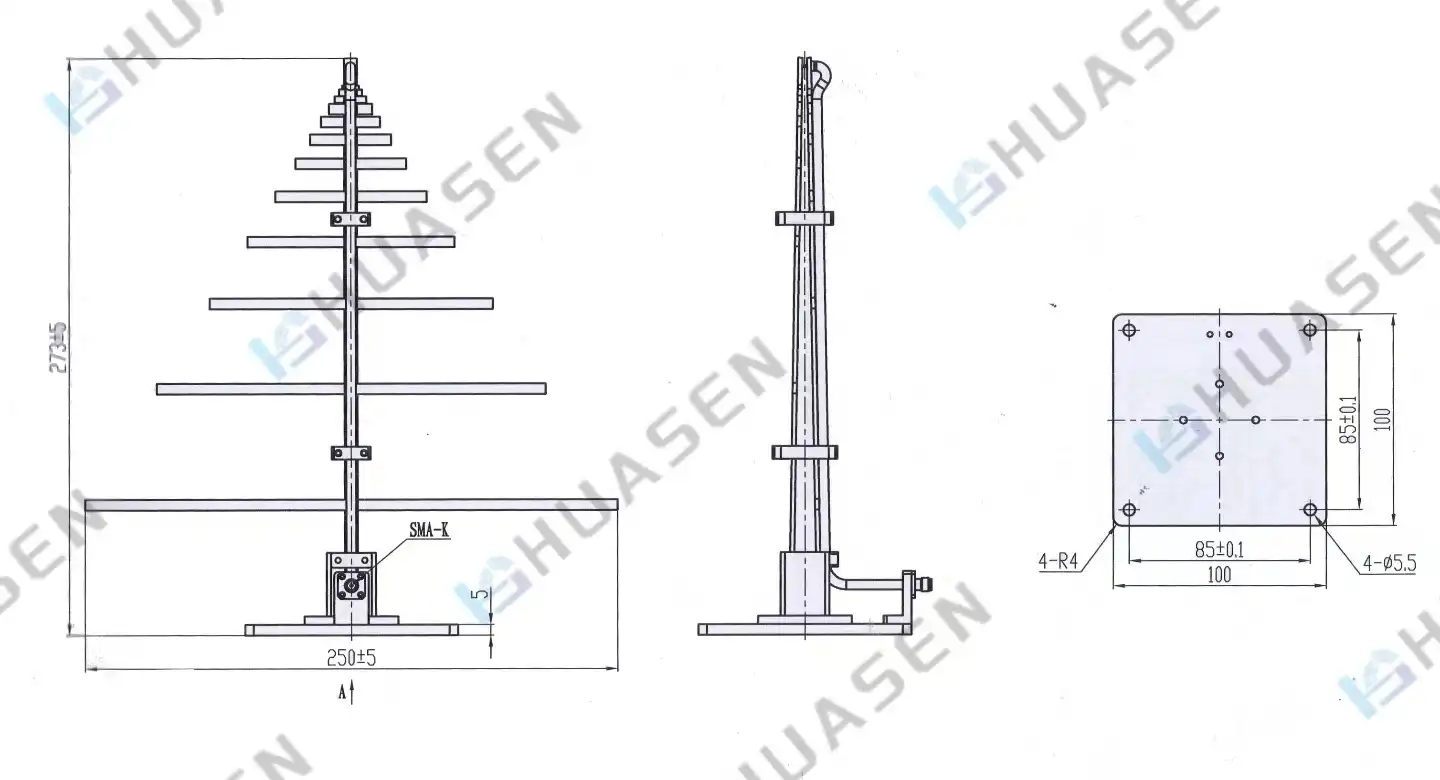
The Log Periodic Antenna works well in both directions and across a wide range of frequencies thanks to its mathematically accurate geometric scaling. Each dipole element is the right size and spread out based on a logarithmic ratio. This makes a "active region" that moves along the boom as the frequency changes. With this design, the antenna can keep its resistance, radiation patterns, and gain constant over a wide range of frequency range, often 10:1 or more. The forward-firing directional pattern is caused by phased interactions between elements, and the broadband coverage means that you don't need multiple narrowband antennas for demanding RF uses.
Understanding the Fundamentals of Log Periodic Antennas
The Principle of Logarithmic Periodicity
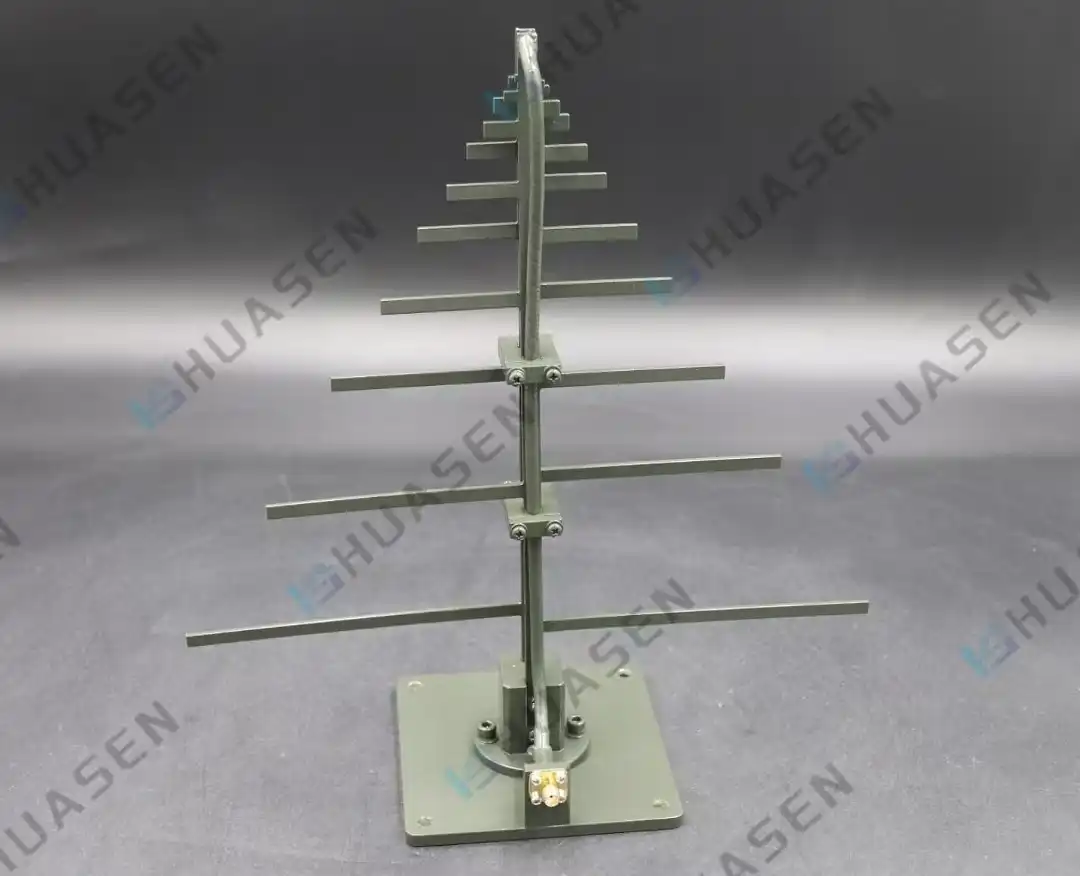
Log periodic dipole arrays work on a concept that doesn't depend on frequency and is based on self-similarity. Unlike most antennas that are made to work with a single band, these structures repeat their geometric features on a logarithmic scale. The scaling factor (ϱ) sets the ratio between the lengths of successive elements, and the spacing factor (π) sets the space between elements that are next to each other. When electromagnetic waves hit the array, only certain parts that are close to resonance at a certain frequency turn on the electricity. This active area moves smoothly along the boom as the operating frequency changes, keeping its stable electrical properties across the entire bandwidth.
How Element Arrangement Creates Directionality
The directed radiation pattern is made when currents are carefully phased across many dipole elements. High frequencies are handled by the shorter elements near the front of the array, and low frequencies are handled by the longer elements near the back. When the feeder line goes through the boom, it changes the phase of the elements that are next to each other. This causes positive interference going forward and destructive interference going backward. This phasing process creates front-to-back ratios that are often higher than 20 dB. This makes sure that there is very little backward radiation and that signal energy is focused in the right direction.
Achieving Stable Impedance Across Wide Bandwidths
To keep the 50-ohm input resistance constant over a wide range of frequencies, the reactances of the elements must be carefully balanced. The boom structure connects energy to the active area, no matter what frequency it is, like a balanced transmission line. The voltage standing wave ratio stays below 2.0:1 throughout the working band because of this self-compensating behaviour. This makes sure that power transfer works well without the need for external matching networks. As a result, the antenna works consistently across HF, VHF, UHF, and microwave bands, without needing to be tuned or adjusted.
Key Design Principles Behind Directionality and Broadband Performance
Critical Geometric Parameters and Scaling Factors
Two dimensionless factors, tau (ϱ) and sigma (π), have a big effect on the performance envelope of a log periodic array. Tau is the ratio of the lengths of the elements that come after it (usually between 0.7 and 0.95), LPA, and it has a direct effect on bandwidth and gain. When tau is small, bandwidths are wider, but gain is lower. When tau is large, performance is concentrated over smaller ranges. Sigma describes the distance between elements as a percentage of their usual length. This affects the stability of the impedance and the directionality. Engineers have to find the best balance between these factors and the needs for speed and size. They often use computer electromagnetic modelling to do this before the designs are made.
Impedance Matching and VSWR Optimization
Paying close attention to the design of the feed system is necessary to get low VSWR across decade bandwidths. The transmission line that goes through the boom has to keep its characteristic impedance equal to the 50-ohm system standard. Balanced-to-unbalanced transformers (baluns) are used at the feed point in high-quality versions to stop common-mode currents that would change the radiation patterns. At higher frequencies, where millimeter-scale differences can cause impedance discontinuities, manufacturing errors become very important. Precision manufacturing methods and quality control procedures make sure that production units meet the required VSWR performance across the whole frequency range that is promised.
Comparison With Alternative Broadband Antenna Designs
There are different kinds of antennas that can handle broadband, but each has its own problems. Spiral antennas have circular polarisation and very wide bandwidths, but they lose gain and aren't as small. Biconical dipoles can cover all directions, but they don't have the directionality needed for point-to-point links or to get rid of interference. Yagi-Uda arrays have a lot of gain, but they only work well over very small bandwidths (10–20%). Because their shape is self-similar, fractal antennas can achieve multiband resonance. However, they usually can't match the continuous frequency range of log periodic designs. Knowing these differences helps procurement professionals choose the best option for each application's needs. Looking at real-world deployment scenarios makes the flexibility of log periodic configurations clear. Spectrum monitoring sites use these antennas to quickly find unauthorised transmissions or sources of interference from the VHF band to the microwave band without having to change their equipment. EMC testing labs like it when the antenna factor stays the same across frequencies. This makes calibration easier and lowers the error of measurements. Instantaneous broad coverage is needed for military electronic warfare systems to find and identify threat transmitters that use frequencies that are hard to predict. These uses show why log periodic technology is still necessary, even though antenna studies over the past few decades have led to many other designs.
Practical Applications and Benefits in the B2B Procurement Context
EMC Testing and Compliance Verification
Electromagnetic compatibility testing facilities face constant pressure to process certification projects efficiently while maintaining measurement accuracy. Traditional test setups requiring antenna changes between frequency bands introduce cable reconnection errors, extend setup times, and increase labor costs. Log periodic arrays eliminate these inefficiencies by covering the entire 30 MHz to 6 GHz range specified in IEC 61000-4-3 radiated immunity standards. Automated test systems can sweep through required frequencies without interruption, reducing chamber occupancy time and accelerating time-to-market for client products. The consistent antenna factor across frequencies also simplifies data analysis and report generation, particularly when comparing emissions or immunity levels at different frequencies.
Spectrum Monitoring and Regulatory Enforcement
Telecommunications regulators and security agencies require continuous visibility across allocated spectrum to identify interference, unauthorized transmissions, or jamming attempts. Fixed monitoring stations and mobile direction-finding vehicles deploy log periodic antennas to maintain uninterrupted surveillance from HF through UHF bands. The directional characteristics enable triangulation of signal sources through bearing measurements from multiple locations. When signals hop between frequencies to evade detection, the broadband coverage ensures no transmission escapes monitoring regardless of channel selection. These capabilities prove essential for border security, event protection, and telecommunications infrastructure management, where spectrum integrity directly impacts public safety,LAP, and economic activity.
Tactical Military Communications and Electronic Warfare
Defense applications demand rapid frequency agility to counter jamming and exploit propagation conditions. Over-the-horizon radar systems and long-range communication links benefit from log periodic antennas that allow operators to shift frequencies instantaneously without antenna reconfiguration. The directional gain improves link budgets for secure point-to-point communications while reducing the probability of intercept by adversary direction-finding systems. Electronic warfare platforms rely on wideband reception to characterize threat emitter signatures across their entire operating ranges. Airborne and shipboard installations particularly value the mechanical simplicity and ruggedness of log periodic designs, which withstand vibration and environmental stresses without the failure-prone tuning mechanisms required by narrowband alternatives. Procurement managers evaluating antenna solutions for these mission-critical applications weigh several factors beyond basic electrical specifications. Total cost of ownership includes not only unit price but also installation complexity, maintenance requirements, and operational flexibility. A single log periodic antenna replacing three or four narrowband alternatives delivers immediate inventory reduction and simplified logistics. The absence of moving parts or active tuning circuits enhances reliability in harsh environments, reducing field service interventions. These practical benefits translate directly to lower lifecycle costs and improved system availability, justifying premium pricing for quality implementations.
Choosing and Procuring the Right Log Periodic Antenna
Defining Technical Requirements for Your Application
Successful antenna procurement begins with a precise definition of performance requirements derived from system specifications. Operating frequency range represents the most fundamental parameter—whether covering 80-1000 MHz for tactical communications, 700 MHz-6 GHz for cellular testing, or 1-18 GHz for wideband EW applications. Gain requirements balance link budget needs against physical size constraints, with typical values ranging from 6 to 10 dBi depending on element count and boom length. Environmental factors dictate mechanical specifications, including wind loading, temperature range, corrosion resistance, and waterproof integrity. Interface requirements encompass connector types (N-type, SMA, 7-16 DIN), mounting configurations, and any special features like radome protection or lightning arrestors.
Evaluating Manufacturers and Supply Chain Reliability
The global market for professional log periodic antennas includes specialized manufacturers with varying capabilities and quality standards. Evaluating potential suppliers requires examining manufacturing certifications such as ISO 9001 quality management and environmental compliance standards like RoHS and REACH. Production capacity and lead times become critical for high-volume procurement or rapid deployment projects. After-sales support, including technical assistance, calibration services, and warranty terms, can significantly impact total ownership experience. Established suppliers often provide detailed test data showing measured VSWR, gain patterns, and antenna factor across the specified frequency range, allowing verification against published specifications before deployment.
Customization Options for Specialized Requirements
Standard catalog products serve many applications effectively, yet certain projects demand tailored solutions. Custom frequency ranges accommodate specialized bands not covered by off-the-shelf products, such as extended UHF ranges for satellite uplinks or narrowed bands optimized for specific radar frequencies. Physical modifications might include specialized mounting brackets for vehicle integration, compact designs for space-constrained installations, or ruggedized construction meeting MIL-STD-810 shock and vibration specifications. Connector changes, cable length adjustments, and protective radomes can be incorporated during manufacturing more cost-effectively than field modifications. Engaging suppliers early in the design phase allows collaborative optimization of antenna specifications to match system requirements while controlling costs and delivery schedules. At Huasen Microwave, our engineering team brings three decades of RF component expertise to every project. We recognize that antenna selection involves complex trade-offs between electrical performance, mechanical constraints, and budget realities. Our technical support staff assists procurement professionals in translating system-level requirements into detailed antenna specifications, identifying optimal solutions from our product portfolio, or recommending custom development when necessary. This consultative approach ensures that clients receive antenna systems genuinely matched to their application needs rather than being steered toward standardized products that may require costly workarounds during integration.
Future Trends and Performance Optimization in Log Periodic Antenna Technology
Advanced Materials and Manufacturing Techniques
Emerging materials and fabrication methods are pushing log periodic antenna performance boundaries. Carbon fiber composite booms reduce weight while maintaining structural rigidity for airborne applications where every kilogram impacts fuel consumption and payload capacity. Additive manufacturing enables complex element geometries that optimize current distributions for improved pattern control. Specialized coatings enhance corrosion resistance for maritime environments while minimizing surface roughness that can degrade performance at millimeter-wave frequencies. These manufacturing innovations allow designers to achieve performance levels previously constrained by conventional aluminum fabrication limitations.
Integration With Active and Adaptive Systems
Active electronics are being built directly into antenna structures more and more in modern transmission architectures. Low-noise amplifiers built into the feed point make the system more sensitive to weak signals, which is very important for radio astronomy and satellite transmissions. Software-defined radios can match antennas better across their tuning ranges thanks to switched filter banks. This makes up for the fact that ultra-wideband designs have differences in VSWR. Adaptive beamforming networks with many log periodic elements make patterns that can be electronically steered without using mechanical pointing systems. This is useful for mobile platforms and situations where more than one object needs to be tracked. The broadband base of log periodic geometry is used in these hybrid active-passive methods, and electronic control adds freedom.
Millimeter-Wave and 5G/6G Applications
Millimeter-wave bands used by next-generation wireless networks present both problems and chances for log periodic technology. At 28 GHz and higher, the small element sizes make it possible to make antenna arrays that are doable and good for base station and backhaul use. Channel aggregation strategies that boost throughput in 5G deployments are supported by broadband service across 24–40 GHz bands. As wavelengths get smaller, it's important to have very tight manufacturing tolerances. This is why companies are investing in advanced manufacturing measurement and process control. Eventually, research into integrated antenna-on-package solutions could combine log periodic principles with semiconductor substrates to make wideband millimeter-wave antennas that can be mass-produced cheaply. To stay competitive in wireless markets that are changing quickly, companies need to keep improving performance and cutting costs. Method-of-moments and finite-element analysis-based simulation tools let you make virtual prototypes of different design versions before committing to making the real thing. When you look at element taper schedules, spacing algorithms, and feed network setups through parametric studies, you can find performance gains that can be made with small changes to the design. When antenna suppliers and system developers work together, component specifications change to meet new application needs instead of staying the same as technology moves forward around them.
Conclusion
Log periodic antennas represent a mature yet continually evolving technology addressing fundamental challenges in wideband directional communications. Their unique combination of multi-octave bandwidth, consistent gain, and stable impedance characteristics makes them irreplaceable across applications from spectrum monitoring to tactical communications. Procurement professionals benefit from understanding the design principles underlying these capabilities when evaluating solutions for complex RF systems. As wireless technologies advance toward higher frequencies and greater bandwidth demands, log periodic architectures adapted through modern materials and integration techniques will continue serving critical roles in communications infrastructure, test equipment, and defense systems worldwide.
FAQ
1. What distinguishes log periodic antennas from other broadband designs?
Log periodic antennas provide a unique combination of directional radiation patterns and continuous broadband coverage that distinguishes them from alternatives. Unlike spiral or biconical antennas offering omnidirectional or wide beamwidth patterns, log periodic arrays concentrate energy in a single direction with front-to-back ratios exceeding 20 dB. Compared to Yagi-Uda antennas delivering high gain across narrow bandwidths, log periodic designs maintain consistent performance across 10:1 frequency ranges or greater without retuning.
2. How do I calculate element dimensions for a specific frequency range?
Element dimensions derive from the scaling factor tau (τ) and spacing factor sigma (σ). The longest element length equals approximately half-wavelength at the lowest operating frequency, while successive elements follow the ratio L(n+1) = τ × L(n). Element spacing follows d(n) = σ × L(n) / 2. Practical designs typically use τ between 0.85 and 0.95 and σ between 0.10 and 0.20, with specific values chosen through electromagnetic simulation to optimize VSWR and gain patterns.
3. Can log periodic antennas be customized for specialized requirements?
Extensive customization options exist to match specific application needs. Frequency ranges can be tailored to cover only required bands, reducing physical size and improving gain within the target spectrum. Environmental hardening includes marine-grade corrosion protection, temperature-stabilized materials, and shock-resistant construction meeting military standards. Physical modifications accommodate mounting constraints, connector preferences, and radome integration while maintaining electrical performance specifications.
Partner With Huasen Microwave for Your Broadband Antenna Needs
Huasen Microwave Technology has delivered precision RF components to demanding industries since 1993. Our log periodic antenna portfolio serves telecommunications infrastructure, aerospace platforms, defense systems,and test laboratories requiring uncompromising performance. Whether sourcing standard products or exploring custom-engineered solutions, our technical team provides application-specific guidance backed by decades of microwave expertise. We maintain rigorous quality standards throughout design, manufacturing, and testing phases, ensuring delivered products meet published specifications across their entire frequency ranges. Contact our engineering specialists at sales@huasenmicrowave.com to discuss your project requirements and discover why leading system integrators worldwide rely on Huasen Microwave as their trusted log periodic antenna supplier.
References
1. Carrel, R.L. (1961). "Analysis and Design of the Log-Periodic Dipole Antenna." Technical Report, Antenna Laboratory, University of Illinois.
2. IEEE Standard 145-2013. "IEEE Standard for Definitions of Terms for Antennas." Institute of Electrical and Electronics Engineers.
3. Stutzman, W.L. und Thiele, G.A. (2012). "Antenna Theory and Design, 3rd Edition." John Wiley & Sons, Hoboken, New Jersey.
4. Balanis, C.A. (2016). "Antenna Theory: Analysis and Design, 4th Edition." John Wiley & Sons, Hoboken, New Jersey.
5. IEC 61000-4-3:2020. "Electromagnetic Compatibility (EMC) – Part 4-3: Testing and Measurement Techniques – Radiated, Radio-Frequency, Electromagnetic Field Immunity Test." International Electrotechnical Commission.
6. DuHamel, R.H. and Isbell, D.E. (1957). "Broadband Logarithmically Periodic Antenna Structures." IRE National Convention Record, Vol. 5, Part 1, pp. 119-128.
Send Inquiry