Waveguide Cross Directional Coupler Frequency Band Selection Guide






2026-01-21 22:17:14
When designing high-frequency RF systems, engineers constantly face signal integrity challenges that threaten system performance. Selecting the wrong frequency band for your Waveguide Cross Directional Coupler can lead to excessive insertion loss, poor directivity, and unreliable power measurements in critical applications. This comprehensive guide provides you with proven selection criteria and technical specifications to match your Waveguide Cross Directional Coupler precisely to your operational frequency requirements, ensuring optimal signal monitoring, power distribution, and VSWR measurement across telecommunications, radar, and satellite communication systems.
Understanding Waveguide Cross Directional Coupler Technology
Waveguide Cross Directional Couplers represent a specialized category of passive microwave components designed for high-frequency signal sampling and monitoring in waveguide transmission systems. Unlike Coaxial Directional Couplers that utilize coaxial transmission lines, the Waveguide Cross Directional Coupler employs rectangular or circular waveguide structures with coupling apertures or probes positioned at precise orientations to extract a known fraction of the transmitted signal. These components are essential in applications where high power handling, low insertion loss, and exceptional directivity are paramount requirements that cannot be adequately met by coaxial alternatives.
The fundamental operating principle of a Waveguide Cross Directional Coupler involves electromagnetic field coupling through strategically positioned apertures or coupling mechanisms within the waveguide structure. When an electromagnetic wave propagates through the main waveguide channel, a controlled portion of the signal couples into the secondary port through these apertures, creating a sampled output that maintains a fixed relationship with the primary signal. This coupling mechanism enables engineers to monitor forward and reflected power simultaneously without significantly disrupting the main signal path. The cross-configuration specifically refers to the geometric arrangement where coupling occurs perpendicular to the main propagation direction, providing superior isolation characteristics compared to traditional inline coupling designs.
Critical Performance Parameters
The effectiveness of any Waveguide Cross Directional Coupler depends on several interrelated performance metrics that must be carefully evaluated during the selection process. Coupling factor, typically ranging from 10 dB to 50 dB, determines the ratio of power extracted from the main transmission line to the coupled port, directly impacting measurement accuracy and system sensitivity. Directivity, generally exceeding 20 dB in quality designs, measures the device's ability to distinguish between forward and reflected signals, which becomes critically important in VSWR measurement applications where reflected power analysis requires precise isolation from the forward signal component.
Insertion loss represents another crucial specification, typically maintained below 0.5 dB in well-designed Waveguide Cross Directional Couplers, ensuring that the coupling mechanism introduces minimal attenuation to the primary signal path. Frequency bandwidth defines the operational range over which the coupler maintains specified performance characteristics, with different waveguide standards covering distinct frequency allocations from L-band through W-band and beyond. Power handling capability varies significantly between standard and high-power variants, with specialized designs supporting continuous average power levels exceeding 500W while maintaining thermal stability and structural integrity under sustained high-power operation.

Frequency Band Classification for Waveguide Cross Directional Couplers
Selecting the appropriate frequency band for your Waveguide Cross Directional Coupler requires understanding the standardized waveguide designations and their corresponding frequency ranges. Each waveguide band is optimized for specific frequency coverage, with physical dimensions precisely calculated to support dominant mode propagation while suppressing higher-order modes that could compromise signal integrity. The relationship between waveguide dimensions and operational frequency follows fundamental electromagnetic principles, where the cutoff frequency is inversely proportional to the largest cross-sectional dimension of the rectangular waveguide structure.
L-band waveguide systems, operating between 1 GHz and 2 GHz, utilize relatively large physical dimensions suitable for lower frequency applications including radar systems and satellite communication ground stations. S-band coverage, spanning 2 GHz to 4 GHz, finds extensive deployment in meteorological radar, surface ship radar, and some communication satellite systems where moderate bandwidth and penetration characteristics provide optimal performance. C-band waveguides, operating from 4 GHz to 8 GHz, dominate satellite communication applications due to their excellent balance between bandwidth capacity, atmospheric propagation characteristics, and antenna sizing requirements that make them economically attractive for commercial satellite operations.
Higher Frequency Band Applications
X-band Waveguide Cross Directional Couplers, covering 8 GHz to 12 GHz, serve critical roles in military radar systems, satellite communication, and terrestrial microwave links where higher frequency operation enables improved resolution and more compact antenna designs. Ku-band systems, spanning 12 GHz to 18 GHz, have become increasingly popular for direct broadcast satellite services and VSAT networks, offering substantial bandwidth for high-data-rate communications despite increased susceptibility to rain attenuation at these frequencies. Ka-band waveguides, operating between 26.5 GHz and 40 GHz, represent the frontier of commercial satellite communications, providing enormous bandwidth capacity for next-generation high-throughput satellite systems, though requiring more sophisticated engineering to manage propagation challenges and component precision tolerances.
W-band and millimeter-wave Waveguide Cross Directional Couplers, extending beyond 75 GHz, serve specialized applications in automotive radar systems, wireless backhaul networks, and scientific instrumentation where extremely high frequencies enable unprecedented resolution and bandwidth. These advanced frequency bands demand exceptional manufacturing precision, with dimensional tolerances measured in micrometers and surface finish requirements that significantly impact component performance. While Coaxial Directional Couplers can address lower frequency requirements with greater flexibility, waveguide solutions become increasingly advantageous as operating frequencies rise above 18 GHz, where waveguide's inherently lower loss and higher power handling capabilities outweigh the size and flexibility advantages of coaxial structures.
Selection Criteria Based on Application Requirements
Choosing the optimal Waveguide Cross Directional Coupler for your specific application demands careful analysis of multiple technical and operational factors that interact in complex ways to determine overall system performance. Application-specific requirements must be thoroughly documented before component selection begins, including precise frequency range, required coupling factor, directivity specifications, power handling needs, environmental conditions, and physical space constraints that may limit available options. The selection process should begin by identifying the primary function the coupler will serve, whether signal monitoring, power distribution and synthesis, VSWR measurement, or multiple simultaneous functions that may require different performance trade-offs.
For satellite communication ground stations operating in C-band or Ku-band, Waveguide Cross Directional Couplers must deliver exceptional directivity to accurately measure antenna VSWR and system return loss, typically requiring directivity specifications exceeding 25 dB across the operational bandwidth. Radar systems demand couplers with excellent amplitude and phase stability across temperature variations, as these parameters directly affect target detection accuracy and range resolution. Maritime and aviation communication systems require ruggedized designs that can withstand severe mechanical vibration, temperature cycling, and humidity exposure without degradation in electrical performance or mechanical integrity.
Power Handling Considerations
Standard Waveguide Cross Directional Couplers typically handle average power levels up to 100W, suitable for most monitoring and measurement applications in telecommunications infrastructure and test equipment. High-power variants, specifically designed with enhanced thermal management and structural reinforcement, support continuous average power levels reaching 500W or higher, essential for high-power transmitter monitoring, broadcast stations, and radar systems where failure to adequately handle power levels could result in component damage or catastrophic system failure. The relationship between power handling and frequency is not linear, with higher frequencies generally requiring derating of maximum power specifications due to increased ohmic losses and reduced thermal dissipation efficiency in smaller waveguide structures.
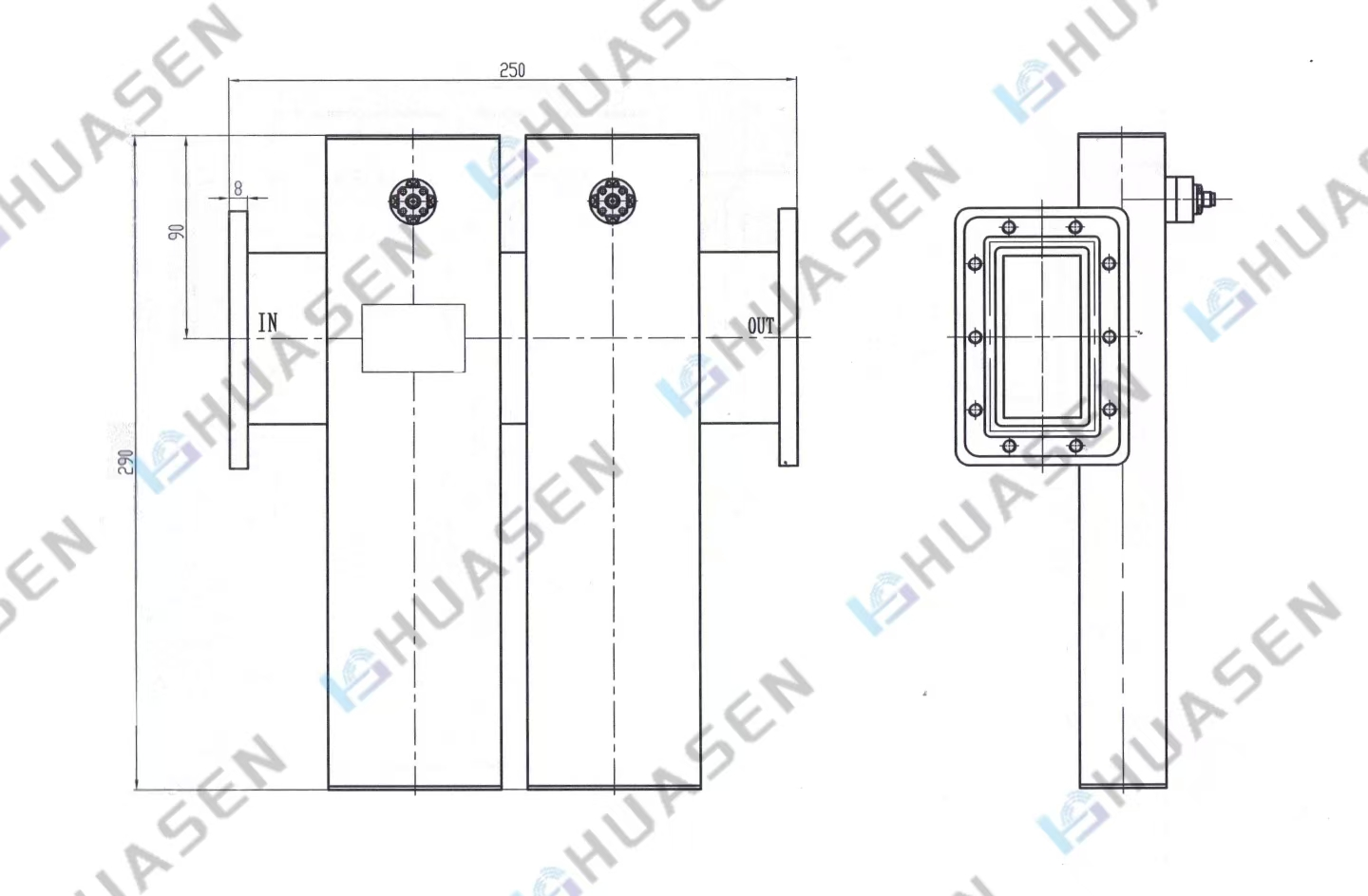
Bidirectional Waveguide Cross Directional Couplers provide simultaneous monitoring of forward and reflected signals through independent coupled ports, eliminating the need for separate directional couplers in applications requiring comprehensive power measurement and VSWR analysis. These sophisticated designs incorporate dual coupling structures with carefully engineered isolation between ports, ensuring that measurements of forward power remain uncontaminated by reflected signal components and vice versa. The bidirectional configuration proves particularly valuable in automatic antenna tuning systems, amplifier protection circuits, and transmitter monitoring applications where real-time knowledge of both forward and reflected power enables rapid response to impedance mismatches or component failures.
Technical Specifications and Performance Verification
Understanding the detailed technical specifications of Waveguide Cross Directional Couplers enables engineers to make informed selection decisions and properly integrate these components into complex RF systems. Coupling factor tolerance, typically specified as ±0.5 dB to ±1.0 dB across the operational bandwidth, determines measurement accuracy and calibration requirements for power monitoring applications. Frequency flatness specifications define how coupling factor varies across the intended frequency range, with premium designs maintaining coupling variation within ±0.3 dB to ensure consistent performance across wide bandwidth operation.
Input and output VSWR specifications, typically better than 1.20:1 for the main transmission path, indicate how well the coupler is impedance-matched to the system, minimizing reflections that could interfere with accurate power measurements or degrade overall system performance. The coupled and isolated port VSWR specifications may be more relaxed, often specified at 1.50:1 or better, as these ports typically connect to measurement instrumentation or terminated loads rather than critical signal paths. Connector compatibility represents another essential specification, with waveguide flanges conforming to standard specifications such as UG-style or IEC standards ensuring mechanical and electrical compatibility with existing system components.
Manufacturing Quality and Testing Standards
Quality manufacturing processes directly impact the performance reliability and longevity of Waveguide Cross Directional Couplers in demanding operational environments. Precision CNC machining achieves the tight dimensional tolerances essential for maintaining specified electrical performance, with waveguide internal dimensions typically held to tolerances of ±0.025 mm or better. Surface finish quality within the waveguide cavity significantly affects insertion loss and power handling capability, with electrolytic silver plating providing optimal conductivity while offering excellent corrosion resistance for outdoor and maritime applications where environmental exposure could otherwise degrade performance over time.
Rigorous testing protocols ensure that every Waveguide Cross Directional Coupler meets published specifications before shipment to customers. Factory testing typically includes swept frequency measurements of coupling factor, directivity, insertion loss, and return loss across the entire specified frequency range using calibrated vector network analyzers traceable to national standards. High-power testing verifies thermal performance and mechanical stability under sustained power levels, while environmental stress screening may include temperature cycling, vibration testing, and humidity exposure to validate reliability in harsh operating conditions. Certification to ISO 9001 manufacturing standards, compliance with MIL-STD specifications for military applications, and adherence to RoHS environmental directives provide additional assurance of manufacturing quality and regulatory compliance.
Conclusion
Selecting the appropriate Waveguide Cross Directional Coupler frequency band requires comprehensive understanding of application requirements, operational environment, and system performance objectives. This guide provides the technical foundation necessary to make informed decisions that optimize signal integrity, measurement accuracy, and long-term reliability across diverse microwave applications.
Cooperate with Huasen Microwave Technology Co., Ltd.
Partner with Huasen Microwave Technology Co., Ltd., a leading China Waveguide Cross Directional Coupler manufacturer and China Waveguide Cross Directional Coupler supplier with over 30 years of specialized expertise in RF and microwave component development. Our China Waveguide Cross Directional Coupler factory delivers High Quality Waveguide Cross Directional Coupler solutions with competitive Waveguide Cross Directional Coupler price and extensive Waveguide Cross Directional Coupler for sale inventory supporting telecommunications, radar, aerospace, and defense applications. As a certified China Waveguide Cross Directional Coupler wholesale provider with ISO 9001 certification and comprehensive testing facilities including multiple anechoic chambers and advanced vector network analyzers, we offer customizable solutions tailored to your precise specifications. Contact our technical team at sales@huasenmicrowave.com to discuss your waveguide coupler requirements and discover how our engineering expertise and manufacturing capabilities can enhance your RF system performance.
References
1. Pozar, David M. "Microwave Engineering, Fourth Edition" - John Wiley & Sons, comprehensive treatment of directional coupler theory and waveguide components
2. Collin, Robert E. "Foundations for Microwave Engineering, Second Edition" - IEEE Press, authoritative reference on waveguide propagation and coupling mechanisms
3. Montgomery, C.G., Dicke, R.H., and Purcell, E.M. "Principles of Microwave Circuits" - MIT Radiation Laboratory Series, fundamental analysis of directional coupler design principles
4. Saad, Theodore S. "Microwave Engineers' Handbook, Volume 1" - Artech House, practical design guidance for waveguide components and frequency band selection
5. Baden Fuller, A.J. "Microwaves: An Introduction to Microwave Theory and Techniques" - Pergamon Press, educational foundation for understanding waveguide cross coupler applications
Send Inquiry