Pyramidal Horn Antenna Radiation Pattern and Gain Profile






2026-05-21 21:42:49
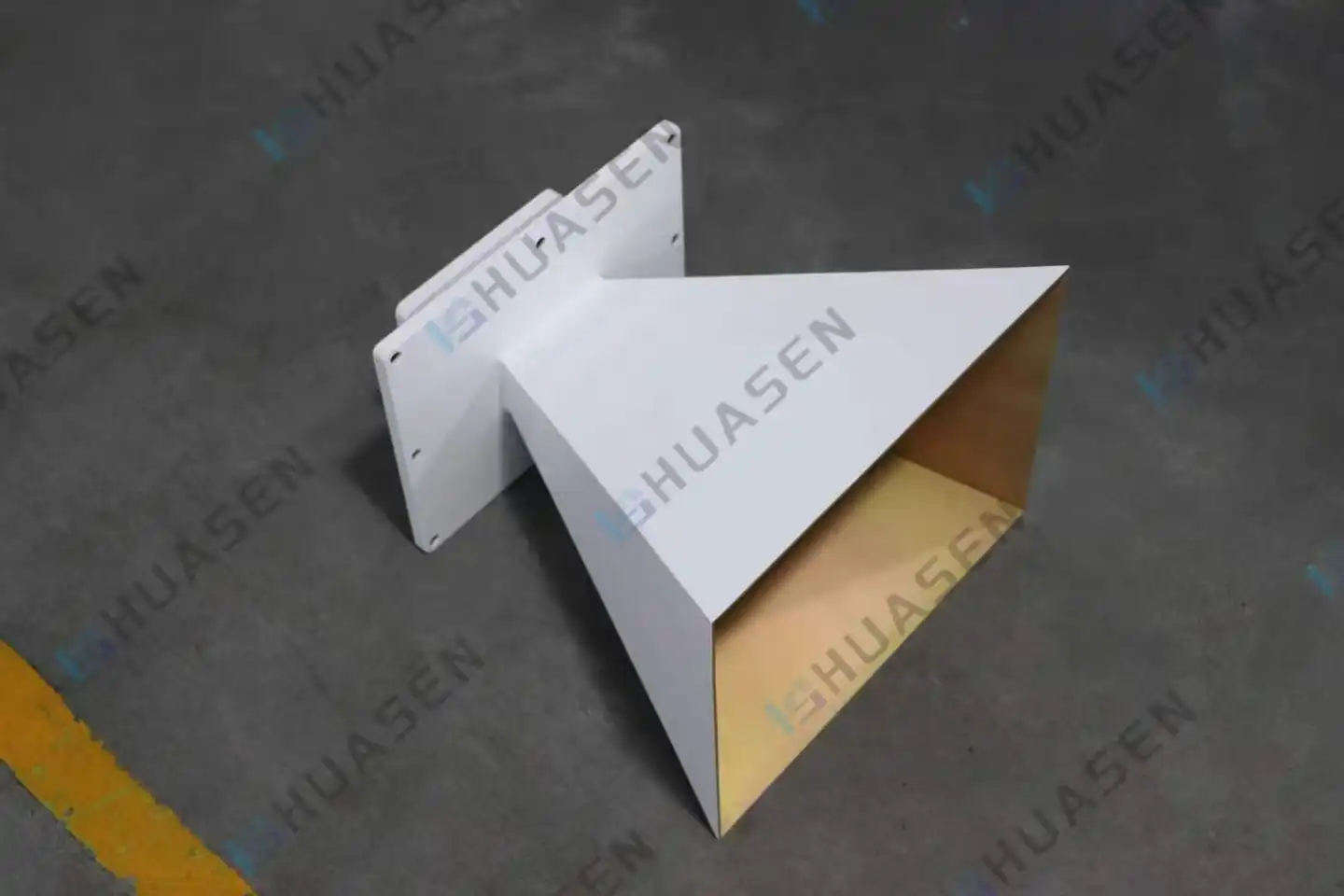
Engineers and procurement professionals must understand the Pyramidal Horn Antenna's radiation pattern and gain profile to pick antennas for critical RF applications. Special aperture antenna for microwave and millimetre-wave bands. It emits electromagnetic radiation precisely while maintaining performance. The gain profile indicates how successfully the antenna concentrates signal power, while the radiation pattern illustrates how energy is distributed in space with main, side, and back lobes. These parameters affect communication range, measurement precision, and system dependability in 5G infrastructure, radar systems, satellite communications, and EMC compliance testing. By understanding these essentials, purchasing teams may pick antennas that match all technical criteria and maximise ROI.
Understanding the Basics of Pyramidal Horn Antenna Radiation Pattern
In three dimensions, the radiation pattern displays electromagnetic energy moving from an antenna opening into its surroundings. This pattern shows the important performance criteria that indicate real-world operational performance.
Main Lobe Characteristics and Directivity
The major radiation zone, or lobe, concentrates the greatest energy. Pyramidal Horn Antenna units have concentrated elliptical beam central lobes that align with the opening axis. Engineers measure directivity by comparing peak energy to isotropic reflector energy. Directivity is usually 15–25 dBi, depending on aperture size and frequency. This concentrated beam blocks noise and transmits messages great distances. This concentrated energy dispersion helps radar tracking systems and satellite uplinks accurately illuminate targets.
Side Lobe Levels and Their Impact
Extra radiation peaks at angles to the beam line, called side lobes. Unintended radiation zones leak signals, disrupt surrounding systems, and distort measurements. Well-made horn antennas keep side lobe levels below -20 dB from the main lobe peak. Lower side lobe performance is crucial when several transmission systems use the airwaves simultaneously. To protect transmissions and obey the requirements, base station and electronic warfare procurement teams should choose antennas with superior side lobe reduction.
Beamwidth Definitions and Coverage Patterns
Angle of main lobe spread is the beamwidth. It is commonly measured at the E- and H-plane half-power (-3 dB) positions. Pyramidal Horn Antennas have different beamwidths in these orthogonal planes due to their rectangular openings. E-plane beamwidth is frequently higher than H-plane due to physical asymmetry. Narrow beamwidths acquire more and range further, but cover less. However, wider beams lose gain to cover more area. System designers may pick antennas that satisfy coverage demands when they understand this trade-off. This applies whether they are lighting a satellite ground station parabolic reflector or building up city point-to-point wireless connectivity.
Geometric and Frequency Influences
Aperture diameters, flare angles, and waveguide feed measurements impact antenna radiation. Larger holes provide narrower, higher-gain beams, whereas smaller structures cover more area but are less direct. Operating frequency affects pattern form. Higher frequencies have shorter wavelengths, and beams are sharper and more defined from the same aperture. Surface conductivity and internal dielectric characteristics impact pattern clarity. Phase errors and absorption losses might result from these features. All of these factors determine whether an antenna fulfils the tight RF testing room or flying radar system standards.
Exploring Gain Profile and Its Impact on Antenna Performance
Compared to a reference source, gain measures how well an antenna can direct transmitted power in a certain direction. It is usually given in dBi (relative to an isotropic radiator) or dBd (relative to a dipole).
Gain Values and Measurement Standards
Across their working span, pyramidal antenna structures usually give out gains of 10 to 25 dBi. This measure of success comes from aperture efficiency, which is how well the hole turns guided waves into radiated energy. Standard gain horns are used in calibration labs to keep gain standards very tight, with errors of less than 0.5 dB, as confirmed by ISO 17025-certified measuring centres. When using gain transfer methods to test unknown antennas, these precise devices are used as standards. Received power comparisons give accurate information about how well the antennas work. When buying antennas for measuring purposes, procurement managers should make sure that the calibration can be tracked back to national metrology institutes to make sure the data is accurate.
The Gain-Beamwidth Relationship
The relationship between gain and beamwidth is negative, which means that as gain goes up, beamwidth goes down by the same amount. Decisions about system design are affected by this basic trade-off in both sensing and messaging. High-gain designs focus energy into narrow beams, which increases the range of contact and makes it easier for radar systems to tell the difference between targets. However, narrow beams make it harder to align things and make it harder to handle platform movement in mobile applications like robotic aerial vehicles or marine sites. On the other hand, moderate-gain antennas with wider beams are easier to place and keep a connection even when the platform moves, but they don't have as good a range. When setting antenna parameters, system designers have to weigh these rival factors against the needs of the operation.
Efficiency Factors and Power Handling
Antenna efficiency shows how well input power is turned into transmitted energy, with losses happening because of things like material absorption, impedance mismatch, and flaws in the structure. Well-made horn antennas have efficiencies of more than 90%, which means they waste less power and don't need as much heat control. Power handling is very important in high-power situations like radar emitters or EMC immunity tests, where devices need to be able to handle continuous wave power or high-peak pulse energy without breaking. In this case, waveguide horn antennas work really well because they are built simply and well, and they don't have any lossy parts inside them, like resistive loading or ferrite materials. Because there are no resonant structures, the device can also work across octave bandwidths with stable gain profiles.
Impact on Communication Range and Signal Clarity
Higher gain directly increases the communication range by sending more useful power in the desired direction. At the same time, it improves listener awareness by collecting more signals. In free-space transmission situations, a 6 dB gain increase doubles the useful range. This shows how important antenna selection is for operations. A higher signal-to-noise ratio makes the information clearer, and directed gain blocks interference coming from off-axis directions. This is especially helpful when the bandwidth is crowded, and co-channel interference lowers the level of service. When network planners make 5G backup links or point-to-point bridges, they use these features to make sure that connections are stable over long distances with little interference.
Pyramidal Horn Antenna Design Considerations for Optimal Radiation and Gain
To get the best performance, you need to pay close attention to a number of interconnected design factors that affect both the radiation characteristics and the gain results.
Aperture Dimensions and Flare Angles
Antenna theory says that the opening determines the transmitting surface area, which has a direct effect on the gain and beamwidth. As the aperture area (measured in square wavelengths) grows, the gain goes up, and the beams get smaller. This is because efficiency scales proportionally with aperture area. The phase spread across the radiating surface is controlled by flare angles, which are the rates at which the walls of the waveguide grow from the feed section to the aperture. The best Pyramidal Horn Antenna designs find a mix between gradual flares that keep the phase regular and small structures that stay within the allowed size range. Too-aggressive flare angles cause phase mistakes that hurt the clarity of the pattern and lower the gain, and structures that are too long make them heavier and harder to install. Engineers use mathematical models and electromagnetic simulations to find shapes that meet performance goals while staying within the limits of what is possible.
Material Selection Trade-offs
Material choices greatly impact electrical efficiency, environmental durability, and total cost of ownership. Because they are easy to work with and have good conductivity-to-weight ratios, aluminium alloys are the best choice for most industrial uses. Aluminium horns that are precisely made have surface finishes that are less than 32 microinches Ra. This keeps ohmic losses to a minimum at millimetre-wave frequencies. Copper is a better conductor than aluminium, but it's heavier and harder to work with. Surface treatments like chemical passivation, anodising, or valuable metal plating with silver or gold make things more resistant to rust for outdoor use and lower the performance loss caused by oxidation over time. When marine communications systems or base station parts are subject to salt spray and sudden changes in temperature, these protective coatings become necessary.
Impedance Matching Techniques
Impedance matching between the waveguide feed part and the radiation environment in open space increases power transfer and decreases reflections. The Pyramidal Horn Antenna automatically changes impedance because of its smooth flare shape, which tapers from about 377 ohms (waveguide mode impedance) to 377 ohms (free-space impedance). To get a low VSWR—usually less than 1.5:1 across all working bandwidths—the flare shape and aperture size need to be carefully optimised. To increase bandwidth while keeping impedance match, more advanced designs use multi-step changes or ridged waveguide sections. Specifications for purchases should clearly state the lowest accepted VSWR levels across all frequency bands to make sure that devices work as promised without having too many mismatch losses that lower system efficiency.
Simulation Software Validation
Electromagnetic modelling tools like CST Microwave Studio, ANSYS HFSS, and FEKO are used a lot in modern antenna creation to make sure that designs work before they are made. These software tools use numbers to solve Maxwell's equations and predict radiation patterns, gain profiles, impedance features, and how sensitive they are to manufacturing tolerances. Simulation lets you quickly try out different design options and see how the trade-offs between different factors affect the final product without having to go through expensive prototyping processes. Companies that are making custom antenna solutions should work with providers that can show they have strong simulation tools and test confirmation methods. By asking for both measured and simulated performance data, you can be sure that the goods meet the requirements in all the environments and frequency ranges that are important for the apps that will be used.
Procurement Insights: Buying and Customising Pyramidal Horn Antennas
Antenna buying that works well strikes a balance between technical performance, cost effectiveness, and the dependability of the supply chain. This is done by working with suppliers strategically and creating clear specifications.
Leading Supplier Capabilities
A number of companies have built names for making high-quality Pyramidal Horn Antenna solutions that you can count on. Keysight Technologies and other companies sell accurate standard gain horns with full calibration data to the measurement and testing markets. ETS-Lindgren makes tools for EMC compliance, like broadband horn antennas that are best for checking for radiated immunity and emissions according to international standards. EMCO offers low-cost options for industrial uses, and Pasternack keeps a large inventory so that common setups can be sent out quickly. Besides these big names, there are also regional experts who offer customisation services at reasonable prices. This is especially helpful for businesses that need custom frequency ranges, mounting interfaces, or environmental protection that goes beyond what catalogues have to offer.
Cost Structure and Volume Considerations
Pyramidal Horn Antenna units usually cost between $800 and $5,000, but the price depends on the frequency range, gain specifications, and testing certification. Large discounts are available when you buy a lot of something. When you buy more than 50 units, you can often get 15% to 30% off the price of a single unit. Customisation costs more but improves performance; expect to pay an extra 20% to 50% for non-standard frequencies, special finishes, or different mounting arrangements. Delivery times depend on the provider and the complexity of the order. Catalogue items usually ship within two weeks, but unique designs need eight to twelve weeks for engineering, prototyping, and manufacturing. Companies that want to do large-scale deployments should work with their suppliers early on in the project cycle to get better terms and set production plans that work with deployment goals.
Customisation and Technical Support Services
The best providers do more than just sell products; they also offer tech help that speeds up integration and improves system performance. Design aid turns broad needs into specific antenna requirements, using the supplier's knowledge to stay away from common problems. Sample trials let you test in the real world before committing to large-scale production, which lowers the technology risk in serious situations. Calibration data sets include measured gain, pattern cuts, and VSWR plots for all operating frequencies. These help with modelling the system and making predictions about its performance. After the sale, responsive service takes care of installation problems and unplanned compatibility issues, keeping project schedules and budgets safe. Product specifications and expert help should both be taken into account in procurement reviews, as the quality of the supplier relationship has a big impact on the long-term success of a project.
Warranty Terms and Long-term Reliability
Standard guarantee coverage usually lasts between one and three years and covers problems with the way the product was made and early failures that happen in normal use. Some of the extras that come with premium warranties are longer coverage periods, on-site help, or faster replacement services that keep important projects running as smoothly as possible. It's also important to know what the guarantee doesn't cover. Damage caused by an overpowering force, physical contact, environmental exposure that goes beyond what was specified, or unauthorised changes usually isn't covered. Companies that put antennas in harsh locations should make sure that their suppliers' quality programmes include rapid lifetime testing, corrosion resistance validation, and thermal cycling validation to deal with environmental stresses. Asking for failure mode analysis and reliability data shows that the seller cares about the long-term performance of the product, which boosts trust in procurement choices.
Conclusion
Radiation patterns and gain profiles are the main things that decide if Pyramidal Horn Antenna units work well in radar, satellite communications, telecommunications, and measurement systems. By knowing how geometric factors, material properties, and design optimisation affect these features, you can make smart purchasing choices that balance performance, cost, and working needs. Comparative research shows that pyramidal configurations have clear benefits over other horn types. This helps with choosing solutions that meet specific technical needs. When you work with qualified providers who offer full customisation, tech support, and reliable warranty coverage, buying antennas stops being a transactional purchase and becomes a strategic relationship. Companies that use this information get parts that make systems more useful while keeping total purchase costs low throughout their entire working lifecycles.
Frequently Asked Questions About Pyramidal Horn Antennas
1. How does frequency affect radiation pattern shape?
With the same physical aperture, higher operating frequencies make the main lobes smaller and the side lobe structures more marked. This happens because electrical size, which is measured in waves, grows with frequency, which makes directivity better. Pattern traits stay the same across an antenna's working bandwidth, but as frequency goes up, absolute beamwidth gets smaller.
2. What gain difference exists between pyramidal and conical horn designs?
Pyramidal Horn Antenna and conical horns have similar gain values, usually within 1 dB, for opening areas that are the same. Pattern traits show changes in performance. For example, pyramidal designs tend to have smaller side lobes and better cross-polarisation discrimination, while conical designs offer patterns that are rotationally symmetric. Instead of raw gain specs, selection is based on the pattern needs of the application.
3. Can horn antennas be customised for specific frequency bands?
Of course. Manufacturers often change the size of horns to get the best performance across frequency bands that customers specify. Custom designs can work with non-standard bands, low bandwidth needs, or more than one band at the same time. As part of the customisation process, electromagnetic modelling, prototype validation, and measurement verification are used to make sure that devices live up to their performance promises before they are sent to production.
Partner with Huasen Microwave for Premium Antenna Solutions
The quality, dependability, and technical partnership of the Pyramidal Horn Antenna provider you choose will decide the success of your project. Since 1993, Huasen Microwave Technology has provided high-quality RF and microwave parts for use in defence, aircraft, telecoms, and radar systems around the world. Our engineering team is an expert at changing the frequency ranges, gain profiles, polarisation features, and mechanical connections of horn antennas to fit the exact needs of a system. Our production skills guarantee consistent performance in harsh settings, whether you need standard gain horns for calibration labs, high-power devices for radar installations, or ruggedised antennas for outdoor base stations. To talk about your pyramidal horn antenna needs, email our expert sales team at sales@huasenmicrowave.com. We are a reputable company with decades of experience in microwave engineering. We offer competitive prices, reliable shipping schedules, and quick customer service that procurement workers need. To experience the Huasen Microwave difference in your next antenna purchase, send us a request for full specs, customisation quotes, or sample trial units right now.
References
1. Balanis, Constantine A. "Antenna Theory: Analysis and Design." Fourth Edition. John Wiley & Sons, 2016.
2. Milligan, Thomas A. "Modern Antenna Design." Second Edition. IEEE Press and John Wiley & Sons, 2005.
3. Love, A.W. "Electromagnetic Horn Antennas." IEEE Press Series on Electromagnetic Wave Theory, 1976.
4. Olver, A.D., Clarricoats, P.J.B., Kishk, A.A., and Shafai, L. "Microwave Horns and Feeds." IEEE Press and IET Electromagnetic Waves Series, 1994.
5. Stutzman, Warren L. and Thiele, Gary A. "Antenna Theory and Design." Third Edition. John Wiley & Sons, 2012.
6. IEEE Standard 145-2013. "IEEE Standard for Definitions of Terms for Antennas." Institute of Electrical and Electronics Engineers, 2013.
Send Inquiry