
Choosing End Launch Waveguide to Coaxial Adapter






2026-06-22 23:01:15
To pick the correct End Launch Waveguide to Coaxial Adapter, you need to know the frequency range of your system, how much power it needs, and which interfaces it works with. These precise RF parts move microwave energy between rectangular waveguides and coaxial transmission lines with a straight shape. They do this with very little insertion loss and great VSWR performance. If you choose adapters from companies that have a track record of skill in mode conversion, strong material quality, and full customization support, you can be sure that your phone, radar, or satellite system will work reliably in harsh environments and meet important standards for signal integrity and mechanical durability.
Understanding End Launch Waveguide to Coaxial Adapters
The Role of Waveguide-to-Coax Transitions in Modern RF Systems
Every day, we see waveguide-to-coaxial transitions in defense radar sites, satellite ground stations, and communication infrastructure. These adapters connect two very different ways of sending signals: coaxial lines that work in TEM mode and rectangular waveguides that work in TE10 mode. End Launch Waveguide to Coaxial Adapter designs are different from standard right-angle models because they have an inline setup that places the coaxial connector parallel to the waveguide propagation. This shape is necessary when there isn't enough room for perpendicular mounting or when linear system designs need signal lines to be as short as possible.
A precision-machined probe or a stepped impedance structure built into the waveguide backshort is often used for the changeover device. This design matches the waveguide's frequency-dependent characteristic impedance to the normal 50-ohm coaxial link in terms of impedance across a wide range of frequencies. Engineers who work with millimeter-wave radio arrays or 5G backhaul links like how this compact shape lowers the size of the system while keeping the signal quality very high. Integrators of telecommunications systems like this option because it puts less mechanical stress on wire connections than right-angle options. This means that outdoor installations can last longer.
Material Construction and Performance Characteristics
High-performance adapters use oxygen-free copper or aerospace-grade aluminium. Copper conducts electricity with small insertion loss, but aluminium is lighter, which is vital for aviation and space purposes. Surface solutions also affect long-term reliability. Silver plating enhances conductivity and solderability, but water and other chemicals can tarnish it. Gold plating is suitable for marine communications and tough industrial situations since it doesn't corrode and maintains contact impedance at all temperatures.
The precision of the interior structure affects the electrical performance. Micrometer-level machining tolerances maintain VSWR throughout the operating duration. Electromagnetic simulations are used to create probe placements, dielectric support structures, and transition taper shapes. RF testing and component characterisation require lab-grade adapters. Precision dowel pins for repeatable flange alignment and hermetic sealing for vacuum chambers are common characteristics.
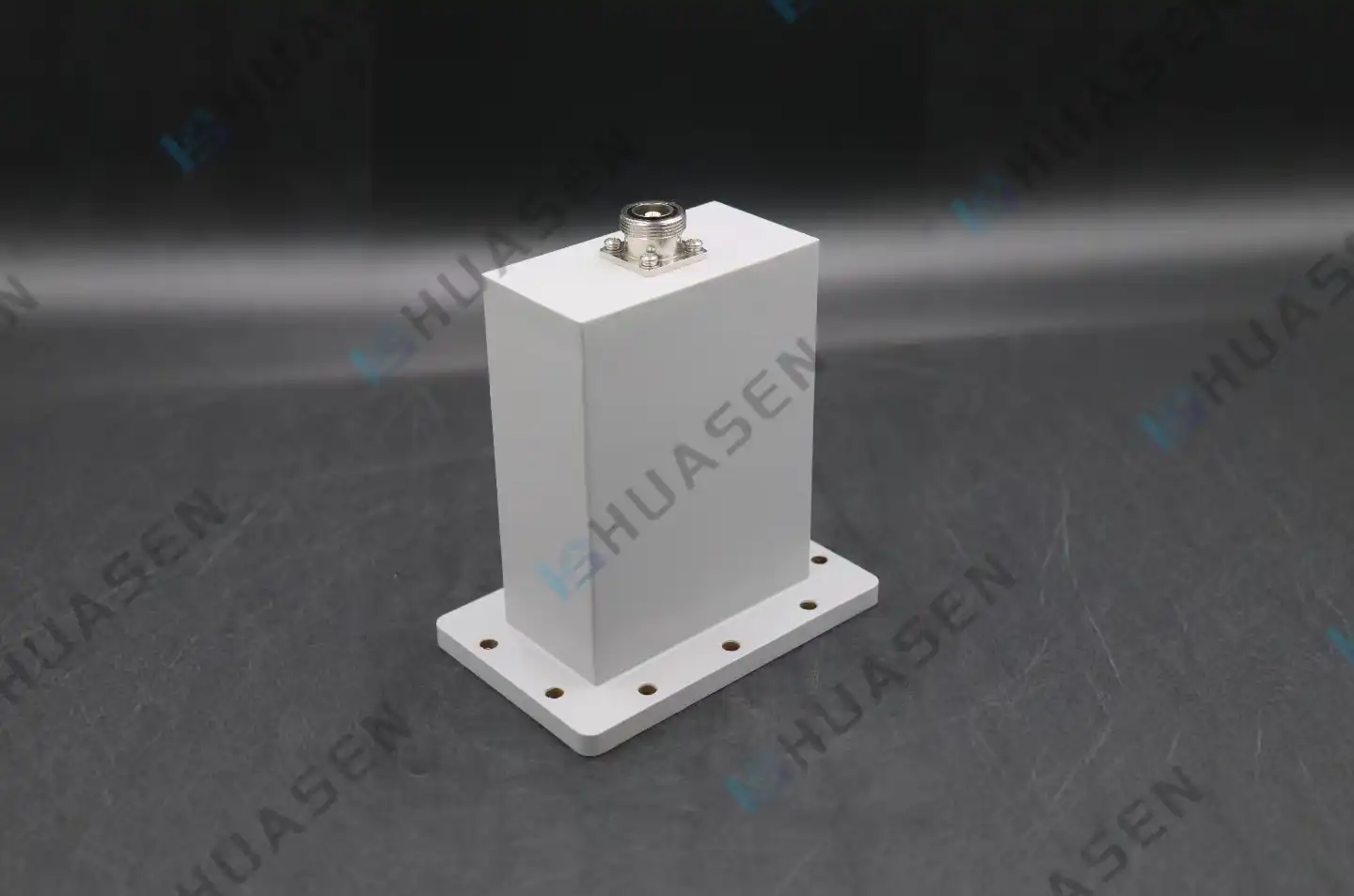
Key Factors to Consider When Choosing an End Launch Waveguide to Coaxial Adapter
Frequency Range and Bandwidth Requirements
Frequency range is the main characteristic that determines which End Launch Waveguide to Coaxial Adapter to buy. The standard waveguide bands go from S-band (2-4 GHz) to W-band (75–110 GHz), and each band has its own waveguide size, such as WR-284 or WR-10. The working frequency of your program must be well within the adapter's range; it should not be used near cutoff frequencies, where performance drops quickly.
Broadband access makes system design easier by lowering the number of parts needed and letting you use a single adapter for multiple bands. Huasen Microwave's adapters cover frequencies continuously from 0.3 GHz to 110 GHz across all of their products. This meets the needs of wideband communication systems and devices for tracking the spectrum. Make sure that the insertion loss stays low and the VSWR stays below 1.25:1 across the whole working bandwidth when choosing adapters for 5G millimeter-wave fronthaul or satellite Ka-band transponders. This consistency makes sure that the system will work as expected when it is put into use in the field.
Power Handling and Environmental Robustness
Power is crucial for radar systems and base station emitters. The coaxial connection side, not the waveguide, usually restricts power handling. A normal SMA connection can withstand 100 watts of continuous power at X-band frequencies. Type-N interfaces with larger sizes may withstand hundreds of watts. Due to voltage breakdown in the dielectric or center wire heating at power levels substantially lower than normal power rates, pulsed operation must include peak power handling.
If durable, adapters can tolerate outdoor, maritime, and aerial vibration patterns. Telecommunications pole adapters must be weatherproof and coated to prevent corrosion. MIL-STD-202 external stress screening may be required for defence applications. These include MIL-STD-810 vibration testing and -55°C to +125°C temperature cycling. Huasen Microwave makes adapters with aluminium or copper bodies treated with oxidation, silver plating, or gold plating to resist weathering and maintain high-frequency electrical performance in a wide range of temperatures and weather conditions.
Connector Interface Compatibility
Which coaxial connection to choose depends on system frequency and technical demands. SMA connections are the most frequent link up to 18 GHz because they are compact and reliable. Millimeter-wave test instruments can employ Type-K connections since they have higher phase stability and can tolerate 40 GHz. Type-N connectors are sturdier mechanically and can withstand more power for outdoor base stations, but their larger size may make them tougher to employ in racks with lots of equipment.
Attention should also be paid to waveguide flange compatibility. Cover and choke flanges are the major kinds. Each needs a match for RF sealing. Lip mismatches cause leaking and unpredictable VSWR. At millimeter-wave frequencies, submillimeter inaccuracy causes quantifiable performance loss; hence, dowel pins are needed for exact alignment. Make that adapters in radio feed networks or test benches match the existing flange types, mounting hole patterns, and coaxial connector genders to avoid costly redesigns.
Comparison of End Launch Waveguide to Coaxial Adapters on the Market
Performance Benchmarking Across Leading Suppliers
Several companies are known for making high-quality RF interconnects. TE Connectivity and Amphenol both have large catalogs that cover a wide range of business telecommunications frequencies. These catalogs are solid and easy to find. Laboratory users who need things quickly, like Pasternack's fast delivery of stock setups. HUBER+SUHNER specializes in making tough designs for the defense and transportation industries.
Huasen Microwave stands out because it covers a wide range of frequencies and can be customized. These features have been created over 30 years of specialized work. Customized End Launch Waveguide to Coaxial Adapters are made to fit the exact needs of a system, while normal catalog goods may force you to choose a frequency band or connector that isn't as good. The company's research team works directly with system installers to improve probe design, choose the right plating for the environment, and use full-band network analysis to confirm performance. This method works especially well for OEM partnerships where adapter specs have a direct effect on how well the end product works.
Material and Construction Trade-offs
Aerospace employs aluminium because it is 60% lighter than copper, and every gram matters. Due to reduced conductivity, insertion loss is generally 0.05 to 0.1 dB more than in identical copper systems. Different thermal expansion qualities determine how stable materials are throughout temperature changes. Copper conducts electricity well, making it ideal for low-loss applications like radio astronomy and high-sensitivity radar front ends, where even a slight level shift can impair sensitivity.
Gold plating costs more than silver plating but doesn't tarnish in damp coastal or sulfur-laden industrial situations. Silver-plated waveguide adapters operate OK while new, but acidic conditions can damage them. Therefore, military standards frequently need gold plating, which costs more upfront but provides reliable contact protection for decades. Silver plating with protective conformal coatings is commonly used in commercial telecoms to balance cost and reliability.
Installation and Troubleshooting Best Practices
Proper Installation Procedures
Cleanliness is the first step to a successful End Launch Waveguide to Coaxial Adapter fitting. When high power is applied, dust or metal debris that gets stuck in waveguide surfaces causes localized impedance changes and possible arcing sites. Clean all areas that will be touching with rubbing alcohol and lint-free wipes before putting them together. Check the O-rings or seals for damage and replace any that show signs of being compressed or cracked.
Pay close attention to the details when aligning flanges. Before tightening any one of the screws, loosely put them through all of the holes. Tighten the screws in a star design, gradually raising the torque until it meets the manufacturer's requirements. For smaller waveguides, this is usually 10-15 inch-pounds, and for bigger flanges, it's 40–50 inch-pounds. Too much torque bends flanges and lowers electrical performance, while not enough torque lets RF leak through. For calibrated torque tools to work with coaxial connections, too. For SMA interfaces, the torque level is 7–10 inch-pounds, and for Type-N, it's 12–15 inch-pounds. When you fix something by hand, the contact pressure is always too low, which causes links to break and the VSWR to rise.
Common Issues and Diagnostic Approaches
Unexpected VSWR jumps are often a sign of contamination or a problem with the way the parts are aligned. Take the connection apart, clean the surfaces again, and use a precision straightedge to make sure the lip is flat. Over time, a drop in VSWR could mean that the connectors are wearing out or rusting, especially in outdoor setups that are exposed to temperature changes. Preventive maintenance done on a regular basis, such as checking the pressure and cleaning the contacts, greatly increases the service life.
Periodic signal interruptions suggest that mechanical vibration is causing bolts to come loose or that cable stress is wearing out connection contacts. By adding pressure relief to coaxial lines, the adapter junction doesn't have to bend over and over again. When bolts are in places with a lot of shaking, like vehicle-mounted systems or wind-buffeted tower installations, lock washers or thread-locking compounds keep them stable. Power handling problems show up as quick increases in insertion loss or damage from arcing. These things usually happen when power levels are exceeded, when moisture gets in and makes electrical paths, or when dielectric materials are manufactured with flaws. Incoming inspections that are very thorough and power deratings that are conservative protect against field breakdowns in important communication links.
Procurement and Supply Chain Considerations for B2B Buyers
Evaluating Supplier Capabilities
Supplier selection is more than just choosing the right End Launch Waveguide to Coaxial Adapter. It also includes things like manufacturing consistency, quality systems, and the amount of expert help available. ISO 9001 certification shows that quality management processes have been formed, and ISO 17025 certification for in-house testing labs shows that they can measure things. Manufacturers that work with the defense and aircraft industries often have extra licenses, such as AS9100 or ITAR registration, that show they know how to meet strict quality standards and keep the supply chain safe.
Lead times are very different depending on how complicated the product is and how much it is customized. Standard stock items from major wholesalers can be shipped within days, which is helpful for quick prototypes and repairs in case of an emergency. For custom setups that need specific frequency optimization, non-standard connector pairs, or special plating requirements, technical approval and production usually take 4 to 8 weeks. Building connections with makers who can make both quick-turn prototypes and large quantities of a product gives you options for different product development processes.
Minimum order numbers show how much it costs to make something. Standard goods may only need a single MOQ, but fully customized designs may need 25 to 100 pieces to cover the cost of the tools. Volume price systems give discounts of 15 to 30 percent for sales of 50, 100, or 500 units or more. Long-term supply deals that commit to a certain yearly amount can often get you better prices and make sure that you can keep making things when demand goes up.
Balancing Cost and Performance
Because of limited funds, it's tempting to lower the standards, but bad adapter performance destroys the whole system's assets. A $200 special adapter in a $50,000 base station only accounts for 0.4% of the cost of the system as a whole, but it has a direct effect on the covering area and capacity. The success of a radar system rests on keeping the noise level low by making sure that receiver front ends have very little insertion loss. Costly field retrofits can be avoided by choosing adapters that meet the real needs of the system instead of just picking ones that are easy to find in a catalog.
The level of technical help is clear when discussing specifications and integrating after delivery. Manufacturers who know a lot about applications engineering can help customers avoid making mistakes when writing specifications and choose the best adapters for each use case. Decisions can be well thought out when recorded S-parameter data, power handling test results, and environmental qualification records are available. Respondent technical service, such as sample evaluation programs and design advice, boosts trust, especially among first-time buyers or people moving into new frequency bands.
Huasen Microwave helps businesses buy things by giving them detailed datasheets, quick quotes, and engineering advice on special needs. The company keeps the same material quality and size standards across all production runs, which is very important for OEMs that need parts that can be swapped out in the field.
Conclusion
Choosing End Launch Waveguide to Coaxial Adapters that work with your system's frequency needs, power levels, and surroundings will make sure it works well and keep costs down over its lifetime. When there isn't a lot of room in a plan, the inline geometry of end launch setups makes up for it by providing great electrical performance through careful impedance matching. Long-term happiness with your procurement choice is affected by the materials you choose, how well they work with connectors, and the skills of the supplier. Working with skilled makers who offer customization options, detailed testing paperwork, and quick technical support can help you get through the complicated process of RF component design. If you put your adapters correctly and do regular upkeep, they will last longer and protect your system investment over years of heavy use.
FAQ
Q1: What frequency bands do these adapters cover?
End Launch Waveguide to Coaxial Adapters work with almost the whole range of microwave and millimeter waves, from S-band, which is around 2 GHz, to W-band, which is 110 GHz. Each common waveguide size covers about an octave of bandwidth, so systems that work across more than one band need adapters that work with those bands. Huasen Microwave's product line covers all popular frequency ranges, from 0.3 GHz to 110 GHz, using different waveguide standards. This makes it suitable for use in military, satellite, and telecommunications applications.
Q2: How do I determine appropriate power ratings?
Compare the average and peak power levels given to your system's send levels. Most of the time, the capacity is limited by the coaxial connection instead of the waveguide part. For continual operation, make sure there are safety gaps of at least 3 dB (50%) and check that the pulse widths and duty cycles stay within the manufacturer's recommendations. Breakdown voltage is affected by things like altitude and temperature in the environment. For sites at high altitudes or high working temperatures, more derating is needed.
Q3: Can adapters function in harsh outdoor environments?
If you choose the right materials and give them the right finishes, adapters that are properly defined can handle tough circumstances. In marine environments, gold finishing stops corrosion, and hermetic covering keeps water out. Temperature-rated designs keep working well in everything from the Arctic to the desert. Check that the adapter you choose meets the weather requirements for your placement, such as the requirements for humidity, salt fog exposure, and temperature cycling according to MIL-STD-810 or a similar standard.
Partner With a Trusted End Launch Waveguide to Coaxial Adapter Manufacturer
Huasen Microwave makes End Launch Waveguide to Coaxial Adapters with great care and has been specializing in RF components for 30 years. Our wide frequency range, from 0.3 GHz to 110 GHz, and ability to handle 5 to 100 watts of power make us a good choice for challenging telecommunications, aerospace, and defense uses. We can make adapters out of aluminum or copper, and the surface can be treated with rust, silver plating, or gold plating, depending on your needs. Our engineering team works with system designers and equipment makers to create custom solutions that make the best use of efficiency for each application. You can talk to our technical experts about your project needs, get full datasheets, or set up a sample review by emailing sales@huasenmicrowave.com. We offer quick help during the planning, buying, and integrating stages, making sure you get adapters that fit your system perfectly and that the supply chain works smoothly.
References
1. Pozar, David M. Microwave Engineering, 4th Edition. Wiley, 2011.
2. Saad, Theodore S. Microwave Engineers' Handbook, Volume 1. Artech House, 1971.
3. Harvey, A.F. Microwave Engineering. Academic Press, 1963.
4. Montgomery, Carol G., Robert H. Dicke, and Edward M. Purcell. Principles of Microwave Circuits. MIT Radiation Laboratory Series, 1948.
5. Ginzton, Edward L. Microwave Measurements. McGraw-Hill, 1957.
6. Collin, Robert E. Foundations for Microwave Engineering, 2nd Edition. Wiley-IEEE Press, 2000.
Send Inquiry



Related Industry Knowledge
- What is a Microstrip Conformal Array Antenna?
- Circular vs. Linear Polarization: Which Antenna is Right for Your Project?
- Fixed vs. Variable Coaxial Loads: Which One Fits Your Test Scenarios Better?
- What key performance indicators should be prioritized when selecting a Dual Channel Waveguide Rotary Joint?
- What Makes High Power Waveguide Attenuators Indispensable for High-Frequency Communication Systems?
- What Factors Affect the Phase Shift Accuracy of Waveguide Phase Shifters? How to Minimize Errors?
- How to test the performance of an ultra-wideband omnidirectional antenna?
- How to optimize the performance of a Rectangular to Circular Waveguide Transition?
