Dual Polarized Horn Antenna Benefits in MIMO RF Systems






2026-04-16 22:03:36
When we talk about improving modern wireless networks, especially ones that need to be fast and reliable, specialized antenna technology plays a huge role. A Dual-Polarized Horn Antenna is one of the most important parts of MIMO (Multiple Input Multiple Output) RF systems because it lets two orthogonally polarized signals pass through the Dual-Polarized Horn Antenna and be received at the same time. This feature directly solves important problems in 5G/6G networks, satellite communications, and radar uses, where polarization variety leads to better spectral efficiency, less multipath fading, and higher signal-to-noise ratios. Our research shows how these devices help system integrators and equipment manufacturers who need reliable, high-performance parts in the real world.
Understanding Dual Polarized Horn Antennas in MIMO Systems
Modern communication networks need antenna systems that make the most of channel bandwidth while taking up as little space as possible. Dual polarization technology does this by using two separate signal lines within the same frequency band. This essentially doubles the amount of data that can be sent without needing more spectrum resources.
The Architecture Behind Dual Polarization Technology
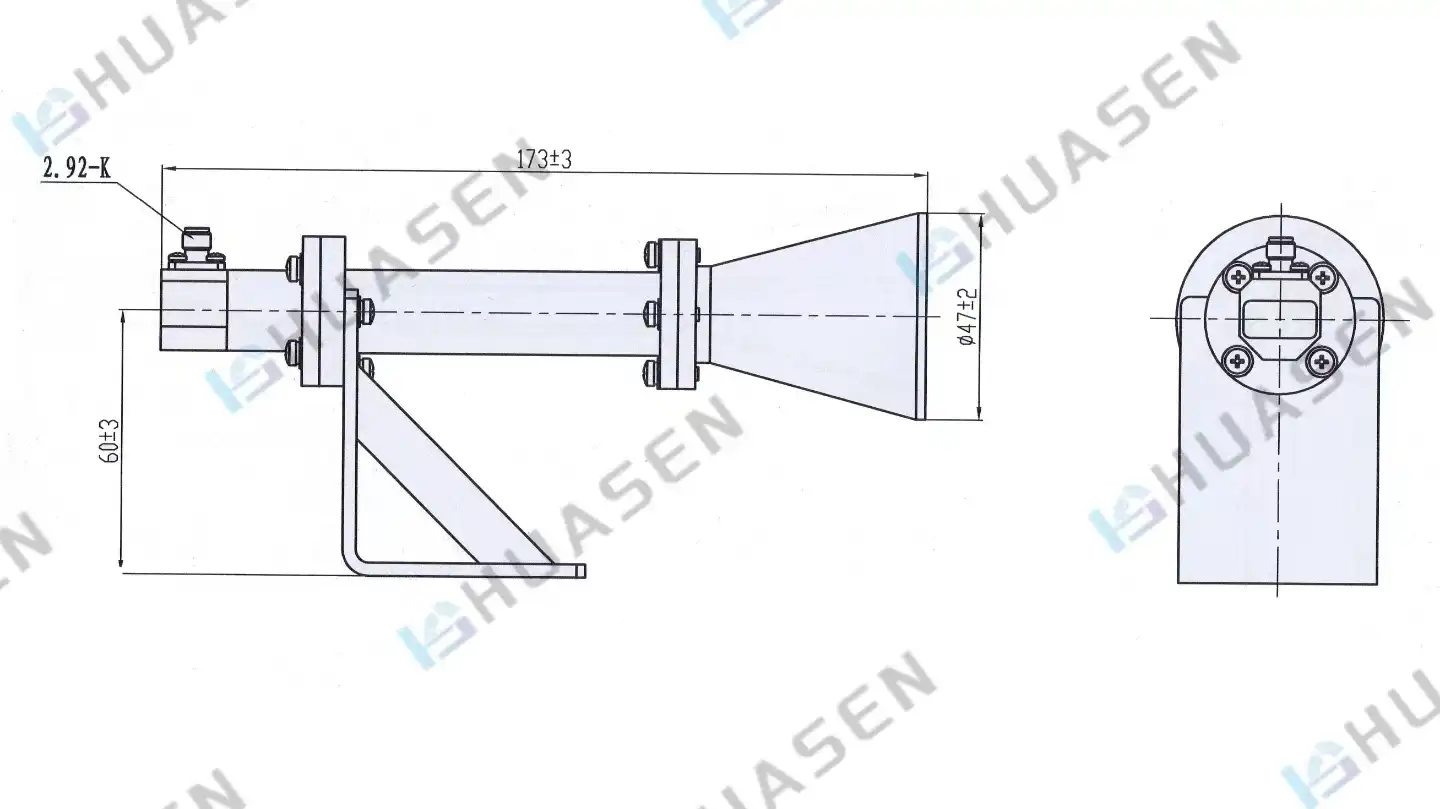
Orthomoder Transducer (OMT) is a complex waveguide part that splits two orthogonal polarizations into different signal ports. It is at the heart of modern Dual-Polarized Horn Antennas. This OMT technology is used in the Huasen Microwave Dual-Polarized Horn Antenna, along with a circular or square conical horn shape, to get great performance. The device can send and receive linearly polarized waves that are not connected to each other along the signal path. These waves usually have vertical and horizontal directions. This architectural method gets rid of the need for mechanical rotation systems that cause delays and mistakes in calibration. This is especially helpful in testing settings and base station operations where dependability can't be compromised.
Two Design Variants for Different Requirements
Knowing the technical differences between the different types of OMT helps buying teams choose the best options for each customer's bandwidth needs. The Conventional OMT type has easier design and production methods, which makes it a cheaper choice for narrowband uses where bandwidth needs to stay within 5% of the center frequency. This setup works well for point-to-point backup links that need to keep frequency stability within very tight limits. On the other hand, the Symmetrical Feed OMT is a more difficult engineering feat that allows an operating bandwidth of up to 40% of the center frequency. For current 5G base stations that need to cover more than one frequency band in a single infrastructure rollout, this wideband feature is important. The symmetrical feed design keeps polarization separation above 30dB across the whole bandwidth. This makes sure that the vertical and horizontal channels can work separately, without cross-talk disturbance that would hurt MIMO performance.
Critical Performance Parameters
Performance at the system level in MIMO deployments is directly related to the technical standards that describe quality in dual-polarized horn antennas. Maximum polarization separation equal to or greater than 30dB keeps the two orthogonal channels separate, which is important for MIMO methods that depend on signal paths that are not connected. Keeping the Voltage Standing Wave Ratio (VSWR) at 1.5 or less ensures that power is transferred efficiently with little signal bounce. This has a direct effect on how efficiently power is transferred and on how much heat is produced in high-power situations. These factors show the level of accuracy in manufacturing and design optimization that sets professional-grade parts apart from consumer alternatives. Because of this, they are important criteria for making B2B purchasing decisions.

Key Benefits of Dual Polarized Horn Antennas for MIMO RF Systems
These antennas have benefits for MIMO deployments that go beyond simple technical specs. They lead to real practical gains and lower costs in a wide range of application areas.
Enhanced Channel Capacity and Spectral Efficiency
Spatial and polarization diversity are at the heart of MIMO technology, which uses them to make multiple separate communication lines within the same frequency band. Dual-Polarized Horn Antennas provide the polarization diversity part, allowing at least 2x2 MIMO setups and higher-order MIMO schemes when used in groups. This polarization multiplexing essentially doubles the data flow without using any more spectrum. This is a huge benefit in places where the spectrum is limited and licensing frequencies cost a lot. System integrators who are working on 5G base station front-end designs really like this feature because it helps them get the most out of their infrastructure investments, dual-polarized horn,by making the most of each site's potential.
Multipath Interference Mitigation
Due to signal reflections from buildings, cars, and terrain features, urban and suburban distribution settings are very hard to work in. Traditional antennas with only one polarization suffer from deep fading when multipath components come in with phase relationships that are not good. The dual polarization method naturally offers diversity gain since multipath effects change polarization states in a way that is different from how line-of-sight signals do. When mixed with advanced signal processing methods, this polarization variation lowers the number of bit errors and increases the coverage area without sending more power. This feature is especially helpful for testing labs and research institutions when they are evaluating antennas and certifying devices.
Simplified System Architecture and Reduced Footprint
Using different antennas for each orientation makes the system more complicated mechanically, adds to the wind load on towers, and makes it harder to route cables and keep them dry. These functions are combined into a single dual-polarized opening, which cuts down on installation time and the need for regular upkeep. This consolidation is especially useful in apps with limited room, like airplanes, drones, and ships, where every gram and cubic centimeter counts. Equipment makers who are making combined communication systems like this simplify things and speed up the development of new products. It also makes the systems more reliable by cutting down on the number of links that could fail in harsh conditions.
Improved Signal Quality in Dynamic Conditions
Communications systems that are used on moving platforms, like ships, planes, or cars, have polarization relationships between send and receive antennas that are always changing because of changes in motion and direction. With dual polarization, at least one polarization stays in a good relationship with the platform, no matter how it is angled. This keeps information from dropping out like it would with single-polarized systems. When maritime communications providers and aircraft system designers switched to dual-polarized infrastructure, link availability and quality of service got a lot better.
Comparing Dual Polarized Horn Antennas with Other Antenna Types
To make smart purchasing choices, you need to know how different antenna technologies stack up in terms of important performance factors and how well they work with certain applications.
Horn Antennas Versus Patch and Microstrip Designs
Patch and microstrip antennas work well in situations where having a low profile and a flexible fitting are important. They also have lower production costs when made in large quantities. But these small designs usually come at the cost of speed, gain, and the ability to handle power. Dual-Polarized Horn Antennas have higher gain levels—often 10–25 dBi, based on the opening size—and keep working well over a wider bandwidth range. The waveguide-based design can naturally handle higher power levels and doesn't have to worry about the heat issues that come up with printed circuit antenna designs. Horn antennas are very popular in research labs that test for emissions and communications. This is because they have clear radiation patterns and stable phase centers, which make it possible to take accurate measurements over and over again. These measures are what compliance certification is based on.
Horn Antennas Compared to Sector and Panel Configurations
Sector antennas and panel antennas are important parts of cellular infrastructure because they provide coverage patterns that are made to work best with certain cell shapes. These usually have several radiating elements hidden behind a secure radome. This makes directional patterns that work well for use in cities. Horn antennas are very different because they are better at situations where precise beamwidth control, low sidelobe levels, and polarization purity are more important than precisely creating the azimuth and elevation pattern. Point-to-point microwave lines, radar systems, and satellite ground stations are all examples of places where horn antenna characteristics work better than sector antenna characteristics.
Performance Trade-offs and Selection Criteria
When procurement teams look at antenna choices, they need to think about more than just the cost of each unit. Horn antennas usually need bigger holes to get the gain they need at lower frequencies, a dual-polarizedhorn,which can limit their use in situations where aerodynamics or stealth are important. On the other hand, their strong construction and ability to seal against the environment make them better for outdoor placements in harsh areas where changes in temperature, UV light, and rain could damage other types of antennas. The decision framework should incorporate the total cost of ownership, including installation complexity, expected service life, and maintenance requirements, rather than focusing solely on component pricing.
Procurement Considerations for Dual Polarized Horn Antennas
Building partnerships with providers that can meet both technical and business needs over the course of multiple years is key to the success of large-scale deployments.
Supplier Qualification and Certification Requirements
For example, MIL-STD-810 is used for environmental testing, and MIL-STD-461 is used for electromagnetic compatibility. These standards are usually followed by defense companies and aerospace makers. Commercial phone companies may put an emphasis on getting ISO 9001 quality management certification and RoHS compliance to show they care about the environment. Huasen Microwave Technology Co., Ltd. has been around since 1993 and has a wide range of quality control methods and testing tools to meet all of these licensing needs. Our many years of experience making high-frequency microwave and millimeter-wave parts give procurement workers the technical background they need to choose providers for mission-critical projects.
Customization Capabilities and Engineering Support
Standard catalog items work well for many uses, but complicated systems often need parameter improvement for certain rollout situations. When choosing a provider, the ability to change frequency ranges, polarization configurations, connector types, and mechanical connections sets them apart. During the design process, our engineering team works together with clients to provide simulation data, test units, and calibration paperwork that speeds up integration and lowers the risk of development. This way of working together is technically especially helpful for OEM users who are making their own systems, and antenna performance has a direct effect on how competitive they are.
Volume Pricing and Delivery Reliability
For large network deployments and making production tools, supply lines need to be reliable and able to handle high demand during the execution parts of a project. Cost control and practical speed can be balanced by negotiating framework agreements that set price tiers based on yearly amounts while still allowing for freedom for individual buy orders. For just-in-time shipping schedules, our factories keep extra supplies of popular configurations and raw materials in stock. This lets us keep wait times short without making customers carry too much safety stock. This responsiveness in the supply chain has been very important for base station builders who have to manage rollout plans across various regional areas at the same time.
Best Practices for Integrating Dual Polarized Horn Antennas in MIMO Systems
For dual-polarized antenna systems to work at their best, they need to be installed and set up correctly, along with carefully choosing the right technical components.
Installation and Alignment Procedures
To get the required polarization isolation, the installation must pay close attention to the mechanical orientation. For uses that need maximum isolation, the antenna's polarization referenceDual-Polarized Horn Antenna marks need to be lined up exactly with the system's coordinate frame, usually within ±2 degrees. Mounting clamps should have a solid connection that doesn't move when the wind blows or when the device shakes. This is because even small changes in angle can make cross-polarization detection less accurate. When connecting coaxial cables to the two RF ports, making sure they are the same length electrically stops time differences caused by polarization from causing phase shifts that could mess up MIMO processing methods. Installation teams should write down the exact alignment that was done. These "as-built" records are useful for fixing and improving the performance of the system.
Environmental Protection and Maintenance
Extreme temperatures, water intrusion, UV damage, and corrosive air in seaside or industrial settings are some of the harsh elements that outdoor sites have to deal with. Best dual-polarized horn antennas have weather sealing at all connection points and are made of materials that will last for a long time. Regular checks should be done to make sure that the connection seals are still in good shape, that the mounting hardware isn't corroded, and that the radome surfaces (if they're there) aren't damaged in any way that could affect the RF performance. Setting up routines for preventative maintenance increases the useful life of parts and stops them from breaking down without warning, which would cause service interruptions and require expensive emergency fixes.
Performance Verification and Troubleshooting
Once the system is set up, measuring its success at the start of use creates standard data that can be used for future comparisons. Checking the VSWR at both sides over the working bandwidth makes sure that the antenna works right and the cable is intact. Checking port-to-port separation makes sure that the installation didn't add any mechanical force that could connect the two polarizations. Periodic retesting finds decline trends before they affect service quality over the life of the system. Checking the accuracy of alignment, wire connections, and weather seals is a good way to find problems that can be fixed without having to replace parts when looking into speed issues.
Conclusion
Dual-Polarized Horn Antennas are tried-and-true technology that directly meet important needs in current MIMO RF systems used in research, military, defense, and telecommunications. They make it possible for two separate, highly isolated signal lines to exist within a single small aperture. This improves spectral efficiency, system stability, and the ease of operation. Because conventional and symmetrical feed OMT designs are technically different, buying teams can match the features of parts to specific bandwidth needs and price limits. When bought from makers with a lot of experience, strong quality control systems, and expert support, these antennas become reliable parts of infrastructure that can handle difficult tasks for many years. Investment in the right dual-polarized horn antenna technology will pay off in the form of better performance and operating efficiency for organizations looking to upgrade their networks, create new communication goods, or set up test facilities.
FAQ
1. How do dual-polarized horn antennas improve signal quality in MIMO systems?
By offering polarization diversity, these antennas improve signal quality by sending two separate signal lines through the same channel. This variety lessens the effects of multipath fading that hurt single-polarization systems. This makes bit error rates lower and the output more reliable. Different orthogonal polarizations fade in different ways, which lets signal processing programs choose or mix the best signal at any given time.
2. What frequency ranges do these antennas typically support?
Dual-Polarized Horn Antennas can be made for almost any frequency, from very low frequencies (VHF) to millimeter waves. Cellular applications use frequencies between 1.7 and 2.7 GHz, 5G applications use frequencies between 3.3 and 4.2 GHz, and millimeter-wave operations use frequencies between 24 and 40 GHz. The amount of bandwidth changes by design. Standard OMT versions usually cover 5% bandwidth, while symmetrical feed designs can reach up to 40% bandwidth around the center frequency.
3. Should procurement teams choose horn antennas over patch antennas for MIMO applications?
The choice varies on the needs of the program. When gain, bandwidth, power handling, and polarization purity are important, horn antennas work best. This is often the case in base station infrastructure, satellite communications, and testing. Patch antennas work well in situations where they need to be mounted low-profile, be light, have low unit prices, and where average performance is enough. Instead of just looking at the price of a component, system designers should think about covering needs, environmental factors, and the total cost of ownership when weighing trade-offs.
Partner with Huasen Microwave for Advanced Dual Polarized Horn Antenna Solutions
We know that picking the right antenna parts can affect the performance of your whole system and the competitiveness of your business. Huasen Microwave brings over three decades of specialized experience in developing high-frequency microwave and millimeter-wave components that meet the demanding requirements of telecommunications, aerospace, and defense applications. With narrowband and wideband versions that are best suited for various MIMO deployments, our Dual-Polarized Horn Antenna catalog includes both traditional and symmetrical feed OMT designs. Our expert team offers design help, calibration data, and after-sales support that procurement professionals value, whether they need stock items that can be sent right away or solutions that are specially designed to meet their needs. You can talk to experienced experts who understand the problems you're having by emailing our specialist team at sales@huasenmicrowave.com.
References
1. Balanis, Constantine A. Antenna Theory: Analysis and Design. 4th ed. Hoboken: John Wiley & Sons, 2016.
2. Goldsmith, Andrea. Wireless Communications. Cambridge: Cambridge University Press, 2005.
3. Milligan, Thomas A. Modern Antenna Design. 2nd ed. Hoboken: John Wiley & Sons, 2005.
4. Paulraj, Arogyaswami, Rohit Nabar, and Dhananjay Gore. Introduction to Space-Time Wireless Communications. Cambridge: Cambridge University Press, 2003.
5. Skolnik, Merrill I. Radar Handbook. 3rd ed. New York: McGraw-Hill Education, 2008.
6. Stutzman, Warren L., and Gary A. Thiele. Antenna Theory and Design. 3rd ed. Hoboken: John Wiley & Sons, 2012.
Send Inquiry