Broadband Horn Antenna Applications in Wireless Measurement






2026-06-05 17:05:35
Engineers need antennas that can pick up a lot of different bands so they can test wireless systems without having to change any gear. Broadband horn antennas can do just that. They can cover a wide range of frequencies, from 1 GHz to 18 GHz, and their radiation patterns can be predicted. These antennas change how we detect electromagnetic fields, make sure devices are calibrated, and make sure they meet world standards. Because they work the same way across a wide range of bandwidths, labs, manufacturers, and research institutions that need precise measurements trust them.
Understanding Broadband Horn Antennas in Wireless Measurement
Wireless measurement demands antennas that work the same way across a range of bands and keep their directional features fixed. This is possible because broadband horn antennas have a curved waveguide structure that moves electromagnetic energy from transmission lines into free space with little return.
Fundamental Working Principles
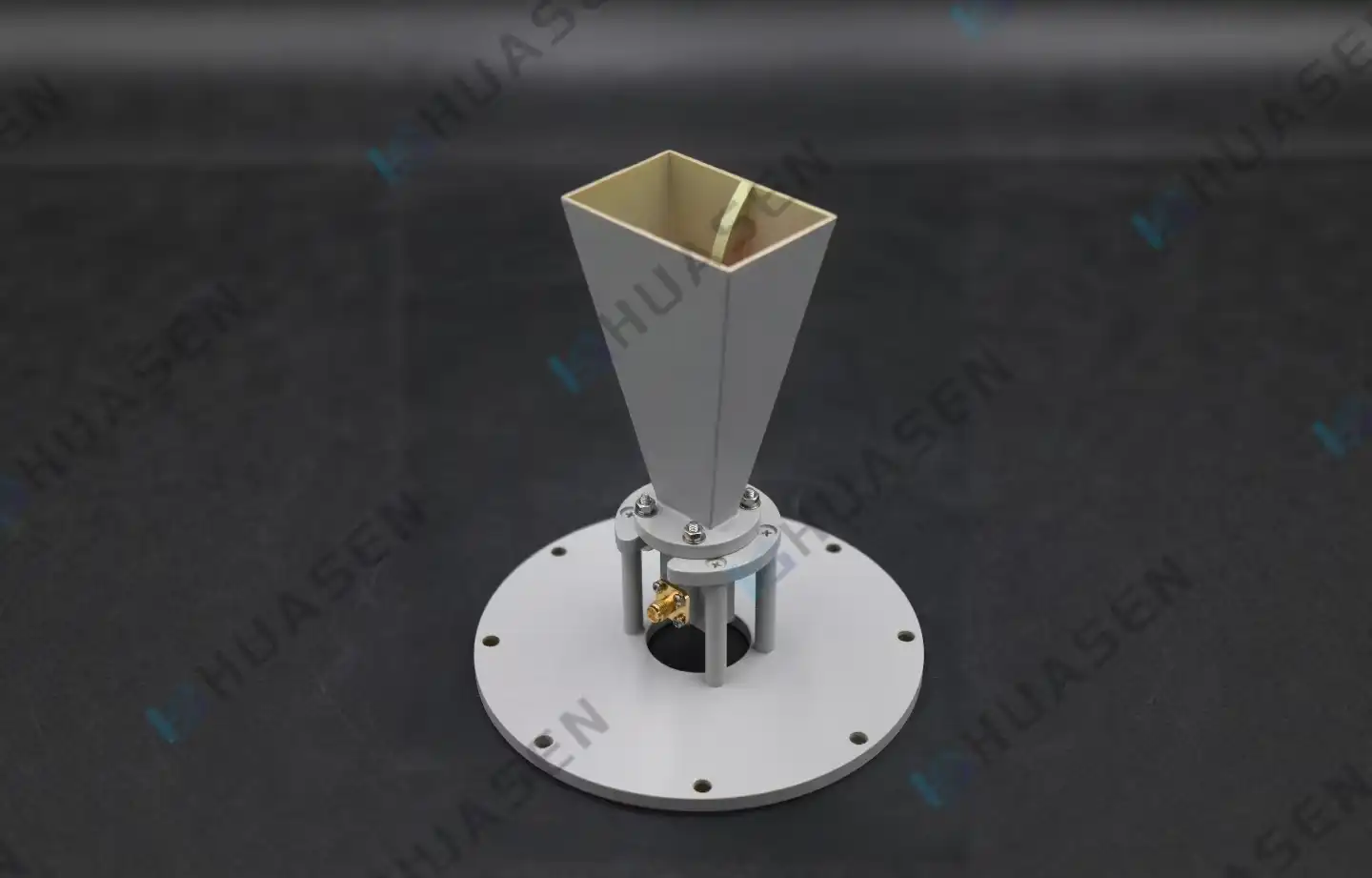
The broadband horn antenna works by slowly opening up a waveguide. This makes a smooth change in resistance between the feed system and the air. Compared to sudden changes, this taper cuts down on reflection and makes the bandwidth much wider. The opening sends out energy with a phase distribution that makes a directed beam. This beam focuses power along the antenna's axis and blocks side lobes.
Types of Broadband Horn Configurations
Different horn shapes are better for different kinds of measurements. When pyramidal horns spread out in both horizontal and vertical directions, they make symmetrical beams that are great for general tests. Circular symmetry is provided by conical tips, which makes polarization research easier. Sectoral horns only grow in one direction, making fan-shaped beams that can be used to measure specific patterns. Double-ridged versions have metal elements inside that make the bandwidth even wider, with VSWR below 2.0:1 from 1 GHz to more than 18 GHz.
Frequency Range and Bandwidth Characteristics
Most broadband horn antennas work well from low microwave frequencies up to Ku-band, and some types can even work at millimeter-wave frequencies. This covers important wireless transmission bands, like 5G frequencies, satellite downlinks, and radar monitoring ranges, without the need to switch out multiple antennas. The wide bandwidth makes testing easier, lowers the cost of tools, and gets rid of the problem of narrowband receivers not being calibrated correctly.
Key Advantages for Measurement Applications
Broadband horn antennas have a lot of great advantages. Because they have a high gain (6 to 15 dBi, based on frequency), signal-to-noise ratios in sensitive readings are better. Results can be repeated because the radiation patterns are stable across the band. Unlike parabolic mirrors, broadband horn antennas have small footprints that make them good for test ranges outside and anechoic rooms. The metal design is mechanically tough and can handle stress from the environment. Standard connectors like N-type and SMA make it easy to connect to other RF test equipment.
Core Applications of Broadband Horn Antennas in Wireless Measurement
Broadband horn antennas are used by engineers in many fields to check the performance of systems, find sources of interference, and make sure that equipment meets legal standards. When buying teams know where these antennas work best, they can match their skills to what the operations need.
Electromagnetic Compatibility and EMI Testing
The main thing that broadband horn antennas are used for is compliance testing. These antennas are used by EMC labs to create measured electromagnetic fields for testing radiated protection in line with CISPR 16 and MIL-STD-461. The antenna shines light on a gadget that is being tested while experts check for problems that could be caused by interference from outside sources. The broadband horn antenna then acts as a receiving antenna to pick up the product's radiated emissions. This lets the device measure any annoying signals that might mess up other equipment. Being able to sweep from 1 GHz to 18 GHz without switching antennas speeds up testing and makes sure that regulatory bodies' requirements for ongoing frequency coverage are met.
Antenna Pattern Characterization and Gain Validation
Laboratories that do calibration use broadband horn antennas as measures to compare unknown antennas to. Engineers use the ANSI C63.5-defined Three-Antenna Method to find gain and antenna factors with accuracy that can be traced back to NIST. As both a sender and a receiver, the broadband horn antenna maps radiation patterns in both the horizontal and elevation directions. Its gain profile is well-defined, which lets you accurately figure out path loss and turn readings of incoming power into absolute field strength values. Broadband horn antennas that work well across their entire frequency range are perfect for this purpose because they keep the phase center stable, which is the point where the radiation seems to come from.
Over-the-Air Testing for Wireless Devices
OTA testing is done on 5G smartphones, IoT modules, and wireless infrastructure to make sure that the total power sent, the sensitivity of the receiver, and MIMO performance are all correct. Test rooms with controlled signal levels are lit by broadband horn antennas that mimic real-world propagation settings. While the broadband horn antenna records three-dimensional radiation patterns, engineers turn devices on tracking systems. Dual linear feed setups allow studies of polarization diversity, which is important for checking cross-polarization discrimination in modern wireless systems' complex antenna arrays.
Radar Cross Section Measurement
Broadband horn antennas are used by defense companies and aircraft makers to describe how targets reflect radar energy. The antenna shines light on models of airplanes, weapon parts, or ships at close ranges, and receivers pick up scattered signals from a variety of directions. Engineers can test RCS across threat radar bands without having to change how the tests are set up because of the wide bandwidth. Power handling up to 300W CW lets you simulate situations with high-intensity radar light.
Satellite Communication Link Testing
Ground stations test the behavior of satellite terminals by using broadband horn antennas that imitate the way signals behave in space. You can test data devices, tracking systems, and control uplinks across satellite communication bands with these antennas. Because circular polarization versions account for Faraday rotation in the ionosphere, the integrity of the link is maintained without the need for mechanical tracking changes. When broadband horn antennas are used outside, where they are exposed to temperature changes and rain, this application needs great weather sealing.
Comparing Broadband Horn Antennas with Alternative Antenna Types
To choose the right radio technology, you need to know how to balance efficiency. While broadband horn antennas are great in some situations, other forms have different benefits based on the measurement goals.
Broadband Horns vs. Log-Periodic Antennas
Even wider fractional bandwidths can be reached with log-periodic antennas, which can sometimes cover decade ratios from 200 MHz to 6 GHz. It costs less to make their flat element arrays than to make precision-machined broadband horn antennas. Log-periodic designs, on the other hand, have less gain at the same size and make patterns that are less steady, with the beam direction changing as the frequency changes. Even though they have a smaller bandwidth, broadband horn antennas are better for precise tuning work because they have better directivity and reliable phase centers.
Broadband Horns vs. Parabolic Reflector Antennas
Large opening areas in parabolic dishes make them very gainy—often more than 25 dBi. Their narrow beamwidths let pattern readings have a high level of spatial precision. The problem is that they are big; to get the same gain, you need mirrors that are several feet in diameter, which makes putting them together in the room harder. Broadband horn antennas provide enough gain in small packages, and they are also easier to put in mechanically and don't get as windy when used outside.
Broadband Horns vs. Waveguide Slot Arrays
Through interference patterns from many emitting elements, slotted waveguide arrays can control the shape of the beam. For specialized tests, this allows for accurate field distribution. One problem is that they only cover a small range of frequencies (10–15%), so they need more than one array to cover all the frequencies that a single broadband horn antenna or double-ridged horn antenna can reach. When compared to broadband horn antennas and double-ridged horn antennas, slot arrays have simpler shapes, but they need more complicated feed networks, which raises the cost of production and insertion loss.
Selection Matrix for Measurement Scenarios
Parabolic mirrors are a good choice when high directivity is more important than a wide bandwidth. For ultra-wide frequency sweeps where modest gain is enough, choose antennas with a logarithmic period. If you want good performance, a small size, and pattern stability all at the same time, choose broadband horn antennas. Patch antennas work well for combined uses that need a low profile, but they lose some gain and bandwidth. This choice framework helps buyers get antennas that meet specific test needs instead of general standards.
Procurement Considerations for Broadband Horn Antennas
To get the right broadband horn antenna, you have to weigh the technical requirements against the working needs while keeping cost and shipping requirements in mind. It's helpful for procurement managers to know which factors have a direct effect on the quality of measurements and which ones are more flexible.
Critical Technical Parameters
The broadband horn antenna's useful spread is set by its frequency range. Make sure that the bands you've chosen meet all of your test standards, even the edges of the bands where performance may drop. Specifications for gain should include frequency-dependent curves as well as peak values. Accurate measurements depend on knowing the exact gain at each test frequency. VSWR below 2.0:1 makes sure that power is transferred efficiently and that there aren't too many echoes that mess up readings. Physical measurements affect how well the chamber fits and how far away the fields are. Make sure that the aperture size fits within the available room.
Material Durability and Environmental Ratings
Finishes that don't rust, like powder-coated metal that meets ASTM B117 salt spray standards, are needed for outdoor use. When used in a lab, bare metal is allowed, which lowers the loss of surface roughness. Power handling is determined by the type of connector used. For example, N-type connectors can safely handle 300W CW, but SMA connectors can only handle smaller power levels. Temperature stability makes sure that performance stays the same throughout the year, especially for long-term installations on test areas that are subject to extreme weather.
Leading Global Suppliers and Support Services
Well-known companies like ETS Lindgren, Keysight Technologies, and Narda offer calibrated broadband horn antennas with test data that can be tracked back to NIST, which is necessary for certified labs. These companies sell complete antenna factor tables and radiation pattern plots that can be used with measurement tools. Recalibration services (every 18 to 24 months are suggested) and expert advice for difficult measurement problems are part of the after-sales support. North American buyers can cut down on wait times by working directly with manufacturers, but regional distributors often offer more customization choices.
Pricing Structures and Volume Purchasing
Standard stock broadband Horn antennas cost between $2,000 and $8,000, based on how well they cover frequencies and how precise they are. Custom designs that include specific orientation, extra bandwidth, or unique fastening features cost more than off-the-shelf models but solve problems that generic models can't. When you buy five or more units, you can usually get a 15% to 20% discount. This is helpful for production test sites that use the same types of antennas in all of their rooms.
Customization Capabilities
A lot of test cases need changes that aren't in the list. Custom lens sizes make the gain work best for certain frequencies. With dual linear lines, you can switch between horizontal and vertical polarization without having to turn the device mechanically. Double Ridged Horn Antenna designs provide broadband performance across extended frequency ranges. Specialized plugs work with the cables that are already in stock, so you don't have to buy expensive adapter chains that cause loss and VSWR decline. Early on in the project planning process, talk to makers to find out if customized solutions are possible, how much they will cost, and when they can be delivered.
Conclusion
Broadband horn antennas are the most flexible way to measure wirelessly for EMC compliance, antenna calibration, over-the-air (OTA) tests, and radar analysis. Test labs, equipment makers, and research institutions can use them because they cover a wide range of frequencies, have stable radiation patterns, and are built to last. Procurement teams can choose antennas that improve measurement accuracy while keeping costs low by knowing technical specs, application requirements, and best practices for operation. As wireless systems move toward 6G and millimeter-wave technologies, precise measuring tools like broadband horn antennas play a bigger role in making sure devices work well and follow the rules.
FAQ
1. Broadband horn antennas usually cover what frequency ranges?
Most commercial broadband horn antennas work between 1 GHz and 18 GHz, which is a wide range that covers most radar and wireless transmission bands. For millimeter-wave uses, units that go as low as 500 MHz or as high as 40 GHz are available. The biggest bandwidth is achieved by double-ridged designs, which have internal features that keep VSWR low over many octave ranges.
2. What makes broadband horn antennas different from regular narrowband horn antennas?
Standard horns work best in certain frequency bands, usually between 10% and 30% of the bandwidth. Some types of broadband horn antennas use ridge-loading, slow tapers, or multi-section transformers to make the useful bandwidth bigger than octave or even decade ratios. This gets rid of the need for multiple antennas when testing at different frequencies, but broadband horn antenna designs don't always have the same peak gain as narrowband designs that are designed for specific frequencies.
3. Is it possible to buy a lot of these antennas with specific needs?
There are usually discounts running from 15% to 20% for sales of five or more units. Most makers can make custom specifications, such as ones with particular frequency ranges, polarization setups, mounting interfaces, or connector types. Customization takes 8 to 12 weeks, based on how complicated it is, and engineering fees are sometimes charged for design work that doesn't happen again. Talking about needs with providers early on makes sure that custom solutions meet technical goals while staying within price and time limits.
Partner with Huasen Microwave for Your Broadband Horn Antenna Needs
Huasen Microwave has been making high-performance RF and microwave parts for tough measurement tasks since 1993. Our broadband horn antennas are made with careful planning, strict quality control, and NIST-traceable testing to give you reliable measurements. Before being shipped, each antenna is tested with a vector network analyzer to make sure it works well and that it has the right VSWR and other characteristics.
Our technical team works with you from reviewing the specifications to providing help after the delivery, whether you need normal catalog models or solutions that are specially made to meet your test needs. We know what problems EMC labs, antenna test ranges, and wireless device makers face, like meeting tight deadlines for deliveries, keeping costs down, and making sure measurements are accurate over multiple years. Huasen Microwave is a trustworthy company that can provide you with Broadband Horn Antennas. They have thirty years of experience in radio frequency (RF) technology and a dedication to quality that has won them the trust of Fortune 500 companies and government research institutions. Email our sales team at sales@huasenmicrowave.com to talk about your wireless measurement needs and get more information, such as full specs, calibration data, or price quotes for large orders.
References
1. Balanis, C.A. (2016). Antenna Theory: Analysis and Design, 4th Edition. Wiley-Interscience, Hoboken, NJ.
2. Hemming, L.H. (2002). Electromagnetic Anechoic Chambers: A Fundamental Design and Specification Guide. IEEE Press, Piscataway, NJ.
3. ANSI C63.5-2017. American National Standard for Electromagnetic Compatibility - Radiated Emission Measurements in Electromagnetic Interference (EMI) Control - Calibration of Antennas.
4. Rudge, A.W., Milne, K., Olver, A.D., and Knight, P. (1986). The Handbook of Antenna Design, Volume 1. Peter Peregrinus Ltd., London.
5. Wittmann, R.C., Alpert, B.K., and Francis, M.H. (2007). "Near-Field, Spherical-Scanning Antenna Measurements with Nonideal Probe Locations." IEEE Transactions on Antennas and Propagation, 52(8), pp. 2184-2186.
6. Paul, C.R. (2006). Introduction to Electromagnetic Compatibility, 2nd Edition. Wiley-Interscience, Hoboken, NJ.
Send Inquiry