Best Practices for Using standard gain horn antenna in Measurement






2026-03-25 21:15:29
When engineers and procurement workers need to be very accurate when measuring electromagnetic fields, the best tool to use is a standard gain horn antenna. These carefully designed devices have stable gain patterns that can be predicted, which makes them essential for calibrating test tools and confirming antenna performance in mission-critical situations. Broadband test antennas rely on real-world data, but standard gain horn antennas are based on rigorous physics-based calculations that back up their theoretical correctness. This makes sure that measurements can be tracked and that they meet international standards.
Understanding Standard Gain Horn Antennas: Definitions and Core Principles
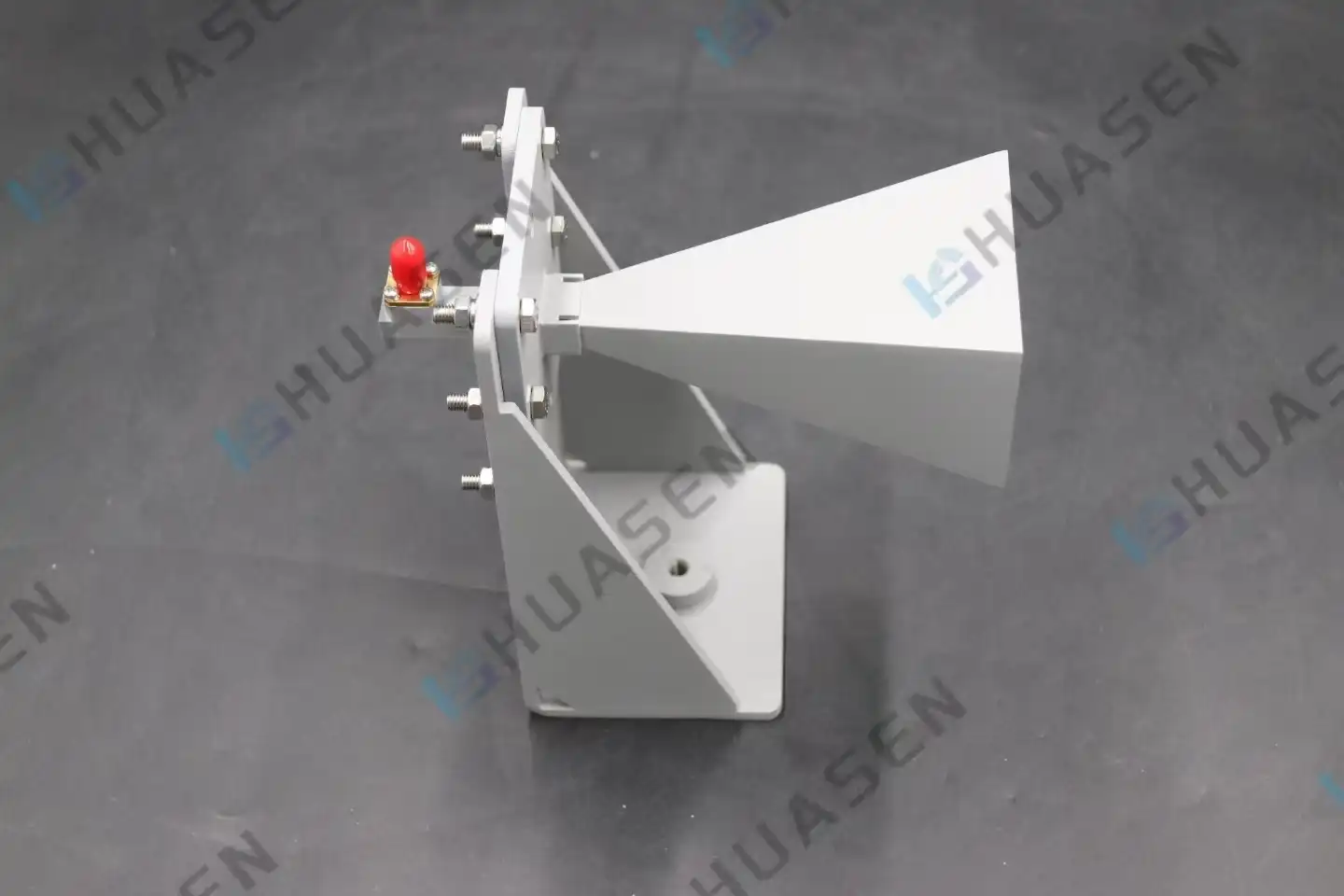
Standard gain horn antennas represent precision-engineered microwave components designed specifically as metrological references in RF measurement applications. These specialised devices feature pyramidal or conical horn structures that transform guided electromagnetic waves into focused, predictable radiation patterns essential for accurate testing and calibration procedures.
Fundamental Design Architecture
The electromagnetic principles that rule these antennas are based on carefully calculated geometric transitions that control the propagation of waves. The device keeps the phase coherence while getting optimal impedance matching as RF energy moves from the waveguide throat through the expanding horn aperture. This exact engineering makes sure that voltage standing wave ratios are usually less than 1.25:1. This keeps signal reflections to a minimum, which would otherwise affect the accuracy of measurements. Modern horn antennas are made of electroformed copper or precisely cut aluminium, and the inside surfaces are plated with silver or gold to make them more conductor-rich and reduce resistive losses. To get gain values between 10 dBi and 25 dBi that are very accurate, usually within ±0.3 dB error at lower frequencies, the aperture sizes and flare angles are carefully calculated.
Operational Frequency Characteristics
Standard gain horn antennas work in certain waveguide bands, covering frequencies from L-band to millimetre waves and above, up to and including 40 GHz. Each antenna covers specific frequency ranges that match standard waveguide measurements. This makes sure that the antennas work at their best within the limits of their operational parameters. This frequency-specific method lets engineers choose the right measuring tools for their needs while still keeping track of the calibration. These devices have linear polarisation and cross-polarisation discrimination greater than 25 dB, which ensures pure signal transfer that is needed for accurate antenna testing. This better polarisation purity is especially important for tasks that need to measure field strength accurately or make sure they comply with EMC regulations.
Comparing Standard Gain Horn Antennas with Other Antenna Types: Making the Right Choice
Procurement decisions require careful evaluation of antenna characteristics against specific measurement requirements. Understanding how standard gain horn antennas compare with alternative solutions helps engineers make informed selections that optimise both performance and cost-effectiveness.
Performance Analysis Against Alternative Solutions
In terms of mechanical ease and calibration stability, horn antennas are much better than parabolic reflector antennas. The gain is higher in parametric systems, but they are more complicated because the feed has to be placed in a certain way, and the accuracy of the surface depends on it, which can make it harder to repeat measurements. With horn antennas, these factors don't matter, and the performance is stable and reliable across their operational bandwidth. Dipole and log-periodic antennas can handle a wider range of frequencies, but they don't have the precise gain characteristics that are needed for reference uses. Because these broadband solutions rely more on real-world calibration data than on theoretical calculations, they are not as good as the main measurement standards, where traceability is very important.
Selection Criteria for Optimal Performance
When engineering teams choose horn antennas for measurement purposes, standard gain horn antennas,they have to look at a number of important factors. The precision needed often determines the choice, especially in situations where NIST-traceable calibration standards are needed. Choices are also affected by the mechanical limitations of test settings. For example, horn antennas usually need less precise mounting than reflector systems. Costs should be thought about not only when buying something, but also when it needs to be calibrated and maintained over time. Standard gain horn antennas are very valuable because they are inactive and stable over time, which means they don't need to be calibrated often and keep measuring accurately for long periods of time.
Best Practices for Measurement with Standard Gain Horn Antennas
Achieving optimal measurement accuracy with horn antennas demands adherence to established calibration procedures and environmental controls. These practices ensure repeatable results while maintaining compliance with international measurement standards.
Calibration Protocols and Procedures
Checking the antenna's physical state and accuracy in terms of its dimensions is the first step in effective calibration. Engineers should check the opening of the horn for damage, contamination, or rust that might affect how well it works. Pay close attention to the waveguide flange because bad contact can cause RF leaks and make calibration data useless. Calibration methods must follow set steps that are based on NIST or national standards that are similar. The process includes checking the antenna's gain curve over its working range and comparing the results with what the theory says should happen. Any deviations that are bigger than the allowed range show that there might be a problem that needs to be looked into before measures can continue. The accuracy of measurements is greatly affected by things in the environment, especially changes in temperature that can cause mechanical expansion, which can change the gain properties. Keeping the environment stable during the test and calibration processes helps make sure that the results are always the same. Controlling humidity is also important because water can change the dielectric properties and cause measurement mistakes.
Positioning and Alignment Techniques
Accurate readings depend on having the antennas placed correctly. To get plane wave conditions, the far-field distance requirements must be met. Usually, separation distances of 2D²/λ are needed, where D is the antenna aperture width, and λ is the wavelength. When there isn't enough space between them, near-field effects happen that change how the visible gain works. It is important to pay close attention to both angular and positional accuracy during alignment processes. Mechanical mounting systems should be able to place things consistently and steadily, with little to no sensitivity to vibration. Small changes in angle can cause big problems with measurements, especially with high-gain devices, so the antenna boresight needs to be perfectly lined up with the test target.
Maintenance and Storage Considerations
With regular upkeep, you can make antennas last longer and keep their measurement accuracy. Temperature and humidity levels should be kept under control in storage areas to prevent rusting and mechanical stress. Protective covers or cases keep things from getting damaged while they are being moved or stored. Setting up regular review times helps find problems before they affect the accuracy of measurements. A visual inspection of the inside of the horn and the surfaces of the flanges can show contamination or damage that needs to be fixed. By writing down the results of inspections, you can keep track of the state of an antenna over time.
Procurement Guide for Standard Gain Horn Antennas: Ensuring Best Value and Reliability
Successful procurement requires understanding market dynamics, supplier capabilities, standard gain horn antennas and technical specifications essential for meeting measurement requirements. This comprehensive approach ensures optimal value while securing reliable, high-performance equipment.
Market Analysis and Supplier Evaluation
On the global market for precision horn antennas, there are well-known companies that make goods that meet strict measurement standards. The best providers keep a wide range of products that cover many frequency bands and come in a variety of mechanical and gain configurations. Most of the time, these businesses offer full technical support, which can include calibration services and the ability to make changes. When evaluating a supplier, you should look at their manufacturing skills, quality processes, and calibration accreditation. Companies that keep ISO 17025-accredited calibration labs have a lot of benefits, like being able to track measurement standards and follow documented quality procedures. For custom applications that need unique antenna configurations, technical help becomes even more important.
Specification Development and RFQ Preparation
Specifications that are very detailed allow for accurate quotes and make sure that the products delivered meet the needs of the application. Some important factors are the operational frequency range, the gain specifications, the impedance characteristics, and the mechanical limits. It's important to be clear about environmental needs like temperature range, humidity tolerance, and resistance to vibration. The papers that ask for quotes should spell out the delivery requirements, the terms of the warranty, and the level of support that is expected after delivery. Pay close attention to the calibration requirements because different uses may need different levels of accuracy and paperwork. Pricing and choosing a seller are also affected by the amount of goods needed and when they need to be delivered.
Cost Optimisation Strategies
Procurement costs extend beyond initial purchase prices to include calibration, maintenance, and operational expenses. Bulk purchasing can reduce unit costs while ensuring consistent performance across multiple devices. Long-term supplier relationships often yield advantages through preferential pricing and priority support services. Total cost of ownership analysis should consider calibration intervals, maintenance requirements, and expected service life. Higher-quality devices may command premium prices but deliver superior long-term value through extended operational life and reduced calibration frequency.

Performance Optimisation: Enhancing Measurement Accuracy with Standard Gain Horn Antennas
Maximising measurement precision requires systematic approaches to identifying and eliminating sources of uncertainty. Advanced techniques and monitoring procedures enable engineers to achieve exceptional accuracy while maintaining operational efficiency.
Identifying Common Performance Issues
Environmental interference represents a significant source of measurement uncertainty, particularly in laboratory environments with multiple RF sources. Electromagnetic compatibility considerations require careful attention to equipment placement and shielding effectiveness. Proper grounding and cable management help minimise unwanted signal coupling that can affect measurement accuracy. Calibration drift over time can introduce systematic errors that compromise measurement validity. Temperature cycling, mechanical stress, and normal ageing processes may gradually alter antenna characteristics. Establishing monitoring procedures helps detect these changes before they significantly impact measurement accuracy.
Advanced Measurement Techniques
Implementing continuousstandard gain hornantennas andmonitoringsystems enables real-time detection of measurement anomalies and environmental variations. Automated data collection and analysis can identify trends indicating potential calibration drift or environmental interference. These systems provide early warning capabilities that help maintain measurement quality while reducing manual monitoring overhead. Network analyser techniques offer enhanced measurement capabilities through comprehensive characterisation of antenna performance parameters. Time domain analysis can reveal structural issues or contamination affecting antenna performance. These advanced diagnostic capabilities support preventive maintenance programs that optimise long-term performance.
Conclusion
Implementing effective practices for standard gain horn antenna measurements requires comprehensive attention to calibration procedures, environmental controls, and systematic quality management. These precision instruments serve as essential references for electromagnetic testing across telecommunications, aerospace, and defence applications. Through proper selection, calibration, and maintenance procedures, engineering teams can achieve exceptional measurement accuracy while optimising operational efficiency. The investment in quality horn antennas and supporting procedures delivers long-term value through reliable performance and reduced uncertainty in critical measurement applications.
FAQ
1. What frequency ranges do standard gain horn antennas typically cover?
Standard gain horn antennas operate across specific waveguide bands corresponding to established frequency allocations. Common ranges include L-band (1-2 GHz), S-band (2-4 GHz), C-band (4-8 GHz), X-band (8-12 GHz), Ku-band (12-18 GHz), K-band (18-27 GHz), and millimetre-wave frequencies extending beyond 40 GHz. Each antenna design optimises performance within its designated band while maintaining gain accuracy and impedance matching characteristics.
2. How often should standard gain horn antennas undergo calibration verification?
Calibration intervals depend on application requirements and environmental conditions, but typical industrial practice suggests verification every 3-5 years for passive horn antennas. Unlike active electronic components, mechanical horn structures maintain stable characteristics when properly maintained. However, ISO 17025 compliance often mandates periodic verification to detect potential physical changes or contamination affecting performance. Critical applications may require more frequent verification to ensure continued measurement accuracy.
3. Can standard gain horn antennas be customised for specific applications?
Yes, manufacturers commonly provide customisation services for specialised measurement requirements. Custom options include specific frequency bands, modified gain characteristics, alternative polarisation configurations, and specialised mechanical interfaces. Environmental hardening for outdoor or harsh conditions represents another common customisation area. However, custom devices may require extended delivery times and additional calibration procedures to establish measurement traceability.
4. What environmental factors most significantly affect horn antenna performance?
Temperature variations can cause mechanical expansion, affecting aperture dimensions and gain characteristics. Humidity may introduce dielectric changes and promote corrosion of metallic surfaces. Vibration and shock can cause mechanical damage or misalignment issues. Electromagnetic interference from nearby RF sources can contaminate measurements. Maintaining controlled laboratory conditions helps minimise these environmental impacts on measurement accuracy.
5. How do I verify the quality and authenticity of calibration data?
Authentic calibration data must include clear traceability to national measurement standards such as NIST. Look for calibration certificates displaying laboratory accreditation numbers, measurement uncertainties, and environmental conditions during calibration. The certificate should identify specific measurement equipment used and include signatures from qualified personnel. Reputable suppliers provide detailed documentation supporting the calibration process and measurement traceability chain.
Partner with Huasen Microwave for Precision Horn Antenna Solutions
Achieving measurement excellence requires partneringstandard gain horn antennaswith experienced standard gain horn antenna suppliers who understand the critical requirements of precision RF applications. Huasen Microwave Technology, established in 1993, brings three decades of specialised expertise in developing and manufacturing high-performance microwave components for demanding measurement applications. Our engineering team combines advanced design capabilities with rigorous quality control procedures to deliver horn antennas meeting the most stringent accuracy requirements.
Our comprehensive product portfolio includes standard gain horn antennas covering frequency ranges from L-band through millimetre-wave applications, each individually calibrated with NIST-traceable measurement data. We understand the unique challenges facing procurement professionals and provide complete technical support throughout the selection and implementation process. Contact our technical team at sales@huasenmicrowave.com to discuss your specific measurement requirements and discover how our proven solutions can enhance your testing capabilities while optimising long-term operational costs.
References
1. Hollis, J.S., Lyon, T.J., and Clayton, L. "Microwave Antenna Measurements." Scientific-Atlanta Press, 1985.
2. Balanis, Constantine A. "Antenna Theory: Analysis and Design." John Wiley & Sons, 4th Edition, 2016.
3. IEEE Standard 149-2021. "IEEE Recommended Practice for Antenna Measurements." Institute of Electrical and Electronics Engineers, 2021.
4. Milligan, Thomas A. "Modern Antenna Design." McGraw-Hill Professional, 2nd Edition, 2005.
5. Johnson, R.C. and Jasik, H. "Antenna Engineering Handbook." McGraw-Hill Professional, 3rd Edition, 1993.
6. ANSI C63.5-2017. "American National Standard for Electromagnetic Compatibility - Radiated Emission Measurements in Electromagnetic Interference (EMI) Control." American National Standards Institute, 2017.
Send Inquiry