What Are the Advantages of a Loop Antenna?






2026-07-08 09:14:25
Loop antennas have great noise rejection, a small design, and effective magnetic field reception. These are all features that directly solve problems in 5G infrastructure, satellite communications, radar systems, and RF testing settings. They are different from electric field antennas like dipoles because they are sensitive to magnetic fields. This lets them get better signal-to-noise ratios in places with a lot of electromagnetic interference, like cities. It doesn't matter if loop antennas are used in base station front-ends, marine communications, or EMC compliance labs; they give system designers and equipment makers flexible solutions that balance performance, space efficiency, and environmental resilience. Knowing these benefits helps people who buy things choose radio technologies that make systems more reliable and lower the total cost of ownership for tough uses.
Introduction
Antenna options for modern transmission systems need to be accurate, long-lasting, and flexible. Mobile communications, satellite links, radar operations, and RF tests are just a few of the businesses where loop antennas have become crucial parts. It's getting harder and harder for procurement managers, system designers, and engineering teams to find parts that make system design easier while still performing well in harsh circumstances.
This article talks about why loop antennas always work better than other types of antennas in certain situations. We look at how they work, their comparative advantages, the benefits they offer for business-to-business uses, and the best ways to buy from suppliers. Case studies from the defense, aircraft, and telecoms industries show how these devices keep signals clear in tough conditions. By the end, you'll have useful information that you can use to decide if a loop antenna is right for your projects and get in touch with sellers who can give you unique, standards-compliant solutions and quick technical support.
Understanding Loop Antennas: Fundamentals and Core Principles
How Do Loop Antennas Operate Through Electromagnetic Induction?
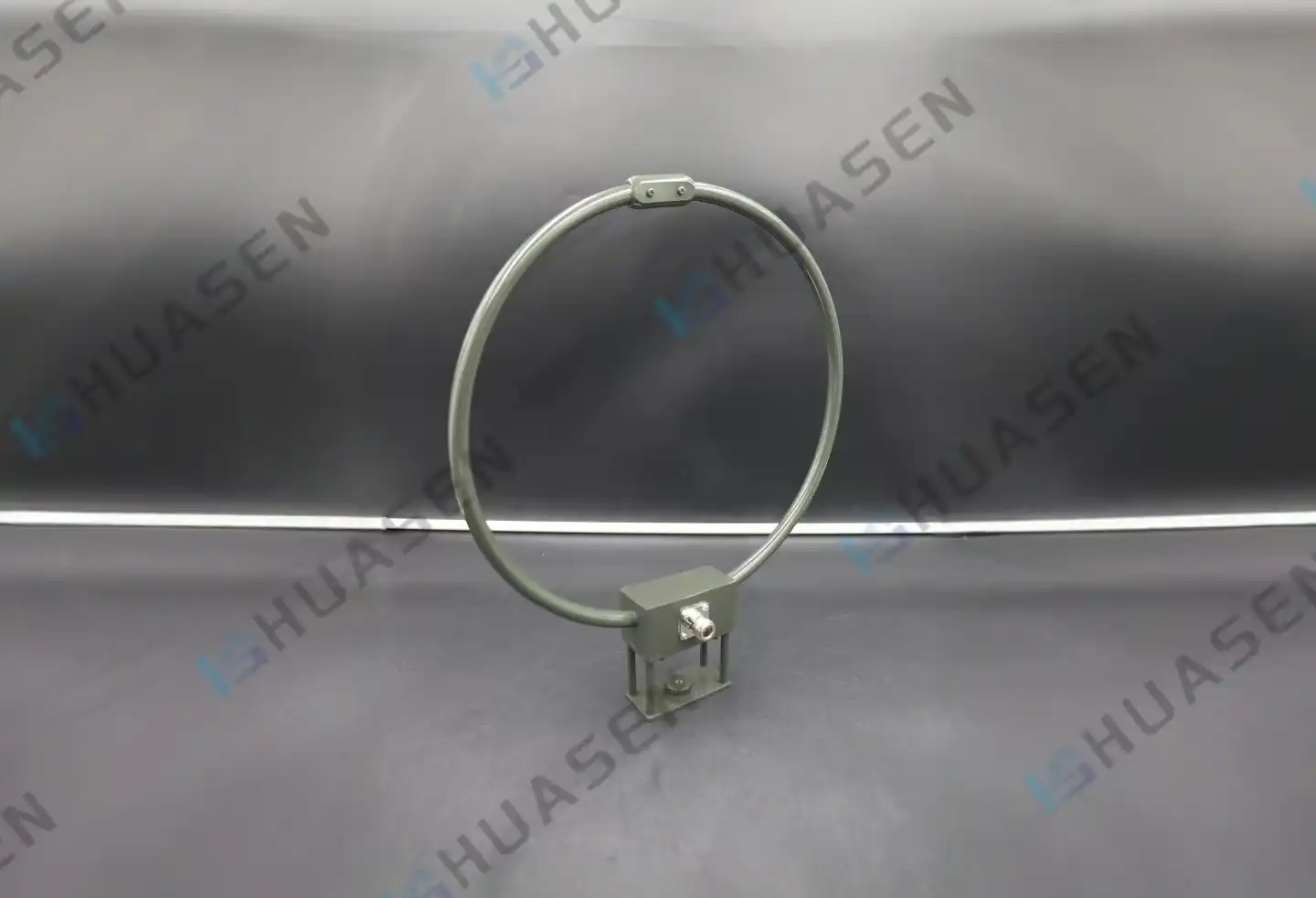
Loop antennas are made up of conductor loops that interact with radio frequency signals through electromagnetic induction. These loops are usually made of copper tube or wire. Loop antennas couple with magnetic field components of electromagnetic waves, unlike dipole antennas, which react mainly to electric fields. Because of this basic difference, they work best in close-range situations and places with a lot of electrical noise, like factories or cities with lots of people.
Classification by Size and Frequency Response
Antenna builders put loop configurations into groups based on how big the circumference is compared to the working wavelength. Electrically small loops—with a diameter of less than 0.1 wavelengths—show magnetic dipole radiation patterns with a figure-eight shape and sharp nulls that are not in the loop plane. Loops that are resonant and have circumferences close to one wavelength act like bent dipoles but cover a wider area. Small magnetic loop antennas usually operate on high-frequency bands between 1 kHz and 30 MHz, while bigger designs can operate in the very high frequency (VHF) range and support a wide range of communication protocols, from shortwave to tactical radio systems.
Active Versus Passive Configurations
Active loop antennas have preamplifiers built in that boost weak signals before sending them to receivers. This makes low-frequency receiving below 30 MHz much more sensitive. The AHA series is a good example of this design because it has BNC female ports, rechargeable 13.8VDC power sources with saturation indicators, and built-in amplification with 20dB flat-response insertion loss factors. Passive loop antennas, like the KHA series, don't need any extra power to work. They can send and receive signals in both directions up to 30 MHz and have insertion loss factors of 80dB, which makes them very isolated. These passive designs work with both BNC-K and N-K connections, giving you options for high-frequency uses where preamplifying could cause intermodulation distortion.
Advantages of Loop Antennas Compared to Other Antenna Types
Superior Noise Immunity in Electromagnetically Hostile Environments
Most disturbances made by people come from electric fields that are polarized vertically. These fields come from things like power lines, switching electronics, and LED lights. Loop antennas are mostly immune to near-field electric noise, which makes dipole and monopole antennas perform worse. Instead, they react primarily to magnetic field components. When magnetic loop antennas are used instead of regular whip antennas at frequencies below 10 MHz, testing in urban RF settings shows gains in the signal-to-noise ratio of more than 10dB. This feature is very useful for base station listeners in cities, marine communications close to electronics on ships, and tactical systems working in electromagnetic battlespaces.
Compact Footprint Enabling Space-Constrained Installations
Resonant dipole antennas need lengths that are close to half a wavelength, which makes them unsuitable for platforms with limited room for installation, like UAVs, small boats, or portable test equipment. Small loop antennas can pick up signals with circular or square perimeters that are a lot smaller than quarter-wavelength monopoles at the same frequencies. A properly set magnetic loop antenna working at 7 MHz might take up an area 1 meter across, while a dipole needs about 20 meters of straight room. Aerospace engineers like this space economy because they have to make antenna systems for drones and spaceships, which have limited part sizes because of weight and aerodynamic profiles.
Directional Nulling Capabilities for Interference Mitigation
Small loop antennas have a two-way radiation pattern that creates deep nulls that are perpendicular to the loop plane. These nulls often have loss levels higher than 30dB compared to the peak response directions. Operators can physically spin loop antennas to point nulls at specific sources of interference. This blocks unwanted signals successfully without the need for complicated phased array systems. EMC testing labs use loop antennas to separate magnetic field emissions from electric field components during compliance reviews per MIL-STD-461 and CISPR standards. Direction-finding uses in electronic countermeasures use this feature to find transmitters.
Performance Stability Across Variable Environmental Conditions
Loop antenna impedance characteristics stay mostly the same when installed close to the ground or low to the ground, which are mounting places that badly detune monopole antennas due to ground plane coupling losses. This toughness helps tactical communications that need to be set up quickly in a variety of terrains and marine settings, where salt spray and conductive surfaces make it hard for standard antennas to work. When you make transmitting loops out of smooth copper or silver-plated wires, you reduce skin-effect losses and keep the efficiency even when the temperature and humidity change, which can damage antennas that use complex matching networks.
When you look at these features next to dipole arrays, Yagi directional antennas, and whip setups, you can see where loop antennas really shine. In long-range point-to-point links, high-gain directional antennas work better than loops. However, system designers who care more about noise immunity, small installation, and quick deployment processes are increasingly specifying loop configurations. Active loop models with preamplification increase sensitivity to the same level as or higher than passive dipole systems. This makes them competing options for base station antennas, spectrum tracking gear, and RF test equipment.
Practical Benefits of Using Loop Antennas in B2B Communication Systems
Simplifying System Architecture Through Frequency Versatility
When paired with adjustable matching networks or broadband preamplifiers, loop antennas can cover a wide frequency range with a single device. This is something that equipment makers who are making multi-band communication systems really like. The passive KHA series can work from low HF to 30 MHz, so it can be used for a wide range of tasks, from NVIS propagation at 3–10 MHz to upper HF data links close to 30 MHz, all without the need for complicated multiplexers or antenna switches. This flexibility lowers the number of parts that need to be kept on hand, makes installation easier, and speeds up upkeep in the field. All of these things have a direct effect on the total cost of ownership for system designers who are setting up maritime communication networks or national telecommunications infrastructure.
Enhancing Reliability in Harsh Operating Environments
Marine-grade materials are used to build loop antennas, which can survive conditions that quickly break down other designs. The tuning capacitors and connecting ports are protected by sealed cases that meet IP67 ingress protection standards. This means that they can keep working even in heavy rain, salt fog, and dirty industrial settings. Stability at temperatures ranging from -40°C to +70°C guarantees steady performance at study stations in the Arctic, military bases in the desert, and tropical sea routes. Vibration and shock resistance that meets MIL-STD-810 standards keeps mechanical breakdowns from happening in mobile platforms like helicopters, ground vehicles, and military ships, where structural stresses can damage parts. These features make something last longer and require less upkeep, which are important factors for procurement managers who are looking at lifetime costs.
Reducing Electromagnetic Interference in Sensitive Systems
The magnetic coupling device built into loop antennas (magnetic loop antennas) reduces the transmission of unwanted signals that could mess up nearby electronics, which is a problem that always comes up with high-power sending antennas. This trait is very important for communications security systems that handle sensitive information, since electromagnetic waves could let enemies receive or analyze the data. When research institutions do precise RF readings, loop antennas' clean radiation patterns help because they cut down on reflections inside protected rooms and coupling to nearby test equipment. Manufacturers of lab instruments like spectrum analyzers and field strength meters define loop designs to make sure that measurements are accurate enough to meet national standards.
These useful benefits show why more and more OEMs, system developers, and research sites are using loop antenna technologies. The mix of wide bandwidth coverage, environmental stability, and interference control solves the main problems that people are looking for when they buy something. These are features that are hard for a single competing antenna type to match.
Procurement Considerations: How to Source and Select the Best Loop Antennas?
Evaluating Supplier Technical Capabilities and Certification Compliance
Procurement teams should give more weight to makers that show they know a lot about design by putting out technical data, application notes, and safety certifications. Ask for test results from a vector network analyzer that confirm VSWR performance over certain frequency ranges and show return loss values below -15 dB at working bands. Check that the seller follows the rules for ISO 9001 quality management and RoHS environmental compliance, especially if you are buying parts for the European or North American markets. Proof of MIL-STD-461 EMC testing is needed for military and aerospace uses, while FCC or CE marking is needed for business telecommunications equipment. When suppliers offer calibration certificates that can be tracked back to NIST or a similar national measuring center, you can be sure that the measurements are accurate, which is very important for test equipment.
Assessing Customization Flexibility and Engineering Support
Standard catalog items don't always meet all the needs of specialized communication systems. Check to see if possible providers are willing and able to change things like the resonant frequency, the amount of power they can handle, the types of connectors they offer, and the environmental protection ratings. Before making large purchases, ask for, for example, tests to make sure that the Loop Antennas' performance works well with current system architectures. Top providers are different from average ones because they offer quick and helpful technical support. To speed up project timelines and lower integration risks, look for makers that offer design help, electromagnetic simulation modeling, and field troubleshooting.
Balancing Cost, Quality, and Supply Chain Reliability
Unit pricing affects buying choices, but procurement workers with a lot of experience look at the total costs, which include things like failure rates, warranty terms, and how to get a replacement. Set clear standards for wait times and minimum order amounts that work with project plans. This is especially important for custom configurations that need special manufacturing methods. Diversify your supplier relationships to lower the risk of relying on a single source, but keep your main ties with makers that can show they can deliver on time and keep prices stable over multiple years. When it comes to large-scale deployments like base station networks, magnetic loop antennas, or fleet car communications updates, payment terms, volume discounts, and consignment inventory choices become things that can be negotiated.
Conclusion
Through their excellent noise insulation, magnetic field sensitivity, and small footprint, loop antennas meet important needs in today's communication infrastructure. Their benefits over dipole and monopole configurations become clear in places with a lot of electromagnetic interference, limited room, and tough working conditions, where regular antennas have trouble. Active and passive setups give you the freedom to choose the right one for your application, whether you need a sensitive receiving system that needs pre-amplification or a high-power sending system that needs a strong passive design.
If procurement workers know about the basics of loop antennas, how their benefits compare, and how to evaluate suppliers, they can make smart choices that improve system performance while keeping costs low. The technology has been used successfully in testing, marine, defense, telecommunications, and other areas. It has been shown to be reliable under practical stresses that are hard for other antenna types. For businesses that value signal quality, installation freedom, and long-term value in their communication system deployments, choosing loop antennas is a smart decision.
FAQ
1. What frequency ranges do loop antennas cover effectively?
Depending on design, loop antennas perform well in both high frequency (HF) and low frequency (VHF) bands, usually from 1 kHz to 300 MHz. For reception purposes, small magnetic loops work best below 30 MHz, while bigger resonant loops can reach VHF ranges. Active models improve awareness at lower frequencies, while passive designs allow two-way contact at higher frequencies. The frequency response is different for each application and relies on the loop circumference, conductor width, and tuning network properties.
2. How do loop antennas achieve better noise rejection than dipole antennas?
Dipole antennas mostly pick up electric field components that carry most of the clutter that people make from electronics and power systems. Loop antennas couple with magnetic field components and are unaffected by the electrical noise that is common in cities and factories. This basic physical difference makes the signal-to-noise ratio better by more than 10dB in places with a lot of clutter. This lets you receive signals more clearly without having to use complicated signal processing or filters.
3. Can loop antennas be customized for specialized industrial applications?
Reliable makers allow for a lot of customization, such as changing the frequency, the amount of power it can handle, the environmental sealing grades, and the connection specs. For custom projects, you might need special mounting brackets, the ability to work with current casings, or coatings that are resistant to chemicals. Getting suppliers involved early in the design process lets you do electromagnetic modeling and test prototypes, which makes sure that the customized loop antennas meet performance standards before you commit to making them.
Partner With Leading Loop Antenna Manufacturers for Your Next Project
Since 1993, Huasen Microwave Technology has been providing precision-engineered loop antenna solutions to the aerospace, defense, telecommunications, and testing businesses. Our active and passive loop setups have been tested and shown to work across HF to VHF bands. They come with full technical documentation and safety certifications, such as those for MIL-STD and RoHS standards. Our engineering team can make unique designs that meet your exact needs, whether you need small receiving antennas for 5G infrastructure, ruggedized transmitting loops for marine communications, or calibrated probes for EMC labs.
Our flexible manufacturing, quick expert help, and reliable delivery schedules that fit project timelines are all good for procurement pros. We provide example evaluation programs, thorough vector network analyser test data, and design help to make sure that they work well with current system architectures. Get in touch with our experts at sales@huasenmicrowave.com to talk about your loop antenna needs and find out why top system designers choose Huasen Microwave as their first choice for mission-critical RF components.
References
1. Johnson, R.C., "Antenna Engineering Handbook," Fourth Edition, McGraw-Hill Professional, 2007.
2. Balanis, C.A., "Antenna Theory: Analysis and Design," Third Edition, Wiley-Interscience, 2005.
3. IEEE Standard 145-2013, "IEEE Standard for Definitions of Terms for Antennas," Institute of Electrical and Electronics Engineers, 2013.
4. MIL-STD-461G, "Requirements for the Control of Electromagnetic Interference Characteristics of Subsystems and Equipment," Department of Defense, 2015.
5. Carr, J.J., "Practical Antenna Handbook," Fifth Edition, McGraw-Hill/TAB Electronics, 2011.
6. Silver, H.W., "The ARRL Antenna Book," 23rd Edition, American Radio Relay League, 2015.
Send Inquiry