Pyramidal Horn Antenna in EMC and Field Strength Measurement






2026-04-03 21:43:10
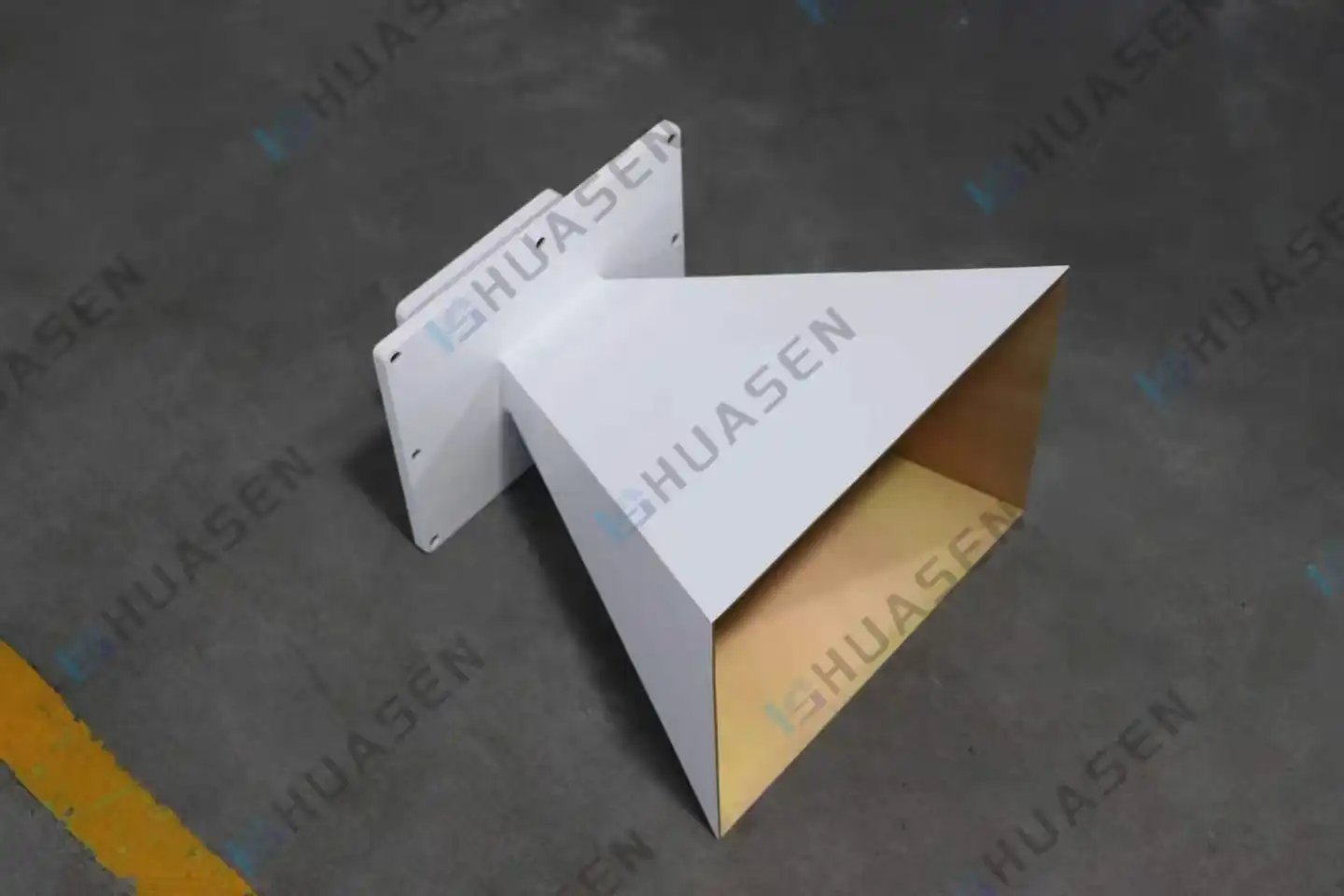
Pyramidal horn antennas are the best way to measure field strength and electromagnetic compatibility (EMC) in a wide range of businesses. These special waveguide horn antennas have a unique conical flare that grows in both electric and magnetic field sizes. This makes the impedance match between the waveguide feeds and free space perfect. Because they have consistent radiation patterns, high gain, and a strong build, they are essential for compliance testing, antenna calibration, and accurate field readings in both lab and factory settings.
Understanding Pyramidal Horn Antennas in EMC and Field Strength Measurement
The fundamental architecture of pyramidal horn antennas addresses critical impedance matching challenges that plague open-ended waveguides. These antennas function as sophisticated electromagnetic impedance transformers, gradually transitioning from the constrained waveguide environment to free space radiation. This controlled transformation eliminates the high voltage standing wave ratio (VSWR) problems inherent in simple waveguide terminations.
Core Operating Principles and Design Architecture
Through careful geometric optimisation, the pyramidal construction makes a smooth change in impedance. To keep phase coherence across the antenna's aperture while maximising power transfer efficiency, the flare angles and aperture sizes are carefully estimated. To get the most accurate measurements, modern pyramidal horn designs usually have VSWR values below 1.5:1 across their operational bandwidth. This means that the antenna can respond to frequencies from L-band to millimeter-wave, and its gain ranges from 10 dBi to 25 dBi depending on the aperture size and frequency. They can work in a lot of different situations, which makes them useful for a wide range of EMC testing tasks, from checking that 5G base stations are compliant to describing sonar systems.
Radiation Pattern Characteristics and Measurement Precision
Pyramidal horn antennas have very consistent radiation patterns and half-power beamwidths that don't change over the frequency range they work with. This uniformity is very important for EMC testing, since the accuracy of compliance certification depends on how well measurements can be repeated. The antennas' linear polarisation purity is usually higher than -20dB cross-polarization suppression, which makes sure that signals sent and received for field strength measurements are clean. The controlled beamwidth properties allow for precise spatial resolution in electromagnetic field mapping applications. Engineers who test for emissions or protection depend on this level of spatial accuracy to find specific sources of radiation or target specific parts of the equipment being tested. Because the gain response is stable across frequency, you don't have to make any complicated changes to the calibration when you measure over a wide frequency range.
Comparing Pyramidal Horn Antennas with Other Horn and Antenna Types
Understanding the comparative advantages of pyramidal horn antennas helps procurement professionals make informed decisions for their specific EMC testing requirements. The antenna selection process involves evaluating multiple factors, including frequency coverage, gain stability, polarization purity, and mechanical robustness.
Performance Comparison Against Conical Horn Antennas
While conical horn antennas offer circular radiation patterns suitable for certain applications, pyramidal horn antennas provide superior performance for linearly polarized EMC measurements. The rectangular aperture of pyramidal designs naturally preserves the polarization characteristics of rectangular waveguide feeds, eliminating the need for complex polarization conversion networks. Conical horns require circular waveguide interfaces or mode converters when used with standard rectangular waveguide test equipment. This additional complexity introduces potential loss points and phase variations inpyramidal antennas that can compromise measurement accuracy. Pyramidal horn antennas connect directly to rectangular waveguide systems, maintaining signal integrity throughout the measurement chain.
Advantages Over Sectoral Horn Designs
Sectoral horn antennas, which flare in only one dimension, offer limited gain improvement compared to pyramidal designs. The dual-plane flaring of pyramidal horns provides enhanced directivity and higher gain performance within similar physical footprints. This efficiency translates to improved measurement sensitivity and extended dynamic range for EMC testing applications. The symmetrical radiation pattern of pyramidal horns also simplifies antenna positioning and alignment procedures during field strength measurements. Sectoral designs require careful orientation to achieve optimal performance, while pyramidal antennas maintain consistent characteristics regardless of their rotational position around the main beam axis.
Comparison with Parabolic Reflector Systems
Large parabolic antennas can achieve higher gain values than pyramidal horns, but their size and complexity make them impractical for many EMC testing environments. Pyramidal horn antennas offer an optimal balance of performance and practicality, providing sufficient gain for most applications while maintaining compact, lightweight form factors suitable for laboratory and field use. The absence of complex feed networks and reflector alignment requirements makes pyramidal horns more reliable and easier to maintain than parabolic systems. This reliability proves particularly valuable in production testing environments where equipment downtime directly impacts operational efficiency.
Benefits and Applications of Pyramidal Horn Antennas in B2B Fields
The commercial value of pyramidal horn antennas extends beyond their technical specifications to encompass operational efficiency, measurement reliability, and compliance assurance. Organizations investing in these antennas realize multiple benefits that directly impact their testing capabilities and business outcomes.
Enhanced EMC Testing Efficiency and Accuracy
Modern EMC testing facilities depend on pyramidal horn antennas for standardized gain horn applications in anechoic chambers. These antennas serve as calibrated reference sources for validating other antenna measurements and ensuring traceability to national measurement standards. The predictable performance characteristics enable automated testing systems to operate with minimal human intervention, reducing testing time and labor costs. The frequency stability and gain accuracy of pyramidal horns directly impact measurement uncertainty budgets in EMC testing. Reduced measurement uncertainty allows for tighter specification margins and more confident compliance declarations. This accuracy proves particularly valuable for products approaching regulatory limits, where measurement precision can determine pass/fail outcomes.
Applications Across Diverse Industry Sectors
Pyramidal horn antennas are used by phone companies to test base stations and make sure that 5G systems work. Because the antennas can create controlled field distributions, it is possible to measure base station radiation patterns accurately and stay within dose limits. As 5G networks use antenna arrays that are more complicated, pyramidal horns' reference skills become more important for describing the system. For testing radar systems and making electronic countermeasures, these devices are used in aerospace and defence. Pyramidal horns can handle a lot of power, and their main limit is the air breakdown voltage. This makes them good for testing transmitters. Because they are built to last, they can handle the harsh conditions that are common in military and aerospace testing centers.
Material Characterization and Quality Control Applications
Pyramidal horn antennas are used in non-destructive testing tools for characterising materials in the manufacturing industry. The focused beam properties make it possible to precisely test samples of material without touching them, which helps quality control in fast-paced industrial settings. This feature is especially useful for measuring dielectric properties and checking the amount of moisture in production processes. It's clear from these uses that pyramidal horn antennas can be used for more than just EMC tests. Because they can make controlled electromagnetic fields that spread out in predictable ways, they are useful for quality control and tracking industrial processes.
How to Choose and Procure the Right Pyramidal Horn Antenna
Successful procurement of pyramidal horn antennas requires careful evaluation of technical specifications, supplier capabilities, and long-term support requirements. The selection process should balance performance requirements with budget constraints while ensuring compatibility with existing test systems.
Critical Performance Specifications and Standards Compliance
Frequency range selection must align with specific testing requirements while providing adequate margin for future applications. Standard waveguide sizes correspond to specific frequency bands, with WR-90 supporting X-band applications and WR-28 covering Ka-band frequencies. The chosen antenna must maintain specified performance across the entire operational bandwidth. Gain accuracy and stability specifications directly impact measurement precision. High-quality pyramidal horn antennas maintain gain specifications within ±0.5 dB across their operational frequency range. VSWR specifications should remain below 1.5:1 to ensure efficient power transfer and minimal measurement uncertainty contribution.
Compliance with international standards such as MIL-STD specifications ensures long-term reliability and interoperability with existing test equipment. These standards address construction materials, environmental performance, pyramidal antennas,and electrical specifications that impact operational reliability.
Supplier Evaluation and Support Services Considerations
Supplier selection involves evaluating manufacturing capabilities, quality control processes, and technical support services. Established suppliers provide calibration certificates traceable to national measurement standards, ensuring measurement accuracy and regulatory compliance. The availability of custom design services enables optimization for specific applications while maintaining standard interface compatibility. Technical support services should include design assistance, sample evaluation programs, and responsive customer service. The complexity of EMC testing applications often requires specialized expertise during antenna selection and system integration. Suppliers offering comprehensive technical support reduce implementation risks and ensure optimal system performance.
Procurement Lifecycle and Cost Optimization Strategies
Effective procurement planning considers both initial acquisition costs and long-term operational expenses. Volume purchasing agreements can provide significant cost savings for organizations with ongoing antenna requirements. Custom manufacturing options enable optimization for specific applications while potentially reducing costs through design simplification. Delivery timeframes vary significantly based on standard versus custom configurations. Standard waveguide sizes and frequency ranges typically offer shorter delivery times, while custom specifications may require extended manufacturing periods. Early engagement with suppliers during system planning phases helps ensure timely delivery and optimal performance.
Optimizing Performance and Ensuring Long-Term Satisfaction
Maximizing the operational lifespan and measurement accuracy of pyramidal horn antennas requires attention to proper installation, calibration procedures, and preventive maintenance practices. These activities ensure consistent performance and protect the investment value of precision measurement equipment.
Installation Best Practices and Environmental Considerations
The right mechanical fixing keeps the antenna in place and reduces measurement errors caused by vibrations. During alignment processes, mounting systems should provide rigid support while still letting precise angular adjustments be made. When deciding how to position the antenna, you need to think about the measurement environment's polarisation needs and possible interference sources. Protection from the environment is especially important for uses that will be used outside or in harsh conditions. Installations of radar domes keep antenna openings dry and protect them from moisture buildup while keeping electromagnetic signals clear across the operating frequency range. If you don't use the right environmental settings, changes in temperature and humidity can affect the accuracy of your measurements.
Calibration Procedures and Measurement Verification
Regularly checking the calibration keeps the measurements accurate and makes sure that quality standards are still being met. Three-antenna measurement methods let you connect measurements to national norms and find places where performance might be dropping. Compared to manual methods, automated calibration systems cut down on measurement time while improving repeatability. Recording calibration data helps quality management systems and meets regulatory compliance needs. If you look at measuring data over time, you can see how performance changes over time. These changes could mean that maintenance is needed or that the environment is having an effect. This proactive method stops problems with measurement accuracy before they affect test results.
Maintenance Requirements and Troubleshooting Guidelines
The major goal of routine maintenance is to keep the conductive surface quality and waveguide interface integrity. The performance of insertion loss and VSWR is directly affected by how clean the internal surface is. Long-term electrical performance is maintained by preventing oxidation through proper storage and handling methods. Flange interface inspection makes sure proper RF sealing ofPyramidal horn antennasand stops signal leakage that could affect measurement accuracy. To make sure that the interface always works right, torque specs for mounting hardware must be followed. Visual inspections done on a regular basis can find problems before they affect the ability to measure.
Conclusion
A basic part of EMC and field strength measurement applications in many fields, from telecommunications to aerospace, is the pyramidal horn antenna. Their reliable construction, ability to cover a wide frequency range, and ability to work as expected make them essential for compliance testing and system characterisation. Pyramidal designs have technical benefits like better impedance matching, stable radiation patterns, and high polarisation purity. These benefits directly affect how accurately measurements are made and how efficiently they are used. When companies buy good pyramidal horn antennas, they get a lot of benefits, like shorter testing times, more accurate measurements, and better ability to follow regulations.
FAQ
1. What frequency ranges are typically covered by pyramidal horn antennas?
Pyramidal horn antennas operate across frequency ranges determined by their connecting waveguide size. Common configurations include WR-90 for X-band (8.2-12.4 GHz), WR-62 for Ku-band (12.4-18 GHz), and WR-28 for Ka-band (26.5-40 GHz). Custom designs can extend coverage to millimeter-wave frequencies exceeding 100 GHz for specialized applications.
2. How do I verify the gain and radiation pattern specifications?
Gain verification typically employs the three-antenna method or comparison against NIST-traceable standard gain horns. Radiation pattern measurements require anechoic chamber facilities with appropriate positioning systems. Many suppliers provide calibration certificates with detailed gain and pattern data traceable to national measurement standards.
3. Can pyramidal horn antennas handle high-power transmission applications?
These antennas excel in high-power applications due to their air-filled construction without fragile dielectric components. Power handling limitations are typically determined by air breakdown voltage within the waveguide or at the aperture. Proper design and construction can support kilowatt-level power transmission for radar and communication applications.
4. What customization options are available for specialized industrial applications?
Manufacturers offer customization, including frequency optimization, aperture dimensions, flange types, and environmental protection features. Custom polarization configurations and dual-band designs address specific application requirements. Material selection can be optimized for particular environmental conditions or power handling requirements.
5. How does flare length affect antenna performance?
Flare length directly influences phase error across the antenna aperture, affecting gain and beam pattern characteristics. Insufficient flare length increases phase error, reducing gain and distorting radiation patterns. Optimal designs balance flare length with aperture size to minimize phase error while maintaining practical size constraints.
Partner with Huasen Microwave for Your Pyramidal Horn Antenna Requirements
Huasen Microwave Technology brings three decades of expertise in high-frequency microwave and millimeter-wave component manufacturing to support your EMC and field strength measurement needs. Our comprehensive range of pyramidal horn antennas delivers the precision, reliability, and performance standards demanded by telecommunications, aerospace, Pyramidal horn antennasand defense applications. As an established pyramidal horn antenna manufacturer, we combine advanced design capabilities with rigorous quality control processes to ensure optimal measurement accuracy and long-term operational reliability. Our engineering team provides complete technical support from initial specification development through installation and calibration. Contact our specialists at sales@huasenmicrowave.com to discuss your specific requirements and discover how our pyramidal horn antenna solutions can enhance your testing capabilities and measurement confidence.
References
1. Balanis, Constantine A. "Antenna Theory: Analysis and Design, Fourth Edition." John Wiley & Sons, 2016.
2. IEEE Standard 149-2021. "IEEE Recommended Practice for Antenna Measurements." Institute of Electrical and Electronics Engineers, 2021.
3. Milligan, Thomas A. "Modern Antenna Design, Second Edition." IEEE Press, 2005.
4. Rudge, Alan W. "The Handbook of Antenna Design, Volume 1." Peter Peregrinus Ltd, 1986.
5. CISPR 16-1-4:2019. "Specification for radio disturbance and immunity measuring apparatus and methods - Part 1-4: Radio disturbance and immunity measuring apparatus - Antennas and test sites for radiated disturbance measurements." International Electrotechnical Commission, 2019.
6. Love, A.W. "Electromagnetic Horn Antennas." IEEE Press Selected Reprint Series, 1976.
Send Inquiry