Lens Horn Antenna Performance Factors to Evaluate






2026-05-18 22:31:31
Procurement professionals must evaluate Lens Horn Antenna performance based on a few important parameters that affect system efficiency and ROI. A Lens Horn Antenna flattens spherical wavefronts using a dielectric lens and horn construction. The antenna becomes straighter and shorter. When choosing an antenna, gain efficiency, sidelobe suppression, return loss, polarisation purity, and environmental resilience are key factors. All of these aspects affect the antenna's ability to fulfil demanding 5G backhaul, satellite communications, radar systems, and RF testing criteria for accuracy and reliability.
Understanding Lens Horn Antenna Basics
Operating Principles and Phase Correction Mechanics
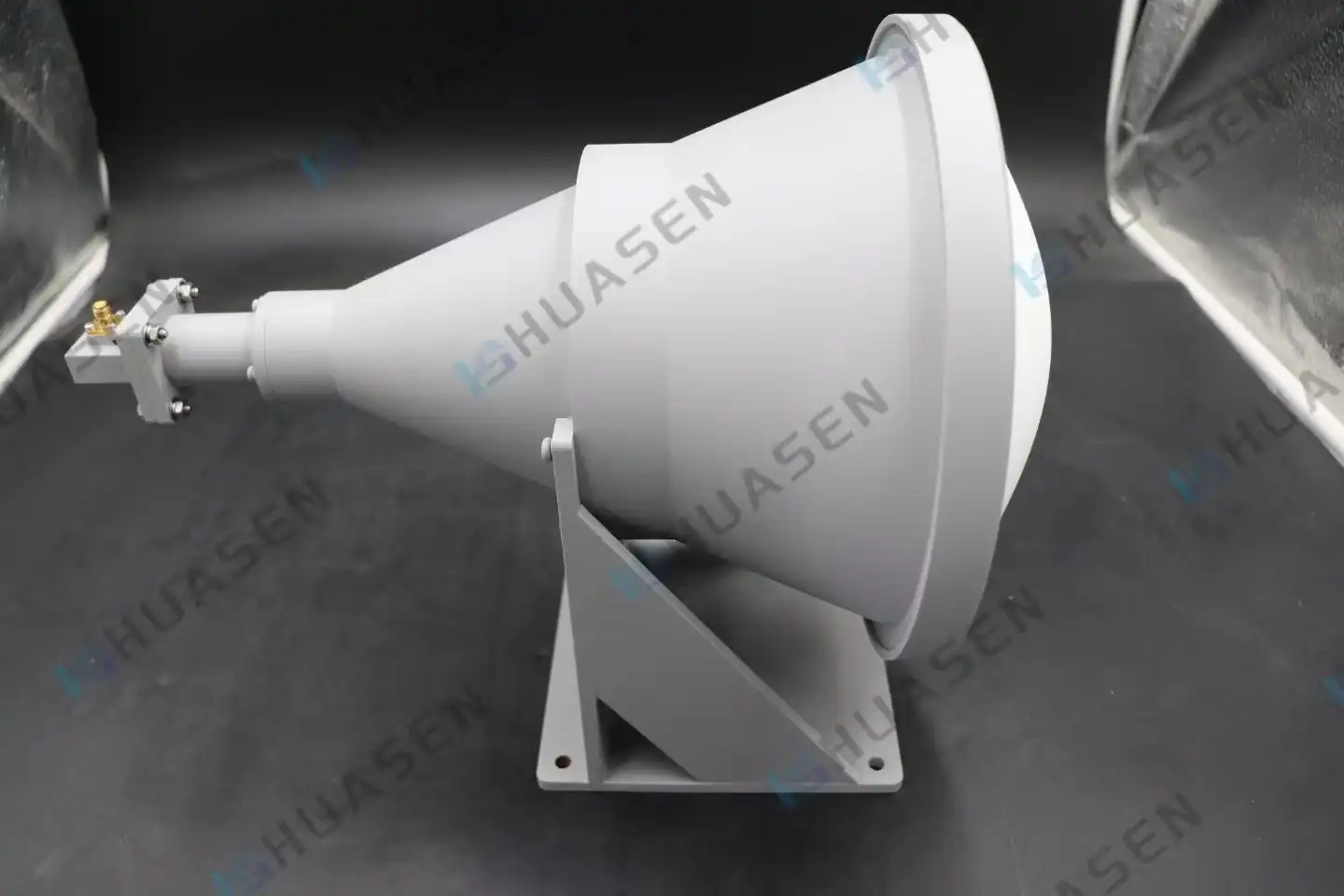
Lens Horn Antennas solve the phase error that plagues normal horn designs, which is their principal benefit. Traditional conical or pyramidal horns emit spherical electromagnetic waves. Phase changes throughout the opening reduce efficacy. These antennas use a precision-engineered dielectric lens to flatten circular wavefronts. The lenses are commonly PTFE, Rexolite, or low-loss TPX. With this phase correction device, opening efficiency is over 60%, far greater than with a normal horn of the same size.
Antenna Type Classifications and Structural Variations
Various configurations of modern lens horn antennas are suitable for various situations:
LHA Conical Horn Lens: Circular waveguide feed, axisymmetric lens construction. This design is ideal for rotationally uniform radiation jobs. Radiometric sensing and satellite communications employ it for pure polarisation.
A rectangular waveguide feed and curved dielectric lens form the Pyramidal Horn Lens. Compact Antenna Test Ranges (CATR) characterise 5G huge MIMO using this configuration. The rectangular entrance simplifies polarisation control and far-field simulation in tiny chambers.
Feed-Illuminated Lens: A primary feed horn illuminates a broader lens structure, producing an optical system. High-frequency millimetre-wave applications requiring gain >40 dBi employ this structure.
Point-Focus Lens (PLHA): Allows numerous feed setups with a focal point design like optical lenses. This adaptability makes it appropriate for beam-steering and multi-band applications.
Choose between these varieties based on system frequency range, polarisation demands, location limits, and integration complexity.
Material Selection and Performance Implications
The dielectric materials used to make lenses affect insertion loss, temperature stability, and frequency. PTFE (Teflon) has excellent electrical characteristics and consistent dielectric constants at many temperatures. It is ideal for outdoor usage in tough climates. For circumstances where every tenth of a dB matters, Rexolite offers reduced loss tangent values at millimetre-wave frequencies. The lowest density, TPX (polymethylpentene), reduces antenna weight, which is significant for aeroplane and UAV installations.
Most horn bodies are silver- or gold-plated copper or aluminium. For ocean and coastal applications, gold plating protects against corrosion, whereas silver plating decreases surface resistance, losing the most at high frequencies. Machine the horn and lens surfaces to tight tolerances (RMS errors < λ/50) to maintain phase coherence and prevent beam deterioration.
Primary Industrial Applications
Lens horn antennas are vital in many applications. They provide precise target modelling in anechoic chambers for automobile radar ADAS validation at 77–81 GHz. Phone companies employ them for E-band (71–86 GHz) wireless backup connections that require high gain in tiny packaging due to atmospheric loss. Defence businesses utilise them in electronic warfare equipment that must be hard to notice and create beams quickly. The major standards used by research centres for antenna calibration and radiometric measurements must be traceable to national standards.
Core Performance Factors to Evaluate
Antenna Gain and Aperture Efficiency
Gain is the antenna's energy-focusing capacity. Unlike an isotropic reflector, it is measured in dBi. Lens Horn Antenna gains vary with frequency and opening size from 20 to 45 dBi. The gain-to-length ratio is the main difference between lens-corrected and conventional horns. Lens-corrected designs provide the same benefit at 40–60% shorter length.
Phase correction quality is closely proportional to aperture efficiency, calculated by dividing effective aperture area by real aperture area. High-performance Lens Horn Antennas have 50–65% aperture efficiency, whereas standard maximum gain horns have 30–45%. This efficiency results in greater receiver signal-to-noise ratios and broader transmitter reach. The purchasing specs should include the lowest gain values permitted over the working bandwidth. Standard tolerances are ±0.5 dB.
Radiation Pattern Characteristics and Sidelobe Suppression
The radiation pattern depicts antenna energy distribution in three dimensions. Lens Horn Antennas produce balanced, low-sidelobe main beams well. Performance standards typically include E-plane sidelobe values of -15 dB and H-plane values of -26 dB, which are substantially lower than normal horn designs.
This sidelobe control solves high-density deployment interference. When backup connections are nearby, excessive sidelobes may induce co-channel crosstalk, reducing link quality and network capacity. Lens Horn Antennas' decreased sidelobes allow tighter frequency reuse patterns and more transmission lines in space. The angle at which the gain decreases 3 dB below peak is the half-power beamwidth (HPBW). It may be 5 to 25 degrees, depending on opening size and design frequency. Although narrower beams are better at picking particular locations, they need more precise installation.
Return Loss and VSWR Performance
Resistance discrepancies allow some information to bounce back to the source, causing return loss. High-quality Lens Horn Antennas maintain return loss values below 20 dB (VSWR < 1.22:1) across all frequencies. This parameter is crucial in high-power radar applications because reflected radiation may damage emitter parts or produce measurement errors in high-precision test systems.
Potential resistance breaks during the waveguide-to-horn transition and dielectric lens contact. Advanced designs reduce echoes using multi-section impedance transformers and improved lens shapes. When comparing datasheets from various providers, be sure the return loss parameters include the whole operating band, not just the centre frequency. Broadband applications may be able to tolerate return loss at band edges (>15 dB) if the bandwidth spread compensates.
Polarisation Purity and Cross-Polarisation Discrimination
Polarisation purity is a way to rate how well the antenna stays in the right polarisation direction. In standard Lens Horn Antenna designs, linear polarisation is supported, and cross-polarisation detection is usually greater than 25 dB in the main beam. This behaviour makes sure that dual-polarised communication systems can work with very little interference between channels that are not connected to each other.
You can get circular polarisation by putting a circular waveguide phase changer in front of the horn feed. For satellite communications, this feature is necessary because the Faraday rotation effect in the ionosphere would weaken signals that are linearly polarised. When describing polarisation needs, it is important to make a clear distinction between axial ratio requirements (for circular polarisation) and cross-polarisation separation requirements (for linear polarisation), as these are very different ways to measure performance.
Frequency Range and Bandwidth Considerations
Operating bandwidth is the range of frequencies that the antenna can keep working well with all the given conditions. Lens Horn Antennas usually have fractional bandwidths of 20–40%, but some custom designs can get up to an octave or more of bandwidth. Both the waveguide feed and the lens structure have physical features that limit how well they work with bandwidth.
Material choice has a big effect on speed. Avoid beam squint by making sure the lens material's dielectric constant stays the same across the frequency range. Beam squint is when the main beam direction changes angle with frequency. In broadband radar uses, where frequency variety is used to tell targets apart, this effect can be a problem. Maximum beam squint values (usually less than 0.1° per GHz) are specified in high-quality designs to make sure reliable angle coverage.
Mechanical Design and Environmental Robustness
Long-term dependability under practical pressures depends on how the structure is built. To keep the lens from getting out of alignment due to vibrations, it needs to be firmly attached to the horn frame. This is especially important for aerospace and mobile platform uses, where mechanical shock loads can reach 20 to 30g.
That's why Huasen Microwave's Lens Horn Antenna designs are so useful:
- Short Axial Dimensions: Our small designs take up 40–50% less room than normal horns with the same gain, which is very helpful in equipment racks and platform installations where space is limited.
- Superior Sidelobe Performance: Sidelobe reduction of -15 dB in the E-plane and -26 dB in the H-plane reduces interference in settings with multiple antennas and high network density.
- Polarisation Flexibility: Base setups provide high-purity linear polarisation, and circular polarisation for satellite uses can be achieved with optional circular waveguide phase shifters. Core performance is not affected.
- Customisation Capability: The focal length, opening diameter, and beamwidth factors can be changed to fit the needs of a specific application, taking into account the system's limitations and performance goals.
All of these benefits help our customers with the problems they have the most, like getting the best performance for the smallest amount of space, avoiding interference in situations with a lot of users, and getting parts that work well with their current system designs.
Lens Horn Antenna vs. Alternative Antenna Technologies
Performance Comparison with Parabolic Reflectors
For parabolic dish antennas to have a high gain, electromagnetic reflection is used instead of phase correction. Dishes can provide very high gains (>50 dBi), but they need much bigger physical openings and add blockage losses from the feed structures. Lens Horn Antennas have about the same gain as other types, but they are smaller and don't block the opening. Cost is the trade-off: machined dielectric lenses usually cost more per square inch than printed or moulded reflective surfaces. Lens Horn Antennas are often used in places with a lot of wind because their smaller cross-sectional area makes mounting structures less vulnerable to wind loads.
Distinguishing from Corrugated Horn Designs
When you don't use dielectric lenses, corrugated horns with irregular concentric grooves can get low sidelobes and great polarisation uniformity. They work great in situations where a very wide bandwidth and few reflections are needed. Corrugated horns, on the other hand, need to be much longer—often 3–5 times the opening diameter—to get the same gain. Because of this, they can't be used in situations where space is limited. Lens Horn Antennas have the same sidelobe performance as lens tubes but are only half as long. They are more difficult to make, though. Which of these technologies to use depends on which constraint is more important: length or cost of production.
Evaluation Against Patch and Array Antennas
Passive Lens Horn Antennas can't compare to microstrip patch arrays when it comes to low-profile placement and electric beam steering. Patch arrays, on the other hand, have a smaller bandwidth (usually 5–10%), more insertion loss from feed networks, and more difficult temperature management because they have active parts. Lens Horn Antennas have a wider bandwidth, can handle more power, and don't lose signal in the feed network. They are the best choice for fixed-beam uses where long-term dependability and mechanical simplicity are more important than beam-steering flexibility.
Procurement Considerations for B2B Clients
Supplier Qualification and Certification Requirements
When choosing a reputable Lens Horn Antenna manufacturer, evaluate several areas of their skills. ISO 9001 accreditation shows that you have a quality management system, but it doesn't distinguish your firm. AS9100 (aerospace) and NADCAP certifications demonstrate a company's expertise in high-reliability, regulated fields.
Request verification of measurement tracking. Reputable manufacturers calibrate their test instruments to national standards like NIST in the US and supply calibration documents. Officially, regulated field applications and third-party certification need this traceability. Customer reviews might reveal a supplier's delivery reliability, technical support speed, and product consistency. These factors significantly impact the total cost of ownership, which extends beyond unit pricing.
Customisation Capabilities and Design Flexibility
In advanced system operations, standard catalogue goods rarely meet all the needs. Because you can change the focus length, aperture size, and beamwidth, you can get the best performance for certain link shapes or test setups. Check to see if possible suppliers are ready and able to make changes to designs. Ask about the minimum order numbers for unique setups, the availability of engineering help during the design phase, and the normal iteration processes for developing prototypes.
Huasen Microwave Technology has engineers who are only used for customisation projects and can change all the important factors without affecting the promises for electrical performance. This adaptability is very helpful when adding Lens Antenna products to systems that already exist and have set mechanical connections or unique environmental needs.
Pricing Structures and Total Cost Analysis
The unit price is only one part of the total cost of acquisition. Project plans and the cost of keeping supplies can be affected by lead times. Custom designs can take 8–12 weeks from the time the design is approved to the time the product is delivered. Standard goods may ship within 2–4 weeks. When comparing quotes, you should think about the fees for expediting, the cost of tools for special configurations, and the minimum order amounts that may force you to buy more than you need.
Volume savings on prices usually start at 10 units, and get even bigger at 50 units or more. Set up a framework that deals with your chosen providers to lock in prices for expected annual amounts while still allowing for flexibility in delivery times. Standard contracts last for 12 months, but you may be able to negotiate for longer coverage or performance promises, especially for big purchases. These longer-term agreements lower the risk in situations where replacing something in the field would cost a lot of money in labour or downtime.
Conclusion
To choose the right Lens Horn Antenna, you need to carefully look at a lot of performance factors that affect each other. Gain, sidelobe suppression, return loss, polarisation purity, frequency, and mechanical stability must all meet the needs of the application. By knowing how design choices like lens material, horn shape, and surface accuracy affect these factors, you can make smart purchasing decisions that improve both performance and cost.
Lens Horn Antenna technology has clear benefits over other options like parabolic dishes, corrugated horns, or phased arrays in situations where small size, mechanical simplicity, and wide bandwidth are more important than electronic beam guiding. A successful procurement process includes more than just technical requirements. It also includes qualifying suppliers, finding out what customisations they can make, and doing a total cost analysis that includes lead times and insurance terms. Correct installation and upkeep steps will guarantee that the antenna works perfectly for as long as it's supposed to for as long as it's supposed to.
FAQ
1. What gain values should I specify for my application?
How much antenna gain you need is based on your link budget estimate, which takes into account things like broadcast power, receiver sensitivity, path loss, and the signal-to-noise ratio you need. To get around free-space path loss, you usually need more gain when communicating over longer distances or higher frequency bands. Radar apps need enough gain to find objects at the farthest range possible. Use standard RF propagation models to figure out your system link budget. Then, give the antenna gain a range of two to three decibels to account for installation losses and component errors. Talking to experienced RF engineers while making the specifications keeps expensive mistakes from happening when Lens Horn Antenna capabilities don't match system needs.
2. How do lens horn antennas compare to parabolic designs for radar systems?
Lens Horn Antennas are much shorter than parabolic reflectors with the same gain. This is very important for placements with limited depth, like vehicle-mounted radar or small test ranges. They eliminate aperture blockage from feed structures that can degrade sidelobe performance in reflector systems. When very high gains (>50 dBi) are needed and big openings are needed, parabolic dishes may be cheaper. Which one you buy relies on whether you care more about how small it is or how much it costs per dBi.
3. Can I request customised antenna specifications?
Manufacturers with a good reputation usually let you change the frequency bands, polarisation setups, beamwidth properties, and mechanical connections. Custom focal lengths and aperture sizes make it possible to optimise for certain test range shapes or placement limitations. During the design phase, engineers will be consulted to make sure that any changes that are asked for don't affect the electrical performance or the ability to make the product. Different manufacturers have different minimum order numbers for custom configurations, but they are usually between 5 and 20 units, based on how complicated the design is.
Partner with Huasen Microwave for High-Performance Lens Horn Antenna Solutions
Because it has been making precise microwave and millimetre-wave parts since 1993, Huasen Microwave Technology has 30 years of engineering experience in the defence, aircraft, and telecoms industries. We offer a variety of Lens Horn Antennas, such as the Conical Horn Lens (LHA), the Pyramidal Horn Lens, the Feed-Illuminated Lens, and the Point-Focus Lens (PLHA). All of them have short axial lengths and excellent sidelobe suppression.
As a well-known company that makes Lens Horn Antennas, we can make them exactly how you want them, taking into account your frequency bands, polarisation needs, and mechanical limitations. Our engineering team works directly with clients from the creation of the first set of specifications to the testing of prototypes and production in large quantities. Each antenna goes through a lot of tests and is calibrated in a way that can be traced back to NIST to make sure it meets your performance needs.
Our technical experts are ready to talk about your project needs, whether you're building next-generation 5G infrastructure, radar test systems for cars, or satellite ground stations. You can ask for full datasheets, custom quotes, or technical advice by emailing sales@huasenmicrowave.com.
References
1. Balanis, C.A. (2016). Antenna Theory: Analysis and Design, Fourth Edition. John Wiley & Sons, Hoboken, New Jersey.
2. Goldsmith, P.F. (1998). Quasioptical Systems: Gaussian Beam Quasioptical Propagation and Applications. IEEE Press, New York.
3. Olver, A.D., Clarricoats, P.J.B., Kishk, A.A., and Shafai, L. (1994). Microwave Horns and Feeds. IEEE Press, New York.
4. Milligan, T.A. (2005). Modern Antenna Design, Second Edition. John Wiley & Sons, Hoboken, New Jersey.
5. IEEE Standard 149-2021. IEEE Standard for Antenna Measurements. Institute of Electrical and Electronics Engineers, New York.
6. Kraus, J.D. and Marhefka, R.J. (2002). Antennas for All Applications, Third Edition. McGraw-Hill, New York.
Send Inquiry