Left-Hand vs Right-Hand Circularly Polarized Horn Antenna: Selection Guide






2026-03-07 21:53:58
It's important to know the basic differences between left-hand circular polarisation (LHCP) and right-hand circular polarisation (RHCP) horn antennas when choosing between them for system performance. With horn antenna circular polarisation technology, electromagnetic waves can spin in certain directions, horn antenna circular polarization making patterns that spin either clockwise (RHCP) or anticlockwise (LHCP). This choice has a direct effect on the quality of the signal, the ability to block interference, and the general dependability of communication in satellite, radar, and wireless settings. Which one to use—LHCP or RHCP—depends on the needs for system compatibility, government rules, and the type of application where polarisation alignment is important for getting and sending signals as efficiently as possible.

Understanding Circular Polarisation in Horn Antennas
The electric field vector continuously rotates around the propagation line in circular polarisation, which is a more advanced way to send electromagnetic waves. In linear polarisation, the electric field moves in a set plane. But circular polarisation makes a helical wave pattern that is very helpful in difficult communication situations.
Fundamentals of Circular Polarisation Technology
In horn antennas, circular polarisation is achieved by using special internal parts to change waves that are linearly polarised into signals that are circularly polarised. Linear-to-circular polarisation converters and dual linear polarisation orthogonal stimulation methods are used in modern horn antennas to make this change. These technical methods make it possible to precisely control how waves rotate while keeping the integrity of the signal over a wide range of frequencies. This is Huasen Microwave's Circularly Polarised Horn Antenna (CPHA). It has improved cone-shaped horn designs with step diaphragm configurations and broadband dual linear polarisation synthesis. This method achieves outstanding axial ratio performance of ≤ 0.5dB across frequencies from 0.5GHz to 110GHz, making it ideal for demanding applications that need high polarisation purity.
LHCP vs RHCP: Wave Rotation Characteristics
The direction of spin of the electromagnetic field vector is what makes left-hand circular polarisation different from right-hand circular polarisation. LHCP waves move anticlockwise when looking at the emitter from the receiver's point of view, while RHCP waves move clockwise. This basic difference affects how well signals work and how well systems that send and receive them work together. The direction of movement has a direct effect on the ability to block multipath interference. Signals that are reflected change polarisation; RHCP signals become LHCP signals when they are reflected and vice versa. This happens because circularly polarised antennas naturally reject unwanted reflected signals. This makes signal-to-noise ratios much better in complex propagation settings like cities and factories.
Benefits of Linear Polarisation Systems
Circularly polarised horn antennas are much better than standard linear polarisation systems, especially when the antenna's orientation changes or when signal distortion is caused by the environment. One of the main benefits is that it doesn't lose polarisation when linear antennas get out of alignment because of things like mechanical rotation or the surroundings. In ionospheric communications, where Faraday spin changes signal polarisation, these antennas also work better than others. When travelling through the ionosphere, linear signals lose a lot of their strength. But circular polarisation keeps messages strong, no matter what the ionosphere conditions are. This benefit is very important for long-range radar, space exploration, and satellite communications, where the reliability of the signal directly affects the success of the task.
Key Performance Factors: Left-Hand vs Right-Hand Circular Polarisation
When looking at LHCP and RHCP horn antennas for specific uses, it's important to understand performance measures. These measures help procurement teams make smart choices based on technical needs and operational limitations by figuring out which antennas are best.
Radiation Pattern and Gain Characteristics
When built with the same physical dimensions and frequency requirements, both LHCP and RHCP horn antennas have similar radiation pattern features. The main difference is in the sense of polarisation, horn antenna circular polarisation,not in the basic qualities of the radiation. But small differences in production tolerances and the design of the internal polariser can cause gain patterns to change in ways that affect how well the system works. Gain ranges from 10 to 25dB, based on the frequency band and size of the horn aperture. In this range, Huasen Microwave's CPHA series has selectable gain choices that let customers get the best antenna performance for their link budget needs. The broadband design keeps the gain constant over a wide frequency range, so in multi-band uses, you don't need as many different types of antennas.
Axial Ratio and Polarisation Purity
The most important performance factor for circularly polarised antennas is the axial ratio, which shows how close the antenna is to having perfect circular polarisation. Axial ratio values lower than 3dB usually mean better polarisation clarity, and values below 3dB are fine for most uses. High-performance antennas have axial ratios of 1dB or less, which means that cross-polarisation interference is kept to a minimum. Cross-polarisation discrimination is a way to measure how well an antenna can ignore signals with the opposite polarisation sense. It is directly related to the axial ratio performance. In frequency reuse systems where both LHCP and RHCP signals work at the same time in the same frequency band, better axial ratio performance means better signal quality and interference avoidance.
Frequency Band Considerations
Choosing the right frequency band has a big effect on how well polarisation works and how much bandwidth it can handle. Broadband circular polarisation is hard to implement technically because it needs complex polariser designs to keep the axial ratio constant over a wide frequency range. Narrowband uses usually have better axial ratio performance, but they are less flexible in how they can be used. Huasen Microwave solves this problem by offering a range of customisable bandwidth choices, from narrowband designs with less than 5% bandwidth to broadband solutions with up to 67% bandwidth. This gives customers the freedom to find the best mix between polarisation performance and frequency coverage needs. This lets them choose the best antenna for their application needs while still keeping costs low.
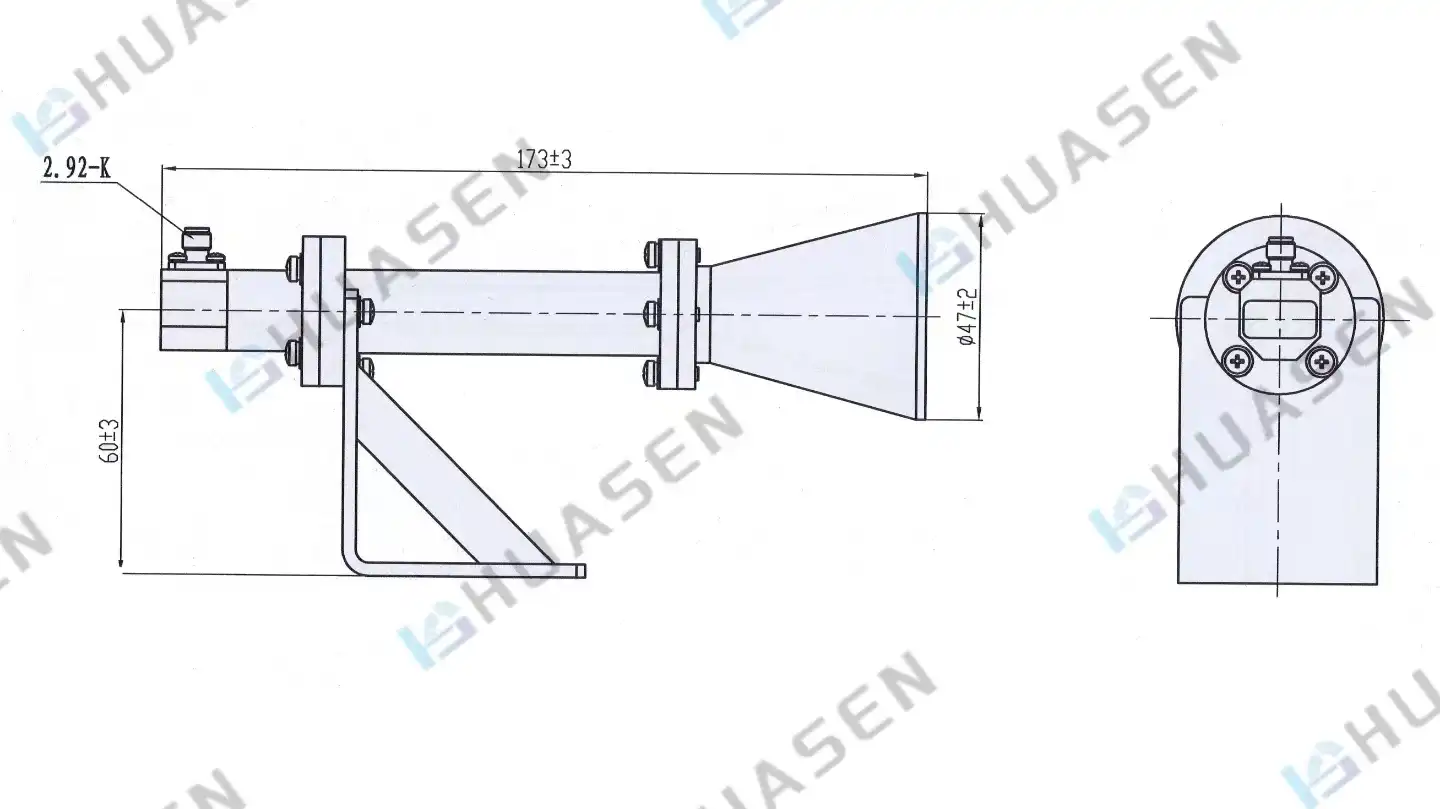
How to Choose Between Left-Hand and Right-Hand Circular Polarised Horn Antennas
The selection process requires careful consideration of system requirements, regulatory compliance, and application-specific performance criteria. Understanding these factors enables procurement teams to make informed decisions that ensure long-term system compatibility and performance optimisation.
Application-Driven Decision Criteria
Different applications favour specific polarisation orientations based on established standards and operational requirements. Satellite communications often specify polarisation orientation to maximise frequency reuse efficiency and minimise interference between adjacent satellites. GPS systems utilise RHCP as the standard, requiring ground-based antennas to match this polarisation for optimal signal reception. Military and aerospace applications may require specific polarisation orientations to maintain compatibility with existing systems or to comply with security protocols. Radar applications sometimes utilise both polarisations simultaneously to extract additional target information through polarisation diversity techniques, requiring dual-polarisation antenna systems.
System Compatibility Assessment
Evaluating system compatibility involves analysing existing infrastructure, regulatory requirements, horn antenna circular polarisation,and future expansion plans. The polarisation orientation must match throughout the communication link to avoid the 3dB polarisation mismatch loss that occurs when LHCP and RHCP antennas attempt to communicate directly. Integration considerations include connector compatibility, mounting requirements, and environmental protection standards. Huasen Microwave provides customisation support for connector types, bandwidth specifications, and gain requirements, enabling seamless integration with existing systems while meeting specific performance criteria. This customisation capability reduces procurement risks and ensures optimal system performance across diverse operating conditions.
Cost-Benefit Analysis Framework
Cost considerations extend beyond initial antenna purchase prices to include installation costs, maintenance requirements, and long-term reliability factors. High-performance antennas with superior axial ratio specifications may justify higher initial costs through improved system performance and reduced maintenance requirements over the antenna's operational lifetime. Supply chain reliability becomes particularly important for critical applications where antenna failures can result in significant operational disruptions. Established manufacturers with proven track records provide greater assurance of consistent quality and reliable technical support, factors that contribute to total cost of ownership optimisation and operational risk mitigation.
Market Overview: Leading Circular Polarisation Horn Antenna Suppliers
The global market for circularly polarised horn antennas encompasses numerous suppliers offering varying levels of technical capability, customisation options, and support services. Understanding supplier capabilities helps procurement teams identify partners capable of meeting specific technical requirements while providing reliable long-term support.
Technology Innovation and Quality Leadership
Leading makers set themselves apart by using cutting-edge polariser designs, high-quality materials, and strict quality control procedures. As a technology leader, Huasen Microwave has made a name for itself by constantly improving the design and production of horn antennas. The company has been making high-frequency microwave and millimetre-wave parts for 30 years, which helps them make consistently high-quality goods that meet the needs of demanding applications. The CPHA series from this company is technically outstanding because it has great axial ratio performance and can cover a wide frequency range. The step diaphragm design method makes sure that the performance stays the same over the frequency range that was given. It also keeps the mechanical strength needed for harsh environments that are common in defence and aircraft applications.
Supply Chain and Service Capabilities
As wait times for parts get longer and quality standards get stricter, it becomes more and more important to have reliable supply chain management. Well-known companies usually have better methods for keeping track of their inventory and making sure the quality of their products. This lowers the risk of delivery problems and makes sure that the products always work well. These features are especially useful for large-scale deployments, such ashorn antenna circular polarizationwhere shipping delays can cause projects to run behind schedule and cost more than planned. Different providers offer very different levels of technical support. Some offer full design help and custom engineering services, while others only offer standard product configurations. The technical team at Huasen Microwave helps with design, sample trials, and provides calibration data. This helps customers choose the best antennas and integrate them more efficiently while lowering the time and technical risks of development.
Applications and Future Trends of Circular Polarised Horn Antennas
There are many areas of industry right now that depend on effective communication, which is why circular polarisation technology is more complicated. By learning about these uses and new trends, procurement teams can make sure that the antennas they choose are in line with long-term technology plans and practical needs.
Current Industrial Applications
The main use for circularly polarised horn antennas is in satellite communications, where they are used as feed elements for parabolic reflector systems and direct radiating elements for smaller terminals. Circular polarisation is necessary for reliable satellite links because it prevents polarisation mismatch and Faraday spin happen. This is especially true for mobile applications, where antenna pointing accuracy may not be very good. Circular polarisation is being used more and more in radar systems for weather tracking and target separation. Based on polarisation characteristics, weather radars can tell the difference between different types of precipitation. On the other hand, circular polarisation is used by military radars to lower radar cross-section vulnerabilities and improve target detection in difficult environments.
Emerging Technology Trends
As we move toward 5G and 6G wireless communications, circular polarisation technology opens up new uses, especially in millimetre-wave applications where effects from the atmosphere are more noticeable. In crowded cities, where multipath propagation has a big effect on signal quality, circular polarisation's natural ability to block interference may be useful. The need for advanced antenna technologies that can safely work in a wide range of temperature and radiation conditions is driven by space exploration projects. Well-designed circular polarisation systems work well and don't break easily. This makes them a good choice for deep space communication needs where strong signal strength is important for mission success and collecting science data.
Conclusion
Before choosing between left-hand and right-hand circularly polarised horn antennas, you need to carefully look at the performance requirements, system compatibility, and application needs. The decision affects the quality of the signal, the ability to block interference, and the long-term dependability of the system in a wide range of communication settings. Understanding the basics of polarisation, horn antenna circular polarisation performance measures, and the needs of a specific application helps you make smart decisions that improve system performance while keeping costs low. As wireless communication technologies and space exploration programs continue to improve, there will be a greater need for high-performance circular polarisation solutions that work reliably in tough operational settings.
FAQ
1. What determines whether to use LHCP or RHCP in my application?
The polarisation choice depends primarily on system standards and compatibility requirements. Satellite systems often specify polarisation orientation to maximise frequency reuse efficiency, while applications like GPS mandate RHCP. Military and aerospace systems may require specific orientations for compatibility with existing infrastructure or security protocols.
2. How does the axial ratio affect antenna performance?
Axial ratio measures how closely an antenna approaches perfect circular polarisation, with lower values indicating better performance. Values below 3dB are generally acceptable, while high-performance applications require axial ratios of 1dB or lower. Poor axial ratio increases cross-polarisation interference and reduces the antenna's ability to reject unwanted signals.
3. Can I use a single antenna for both LHCP and RHCP signals?
Dual-polarisation antennas can simultaneously handle both LHCP and RHCP signals through separate ports, providing excellent isolation between polarisations. Single-port antennas are designed for one specific polarisation and cannot effectively receive the opposite polarisation without significant signal loss.
Partner with Huasen Microwave for Superior Horn Antenna Circular Polarisation Solutions
Huasen Microwave stands as a trusted horn antenna circular polarisation manufacturer with over 30 years of proven expertise in developing advanced RF and microwave solutions. Our CPHA series delivers industry-leading axial ratio performance of ≤ 0.5dB across frequencies from 0.5-110GHz, ensuring superior signal quality for demanding applications. The comprehensive customisation capabilities include bandwidth optimisation, gain selection,horn antenna circular polarisation,and connector compatibility, enabling seamless integration with existing systems while meeting stringent performance requirements. Contact our technical specialists at sales@huasenmicrowave.com to discuss your specific requirements and discover how our circular polarisation expertise can enhance your communication system performance.
References
1. Balanis, C.A. "Antenna Theory: Analysis and Design, Fourth Edition." John Wiley & Sons, 2016.
2. Milligan, T.A. "Modern Antenna Design, Second Edition." IEEE Press, 2005.
3. Kraus, J.D. and Marhefka, R.J. "Antennas: For All Applications, Third Edition." McGraw-Hill Education, 2002.
4. Stutzman, W.L. and Thiele, G.A. "Antenna Theory and Design, Third Edition." John Wiley & Sons, 2012.
5. IEEE Standard 149-2021. "IEEE Recommended Practice for Antenna Measurements." Institute of Electrical and Electronics Engineers, 2021.
6. Love, A.W. "Electromagnetic Horn Antennas." IEEE Press, 1976.
Send Inquiry