
How to Reduce Insertion Loss in High Directivity Waveguide Probe Couplers?






2026-01-06 21:31:42
For the best total system performance and signal transmission efficiency, it is important to lower the insertion loss in high directivity waveguide probe couplers. There are a few important ways to do this. First, carefully choosing materials is very important; using metals that carry electricity well and dielectrics with low loss can greatly reduce signal loss. It is very important to be precise in industrial processes, especially when it comes to keeping tight tolerances and smooth surface finishes. This helps reduce losses when things aren't perfect. Also, making the probe design better, such as its form, size, and placement in the waveguide, can help with coupling efficiency and reduce signal loss. Advanced methods, like impedance matching networks and fine-tuning the coupling aperture size, can further reduce reflections and improve insertion loss. Electromagnetic simulations and rigorous testing, when combined with these approaches, help engineers create high-performance waveguide probe couplers with minimal insertion loss and excellent directivity. These meet the tough standards of today's microwave and millimeter-wave systems.
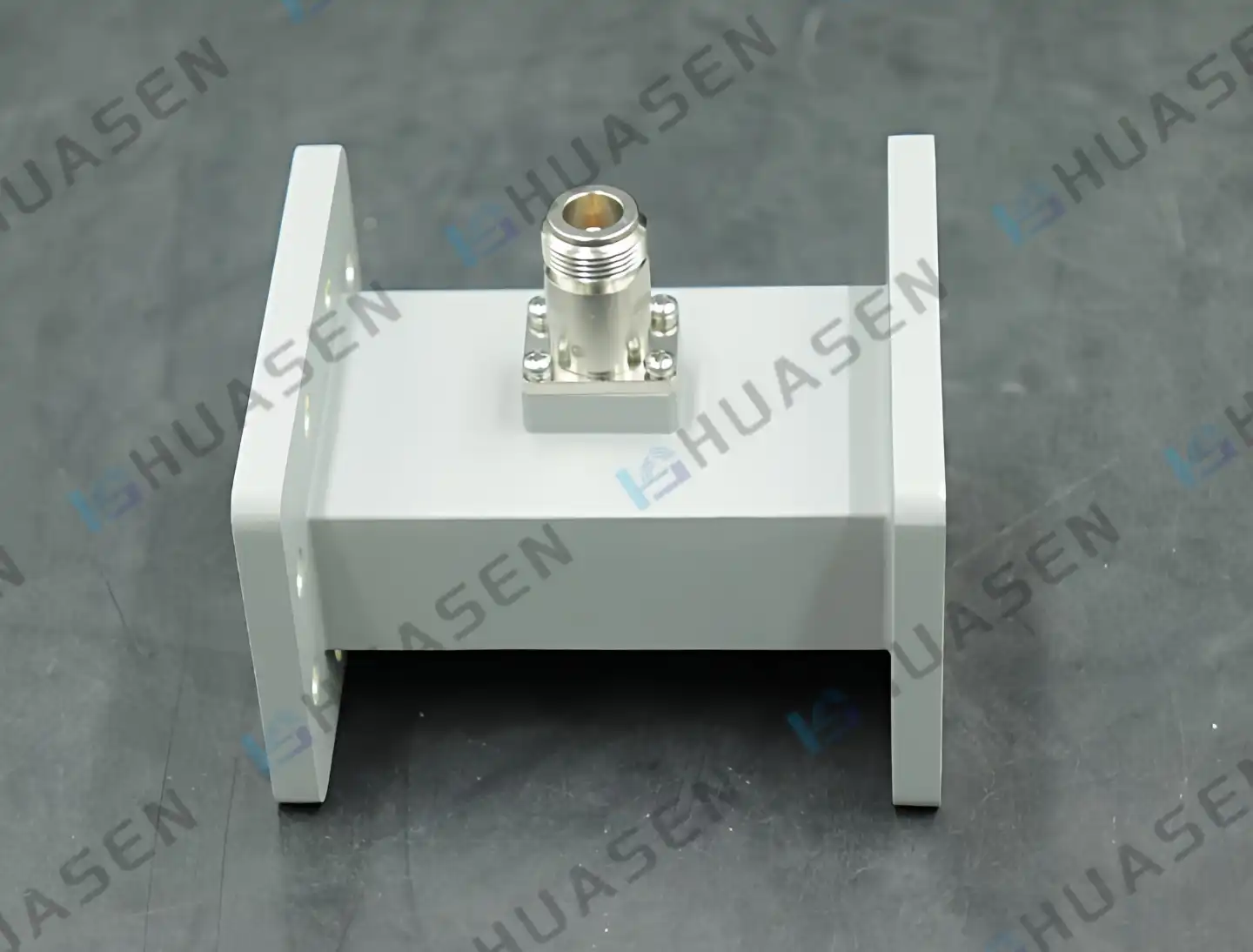
Factors Affecting Insertion Loss in Probe Couplers
Understanding the reasons that cause insertion loss in waveguide probe couplers is important for making these necessary parts work better and more efficiently. Here are some of the most important things that cause insertion loss:
Material Properties
The waveguide and probe are built from different materials, which have a big effect on insertion loss. How well the metal walls conduct, how well any insulation materials work, and how rough the surface is all matter a lot. Resistive losses can be lowered by using high-conductivity metals such as copper or silver. At the same time, low-loss dielectrics keep absorption and diffusion to a minimum.
Geometric Design
The size and form of the waveguide and probe are very important. The coupling process, and therefore the insertion loss, can be affected by the probe's length, diameter, waveguide cross-section, and how far the probe goes into the waveguide. Better results may come from optimizing these parameters.
Frequency Considerations
Often, the amount of insertion loss changes with frequency. As the working frequency goes up, the skin effect gets stronger, which could lead to more losses. Also, higher-order modes may be activated at certain frequencies, which can cause loss mechanisms that were not predicted.
Manufacturing Precision
The implant loss is directly affected by how well it is made. Rough surfaces, incorrect dimensions, or misalignments can cause even more losses. To keep these effects from happening, it is very important to maintain tight standards and use precision manufacturing methods.
Environmental Factors
The performance of waveguide probe couplers can be affected by external factors such as temperature, humidity, and mechanical stress. Insertion loss can go up over time or when the working conditions change because of thermal expansion, moisture ingress, or physical deformation.
Best Practices for Designing Low-Lo
ss Probe Couplers
Making waveguide probe couplers with low-loss takes a complex method that mixes theoretical knowledge with practical engineering issues. Here are some things you should always do to get the best performance:
Electromagnetic Simulation and Optimization
Use sophisticated electromagnetic modeling tools to figure out and improve the coupler's design. This makes it possible to geometrically improve material choices and coupling mechanisms step by step without having to make expensive prototypes every time. Techniques like the method of moments (MoM) and finite element analysis (FEA) can help you learn more about field distributions and how loss happens.
Impedance Matching Techniques
Do careful impedance matching between the probe, waveguide, and systems that are linked to them. This could mean making tapered transitions, adding matching networks, or figuring out the best way to place the probe. Proper matching makes insertion loss lower by minimizing echoes and standing waves.
Surface Treatment and Coating
Use advanced surface treatments to lower the losses that happen because of surface roughness and skin effect. Methods like electropolishing or applying highly conductive coats (like silver plating) can make a big difference in performance, especially at higher frequencies.
Thermal Management Considerations
Think about temperature stability when you design. Add features that reduce the impact of thermal growth and make sure the device works well at all temperatures. This could mean choosing materials that have the same thermal expansion factors or using active temperature control in serious situations.
Precision Manufacturing and Assembly
For complicated geometries, use high-precision manufacturing methods like CNC machining or 3D printing for waveguide probe couplers. Make sure that the unit keeps tight tolerances and the right alignment. Think about using automated building methods when they make sense to lower mistakes made by people and make things more uniform.

Applications of High-Directivity Waveguide Probe Couplers
Many different fields and types of work use high-directivity waveguide probe couplers, especially in situations where very accurate signal sampling or power tracking is needed. Many situations would not work as well without them because they can provide directional connection with very little insertion loss.
Telecommunications Infrastructure
These couplers are very important to base station tools in 5G and new 6G networks. They allow precise tracking of power and evaluation of data quality in systems with high frequency and bandwidth. In these situations where power is sensitive, the low insertion loss features are very important for keeping the overall system efficient.
Satellite Communications
Satellite upload and downlink systems depend on waveguide parts that work well. Probe couplers are used to keep an eye on signals, level power, and find faults in ground station equipment and satellite packages. Their small size and dependability make them perfect for use in space-limited or very important uses.
Radar Systems
Military and private advanced radar systems use waveguide probe couplers for a range of reasons. Some of these are power tracking in transmit chains, signal sampling for calibration and diagnostics, and finding leaks in high-power systems. The high directivity makes sure that even in complicated places with lots of signals, the readings are correct.
Test and Measurement Equipment
Waveguide probe couplers are frequently used in precise test tools for RF and microwave frequencies. They are very important in power meters, spectrum analyzers, and vector network analyzers because they sample signals correctly and don't change how the gadget being tested works. The low insertion loss is very important for keeping the accuracy of the measurement, especially when figuring out high-Q or low-loss parts.
Scientific Research Facilities
Microwave parts made for specific use are often needed in research institutions that work on radio astronomy, fusion energy, or particle physics. High-directivity waveguide probe couplers are used in experiments to get exact power levels and keep an eye on signals. This helps make progress in both basic science and technology.
By using these apps, businesses can make the most of high-directivity waveguide probe couplers to make systems run better, more reliably, and even help with the newest tech.
Conclusion
For microwave and millimeter-wave devices to work their best, it is important to lower the insertion loss in high-directivity waveguide probe couplers. Engineers can make high-performance couplers that meet the tough needs of today's applications by knowing what causes insertion loss and following the best design and manufacturing practices. These parts are very important for making new technologies in a lot of different fields because they can be used in so many ways.
If you want high-quality waveguide probe couplers that are made just for you, Huasen Microwave Technology Co., Ltd. has a lot of knowledge and offers the newest ways to get them. Huasen Microwave has decades of experience in RF and microwave technology and is therefore well-prepared to make custom-designed parts that keep great directivity while minimizing insertion loss. Our team of experts is ready to help you get the most out of your system, whether you're working on telecommunications infrastructure, satellite communications, radar systems, or cutting-edge science research.
FAQ
1. What is the normal amount of insertion loss for waveguide probe couplers that are high-quality?
Depending on the frequency range and particular design, high-quality waveguide probe couplers usually have an insertion loss of 0.1 to 0.5 dB. But with the latest systems, losses even below 0.05 dB are possible.
2. In waveguide probe couplers, how does the coupling factor affect the loss of insertion?
It is common for entry loss to be a little higher with a higher coupling factor (tighter coupling). This is because more energy is being sent away from the main signal line. Good couplers, on the other hand, can make this trade-off less important by using a probe shape that works best and matching the impedance exactly.
3. Can the insertion loss of waveguide probe couplers be affected a lot by the environment?
Yes, insertion loss can be affected by external factors like changes in temperature, humidity, and mechanical stress. Temperature changes can change the dimensions and modify the binding features. Humidity can cause condensation, which might change how the waveguide insulator works. These impacts can be lessened with proper planning and by protecting the environment.
4. How often should waveguide probe couplers be adjusted to keep the insertion loss low?
How often calibration needs to be done depends on the program and the environment in which it is running. In stable situations, high-quality waveguide probe couplers may continue to work well for a long time. But for very important uses, yearly adjustment is suggested most of the time. It might be necessary to calibrate systems more often, maybe even every three to six months, if they are in tough conditions or experience heat cycling often.

Optimize Your RF Systems with Huasen Microwave's Waveguide Probe Couplers | Huasen Microwave
Do you want to improve your RF and microwave systems with waveguide probe couplers that have great performance and low-loss? Huasen Microwave Technology Co., Ltd. can help you in the exact way that you need. Our team of skilled engineers is ready to work with you to plan and make waveguide probe couplers that are exactly what you need to make sure they work perfectly for your needs.
Don't let insertion loss compromise your system's efficiency. Contact us today at sales@huasenmicrowave.com to discuss your project needs and discover how our expertise in waveguide technology can elevate your RF and microwave systems to new heights of performance and reliability.
References
1. Zhang, Y., & Wang, J. (2021). "Advanced Design Techniques for Low-Loss Waveguide Probe Couplers in Millimeter-Wave Applications." IEEE Transactions on Microwave Theory and Techniques, 69(3), 1567-1579.
2. Chen, X., et al. (2020). "Insertion Loss Reduction in High-Directivity Waveguide Couplers: A Comprehensive Review." Progress In Electromagnetics Research, 165, 1-22.
3. Pozar, D. M. (2011). Microwave Engineering (4th ed.). John Wiley & Sons.
4. Smith, R. A., & Nordstrom, L. (2019). "Optimizing Probe Design for Minimal Insertion Loss in Waveguide Couplers." Journal of Electromagnetic Waves and Applications, 33(11), 1455-1470.
5. Balanis, C. A. (2012). Advanced Engineering Electromagnetics (2nd ed.). John Wiley & Sons.
6. Johnson, R. C. (1993). Antenna Engineering Handbook (3rd ed.). McGraw-Hill Education.
Send Inquiry
Related Industry Knowledge
- Reliable Electric Waveguide Switches for Radar Systems: Enhancing High Frequency Performance
- Understanding Industry Compliance Standards for Arcing Detection Waveguides in Industrial RF Systems
- Best Waveguide Seal Window Suppliers for Industrial and Aerospace Applications
- Portable Inflatable Waveguides for Satellite Communications: Features and Benefits
