How to Judge the Quality of Lens Horn Antenna Through Sidelobe Level?






2026-02-12 21:42:23
To use sidelobe level assessment to judge the quality of a lens antenna, you need to look at measurements of the radiation pattern, the E- and H-plane suppression characteristics, and compare maker specifications to industry standards. Lens horn antennas of the highest quality usually have E-plane sidelobe levels of -15dB and H-plane levels of -26dB, which means they effectively control electromagnetic fields and cause little interference. In important RF uses, this basic metric is directly linked to antenna performance, signal integrity, and system reliability.
Understanding Lens Horn Antennas and Sidelobe Levels
Lens horn antennas are a complex step forward in microwave technology. They combine the basic ideas of horn antennas with dielectric lens elements to make them work better. A dielectric lens is built into the aperture of either a conical or a pyramidal feed horn in these specialised devices. This changes the way electromagnetic waves travel in a basic way.
Operating Principles and Frequency Characteristics
The most important new feature is that the lens structure can change circular wavefronts into flat ones. As the aperture size increases, standard horn antennas make spherical phase wavefronts. These wavefronts cause phase errors that lower gain and boost unwanted radiation. Modern lens horn antennas use plano-convex or hyperbolic dielectric materials like PTFE, Rexolite, or Quartz to effectively bend electromagnetic waves. These antennas work best across high-frequency bands, mainly in the Ka-band (26.5-40 GHz), V-band (50-75 GHz), E-band (60-90 GHz), and W-band (75-110 GHz) frequencies, but they can also work in terahertz ranges. The frequency response has a direct effect on the sidelobe performance; higher frequencies allow for more accurate beam control and better suppression.
Defining Sidelobe Levels and Their Impact
Sidelobe levels show unwanted radiation patterns that happen away from the main beam direction. The main lobe has the signal energy that is wanted centred in the direction of transmission or reception. Sidelobes, on the other hand, are made up of unwanted radiation that can interfere with signals, make systems less efficient, and lower the quality of the signals. Engineers who work on antennas evaluate sidelobe levels in decibels in relation to the main beam peak. Lower values mean better performance. Standard measures in the industry tell the difference between E-plane and H-plane sidelobes because the way they suppress signals depends on the antenna's shape and how it is excited.
Applications Driving Quality Requirements
For many important uses, modern transmission systems need to be able to block sidelobes very well. In 5G and 6G backhaul networks, too much sidelobe radiation causes co-channel interference, which lowers the throughput and reliability of the network. To keep from interfering with nearby satellites and to follow international rules, satellite transmission systems need strict sidelobe control. Low sidelobe levels are important for accurate target detection and fewer false alarms in radar applications, especially in car ADAS systems and aerospace installations. In complex electromagnetic settings, industrial measurement systems like level gauges and material analysis tools need clean radiation patterns to keep their measurements accurate.

Analysing Factors That Affect Sidelobe Levels in Lens Horn Antennas
Procurement workers can make more accurate quality judgements when they know the design factors that affect sidelobe performance. The final antenna features are determined by a number of interconnected factors, includinglens horn ranging from simple geometrical factors to complex material selection criteria.
Lens Geometry and Material Engineering
The main thing that determines how well sidelobe suppression works is the design of the dielectric lens. How accurate phase correction is and how much unwanted radiation is present are directly affected by lens thickness, curvature profiles, and zoning methods. Different lens designs are used by manufacturers, such as stepped designs that cut down on weight while keeping electromagnetic performance. The choice of material has a big impact on both electrical function and durability in harsh environments. Low-loss dielectrics like cross-linked polystyrene (Rexolite) and certain ceramics are great for RF properties and keep their shape even when the temperature changes. The frequency range and needs of the application must match the dielectric constant and loss tangent numbers. Zoning techniques similar to those used in Fresnel lenses are used in more advanced lens designs. These reduce total mass and material costs while keeping performance levels acceptable. But these changes can limit the bandwidth and cause small pattern distortions that affect how the sidelobes behave.
Horn Antenna Structural Considerations
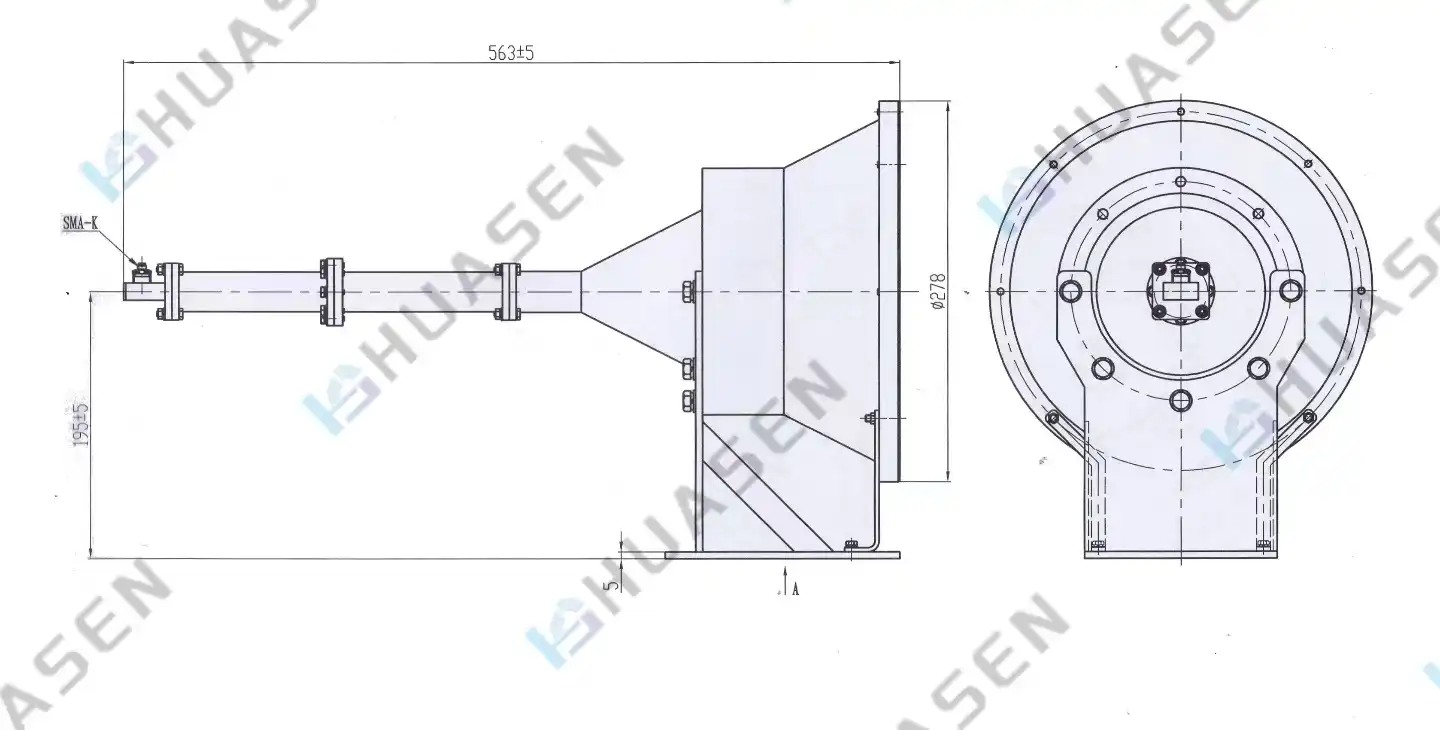
The horn antenna part of the lens system is what really excites it, and the way it's designed has a big impact on how well the sidelobes work overall. The flare angle, aperture size, and finish on the inside of the surface all affect how the electromagnetic field hits the lens element. These conical Horn Lens (LHA) shapes have circular symmetry and uniform polarisation, which makes them perfect for uses that need consistent performance across rotation angles. For pyramidal horn lens designs, the apertures are rectangular, which fit waveguide surfaces and give different E-plane and H-plane properties. Feed-Illuminated Lens antennas use different feed elements to excite the lens structure. This gives designers more freedom, but they need to be very careful to keep sidelobe levels low and spillover losses to a minimum. With Point-Focus Lens (PLHA) configurations, energy is focused at certain focal points. This makes it possible for small designs to have great directivity.
Manufacturing Quality and Tolerance Analysis
Precision in production has a direct effect on sidelobe performance, since small changes in geometry can cause big pattern errors at millimetre-wave frequencies. Tolerance factors that are very important include how well the lens is placed, how smooth the surface is, and how consistent the sizes are across the opening. Manufacturing flaws like air bubbles in dielectric materials, surface roughness that is too rough, or horn and lens elements that are not lined up correctly can greatly raise sidelobe levels. Both mechanical inspection and electromagnetic testing must be used in quality control to make sure these values are correct. When installed outside, where temperature changes, water getting in, and mechanical vibrations can all hurt performance over time, environmental stress screening becomes even more important. Throughout its useful life, the lens locking system must stay intact while keeping its electromagnetic properties.
How to Systematically Judge Lens Horn Antenna Quality Through Sidelobe Level
By creating a thorough evaluation method, procurement teams can fairly judge the quality of antennas and compare products from different suppliers. This organised method uses technical measurements, a review of the documentation, and hands-on tests to get the best selection results.
Industry-Standard Measurement Techniques
For professional antenna evaluation, you need a controlled test setting and instruments that have been properly calibrated. Anechoic chamber tests give the most accurate sidelobe characterisation because they get rid of reflections and outside sources of interference that could hide how well an antenna really works. Far-field test ranges set the measurement lengths needed to get correct data on the radiation pattern. Using the usual formula, R = 2D²/λ, where D is the antenna's largest dimension, and λ is its wavelength, we can figure out how far apart the antennas need to be. Near-field scanning methods are an alternative way to measure for facilities that don't have a lot of room or big antennas. Vector Network Analyser (VNA) systems can fully characterise a network by measuring its pattern, return loss, lens horn, and gain over its entire operating bandwidth. To make sure that measurements are accurate and can be repeated, calibration methods must follow well-known standards like IEEE 149.
Technical Documentation Analysis
Datasheets from manufacturers are very helpful for checking the quality of a product, but people who work in buying need to know how to read them correctly. Gain values, beamwidth specifications, sidelobe level guarantees, and cross-polarisation discrimination ability are some of the most important parameters. Radiation pattern plots show the sidelobe structure in great detail and let you compare various antenna types. Look for consistent suppression at a number of different angles, and make sure that the measured data backs up the stated specs. Unusual patterns with nulls that don't match up or peaks that don't make sense could be a sign of problems with quality control. Long-term dependability is directly affected by environmental factors such as temperature range, resistance to humidity, and ability to withstand mechanical shock. Military standard compliance (MIL-STD) or similar certifications give customers more faith in the quality and durability of a product.
Supplier Quality Assurance Verification
Asking potential suppliers about their quality control methods can show useful details about how consistent their production is and how well they can handle technical issues. Ask for more information about the testing methods, calibration plans, and statistical quality control methods that are used during production. Sample testing programs let people directly check the performance claims before making big purchases. Make sure the exact conditions of measurement and acceptance criteria are clear so that the evaluation results are useful. You might want to ask for test results from more than one production unit to see how repeatable the manufacturing process is. Checking with past customers is a great way to learn about how something works in real life and how reliable it will be in the long run. Talk to people who have already used similar products to find out how well they work, how good the supplier's help is, and if they have any problems while using the product.
Procurement Considerations for Lens Horn Antennas Focused on Sidelobe Quality
Strategic procurement decisions must balance technical performance requirements with cost considerations, delivery schedules, and long-term support needs. Understanding these trade-offs enables optimal supplier selection and contract negotiation outcomes.
Supplier Selection and Certification Requirements
Established manufacturers with extensive RF experience typically provide more consistent quality and better technical support compared to newer entrants. Look for suppliers with ISO 9001 certification, AS9100 aerospace compliance, or equivalent quality management systems that demonstrate commitment to manufacturing excellence. Technical capability assessment should include facility tours, engineering staff qualifications, and equipment sophistication. Suppliers with in-house anechoic chamber capabilities can provide more comprehensive testing and faster development cycles for custom requirements. Geographic considerations affect both delivery times and ongoing support quality. Local suppliers may offer advantages for urgent requirements and hands-on technical assistance, while international sources might provide cost benefits for large-volume purchases.
Cost-Performance Optimisation Strategies
Sidelobe performance improvements often require premium materials and enhanced manufacturing precision, resulting in higher unit costs. Quantify the system-level benefits of superior sidelobe suppression to justify the investment in higher-quality antennas. Volume pricing negotiations can significantly reduce per-unit costs for large purchases while ensuring consistent quality across all delivered units. Consider consolidating requirements across multiple projects to achieve better pricing tiers and strengthen supplier relationships. Custom design options enable optimisation for specific application requirements while potentially reducing overall system costs through improved performance. Work with suppliers to identify cost-effective modifications that enhance sidelobe suppression without unnecessary complexity.
Maintenance and Performance Preservation
Post-installation maintenance practices directly impact long-term sidelobe performance and overall system reliability. Develop procedures for regular performance verification, environmental protection, and preventive maintenance scheduling. The lens surface requires particular attention, as contamination from dust, moisture, or horn lens ice accumulation can severely degrade electromagnetic performance. Hydrophobic coatings or protective radomes help maintain performance in harsh environmental conditions. Periodic calibration checks using portable test equipment can identify performance degradation before it affects system operation. Establish baseline measurements during installation to enable meaningful comparison during future maintenance activities.
Future Trends and Innovations Impacting Lens Horn Antenna Sidelobe Performance
Emerging technologies and manufacturing advances continue to push the boundaries of achievable sidelobe suppression while reducing costs and improving reliability. Understanding these developments helps procurement teams make future-ready investment decisions.
Advanced Materials and Manufacturing Technologies
Additive manufacturing techniques enable complex lens geometries that were previously impossible or cost-prohibitive to produce. These capabilities allow for optimised phase correction profiles and integrated mechanical features that enhance both performance and reliability. New dielectric materials with improved temperature stability and lower loss characteristics enable better sidelobe suppression across wider frequency ranges. Ceramic-loaded plastics and advanced composite materials offer enhanced environmental resistance while maintaining excellent RF properties. Precision machining advances, including diamond turning and laser processing, achieve surface finishes and dimensional tolerances that enable superior electromagnetic performance. These manufacturing improvements directly translate to better sidelobe suppression and more consistent quality.
Smart Antenna Integration and Adaptive Technologies
Integration with digital beamforming systems allows real-time sidelobe suppression optimisation based on operational conditions. These adaptive approaches can compensate for environmental effects and manufacturing variations while maintaining optimal performance. Phased array integration with lens horn elements combines the benefits of electronic beam steering with superior sidelobe characteristics. This hybrid approach enables rapid beam positioning while maintaining the excellent pattern quality of lens-based systems. Machine learning algorithms can optimise antenna patterns for specific interference environments, automatically adjusting parameters to minimise sidelobe impact on system performance. These intelligent systems represent the future of adaptive antenna technology.
Impact on 5G and Next-Generation Systems
As 6G systems move toward higher frequency bands, they need even stricter sidelobe control to keep interference under control and get the most out of the airwaves. Lens horn antennas have been used successfully in the past to meet these difficult needs. Individual elements with good sidelobe suppression are helpful for massive MIMO implementations because they lower coupling between array elements and boost system performance generally. These high-tech systems are put together with high-quality lens horn transmitters. Better interference control is needed for dense network deployments, which can only be done by suppressing sidelobes very well. Putting money into good radio technology now sets the stage for future network growth.
Conclusion
To use sidelobe level analysis to judge the quality of a lens antenna, you need to follow a set of steps that include technical measurements, reviewing paperwork, the horn lens and evaluating the supplier. Better antennas get sidelobe reduction of -15dB in the E-plane and performance of -26dB in the H-plane by being precisely manufactured and designed. Some important things that go into the evaluation are the validity of the measurement method, the compliance of the environmental tests, and the verification of long-term reliability. To be successful at procurement, you need to find a balance between performance needs and cost concerns while choosing sellers with proven quality systems and technical know-how. Future progress in materials science and smart antenna integration will keep making sidelobe suppression better. This means that investing in high-quality lens horn antennas now is a smart move for communication systems that are changing.
FAQ
1. What sidelobe levels should I expect from quality lens horn antennas?
Quality lens horn antennas typically achieve E-plane sidelobe levels of -15dB or better and H-plane suppression of -26dB or lower. Premium models can exceed these specifications, reaching -20dB to -30dB suppression depending on design complexity and manufacturing precision. These values represent significant improvements over standard horn antennas of comparable size.
2. How often should sidelobe performance be tested during operation?
Regular testing frequency depends on application criticality and environmental conditions. Critical communication links require quarterly verification, while laboratory instruments may need annual calibration checks. Outdoor installations exposed to harsh weather should undergo semi-annual performance verification to detect degradation from environmental effects.
3. Can custom lens designs improve sidelobe suppression beyond standard models?
Custom lens designs enable optimisation for specific frequency ranges and application requirements, often achieving superior sidelobe suppression compared to standard products. Tailored lens profiles, specialised materials, and application-specific geometry can improve performance by 3-5dB over conventional designs while addressing unique mechanical constraints.
4. What environmental factors most significantly affect sidelobe performance?
Temperature variations affect dielectric properties and mechanical dimensions, potentially degrading sidelobe suppression. Surface contamination from moisture, ice, or conductive particles creates the most severe performance impact. Mechanical vibration and shock can cause lens misalignment, while UV exposure may degrade certain dielectric materials over time.
5. How do lens horn antennas compare to phased arrays for sidelobe control?
Lens horn antennas provide inherently low sidelobe levels through passive design optimisation, while phased arrays achieve sidelobe control through active electronic beam forming. Lens antennas offer superior sidelobe suppression for fixed-beam applications, while phased arrays enable adaptive nulling and beam steering capabilities at higher complexity and cost.
Contact Huasen Microwave for Superior Lens Antenna Solutions
Huasen Microwave delivers industry-leading lens horn antennas with exceptional sidelobe suppression performance for demanding RF applications. Our comprehensive product portfolio includes Conical Horn Lens (LHA), Pyramidal Horn Lens, Feed-Illuminated Lens, and Point-Focus Lens (PLHA) configurations, each engineered to achieve E-plane sidelobe levels ≤-15dB and H-plane suppression ≤-26dB. With over three decades of microwave technology expertise since 1993, we provide customizable focal length, aperture, lens antennas and beamwidth specifications to meet your exact requirements. Our lens antenna manufacturer's capabilities ensure consistent quality through rigorous testing and precision manufacturing processes. Contact our engineering team at sales@huasenmicrowave.com to discuss your specific sidelobe performance requirements and discover how our proven antenna solutions can enhance your system reliability and communication quality.
References
1. Balanis, Constantine A. "Antenna Theory: Analysis and Design - Lens Horn Antenna Sidelobe Characteristics." Fourth Edition, John Wiley & Sons, 2016.
2. IEEE Standard 149-2021. "IEEE Recommended Practice for Antenna Measurements - Sidelobe Level Assessment Procedures." Institute of Electrical and Electronics Engineers, 2021.
3. Milligan, Thomas A. "Modern Antenna Design - Lens Horn Configuration and Sidelobe Control Techniques." Second Edition, McGraw-Hill Education, 2018.
4. Stutzman, Warren L. and Gary A. Thiele. "Antenna Theory and Design - Lens Horn Antenna Quality Assessment Methods." Third Edition, John Wiley & Sons, 2019.
5. Johnson, Richard C. "Antenna Engineering Handbook - Sidelobe Suppression in Lens-Based Antenna Systems." Fourth Edition, McGraw-Hill Professional, 2017.
6. Collin, Robert E. "Foundations for Microwave Engineering - Horn Antenna Lens Integration and Performance Analysis." Second Edition, IEEE Press, 2020.
Send Inquiry