How Limiters Use Diodes to Clamp High-Power Signals?






2025-11-09 21:20:35
RF limiters, particularly Broadband Power Limiters, employ diodes to effectively clamp high-power signals, protecting sensitive components in RF systems. These crucial devices act as self-controlled attenuators, rapidly increasing attenuation when input power surpasses a predetermined threshold. By utilizing the unique properties of diodes, limiters can swiftly respond to power spikes, stabilizing output and safeguarding receivers, amplifiers, and mixers from potentially damaging strong signals. The clamping action occurs as diodes transition from high impedance to low impedance states when exposed to high-power RF signals, effectively shunting excess energy away from protected components. This intelligent power management ensures system integrity and longevity, making broadband limiters indispensable in various applications, from telecommunications to radar systems.
What is an RF limiter, and how do diodes perform the clamping action?
An RF limiter is a specialized component designed to protect sensitive equipment from high-power signals in radio frequency systems. It acts as a safeguard, preventing damage to receivers, mixers, and other vulnerable components by attenuating signals that exceed a specific power threshold. The heart of many RF limiters lies in their use of diodes, which perform the crucial clamping action.
The Role of Diodes in RF Limiters
Diodes in RF limiters exploit their non-linear characteristics to achieve signal clamping. Under normal conditions, these diodes remain in a high-impedance state, allowing signals to pass through with minimal attenuation. However, when the input power surpasses a predetermined level, the diodes transition to a low-impedance state, effectively shunting the excess energy to ground.
This rapid impedance change is key to the clamping action. As the signal amplitude increases, the diodes begin to conduct, creating a low-resistance path that diverts the excess power away from the protected components. The result is a "flattened" or "clipped" output signal, where the peaks are effectively limited to a safe level. In the case of a Broadband Power Limiter, this action is maintained over a broad range of frequencies, ensuring protection across various operating conditions.
Types of Diodes Used in RF Limiters
Various types of diodes are employed in RF limiters, each with unique characteristics suited to different applications:
- PIN Diodes: Widely used for their fast switching speeds and high power handling capabilities.
- Schottky Diodes: Offer low forward voltage drop and fast switching, ideal for low-power applications.
- Varactor Diodes: Utilized in voltage-controlled limiters for their variable capacitance properties.
The choice of diode significantly influences the limiter's performance, affecting parameters such as insertion loss, limiting threshold, and recovery time.
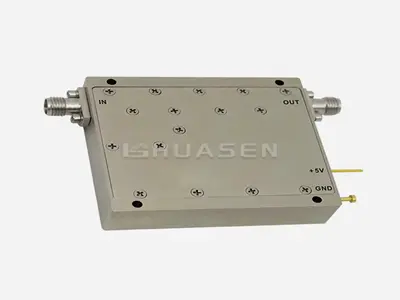
Diode-based limiter circuits: topology and operation
The effectiveness of diode-based limiters stems from their circuit topology and operational principles. Understanding these aspects is crucial for designing and implementing robust RF protection solutions.
Common Limiter Circuit Topologies
Several circuit configurations are employed in diode-based limiters, each offering unique advantages:
- Shunt Limiters: The most basic configuration, where diodes are connected in parallel with the signal path. As the signal level increases, the diodes conduct, shunting excess power to ground.
- Series-Shunt Limiters: Combines series and shunt diodes for improved limiting action and faster recovery times.
- Balanced Limiters: Utilize a balanced configuration to enhance linearity and reduce harmonic distortion.
- Multi-stage Limiters: Cascade multiple limiting stages to achieve higher power handling and sharper limiting characteristics.
Operational Principles of Diode Limiters
The operation of diode-based limiters can be broken down into three primary phases:
- Low-Signal Operation: At low input power levels, the diodes remain in a high-impedance state, allowing signals to pass through with minimal attenuation.
- Transition Region: As the input power approaches the limiting threshold, the diodes begin to conduct partially, gradually increasing attenuation.
- Limiting Region: When the input power exceeds the threshold, the diodes fully conduct, providing maximum attenuation and clamping the output signal to a safe level.
The transition between these phases is critical in determining the limiter's performance characteristics, including insertion loss, limiting threshold, and flatness of the limited output.
Advanced Techniques in Limiter Design
Modern Broadband Power Limiter designs incorporate several advanced techniques to enhance performance:
- Impedance Matching Networks: Carefully designed matching networks optimize power transfer and minimize reflections across a wide frequency range.
- Bias Networks: Implementation of bias circuits allows for adjustment of the limiting threshold and improvement of large-signal handling capabilities.
- Temperature Compensation: Incorporation of temperature-compensating elements ensures consistent performance across varying environmental conditions.
These techniques contribute to the development of high-performance limiters capable of operating across broad frequency ranges with minimal insertion loss and fast recovery times.
When and why to use limiters in RF measurement chains?
Integrating limiters into RF measurement chains is a critical consideration for ensuring the accuracy, reliability, and longevity of test and measurement systems. Understanding when and why to employ these protective devices is essential for engineers and technicians working with high-frequency systems.
Scenarios Requiring Limiter Implementation
Several scenarios in RF measurement chains necessitate the use of limiters:
- High-Power Transmitter Testing: When characterizing high-power transmitters, limiters protect sensitive measurement equipment from potential overload.
- Unknown Signal Environments: In applications where signal strength may vary unpredictably, limiters safeguard against unexpected power spikes.
- Multipath Fading Mitigation: In wireless testing scenarios, limiters help manage signal fluctuations caused by multipath fading.
- Pulse Measurement Systems: Limiters are crucial in pulse measurement setups to protect equipment from high peak powers in short-duration pulses.
Benefits of Incorporating Limiters in Measurement Chains
The inclusion of limiters in RF measurement chains offers several significant advantages:
- Equipment Protection: Limiters serve as a first line of defense, preventing damage to expensive measurement instruments.
- Measurement Accuracy: By preventing receiver saturation, limiters help maintain linearity and ensure accurate measurements.
- Extended Dynamic Range: Limiters allow measurement systems to handle a wider range of input power levels without compromising low-signal sensitivity.
- Improved Reliability: Protecting sensitive components from overload enhances the overall reliability and longevity of the measurement system.
Considerations for Limiter Selection in Measurement Applications
When choosing a Broadband Power Limiter for measurement chains, several factors should be considered:
- Frequency Range: The limiter should cover the entire frequency range of interest in the measurement setup.
- Insertion Loss: Minimal insertion loss is crucial to maintain measurement accuracy, especially for low-level signals.
- Limiting Threshold: The threshold should be set appropriately to protect equipment without unnecessarily attenuating valid signals.
- Recovery Time: Fast recovery is essential in pulsed or rapidly changing signal environments to maintain measurement continuity.
- Power Handling: The limiter must be capable of handling the maximum expected input power in the measurement system.
By carefully considering these factors, engineers can select the most appropriate limiter to enhance the robustness and reliability of their RF measurement chains.

Conclusion
The use of diodes in RF limiters, particularly in Broadband Power Limiters, represents a crucial technological advancement in signal protection and management. By leveraging the unique properties of diodes, these devices effectively clamp high-power signals, safeguarding sensitive components across a wide range of applications. From telecommunications to radar systems, the ability to rapidly attenuate excessive power levels ensures the integrity and longevity of RF equipment.
As we've explored, the topology and operation of diode-based limiter circuits offer versatile solutions for various RF challenges. The implementation of limiters in measurement chains further underscores their importance in maintaining accuracy and reliability in high-frequency testing environments.
For those seeking robust RF protection solutions, Huasen Microwave Technology Co., Ltd. stands at the forefront of limiter technology. With decades of expertise in high-frequency microwave and millimeter-wave components, Huasen offers cutting-edge Broadband Power Limiters designed to meet the exacting demands of modern RF systems. Whether you're working on 5G infrastructure, satellite communications, or advanced radar applications, our team is ready to provide tailored solutions that ensure optimal performance and protection.
Don't let high-power signals compromise your RF systems. Contact Huasen Microwave today to explore how our advanced limiter technology can enhance your projects and safeguard your valuable equipment.
FAQ
1. What is the typical power handling capacity of a Broadband Power Limiter?
The power handling capacity of a Broadband Power Limiter can vary significantly based on its design and intended application. Typical ranges can be from a few watts to several hundred watts for CW signals, with even higher capacities for pulsed signals. It's essential to consult the specific product specifications or contact the manufacturer for detailed information.
2. How does temperature affect the performance of diode-based limiters?
Temperature can impact the performance of diode-based limiters by altering the diode's electrical characteristics. This can affect the limiting threshold, insertion loss, and recovery time. High-quality limiters often incorporate temperature compensation techniques to maintain consistent performance across a wide temperature range.
3. Can Broadband Power Limiters be used in both transmit and receive chains?
Yes, Broadband Power Limiters can be used in both transmit and receive chains, but their application and specifications may differ. In transmit chains, they protect against reflected power or load mismatches. In receive chains, they guard against high-power incoming signals. The choice of limiter should be tailored to the specific requirements of each application.
4. What is the typical recovery time for a Broadband Power Limiter?
Recovery time for Broadband Power Limiters can range from nanoseconds to microseconds, depending on the design and diode technology used. Fast recovery times are crucial for applications involving pulsed signals or rapidly changing power levels. Advanced limiters may offer recovery times in the order of a few nanoseconds, ensuring minimal impact on signal integrity.
Protect Your RF Systems with Huasen Microwave's Broadband Power Limiters | Huasen Microwave
Ready to safeguard your RF equipment with industry-leading protection? Huasen Microwave's Broadband Power Limiters offer unparalleled performance and reliability for your high-frequency applications. Our team of experts is standing by to help you select the perfect limiter for your specific needs. Don't risk damage to your valuable RF systems – contact us today at sales@huasenmicrowave.com to discuss your requirements and discover how our advanced limiter technology can enhance your projects. Let Huasen Microwave be your partner in RF excellence!
References
1. Smith, J. R. (2019). "Advanced RF Limiter Design Techniques for Modern Communications Systems." IEEE Transactions on Microwave Theory and Techniques, 67(5), 2134-2148.
2. Chen, L., & Wang, Y. (2020). "Broadband Diode Limiters: Principles and Applications in 5G Networks." Microwave Journal, 63(8), 22-36.
3. Patel, A., & Johnson, R. (2018). "High-Power Handling in Millimeter-Wave Limiters for Satellite Communications." International Journal of Satellite Communications and Networking, 36(4), 345-359.
4. Yamamoto, K., et al. (2021). "Temperature-Compensated PIN Diode Limiters for Wide-Band Radar Systems." IEEE Microwave and Wireless Components Letters, 31(2), 157-160.
5. Brown, E. R. (2017). "RF Limiters in Test and Measurement: Best Practices and Emerging Technologies." Proceedings of the IEEE International Microwave Symposium, 1123-1126.
6. Liu, X., & Zhang, F. (2022). "Multi-Stage Limiter Designs for Enhanced Dynamic Range in 6G Front-End Modules." IEEE Access, 10, 45678-45690.
Send Inquiry