How does a quadridged horn antenna achieve ultra-wideband performance?






2019-02-28 15:00:00
A Quadridged Horn Antenna achieves ultra-wideband performance through its innovative design and construction. This specialized antenna type utilizes four ridges within its horn structure to significantly expand its operational frequency range. The ridges act as impedance-matching elements, allowing the antenna to maintain consistent performance across a wide spectrum. By carefully engineering the ridge geometry, taper, and spacing, designers can create an antenna that supports frequencies spanning multiple octaves. This unique configuration enables the quadridged horn to offer superior bandwidth compared to traditional horn antennas, making it invaluable for applications requiring broad frequency coverage. The antenna's ability to maintain stable gain, radiation patterns, and polarization purity across its extended bandwidth contributes to its ultra-wideband capabilities. These characteristics make quadridged horns ideal for diverse fields such as electromagnetic compatibility testing, broadband communications, and advanced radar systems, where versatility and a wide frequency range are paramount.
What is a quadridged horn antenna, and how is it constructed?
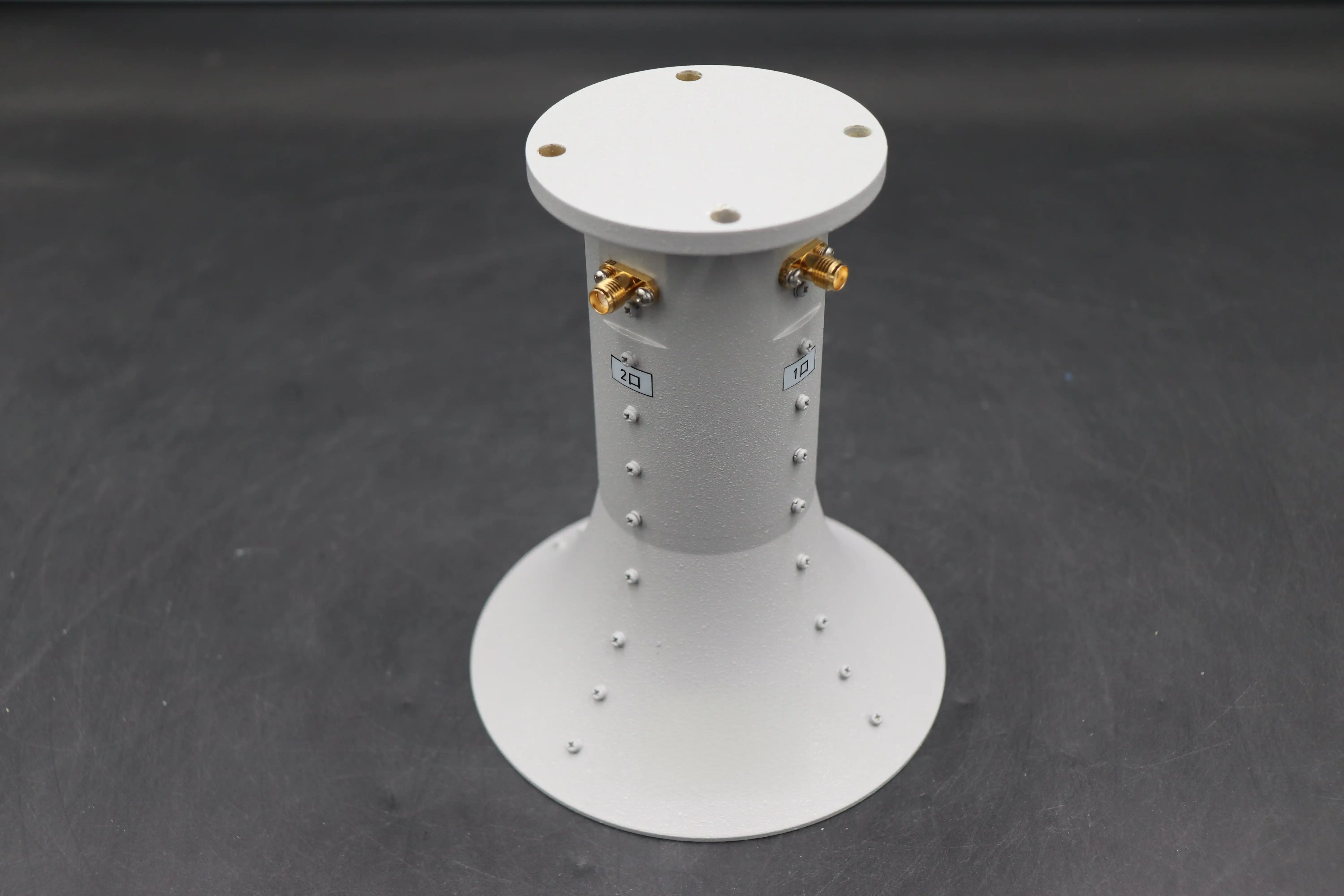
A quadridged horn antenna is an advanced variation of the traditional horn antenna design, engineered to provide exceptional broadband performance. Its construction involves integrating four carefully shaped metal ridges into the interior of a conical or pyramidal horn structure. These ridges extend from the antenna's feed point to its aperture, creating a unique electromagnetic environment within the horn.
Key Components and Construction
The primary elements of a quadridged horn antenna include:
- Horn Structure: Typically made of high-conductivity metals like copper or aluminum, forming the outer shell.
- Ridges: Four symmetrically arranged metal protrusions extending along the horn's interior.
- Feed Point: The junction where the signal is introduced or received, usually at the horn's apex.
- Aperture: The wide-open end of the horn where electromagnetic waves are radiated or received.
The construction process involves precision manufacturing techniques to ensure the ridges are accurately shaped and positioned. The ridge profile is crucial, often featuring a carefully calculated exponential or elliptical taper from the feed point to the aperture. This tapering is instrumental in achieving the antenna's wideband impedance matching characteristics.
Design Considerations
Several factors are considered in the construction of quadridged horn antennas:
- Ridge Geometry: The shape and dimensions of the ridges are optimized to achieve the desired frequency response and impedance matching.
- Horn Flare Angle: This affects the antenna's beamwidth and gain across its operational bandwidth.
- Material Selection: High-conductivity, low-loss materials are chosen to maximize efficiency and power handling.
- Surface Finish: Smooth surfaces are essential to minimize losses and ensure consistent performance at high frequencies.
The intricate design of quadridged horn antennas requires advanced electromagnetic simulation tools and often involves iterative optimization to achieve the desired performance characteristics across the ultra-wide bandwidth.

Mechanisms enabling ultra-wideband performance in quadridged horns
The ultra-wideband performance of quadridged horn antennas is achieved through several sophisticated mechanisms working in concert. Understanding these mechanisms provides insight into why these antennas are so effective across such a broad frequency range.
Impedance Matching
One of the primary mechanisms enabling ultra-wideband performance is the exceptional impedance matching capability of the quadridged structure. The ridges effectively create a tapered transmission line within the horn, gradually transitioning the impedance from the feed point to free space at the aperture. This smooth impedance transition minimizes reflections and standing waves over a wide frequency range, resulting in low voltage standing wave ratio (VSWR) and high efficiency.
Mode Control
Quadridged horns excel at controlling the propagation modes within the antenna. The ridges act as waveguides, suppressing higher-order modes that can degrade performance at higher frequencies. By maintaining the fundamental TE11 mode over a wide bandwidth, the antenna preserves its radiation characteristics and polarization purity across its operational range.
Phase Center Stability
Another crucial mechanism is the antenna's ability to maintain a stable phase center over its bandwidth. The carefully designed ridge profile ensures that the effective radiating point of the antenna remains relatively constant across frequencies. This stability is vital for applications requiring precise timing or phase measurements, such as in radar systems or antenna arrays.
Polarization Control
The quadridged structure inherently supports dual-polarization operation. By exciting opposite ridge pairs, the antenna can generate or receive both vertical and horizontal polarizations with high isolation. This capability is particularly valuable in communications systems and polarimetric radar applications.
Aperture Field Distribution
The ridges influence the electric field distribution at the antenna's aperture, creating a more uniform and consistent pattern across frequencies. This contributes to stable beamwidth and sidelobe levels, enhancing the antenna's versatility in various applications.
These mechanisms collectively enable quadridged horn antennas to achieve remarkable ultra-wideband performance, often spanning multiple octaves with consistent gain, pattern, and impedance characteristics. This makes them invaluable in applications ranging from electromagnetic compatibility testing to advanced communication systems where broad spectrum coverage is essential.

Design trade-offs for quadridged horn antennas: bandwidth vs gain
Designing quadridged horn antennas involves navigating a complex landscape of trade-offs, particularly when balancing bandwidth and gain. Understanding these trade-offs is crucial for engineers and system designers to optimize antenna performance for specific applications.
Bandwidth Expansion Techniques
Expanding the bandwidth of a quadridged horn antenna often involves:
- Optimizing Ridge Profile: Adjusting the taper and shape of the ridges can significantly impact bandwidth. However, extreme profiles that maximize bandwidth may compromise the antenna's efficiency at certain frequencies.
- Aperture Size Modification: Larger apertures generally support lower frequencies but may introduce unwanted modes at higher frequencies, potentially limiting the upper end of the bandwidth.
- Feed Point Design: Sophisticated feed structures can enhance bandwidth but may increase manufacturing complexity and cost.
Gain Considerations
Gain is another critical parameter that often competes with bandwidth:
- Horn Length: Longer horns typically offer higher gain but may limit the lower end of the frequency range due to cutoff frequency constraints.
- Flare Angle: A wider flare angle can improve low-frequency performance but may reduce gain at higher frequencies.
- Ridge Dimensions: While thicker ridges can enhance bandwidth, they may reduce the effective aperture size, potentially lowering gain.
Performance Optimization Strategies
To navigate these trade-offs, designers employ various strategies:
- Multi-objective Optimization: Using advanced algorithms to find the best compromise between bandwidth, gain, and other parameters.
- Hybrid Designs: Incorporating elements from other antenna types, such as combining quadridged structures with lens antennas to enhance gain without significantly compromising bandwidth.
- Adaptive Matching Networks: Implementing tunable elements to optimize performance across different frequency bands, though this adds complexity to the antenna system.
The ultimate design choice depends on the specific application requirements. For instance, electromagnetic compatibility testing may prioritize ultra-wide bandwidth over high gain, while point-to-point communication links might require a more balanced approach.
By carefully considering these trade-offs and employing advanced design techniques, engineers can create quadridged horn antennas that offer an optimal balance of bandwidth and gain for their intended applications. This flexibility and performance make quadridged horns a valuable tool in the modern RF engineer's arsenal.
Conclusion
Quadridged horn antennas represent a remarkable achievement in antenna design, offering ultra-wideband performance that is crucial for many cutting-edge applications. Their ability to maintain consistent performance across a vast frequency range makes them invaluable in fields ranging from telecommunications to aerospace and defense.
For companies and researchers in need of high-performance, ultra-wideband antenna solutions, Huasen Microwave Technology Co., Ltd. stands ready to assist. With our extensive experience in high-frequency microwave and millimeter-wave components, we offer customized quadridged horn antennas tailored to your specific requirements. Whether you're developing next-generation 5G/6G systems, advanced radar technologies, or pushing the boundaries of satellite communications, our team of experts can provide the innovative solutions you need.
FAQ
1. What frequency range can a quadridged horn antenna cover?
Quadridged horn antennas can cover an extremely wide frequency range, typically spanning multiple octaves. Some designs can operate from as low as 0.1 GHz up to 40 GHz or even higher, making them incredibly versatile for various applications.
2. How does the gain of a quadridged horn antenna compare to traditional horn antennas?
While gain can vary depending on the specific design, quadridged horn antennas generally offer comparable or slightly lower gain than traditional horn antennas of similar size. However, they compensate for this with their significantly wider bandwidth and more consistent performance across that bandwidth.
3. Are quadridged horn antennas suitable for outdoor applications?
Yes, quadridged horn antennas can be designed for outdoor use. With proper materials selection and protective measures, they can withstand harsh environmental conditions, making them suitable for applications in telecommunications infrastructure, radar systems, and more.
4. Can quadridged horn antennas support dual polarization?
Absolutely. One of the key advantages of quadridged horn antennas is their inherent ability to support dual polarization. This makes them excellent choices for applications requiring simultaneous reception or transmission of both vertically and horizontally polarized signals.
Elevate Your RF Performance with Quadridged Horn Antennas | Huasen Microwave
Ready to transform your RF and microwave systems with cutting-edge antenna technology? Huasen Microwave's quadridged horn antennas offer unparalleled bandwidth, consistent performance, and customizable solutions to meet your exact specifications. Whether you're in telecommunications, aerospace, defense, or any industry requiring high-performance antennas, we have the expertise to elevate your projects.
Don't settle for less when it comes to your antenna needs. Contact our team of experts today at sales@huasenmicrowave.com to discuss how our quadridged horn antennas can provide the ultra-wideband performance your applications demand. Let Huasen Microwave be your partner in pushing the boundaries of RF technology.
References
1. Mallahzadeh, A. R., & Esfandiarpour, S. (2019). Wideband quadridged horn antenna for EMC applications. IEEE Transactions on Electromagnetic Compatibility, 61(2), 383-390.
2. Bruns, C., Leuchtmann, P., & Vahldieck, R. (2003). Analysis and simulation of a 1-18-GHz broadband double-ridged horn antenna. IEEE Transactions on Electromagnetic Compatibility, 45(1), 55-60.
3. Jacobs, B., Odendaal, J. W., & Joubert, J. (2011). An improved design for a 1-18 GHz double-ridged guide horn antenna. IEEE Transactions on Antennas and Propagation, 59(5), 1790-1795.
4. Hamid, M. R., Hall, P. S., & Gardner, P. (2011). Frequency reconfigurable log periodic patch array. Electronics Letters, 47(2), 84-86.
5. Chung, K. L., & Mohan, A. S. (2003). A systematic design method to obtain broadband characteristics for a stacked microstrip patch antenna for circular polarization. IEEE Transactions on Antennas and Propagation, 51(12), 3239-3248.
6. Pozar, D. M. (2011). Microwave engineering. John Wiley & Sons.
Send Inquiry