Double Ridged Waveguide Bend for Wideband RF






2026-05-09 21:29:40
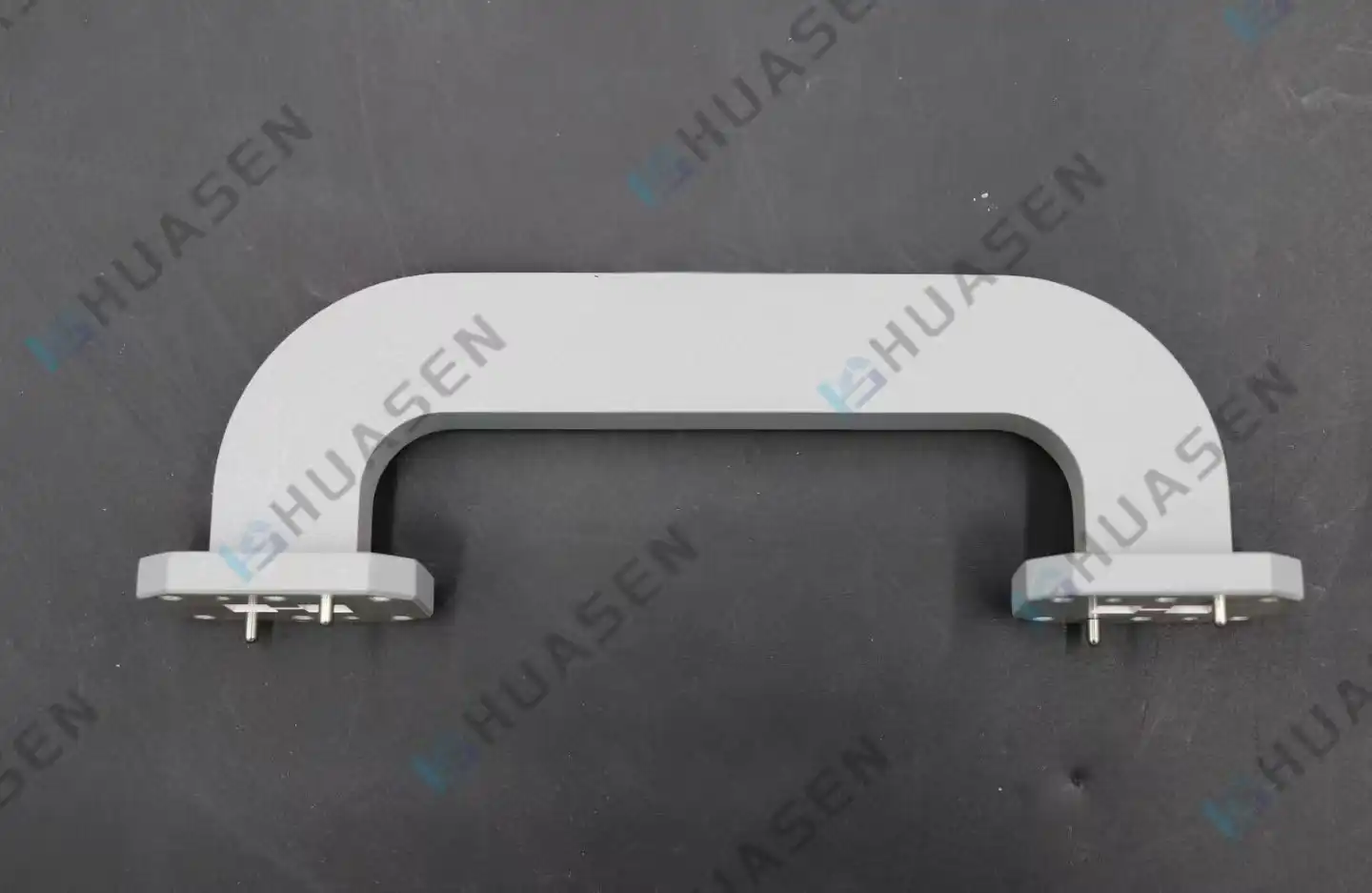
The Double Ridged Waveguide Bend is the best technical option for precise RF systems that need both a very wide bandwidth and reliable signal routing. This unique passive part solves the basic problem of how to guide electromagnetic waves through complicated physical paths without reducing signal quality or losing spectral coverage. This design achieves frequency ranges from 0.84 to 40 GHz by adding metallic ridges inside the waveguide's wide walls. It does this while maintaining excellent impedance matching and low insertion loss, which are important for mission-critical uses in defence, satellite communications, and high-tech test equipment.
Understanding Double-Ridged Waveguide Bends
The Core Design Philosophy
Ridged waveguide designs change the way RF signals are sent through capacitive loading, unlike regular rectangular waveguides that only work within small frequency bands. The dual-ridge shape changes the electromagnetic field distribution inside the guide in a basic way. This lowers the cutoff frequency and lets a single mode propagate across bandwidths greater than 3:1. This means that a single piece of hardware can be used instead of several normal waveguides, which makes the design of the system much simpler.
The bend part is an example of very precise engineering at its finest. When electromagnetic waves go around corners, bad design causes mode conversion and reflection, which damages the purity of the signal. When making ridged turns of good quality, they use swept radii or optimised mitred shapes that keep the characteristic impedance the same throughout the turn, whether the direction changes are 90 degrees or 45 degrees.
Electromagnetic Principles at Work
The internal grooves make areas with a lot of electric field, that make the effective wavelength transmission constant smaller. This lets lower frequencies travel in the basic TE₁₀ mode while blocking higher-order modes that would otherwise make the signal less pure. This means that engineers working on 5G relay lines or satellite ground stations will have better spectral performance across dozens of gigahertz at the same time.
The choice of materials has a direct effect on how well the electricity works. For flying platforms, aluminium construction with oxidised coats offers great conductivity-to-weight ratios. Copper bodies with silver plating, on the other hand, maximise conductivity for laboratory-grade accuracy. Skin effect losses depend on the quality of the surface finish, so metallization specs are an important thing to think about when buying something.
Technical Specifications That Matter
Modern ridged waveguide bends that cover 0.84–40 GHz usually have VSWR values of 1.25 or better across most of the band, with a small drop to 1.3 at the very high frequency corners. These numbers are important because VSWR is directly related to mirrored power. For example, a 1.25 VSWR means that less than 1% of the power is being reflected, which protects the emitter and keeps the signal strong.
When putting together a system, flange connectivity is very important. FP (female) and FM (male) flange configurations can be changed to meet different connection needs, such as when connecting to test equipment, horn antennas, or power amps. Standard dimensional limits of ±0.01 mm guarantee reliable, low-loss mating even when the temperature changes and the machine shakes.
Advantages and Applications of Double Ridged Waveguide Bends
Superior Benefits Over Traditional Solutions
In terms of energy economy, this is the main benefit. Before, a base station builder might have needed three different waveguide runs to cover frequencies in the sub-6 GHz, C-band, and X-band ranges. Now, a single ridged waveguide assembly can do all three. This consolidation cuts down on the physical footprint, simplifies inventory, and speeds up installation plans, all of which are important for system designers who have to meet tight project deadlines.
At microwave frequencies, the signal loss performance is as good as or better than cable options. Insertion loss stays below 0.15 dB per bend throughout the working range, while it ranges from 0.5 to 1.0 dB for similar coaxial adapters. These differences add up in cascaded systems with multiple direction changes, which directly affect link costs and the farthest range that can be reached.
Mechanical durability takes into account usage in harsh environments. Solid-body double ridged waveguide bendunits can survive severe vibration, temperature changes from -55°C to +125°C, and corrosive marine atmospheres better than flexible wires that can wear out over time. This dependability is very important for transmission systems on offshore drilling platforms or radar systems on unmanned flying vehicles.
Here are the core advantages these components deliver to demanding applications:
- Multi-Octave Coverage: Bandwidth ratios of up to 4:1 mean that frequency-specific hardware changes don't have to be made during testing or operation. This cuts down on downtime and tuning times.
- High Power Capacity: The best ridge gap sizes keep the peak power handling above 1 kW on average for many setups. This means that both CW and pulsed radar transmission can happen without the risk of breaking down.
- Compact Integration: E-plane and H-plane bend angles (DRWEB and DRWHB configurations) let you choose how to route signals in structures with limited room, which lets you pack more in each area.
- Environmental Resilience: Construction that is sealed with the right seals gets IP67 waterproofing and salt-fog resistance according to MIL-STD-810. This meets the needs of outdoor telecom infrastructure.
All of these benefits work together to help makers who are building next-generation wireless infrastructure get their products to market faster and more cheaply. This is because standardising components and making the supply chain easier have a direct effect on these factors.
Real-World Industry Applications
In combat aircraft equipped with electronic warfare pods, ridged waveguide bends send jamming signals from transmitters to conformal antennas by going around the airframe's non-linear shapes. The wideband feature lets a single pod block multiple danger radar frequencies at the same time. This makes the task more effective while lowering the system's weight compared to older systems that use multiple bands.
These parts are used in dual-polarisation feedhorn assemblies by satellite earth stations. The bend links orthomode sensors to low-noise block downconverters. Maintaining phase synchronisation and low VSWR across both uplink and downlink bands is important for making sure that high-capacity business communications and military SATCOM networks can send and receive the most data possible.
When characterising antenna patterns or testing RF components under high-power settings in a lab, rigid bends are used. When you pair vector network analysers with precision bends, you can take swept-frequency measurements from L-band to Ka-band without having to reconfigure anything. This makes measures much more accurate and saves a lot of time for the user.
Choosing the Right Double-Ridged Waveguide Bend for Your Project
Critical Selection Parameters
The most important criterion is frequency range. Making sure that the practical band you need is in the bend's promised VSWR range saves you a lot of money on redesigns. It's possible for a device designed for 6–18 GHz to physically send signals at 20 GHz, but the VSWR could drop too far, which could damage solid-state power amps by creating impedance mismatches.
In cascaded systems, careful tracking is needed to keep track of how insertion loss builds up. A single bend that loses 0.12 dB may not seem like much, but a radar frontend with eight bends suddenly loses almost 1 dB, which is the same as 20% less transmission power. For receive chains where the signal-to-noise ratio changes by a tenth of a decibel, low-loss designs with high-conductivity plates are required.
Mechanical assembly is limited by the size of the parts. When choosing a bend radius, you have to choose between electrical performance and room needs. Tighter circles save space, but they may raise VSWR at higher frequencies. RF and mechanical engineers often have to work together in small steps to make sure that performance requirements are met while chassis volume limits are respected.
Comparative Analysis With Alternative Designs
Standard rectangular waveguides have less loss at single frequencies, but they make it harder to change how the system works. A WR-90 guide works great with X-band, but for C-band operation, it needs all new gear, which makes multi-mission systems more difficult to use. Ridged designs give up a small amount of insertion loss (usually an extra 0.05 dB) in exchange for the ability to handle more than one octave, which is a trade-off that is worth making for most current uses.
Coaxial communication lines are very flexible and have small connections, but above 20 GHz, they lose more power and can't handle as much of it. For large-scale applications, phase-matched coaxial cable systems become too expensive, but waveguide solutions can be scaled up without losing any cost. Test labs usually keep both technologies on hand and choose the right one based on the data needs.
While circular waveguide designs can be used for dual-polarisation and rotating-joint uses, they make bending shapes more difficult and make manufacturing more difficult. Double-ridged rectangular structures are the best solution for fixed-orientation systems that need a wide bandwidth, proven reliability, and easy purchase from a number of approved providers.
Custom Design and OEM Considerations
A lot of projects need answers that aren't available in a catalogue. Custom ridge shapes improve VSWR for certain sub-bands, and unique flange patterns let new systems directly connect to old ones. Manufacturers with 30 years of experience making RF components can make these changes, with the help of electromagnetic modelling and prototype testing to ensure accuracy.
When getting quotes for specialised waveguide systems, there should be in-depth technical talks about things like the working environment, power levels, and interface needs. Giving mechanical CAD models and frequency-domain performance goals speeds up the accuracy of the plan and stops specifications from being out of sync. When you order more than 50 units, the benefits of bulk buying become clear. This is because specialised production runs and amortised tooling costs lower unit prices by 20–30%.
Procurement Essentials for Double Ridged Waveguide Bends
Sourcing From Qualified Manufacturers
Besides unit pricing, expert support and supply chain stability are important when selecting a supplier. ISO 9001-certified companies have quality control procedures to maintain production tolerances. Contracts require defence businesses to meet MIL-DTL-85 dimensions and MIL-STD-202 environmental criteria.
Established suppliers with in-house, accurate machining and metal plating are more reliable than intermediaries who utilise freelancers. For over 30 years, Huasen Microwave has made waveguide components, including Double Ridged Bend units, and maintained process control for consistent electrical performance throughout manufacturing lots. System design that requires field-replaceable units must consider this.
Location affects lead times and shipping costs. US distribution facilities reduce local project shipping delays, and engineers may aid with design via maker contacts. To balance these elements, consider overall landed cost and technological risk reduction.
Certification and Compliance Frameworks
RoHS certification ensures hazmat-free structures for commercial telephony. Altitude conditioning, MIL-STD-810 vibration profiles, and salt-fog exposure tests are common in military programs. Suppliers that provide authorised test results for every batch demonstrate their commitment to quality.
Aerospace systems that must pass AS9100 audits must demonstrate traceability. Serialised components with material approvals, measurement inspection records, and electrical performance data enable field failure analysis. These administrative aspects distinguish professional RF component producers from ordinary part vendors.
Pricing Structures and Lead Time Realities
Special setups take six to eight weeks, including design clearance and manufacturing preparation, whereas standard catalogue goods arrive in two to four weeks. Prototypes cost more, but expenses per unit reduce significantly over 25 units. Budgets are more predictable with blanket buys and planned releases for continuing manufacturing.
Ridged waveguide bends in bulk are discounted 15% to 40% for 10, 50, and 250 units. Rush fees hasten delivery but cost 30–50% more. Planning ahead for purchases is good financially. The buying price should include freight. Rugged packaging may add 5–8% to the component's value for international delivery.

Performance Measurement and Optimisation Techniques
Instrumentation and Test Methodologies
Vector network analysers (VNAs) are the major waveguide bend measurement equipment. A calibrated S-parameter shows insertion loss, return loss, and phase uniformity over the working range. Standard calibration sets measurement reference planes at the bend's flange surfaces using precision open-short-load or through-reflect-line (TRL) procedures. The fixture's impacts on data are removed.
When testing VSWR, pay attention to connection repeatability. Flange bolts typically operate at 15–25 inch-pounds, depending on size. Tightening them too much deforms the flange and worsens electrical contact. Production testing with calibrated torque tools and anti-seize compound provides reliable measurements across many mate-demate cycles.
High-power testing verifies peak and average power management. Swept-CW measurements at normal operating temperatures provide thermal breakdown limits. Pulsed, realistic duty cycle testing shows radar compatibility. Infrared thermal imaging detects high temperatures induced by electrical contact or material faults during these tests. Problems may be corrected before field usage.
Installation Best Practices
Proper waveguide alignment prevents mechanical stress that degrades electrical performance. Flange sides must be parallel within 0.002 inches across contact. This needs a proper mounting bracket design and shimming. Anti-rotation pins or dowel holes align angles when pieces are disassembled for repair.
Environmental protection is important when installing outdoors. Gasketed flanges with silicone or fluorocarbon O-rings are moisture barriers. Depending on exposure, examine and replace them every two to three years. Pressure purge with dry nitrogen prevents internal condensation in moist areas, stabilising dielectric characteristics.
Bend direction affects system performance somewhat. E-plane bends (DRWEB configuration) modify the electric field plane, making them better for circularly polarised lines. H-plane bends (DRWHB) maintain polarisation, making them ideal for field vector control. Consult competent RF engineers during plan design to avoid field rework.
Maintenance and Longevity Strategies
Regular visual checks detect corrosion or mechanical deterioration before electrical issues arise. Isopropyl alcohol washing and removal of flange surfaces annually removes oxidation and particle debris that increases contact resistance. Re-torquing screws addresses temperature and vibration issues.
Air steadily oxidises silver plate surfaces, forming silver sulphide layers that worsen loss. Even when not in use, conformal coatings or sealed desiccant bags maintain surface conductivity. Gold polishing eliminates oxidation but enhances part cost by 15–25% and is only needed for precision, low-loss usage.
Performance proof testing every two years detects problems early. S-parameter measurements may be compared to building construction data to find tiny alterations that need to be rectified. This proactive approach prevents systems from failing when required, increasing asset supply.
Conclusion
It is important to carefully consider technical specs, supplier skills, and lifecycle costs when choosing the best wideband RF routeing option. For important communications and radar uses, double-ridged waveguide bends offer unmatched spectral coverage, power handling, and weather robustness. System integrators can choose parts that make projects more successful while staying within budget and meeting deadlines if they understand how frequency performance, mechanical limits, and sourcing issues all affect each other.
FAQ
1. What frequency ranges do double-ridged waveguide bends support?
These specialised parts can usually work between 0.84 GHz and 40 GHz, but this depends on the type. Bandwidth ratios can hit 3:1 or 4:1, which means that a single setup can cover more than one transmission band at the same time. This feature gets rid of the need for multi-band devices to make frequency-specific hardware changes.
2. How does VSWR affect my system performance?
The Voltage Standing Wave Ratio measures how well the resistance matches. If the value is 1.25 or higher, there will be less than 1% returned power. This protects the receivers and keeps the signal's integrity. Higher VSWR numbers mean that there is more bounce, which lowers the power being sent and can, over time, hurt sensitive RF amplifiers.
3. Can these bends handle high-power radar applications?
Ridged waveguide bends that are properly built can handle average power levels of more than 1 kW and peak pulse power levels that are much higher, based on the duty cycle and frequency. Power rates are based on material choice, ridge gap optimisation, and thermal control. Checking the manufacturer's instructions for your unique working conditions is the best way to make sure that the system will work well and not break down.
4. What's the difference between E-plane and H-plane bends?
H-plane bends (DRWHB) go across the direction of the electric field, while E-plane bends (DRWEB) go along it. The choice affects field vector control and maintaining polarisation. For example, E-plane designs are better for some antenna feed transitions, while H-plane designs are better for keeping linear polarisation through routeing routes.
Partner With a Proven Double Ridged Waveguide Bend Manufacturer
Huasen Microwave Technology has been making precise waveguide parts for demanding aircraft, defence, and telecoms uses for more than 30 years. Our Double Ridged Waveguide Bend product line covers 0.84–40 GHz and comes with a promise for VSWR performance. You can also change the E-plane and H-plane setups to fit your system's needs. As a reliable Double Ridged Waveguide Bend supplier, we can help you with design, electromagnetic simulation validation, and full test documentation, whether you need help with fast prototyping or large-scale production. Email our engineering team at sales@huasenmicrowave.com to talk about your wideband RF problems and get a full quote with short wait times.
References
1. Balanis, C.A. (2016). Advanced Engineering Electromagnetics, 2nd Edition. Hoboken: John Wiley & Sons.
2. Marcuvitz, N. (1986). Waveguide Handbook. London: Peter Peregrinus Ltd.
3. Pozar, D.M. (2012). Microwave Engineering, 4th Edition. New York: John Wiley & Sons.
4. Saad, T.S. (1971). "Design of Double-Ridge Waveguides for Wide-Band Applications," IEEE Transactions on Microwave Theory and Techniques, Vol. 19, No. 2, pp. 220–227.
5. MIL-DTL-85/3C: Waveguides, Rigid, Rectangular (and Adapters), U.S. Department of Defence (2015).
6. Chen, T. (2005). "Broadband Characteristics of Double-Ridged Rectangular Waveguide," IET Microwaves, Antennas & Propagation, Vol. 152, No. 5, pp. 383–390.
Send Inquiry