Double Ridged Straight Waveguide in Broadband Labs






2026-04-13 22:40:16
In broadband laboratory environments, the Double Ridged Straight Waveguide represents a transformative solution for engineers facing bandwidth constraints and signal integrity challenges. This specialized passive microwave component features internal conductive ridges along the center of the top and bottom broad walls, capacitively loading the structure to dramatically lower the cutoff frequency while extending single-mode bandwidth. Unlike standard rectangular waveguides limited to bandwidth ratios around 1.5:1, double ridged configurations achieve multi-octave coverage—often 2.4:1 to 3.6:1—within a single compact footprint, addressing the critical need for wide frequency band coverage without hardware switching.
Introduction
High-frequency testing environments demand transmission components that can simultaneously handle multiple frequency bands without compromising signal quality or introducing excessive system complexity. Traditional rectangular waveguides force engineers to maintain multiple component inventories, constantly swapping hardware when testing across different frequency ranges. This operational inefficiency translates directly into extended project timelines and inflated budgets. For B2B procurement stakeholders—including RF engineers at aerospace firms, purchasing managers at telecommunications equipment manufacturers, and technical directors at research institutions—understanding waveguide technology fundamentals directly impacts both component selection accuracy and overall system performance. The right choice minimizes insertion loss, maintains low VSWR across operational bands, and simplifies installation procedures while meeting stringent environmental durability requirements. This comprehensive guide examines how ridged waveguide technology solves bandwidth limitations inherent in conventional designs. We explore the electromagnetic principles that enable octave-spanning performance, compare alternative transmission line solutions, and provide actionable procurement strategies. Whether you're designing next-generation radar systems, calibrating spectrum analyzers, or conducting EMC compliance testing, understanding these components helps optimize both technical outcomes and total cost of ownership.
Understanding Double-Ridged Straight Waveguides
Core Design Principles and Electromagnetic Behavior
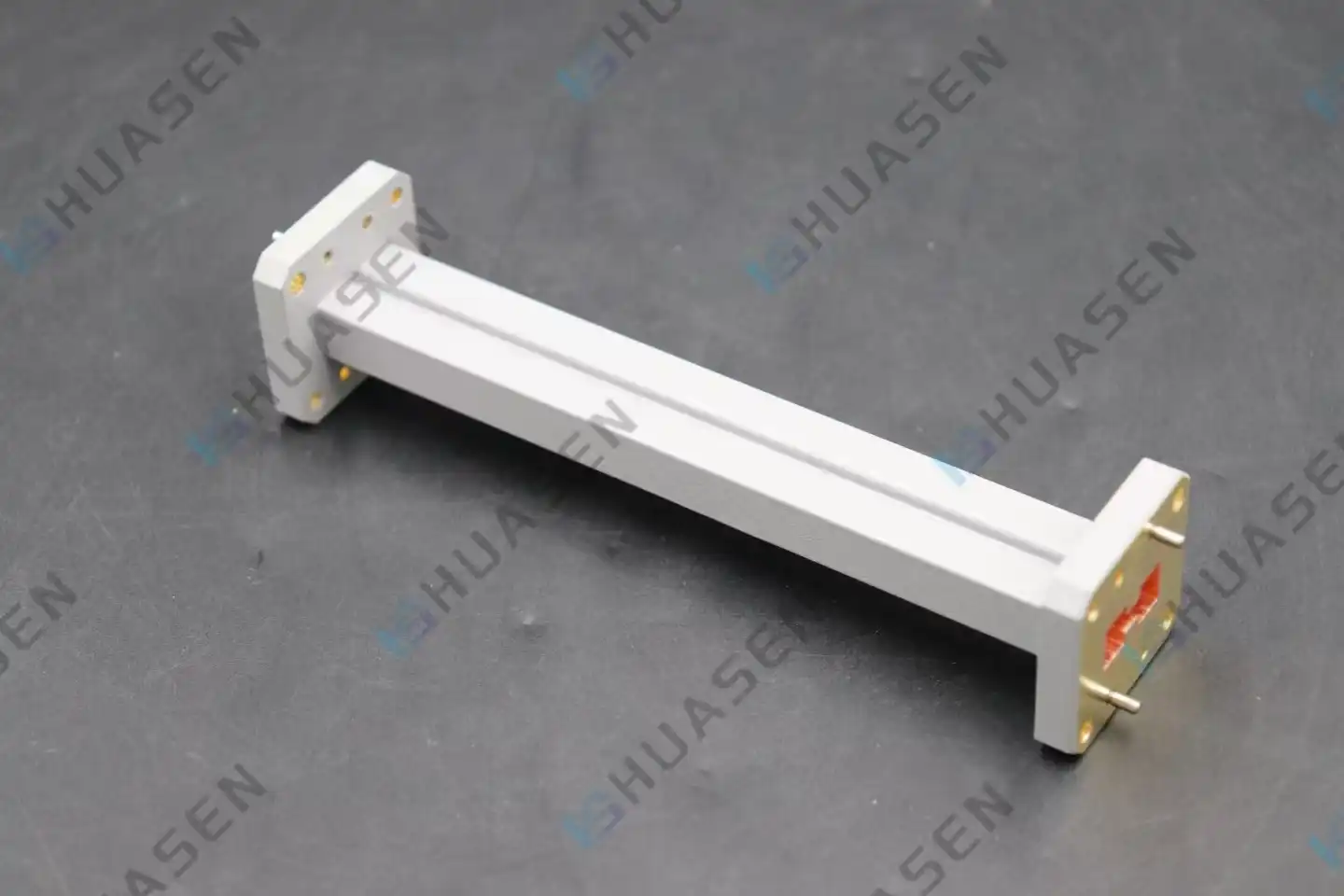
The defining characteristic lies in the physical geometry. Two metallic ridges protrude inward from opposing broad walls, running parallel along the waveguide's longitudinal axis. This configuration alters the electromagnetic field distribution fundamentally. The ridges create capacitive loading that reduces the cutoff frequency of the dominant TE10 mode while simultaneously increasing the cutoff frequencies of higher-order modes like TE20 and TE01. This separation expands the single-mode operating bandwidth dramatically. Standard rectangular waveguides exhibit cutoff frequencies determined solely by their broad wall dimension. Increasing bandwidth requires physically larger structures, which conflict with modern equipment miniaturization requirements. Ridge loading breaks this constraint by modifying field patterns rather than external dimensions. The capacitance introduced by the ridge gaps concentrates electric field energy in the center region, effectively increasing the guide wavelength and enabling propagation at lower frequencies within the same physical envelope.
Technical Specifications and Performance Parameters
Huasen Microwave's DRWAL series demonstrates this principle practically, delivering frequency band coverage from 0.84 GHz to 40 GHz. This exceptional range handles applications from L-band satellite communications through Ka-band radar systems using standardized component families. The VSWR performance remains remarkably consistent: ≤1.15 at lower frequencies and ≤1.2 at higher frequencies. Such low reflection coefficients ensure maximum power transfer efficiency—critical when amplifier output stages cost tens of thousands of dollars and must operate reliably under high-power conditions. Customizable length options spanning 0.1 mm to 500 mm provide mechanical flexibility. Short transitions serve as adapters between test equipment and antennas, while longer runs route signals through complex chassis layouts. The precision-machined construction maintains electrical performance across this dimensional range, with tight tolerances on ridge profile and spacing preventing mode conversion and maintaining characteristic impedance consistency. Material selection addresses environmental durability requirements common in defense and aerospace sectors. Corrosion-resistant alloys withstand salt spray exposure in maritime applications and thermal cycling in spacecraft installations. Surface treatments maintain electrical conductivity and double ridge waveguide sizes, while preventing oxidation that would degrade insertion loss over operational lifetimes measured in decades.
Differentiating Features Compared to Standard Waveguides
Conventional rectangular waveguides dominate microwave systems where narrow fractional bandwidths suffice. A WR-90 guide covers 8.2 GHz to 12.4 GHz—adequate for X-band radar but limiting for wideband electronic warfare receivers needing 6 GHz to 18 GHz coverage. Switching between WR-137, WR-90, and WR-62 guides introduces mechanical complexity, calibration burdens, and potential failure points. Ridge loading eliminates this constraint. A single WRD650 ridged guide spans 6.5 GHz to 18 GHz continuously, replacing three standard guide sizes. The reduction in connector interfaces directly improves system reliability by eliminating potential leak paths and impedance discontinuities. Integration simplifies dramatically in multi-frequency systems like synthetic aperture radar, where instantaneous bandwidth determines image resolution. The tradeoff involves power handling capacity. Ridge structures exhibit higher current densities along ridge edges, increasing resistive losses slightly and limiting peak power compared to equivalent-frequency standard guides. Typical applications handle this limitation through careful thermal management and remaining within rated specifications—Huasen's engineering support helps clients navigate these design considerations during system integration.
Advantages and Applications in Broadband Labs
Key Performance Benefits for Testing Environments
Broadband laboratory operations prioritize measurement accuracy, repeatability, and operational efficiency. Testing a single device under test (DUT) across multiple frequency bands traditionally required reconfiguring test setups—disconnecting cables, installing different waveguide runs, recalibrating network analyzers, and validating system performance at each configuration change. This process consumed valuable engineering hours and introduced opportunities for measurement error through connector wear and calibration drift. Ridged waveguide transmission lines address these inefficiencies through several core advantages that directly impact laboratory productivity. The wide frequency coverage enables sweep measurements without hardware changes. An engineer characterizing a phased array antenna can measure S-parameters from 2 GHz through 18 GHz in a single automated sweep, with the waveguide infrastructure remaining static throughout. Data collection time drops from hours to minutes, while eliminating manual reconfiguration removes operator-induced variability. Low insertion loss maintains signal integrity across the measurement chain. When characterizing devices with narrow dynamic range specifications—high-Q filters, low-noise amplifiers, or precision attenuators—every tenth of a decibel loss in test cables degrades measurement floor and obscures true device performance. Huasen's DRWAL series maintains minimal loss through precision manufacturing that controls surface roughness and dimensional tolerances affecting conductor losses and impedance consistency.
Real-World Laboratory Applications
EMC testing facilities rely extensively on broadband rigid guides. Radiated immunity testing per MIL-STD-461 requires illuminating the equipment under test with electromagnetic fields sweeping from 2 GHz to 18 GHz at defined power densities. Ridge horn antennas fed through these waveguides generate calibrated field strengths without pausing to change antenna systems at band edges. This capability accelerates testing cycles for aerospace contractors, validating avionics compliance before flight certification. Spectrum analyzer calibration laboratories utilize rigid guides as reference transmission lines. When calibrating the frequency response of receivers and analyzers used in radio astronomy or signals intelligence, technicians need traceable standards across multi-octave spans. The phase linearity and amplitude flatness of quality ridged guides provide reliable references against which analyzers can be characterized and adjusted, maintaining measurement traceability to national standards. Radar cross-section measurement ranges employ these components in their illumination and receiving systems. Measuring how aircraft prototypes scatter electromagnetic energy requires coherent transmission and reception across wide frequency ranges to characterize scattering behavior versus aspect angle and frequency. Ridged waveguide feeds enable these ranges to collect comprehensive data sets without lengthy reconfiguration between frequency bands, improving data quality through more consistent measurement geometries. Research institutions developing next-generation wireless systems benefit from the design flexibility. When exploring novel antenna concepts for 5G millimeter-wave backhaul or satellite megaconstellation ground terminals, prototype validation requires flexible test infrastructure. Ridged guides accommodate rapidly changing test configurations as designs evolve, supporting iterative development cycles where requirements crystallize through experimental validation rather than purely analytical prediction.
Comparing Double-Ridged Straight Waveguides with Other Solutions
Performance Metrics Versus Standard Rectangular Guides
The fundamental comparison centers on bandwidth versus double ridge waveguide sizes and power handling. Standard rectangular waveguides excel in high-power applications—a WR-284 guide handles kilowatts of continuous power at S-band frequencies with minimal heating, ideal for radar transmitters and industrial microwave heating systems. The simple rectangular cross-section distributes currents broadly across wide wall surfaces, minimizing current density and resistive losses. Ridged configurations sacrifice some power capacity for bandwidth expansion. Peak power handling drops by 30-50% compared to the same-frequency standard guides due to concentrated currents along ridge edges. This limitation rarely constrains laboratory applications where signal levels remain in the milliwatt to watt range. Even in high-power testing scenarios, proper thermal design accommodates these levels while benefiting from the multi-octave bandwidth advantages. Physical size considerations favor rigid designs when space constraints dominate. A system covering 6 GHz to 18 GHz with standard guides requires three separate waveguide sizes, totaling significant panel space for switching networks. The equivalent rigid solution uses a single component footprint, simplifying mechanical integration in equipment racks and reducing total system weight—crucial metrics for airborne test equipment or portable calibration systems.
Coaxial Cable Alternatives and Application Boundaries
Coaxial cables offer exceptional flexibility and convenient connector standardization. SMA, N-type, and 3.5mm connectors mate reliably through thousands of cycles and provide good electrical performance through Ku-band frequencies. Their mechanical flexibility simplifies test setup reconfiguration—cables route around obstacles and accommodate equipment movement without rigid mounting constraints. The limitations emerge at higher frequencies and power levels. Cable losses increase approximately with the square root of frequency, becoming prohibitive above 18 GHz for runs longer than a few feet. A high-quality phase-stable cable exhibits 0.5 dB/foot loss at 18 GHz; a ten-foot run attenuates signals by 5 dB before reaching the DUT. Waveguide losses remain much lower—often under 0.1 dB/foot across the same frequency range—preserving signal integrity in longer runs. Power handling also favors waveguides. Coaxial cables with solid dielectric insulators between the center conductor and outer shield concentrate electric fields in small volumes, limiting breakdown voltage and average power capacity. High-power applications requiring tens or hundreds of watts drive engineers toward waveguide solutions despite their mechanical rigidity. The decision point depends on specific application requirements: cables suit low-power, flexible routing scenarios; waveguides handle high-power, fixed-geometry installations.
Specialized Waveguide Configurations
Circular waveguides support certain specialized modes advantageous for specific applications—the TE01 mode exhibits extremely low loss in circular guides, making them ideal for long-distance power transmission in particle accelerators. Their lack of broadband single-mode operation limits the general-purpose testing utility. Mode purity maintenance requires careful alignment and introduces sensitivity to mechanical disturbances that rectangular and ridged guides tolerate better. Stepped-impedance waveguide structures achieve bandwidth extension through periodic impedance variations along the propagation path. These designs compete with rigid guides in some applications but introduce greater mechanical complexity and tighter manufacturing tolerances. The distributed impedance transformation makes them sensitive to dimensional variations that affect performance predictability. Ridged guides concentrate the impedance transformation mechanism in the ridge geometry, where precision machining maintains tighter control over electrical characteristics.
Procurement and Customization Guide for B2B Clients
Aligning Specifications with Application Requirements
Successful component selection begins with defining operational parameters precisely. Frequency range requirements drive the primary selection—identify the minimum and maximum frequencies your application demands, then select a waveguide model with a comfortable margin beyond these limits. Operating near band edges invites higher VSWR and potential mode conversion issues that degrade measurement accuracy or system performance. Power handling capacity requires careful evaluation. Calculate maximum continuous and peak power levels your system generates, including safety margins for abnormal operating conditions. Cross-reference these values against manufacturer specifications, remembering that published ratings assume specific operating temperatures and duty cycles. Applications with elevated ambient temperatures or continuous operation may require derating; consult factory engineering support for guidance on thermal management strategies. Mechanical interface requirements shape practical implementation. Waveguide flanges follow standardized dimensions per industry specifications—UG-style flanges for common frequency bands ensure compatibility with existing equipment. Verify bolt patterns, gasket groove dimensions, and flange thickness match your installation requirements. Custom flange configurations accommodate non-standard interfaces but extend lead times and increase costs; standardization simplifies procurement and future maintenance. Environmental exposure dictates material and finish selection. Indoor laboratory installations tolerate standard aluminum construction with light protective plating. Outdoor installations, maritime applications, or corrosive industrial environments demand enhanced corrosion resistance through stainless steel construction or specialized coatings. Huasen's engineering team evaluates environmental specifications and recommends appropriate material grades meeting both performance and longevity requirements cost-effectively.
Evaluating Manufacturer Capabilities and Credentials
Vendor selection extends beyond component pricing to encompass technical capability, quality assurance, and support infrastructure. Established manufacturers maintain documented quality management systems—ISO 9001 certification demonstrates systematic process control and continuous improvement cultures. Defense and aerospace applications may require additional certifications like AS9100 or compliance with MIL-STD specifications, ensuring components meet stringent reliability and traceability requirements. Manufacturing capability assessment examines precision machining equipment and metrology infrastructure. Ridged waveguide performance depends critically on maintaining tight tolerances on internal dimensions—ridge spacing, profile accuracy, and surface finish directly affect electrical characteristics. Vendors employing CNC machining centers with in-process measurement and coordinate measuring machines for final verification demonstrate the capability to meet specifications consistently across production volumes. Technical support responsiveness proves valuable throughout the product lifecycle. Preliminary design consultation helps match components to application requirements accurately, avoiding costly redesigns after procurement. Sample evaluation programs allow validation in actual operating environments before committing to production quantities. Post-delivery support addresses installation questions, troubleshoots unexpected performance issues, and provides calibration data or test reports documenting electrical characteristics for quality records. Supply chain stability matters for projects with extended timelines or requiring long-term component availability. Established manufacturers maintain component families over multi-year product lifecycles, ensuring replacement parts and additional quantities remain available as projects expand or require maintenance. Companies like Huasen Microwave, operating since 1993, demonstrate long-term commitment to product lines and customer relationships extending across decades.
Customization Options and Ordering Protocols
Standard catalog components address many common applications, but specific system requirements often benefit from customization. Length adjustments accommodate precise spacing requirements in densely packaged systems. Huasen's 0.1 mm to 500 mm customizable length range supports applications from compact test fixtures to extended routing through equipment racks. Custom lengths eliminate the need for additional adapter sections that introduce loss and potential failure points. Flange modifications adapt standard waveguide components to non-standard interfaces. Custom bolt patterns, rotated flanges, or specialized sealing grooves integrate with existing equipment or unique mechanical constraints. These modifications typically add minimal cost when specified during initial orders, but complicate procurement if required after receiving standard units. Pricing structures balance unit costs against order volumes and customization requirements. Standard configurations from existing inventory offer the fastest delivery at the lowest unit prices. Custom specifications trigger non-recurring engineering charges covering design validation and tooling, but amortize across larger quantities. Engage procurement discussions early in project planning to optimize pricing—manufacturers often provide budgetary quotes and lead time estimates that inform design decisions and project scheduling. Delivery logistics require coordination matching project timelines. Standard components ship within days to weeks; customized units extend to 4-8 weeks, depending on specification complexity. International shipments add customs clearance time and documentation requirements. Plan procurement activities accounting for these timelines, particularly for projects with firm deadline commitments or staged delivery requirements matching construction schedules.
Future Trends and Innovations in Double-Ridged Straight Waveguides
Advanced Materials and Fabrication Technologies
Additive manufacturing technologies promise Double Ridged Straight Waveguide transformative impacts on waveguide component production. Traditional machining creates ridged waveguide structures through multi-axis milling operations requiring multiple setups, specialized fixturing, and significant material waste. Metal 3D printing builds complex internal geometries layer-by-layer, potentially reducing manufacturing costs and enabling design innovations impossible through conventional machining. Selective laser melting and direct metal laser sintering produce fully dense metal parts approaching wrought material properties. Current limitations include surface roughness affecting RF losses and dimensional accuracy constraints on critical features. As these technologies mature, expect hybrid manufacturing approaches combining printed rough geometries with precision finish machining on critical surfaces—balancing cost reduction with performance requirements. Novel materials address specific performance limitations. Copper-coated aluminum construction reduces weight while maintaining excellent electrical conductivity—important for airborne systems where every gram impacts fuel efficiency. Advanced plating technologies improve corrosion resistance without thickness buildup that affects dimensional tolerances. Ceramic-loaded polymer composites under development may eventually enable lightweight, corrosion-proof structures for specialized applications accepting slightly higher losses.
Integration with Smart Measurement Systems
Industry 4.0 concepts increasingly influence test equipment design. Embedded sensors within waveguide structures could monitor temperature, detect moisture ingress, or measure actual transmitted power in real-time. This diagnostic data feeds system health monitoring platforms, enabling predictive maintenance that replaces components before failures disrupt operations rather than reacting to breakdowns. Digital twin technology creates virtual models mirroring physical hardware characteristics. By correlating measurement data with simulation models, systems detect performance degradation, indicating connector wear, contamination, or damage requiring attention. Machine learning algorithms identify subtle patterns indicating impending failures, improving operational reliability for critical measurement infrastructure supporting aerospace certification or pharmaceutical production monitoring. Automated calibration routines integrated with network analyzers and waveguide components streamline measurement workflows. Systems automatically recognize connected waveguide types through RFID tags or electronic interfaces, loading appropriate calibration coefficients and frequency ranges without manual operator input. This automation reduces setup errors and accelerates testing throughput—particularly valuable in high-volume production testing environments.
Evolving Application Demands
Next-generation wireless systems drive requirements for extended frequency coverage. As telecommunications infrastructure expands into millimeter-wave spectrum for 5G and future 6G systems, test equipment must characterize component performance through 100 GHz and beyond. Ridged waveguide technology scales to these frequencies, with dimensional scaling maintaining the bandwidth advantages that make them valuable at lower frequencies. Satellite megaconstellations deploying thousands of spacecraft create demand for high-throughput ground testing facilities. Characterizing phased array antennas with hundreds of elements across Ku-band and Ka-band frequencies requires flexible test infrastructure handling rapid design iterations during development and high-volume validation during production. Ridged waveguide components supporting these frequency ranges with consistent electrical performance enable the measurement throughput these programs demand. Electronic warfare systems continually expand operational bandwidths as threat environments evolve. Covering instantaneous multi-octave ranges allows simultaneous monitoring across multiple communication and radar bands, improving situational awareness and response capabilities. The transmission line infrastructure supporting these systems must maintain phase coherence and amplitude flatness across these extreme bandwidths—capabilities intrinsic to quality ridged waveguide implementations.
Conclusion
The Double Ridged Straight Waveguide solves fundamental bandwidth limitations constraining modern broadband laboratory operations and high-frequency system designs. By modifying internal electromagnetic field distributions through capacitive ridge loading, these components deliver multi-octave frequency coverage within compact mechanical envelopes. This capability directly addresses B2B procurement priorities: reducing component inventory complexity, simplifying system integration, improving measurement efficiency, and lowering total ownership costs. As wireless communication systems expand into millimeter-wave spectrum and test requirements grow increasingly demanding, ridged waveguide technology provides the performance foundation supporting next-generation development programs across telecommunications, aerospace, defense, and research sectors.
FAQ
1. What frequency ranges do ridged waveguides typically cover?
Ridged waveguide families span from below 1 GHz through millimeter-wave frequencies exceeding 40 GHz. Specific models are optimized for particular bands—some cover 2-18 GHz for broadband electronic warfare applications, while others address 26.5-40 GHz for Ka-band satellite systems. Huasen Microwave's product line extends from 0.84 GHz to 40 GHz across the complete DRWAL series, with individual models providing 2:1 to 3:1 bandwidth ratios within this range.
2. How do I measure waveguide performance characteristics?
Vector network analyzers equipped with appropriate waveguide calibration kits provide accurate S-parameter measurements. The calibration process establishes reference planes at waveguide flanges, removing test cable effects and characterizing the waveguide section independently. Measure return loss (S11) to verify VSWR specifications and insertion loss (S21) across the operating bandwidth. Quality ridged guides exhibit flat insertion loss and return loss better than 20 dB across specified frequency ranges.
3. Why choose ridged over standard rectangular waveguides?
The decision depends on bandwidth requirements versus power handling needs. Applications needing multi-octave coverage—EMC testing, wideband radar, spectrum monitoring—benefit substantially from rigid designs' bandwidth advantages. High-power transmitter applications prioritizing maximum power capacity with modest bandwidth may prefer standard rectangular guides. Laboratory environments typically operate at power levels where rigid guides perform excellently while providing superior operational flexibility.
Partner with Huasen Microwave for Superior Ridged Waveguide Solutions
Huasen Microwave Technology Double Ridged Straight Waveguide delivers proven ridged waveguide performance backed by over three decades of RF engineering expertise. Our DRWAL series offers exceptional versatility—0.84-40 GHz coverage, industry-leading VSWR specifications, and customizable configurations meeting your exact requirements. Whether you're establishing new test capabilities or upgrading existing infrastructure, our engineering team provides comprehensive application support from initial specification through installation validation. Contact our specialists at sales@huasenmicrowave.com to discuss your broadband laboratory requirements and receive detailed technical documentation. As a trusted Double Ridged Straight Waveguide manufacturer, we're committed to delivering reliable components with responsive support that accelerates your project success.
References
1. Montgomery, C. G., Dicke, R. H., and Purcell, E. M. (1948). Principles of Microwave Circuits. McGraw-Hill Book Company, New York.
2. Marcuvitz, N. (1951). Waveguide Handbook. MIT Radiation Laboratory Series, Volume 10, McGraw-Hill, New York.
3. Chen, Y. (1957). "Double-Ridged Rectangular Waveguides." IRE Transactions on Microwave Theory and Techniques, Vol. 5, No. 1, pp. 29-36.
4. Hopfer, S. (1955). "The Design of Ridged Waveguides." IRE Transactions on Microwave Theory and Techniques, Vol. 3, No. 5, pp. 20-29.
5. Saad, T. S. (1976). Handbook of Microwave Integrated Circuits. Artech House, Norwood, Massachusetts.
6. Pozar, D. M. (2011). Microwave Engineering, 4th Edition. John Wiley & Sons, Hoboken, New Jersey.
Send Inquiry