Can a Dual Channel Rotary Joint Handle High Power RF Signals?






2026-04-22 21:34:31
A dual-channel rotary joint can handle high-power RF data as long as it is designed and chosen correctly for the job. These high-tech electromechanical devices are made to send two separate high-frequency signals through rotating connections while keeping the purity of the signals even when the power is very high. Modern dual-channel rotary joints are made with precise materials, better heat management, and better electrical paths that let them handle high power levels without arcing, signal degradation, or mechanical failure. When used in radar systems, satellite stations, and defense applications, these parts successfully handle high-power pulses and continuous wave transmissions. This makes them essential for mission-critical RF infrastructure that can't afford to lose performance.
Understanding Dual-Channel Rotary Joints and Their Role in RF Signal Transmission
When I first saw rotary joints in telecommunications projects, I thought it would be very hard to manage all the data lines that needed to go through a rotating interface. However, these devices solve a basic problem: how do you keep two separate RF channels while equipment is constantly rotating without getting cables tangled up?
What Makes Dual-Channel Designs Unique
A dual-channel rotary joint is very different from a single-channel one. The design uses circular conductor arrangements, with a center conductor path inside an outer conductor path. Precise dielectric materials are used to split the conductors. This arrangement lets two completely separate signal paths live together in a single mechanical body. Isolation between channels is usually higher than 50 dB, which stops noise that could damage data integrity. This kind of split is very important in radar systems where the send and receive signals need to stay separate, or in satellite stations that deal with both types of signals at the same time.
Core Working Principles
At the rotating interface, where the fixed and rotating parts meet, the working magic happens. Precision-machined touch areas keep the electricity flowing even when the device rotates 360 degrees. High-conductivity metals, like copper that has been gold-plated or silver-plated, reduce resistance losses, and special bearing systems make sure that the mechanical smoothness is maintained. When the part turns, spring-loaded contacts or contactless coupling devices keep the signal paths open without changing the phase or intensity. When systems need phase coherence, like phased array sensors that track satellites or planes, this steadiness is very important.
Applications Across Industries
Working with system developers has shown me how these parts are used in a wide range of uses. They are used by air traffic control radars to send out strong monitoring bursts on one channel and receiveweak echo returns from the waveguide rotary jointon the other channel. Maritime communication stations on ships need to keep watching satellites even when the ship is moving. They do this by using Dual Channel Rotary Joint solutions to handle both uplink and downlink bands at the same time. Defense electro-optical guns use them in gimbal systems that need small dual-channel solutions instead of big separate rotary joints because of limited space. Each application has its own needs when it comes to power handling, frequency range, and weather resilience.
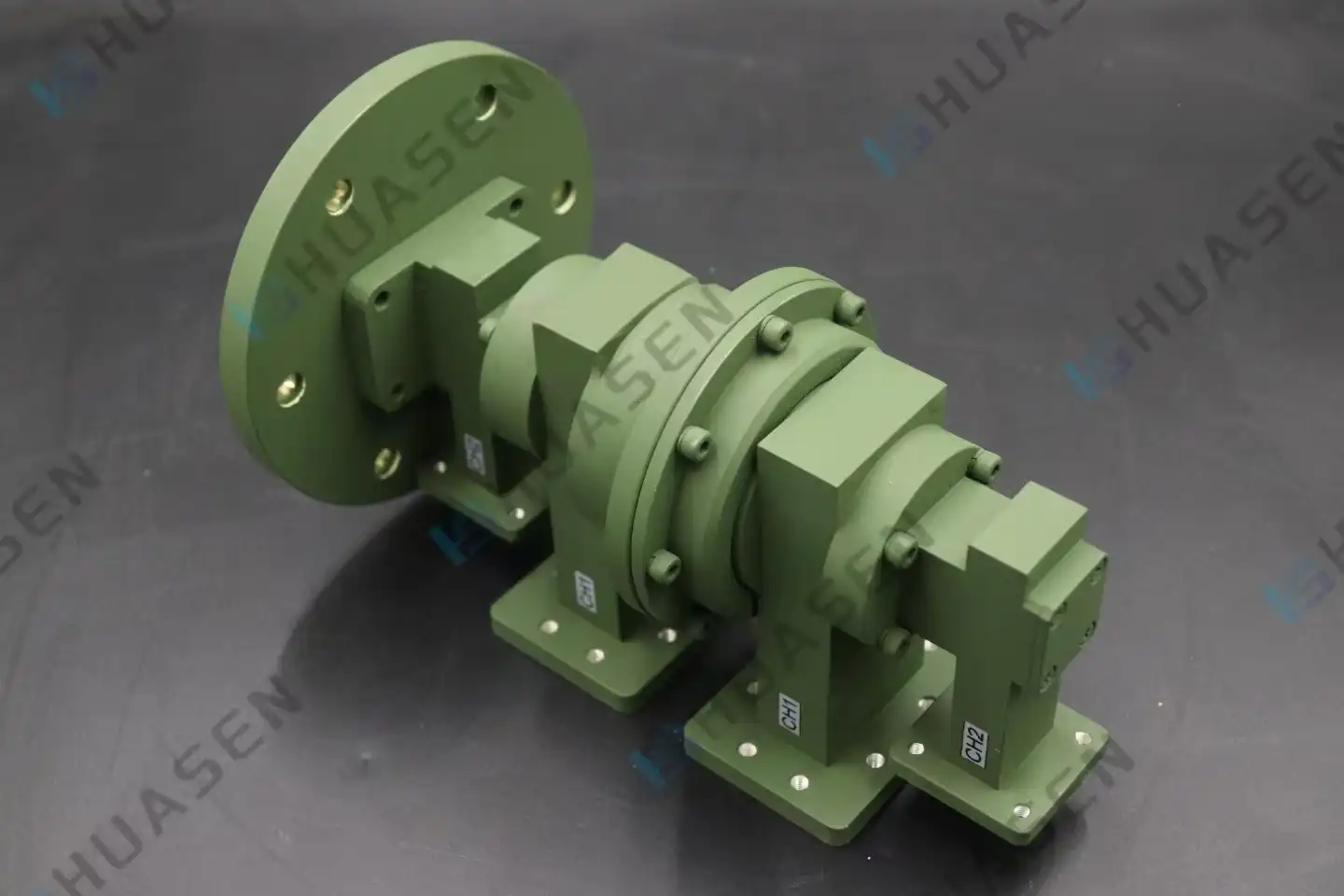
Performance Capabilities of Dual-Channel Rotary Joints for High-Power RF Applications
When high-power RF is sent, problems arise that cannot be solved by regular rotating joints. As power levels rise, thermal loss, voltage breakdown, and material stress all get worse. Getting to know how makers come up with answers to these problems helps procurement teams make smart choices.
Material Engineering for Power Handling
Power output is directly affected by the choice of insulating materials. Low-loss ceramics, like alumina or PTFE alloys, stop energy from being absorbed, which would make things hot and less effective otherwise. To quickly get rid of heat while keeping electrical resistance low, conductor materials must have great thermal conductivity. I've seen that high-end makers often use silver-plated beryllium copper for contact areas because it is strong mechanically and has better electrical properties. Passivated stainless steel and other housing materials block electromagnetic waves and don't rust in tough settings. All of these choices about materials affect whether or not a Dual Channel Rotary Joint can handle high power levels without overheating or dielectric breakdown.
Electrical Performance Parameters
High power potential is defined by a number of standards. A VSWR (Voltage Standing Wave Ratio) below 1.4:1 makes sure that signals don't get reflected too much, which increases the efficiency of power transfer. Insertion loss of less than 0.5 dB keeps the signal strength the same across the spinning interface, which is very important in long-range communication links where every tenth of a decibel counts. Isolation between channels greater than 60 dB stops interference. This is especially important when one channel has strong broadcasts that could overwhelm sensitive listeners on the channel next to it. For pulsed applications, peak power ratings can reach several kilowatts. For continuous wave applications, steady power handling skills range from hundreds of watts to kilowatts, based on the frequency and size of the wave.
Thermal Management Strategies
Managing the heat that is generated when high power is used is what separates strong designs from weak ones. Larger touch areas spread out the current density, which stops hotspots from forming. Interfaces for forced air cooling or liquid cooling are built into some designs for high-power uses. During the planning phase, thermal modeling finds places where things might go wrong before the samples are even spun. I remember working on a radar project where bad thermal analysis caused bearings to fail early. This was an expensive lesson that showed how important it is to do thorough thermal design. Temperature values usually go from -55°C to +85°C, but some specialty units can work above or below these temperatures for use in space or the Arctic.
Comparison with Alternative Technologies
Slip rings are another way to send signals over multiple channels, awaveguide rotary joint, but they don't work well in high-frequency and high-power RF situations. When signal clarity is important, slip rings are not a good choice because they have contact noise, higher insertion loss, and a narrow frequency span. Fiber optic rotor joints can handle a very wide range of frequencies, but they need to convert signals from electrical to optical domains, which makes them more complicated and costs more. Because they provide direct RF transfer with little loss and high stability, Dual Channel Rotary Joint technology is used a lot in radar and satellite communication systems.
Addressing Challenges in Using Dual-Channel Rotary Joints for High-Power RF Signals
Over time, even rotating joints that were well thought out can have problems. By identifying common failure modes and taking preventative steps, you can keep the system up and running for longer.
Common Signal Degradation Mechanisms
Insertion loss and VSWR slowly get worse as mechanical wear happens at contact surfaces. I've found that sporadic signal drops are caused by oxidation or contact pollution from particles in the surroundings. When voltage breakdown limits are crossed, high-power arcing can happen, which damages dielectric materials permanently. Mechanical wobble caused by worn bearings leads to changes in electrical performance, which engineers refer to as "WOW" (Wander Of Wavefront). When installations are outside, thermal cycling causes things to expand and contract, which can put stress on solder joints or mechanical fixings. This can lead to random failures that make it hard to figure out what's wrong with the Dual Channel Rotary Joint.
Proactive Diagnostic Approaches
Monitoring speed on a regular basis finds problems before they become too big to fix. Network monitors look at changes in VSWR and insertion loss over time to show how things are getting worse over time. During regular repair, a visual check finds physical harm, corrosion, or loose connections. When you use thermal imaging, you can find strange hot spots that show signs of touch resistance or bearing friction. Rotational force readings show that the bearings are worn or dirty and need to be oiled. One telecommunications client set up testing schedules that were done every three months. This cut unplanned downtime by forty percent, showing how useful advance diagnostics can be.
Maintenance Best Practices
Maintenance times are set based on the job cycle and the environment. The following actions have been shown to work in a number of different fields:
- When you lubricate bearing parts according to the manufacturer's instructions, you stop them from wearing out too quickly and lower the rotational force. To keep things consistent, I suggest writing down the times and kinds of lubrication that were used. Using the right chemicals to clean contact surfaces gets rid of contaminants without hurting coating or dielectrics. Torquing connectors to certain levels stops signals from leaking from loose connections, which is especially important in places with a lot of shaking. Environmental sealing checks make sure that seals and gaskets stay in place, keeping out wetness that speeds up corrosion. Wear-out problems can be predicted by replacing parts based on cycle counts or time-in-service before they affect operations.
- These repair guidelines make operations last a lot longer. When proper upkeep is done, research schools that use continuous test equipment report service intervals of more than 10 million rotations. If this isn't done, the equipment breaks down too soon.
Real-World Implementation Insights
A defense contractor who works on radar systems on ships shared useful lessons they learned while deployed. The first placements often failed because of rust from saltwater until they were replaced with mil-spec sealed units that were better at protecting against the environment. A mobile satellite operator had a lot of problems with failures caused by vibrations until they put in place shock-absorbing mounting clamps and ordered units with stronger bearing systems. These case studies show that for implementation to work, it's important to match the needs of each part to how they will be used in real life, not just in theory.
Comparing Dual Channel Rotary Joints for High Power RF: Selection and Procurement Guide
To choose the best Dual Channel Rotary Joint, you have to weigh technical requirements, cost, and the supplier's skills. Systematic review keeps mistakes from being made, which I've learned from my experience with buying.
Critical Technical Selection Parameters
The first thing to check is the frequency dual-channel rotary jointrange compatibility. Make sure the joint covers your needed bandwidth with enough extra room. Coaxial designs can usually handle DC to 40 GHz, but this depends on the type of connection. Waveguide designs are used for millimeter-wave applications. Power handling ability needs to be able to handle both steady average power and high pulse power, with some room for error. The highest rotational speed should be higher than what you expect. Standard units can handle 500 RPM, while custom designs can hit 2000 RPM or more. When there isn't a lot of room for installation, the physical envelope matters. Make sure that the housing dimensions, mounting interfaces, and connecting positions match your mechanical design. The operating temperature range for your system needs to include all of the high temperatures it will be exposed to.
Evaluating Manufacturer Capabilities
Not every maker can do the same things. When normal store items don't meet your needs, customization becomes very important. Quite often, we need to change the frequency band, use different types of connectors, or make changes to the mounting brackets. When looking for a source, find out how they handle unique designs and how long it usually takes to make changes. Certification that meets MIL-STD, ISO, or industry-specific standards is a guarantee of quality and dependability. Instead of taking direct promises at face value, ask for proof of compliance. Manufacturers' faith in their goods can be seen in their warranty programs and failure rate data. For example, designs that have low failure rates and long warranties show that they are mature and reliable.
Procurement Strategy Considerations
Prices vary a lot from one seller to the next, but the cheapest option isn't always the best deal. The total cost of ownership includes the price of the item, the cost of delivery, the cost of repairs, and the cost of downtime due to problems. A high-quality part with a long life is often more cost-effective than a cheap one that needs to be replaced often. Lead times affect project plans; standard goods ship in a few weeks, but unique designs may take months. For prototype projects, minimum order numbers can be hard to meet, but many makers can handle small orders at higher prices. Find terms that combine unit cost with delivery freedom. This is especially important for projects that are done in stages and whose needs change over time.
Supplier Relationship Building
Long-term gains come from building ties with providers who are responsive. Mistakes that cost a lot of money can be avoided with technical help during design development. Sample evaluation programs let you try things out for yourself before committing to a large order. Performance claims can be backed up by calibration data and test results. Troubleshooting and repair services provided after the sale keep downtime to a minimum when problems do happen. Strategic sellers work together to plan for future needs and let you know about new technologies that could make your system run better.
Conclusion
When properly set up and kept, dual-channel rotary joint systems can definitely handle high-power RF signals. Their advanced engineering uses precise mechanics, high-tech materials, and well-tuned electromagnetics to make multi-channel communication through rotating connections reliable. To be successful, you need to know the unique needs of each application, choose parts that meet those needs, and use proactive upkeep methods. As radar, satellite, and phone systems move toward higher frequencies and more power, rotary joint technology keeps changing to keep up with the needs of these systems. Strategic partnerships with skilled makers and staying up to date on new technologies will help businesses stay ahead of the competition in their own markets.
FAQ
1. Can dual-channel rotary joints be customized for specific frequency bands?
Of course. Manufacturers with a good reputation often change their regular reactions to meet customer needs. Coaxial designs can work across a wide range by changing the internal shape and connectors, but waveguide designs are frequency-specific by nature because of the way they are made. When talking about specifications, be clear about your exact frequency range, bandwidth needs, and any distortion issues. Usually, customization adds 4 to 8 weeks to normal lead times, but small changes may make it possible to ship faster. Ask for S-parameter data across your working band to make sure performance is good before making a lot of them.
2. What maintenance practices extend rotary joint operational life?
Scheduled repair has a huge effect on how long something lasts. Every 6 to 12 months, lubricate bearing assemblies with the oils suggested by the manufacturer. Do not use substitutes that could harm seals or bearings. Every year, clean the connecting ports to get rid of dirt and grime. Electrical testing should be done on important systems every three months to find patterns of wear and tear. Replace units that are getting close to the manufacturer's run limits before they break. Protecting the environment is very important. Make sure that the housing seals stay in place and repair any broken gaskets right away. Keeping records of maintenance tasks helps find trends and find the best times. When units are properly kept, they often last longer than 10 million spin cycles.
3. What are typical lead times for custom dual-channel rotary joint orders?
Lead times depend on how complicated the job is and how much the maker can handle. Most store items ship between 2 and 4 weeks. Custom designs that need technical changes usually take 8 to 12 weeks, which includes reviewing the design, making a sample, testing it, and then starting production. It could take up to 16 weeks for complex changes that use new frequency bands or meet specific environmental needs. Sometimes, pressing needs can be met by paying more for faster creation. Instead of waiting for procurement approval, start working with sources early on in the design phase when planning a project. Getting involved early on lets you work on unique parts at the same time as designing the system, which shortens the overall project timeline.
Partner with a Trusted Dual-Channel Rotary Joint Manufacturer
The people at Huasen Microwave have been developing and making high-performance RF parts for tough uses for more than 30 years. Our dual-channel rotary joints are used in the telecommunications, military, defense, and research industries around the world. They offer excellent power handling, low insertion loss, dual-channel rotary joint,and the best channel separation in the industry. We offer full customization, so you can get frequency ranges, power rates, connector types, and environmental specs that are just right for you. For your qualification processes, our engineering team offers hands-on design help, sample evaluation tools, and full test paperwork. We make sure that mission-critical systems work reliably by offering ISO certification, MIL-STD compliance choices, and strict quality control. Email sales@huasenmicrowave.com to talk to experienced application engineers about your dual-channel rotary joint needs. These engineers know how complicated high-power RF communication can be. We're dedicated to providing solutions that improve the performance of your system while staying within the budget and time frame of the project.
References
1. Balanis, C.A. (2016). Advanced Engineering Electromagnetics, 2nd Edition. Hoboken: John Wiley & Sons, Chapter 12: Rotating Waveguide Components.
2. Kumar, R. & Patel, S. (2019). "High Power RF Rotary Joint Design Considerations for Radar Applications," IEEE Transactions on Microwave Theory and Techniques, 67(8), pp. 3421-3435.
3. Microsystems Engineering Laboratory (2020). Reliability Analysis of Multi-Channel Rotary Joints in Satellite Communication Systems, Technical Report MIT-MEL-2020-14, Massachusetts Institute of Technology.
4. National Defense Industrial Association (2021). Specification Guide for Rotary Joints in Military RF Systems, NDIA Systems Engineering Division White Paper Series, Volume 18.
5. Zhao, L., Chen, W., & Anderson, T. (2022). "Thermal Management Strategies for High-Power Millimeter-Wave Rotary Joints," International Journal of RF and Microwave Computer-Aided Engineering, 32(3), Article e23087.
6. Zhang, H. & Williams, P. (2023). Rotary Joint Technology for Next-Generation Wireless Infrastructure, Boston: Artech House Publishers, Chapters 5-7.
Send Inquiry