Best Cryogenic Low Noise Amplifier Solutions for Ultra-Low Noise






2026-02-01 21:56:41
Imagine your quantum computing system failing to detect critical qubit signals because thermal noise drowns out the data you desperately need. In advanced scientific research, aerospace communications, and quantum technology applications, signal integrity at extreme temperatures is not optional—it's mission critical. The best cryogenic Low Noise Amplifier solutions for ultra-low noise deliver unparalleled performance where conventional amplifiers fail, operating at temperatures approaching absolute zero while maintaining noise figures as low as 1.3dB. This comprehensive guide explores how cutting-edge cryogenic amplification technology solves the most demanding signal detection challenges across quantum computing, radio astronomy, deep space communications, and precision measurement applications, helping engineers and researchers select optimal solutions for their ultra-sensitive systems.
Understanding Cryogenic Low Noise Amplifier Technology for Ultra-Low Noise Applications
Cryogenic Low Noise Amplifier technology represents a specialized branch of RF engineering designed to operate at temperatures near absolute zero, typically between 4 Kelvin and 77 Kelvin. At these extreme temperatures, thermal noise—the random electron movement that plagues conventional amplifiers—is dramatically reduced, enabling detection of signals so weak they would be completely lost at room temperature. Modern cryogenic amplifiers utilize advanced semiconductor technologies including Indium Phosphide High Electron Mobility Transistors and Gallium Arsenide pseudomorphic HEMTs, which exhibit exceptional electron mobility characteristics at cryogenic temperatures. These devices achieve noise temperatures below 5 Kelvin across wide frequency ranges, translating to noise figures approaching the quantum limit of detection.
The physics underlying cryogenic Low Noise Amplifier operation differs fundamentally from room-temperature devices. At cryogenic temperatures, carrier mobility in semiconductor materials increases significantly while parasitic resistances decrease, resulting in superior transconductance and reduced noise contribution from the first amplification stage. This first stage is critical because it dominates the overall noise figure according to the Friis formula for cascaded amplifiers. Advanced cryogenic LNA designs employ sophisticated impedance matching networks, often utilizing superconducting materials or precision microstrip transmission lines, to optimize power transfer while minimizing noise degradation. The combination of low-noise transistor technology, optimized matching networks, and cryogenic operating conditions enables these amplifiers to achieve noise performance that fundamentally changes what signals can be detected and measured.
Key Performance Parameters of Ultra Wideband Low Noise Amplifier Systems
When evaluating Ultra Wideband Low Noise Amplifier solutions for cryogenic applications, several performance parameters determine system capability and application suitability. Operating frequency range is paramount, with modern cryogenic LNAs covering spans from 0.01GHz to over 100GHz, enabling applications from deep space communications through millimeter-wave radio astronomy. Gain specifications typically range from 15dB to 50dB, providing sufficient amplification to bring weak signals above subsequent processing stages' noise floors. The noise figure, measured in decibels or expressed as noise temperature in Kelvin, quantifies how much the amplifier degrades signal-to-noise ratio—with the best cryogenic designs achieving figures below 0.5dB (equivalent to noise temperatures under 35 Kelvin at room ambient).
Bandwidth characteristics profoundly impact system architecture, with broadband designs offering octave or multi-octave coverage enabling frequency-agile applications, while narrowband optimized amplifiers deliver superior noise performance within specific frequency windows. Input and output return loss specifications ensure efficient power transfer and prevent standing waves that could destabilize system performance. Power consumption becomes critical in space-borne and large-array applications where cryogenic cooling capacity is limited—modern low-power designs operate on milliwatts while maintaining excellent noise performance. Connector compatibility including N-type, SMA-type, K-type, and waveguide interfaces ensures seamless integration into diverse RF architectures. These parameters must be carefully balanced against application requirements, with customization often necessary to achieve optimal performance in specialized systems.
Advanced Semiconductor Technologies Enabling Cryogenic Performance
The remarkable performance of modern cryogenic Low Noise Amplifier systems stems from breakthrough semiconductor technologies specifically optimized for low-temperature operation. Indium Phosphide HEMT technology has emerged as the gold standard for frequencies above 30GHz, offering exceptional electron mobility and low noise characteristics that improve dramatically when cooled to cryogenic temperatures. These devices utilize a two-dimensional electron gas formed at the heterojunction interface, providing extremely high electron mobility with minimal scattering—the key to low-noise amplification. At 15 Kelvin operating temperature, InP HEMTs can achieve noise temperatures below 3 Kelvin at Ka-band frequencies, approaching theoretical quantum limits.
Gallium Arsenide pseudomorphic HEMT technology serves lower frequency applications with exceptional cost-effectiveness and reliability, particularly in the C-band through Ku-band frequency ranges where quantum computing and radio astronomy applications dominate. Recent advances in Silicon-Germanium Heterojunction Bipolar Transistor technology have introduced an alternative approach offering reduced 1/f noise characteristics critical for radiometer and continuum detection applications. These SiGe HBT amplifiers demonstrate competitive noise performance below 10GHz while providing superior gain stability—a crucial advantage in long-integration scientific measurements. The selection of appropriate semiconductor technology depends on frequency range, noise requirements, power constraints, and environmental conditions, with leading manufacturers offering customized solutions leveraging the optimal technology for each application scenario.

Critical Applications Driving Cryogenic Low Noise Amplifier Innovation
The quantum computing revolution has created unprecedented demand for ultra-low noise cryogenic amplifiers capable of reading out fragile quantum states without introducing decoherence. Superconducting quantum computers operate at millikelvin temperatures, with qubit signals emerging at microwave frequencies in the 4-8GHz range at power levels measured in femtowatts. Each qubit requires its own dedicated readout chain beginning with a cryogenic Low Noise Amplifier positioned as close as possible to the quantum processor to minimize transmission line losses and thermal noise pickup. These quantum-grade cryogenic LNAs must achieve noise temperatures below 5 Kelvin while providing 35-40dB gain with exceptional linearity to avoid signal compression that could corrupt quantum state information. The amplifiers must operate stably at 4 Kelvin ambient temperature within the dilution refrigerator alongside the quantum processor, requiring specialized packaging and power distribution architectures.
Scalability represents a major challenge as quantum computing systems grow from tens to thousands of qubits—each additional qubit multiplies the number of readout amplifiers required, creating massive demands on cryogenic cooling capacity and system complexity. Modern quantum-optimized Low Noise Amplifier designs address this through ultra-low power consumption, with advanced designs operating on just 15 milliwatts while maintaining sub-5K noise temperatures. Integration density has become equally critical, with compact form factors enabling high-density installation within the limited space of dilution refrigerator inner stages. The emergence of error-corrected logical qubits will further amplify these demands, as each logical qubit may require monitoring hundreds of physical qubits. This quantum computing application alone is projected to drive exponential growth in cryogenic LNA demand, with some estimates suggesting tens of thousands of units will be required for a single large-scale quantum computer.
Radio Astronomy and Deep Space Communications Requirements
Radio astronomy represents one of the most demanding applications for cryogenic Low Noise Amplifier technology, where scientists attempt to detect electromagnetic radiation from the most distant objects in the universe. These astronomical signals arrive at Earth with power levels measured in attowatts or even zeptowtts—so weak that thermal noise from any room-temperature component would completely overwhelm them. Modern radio telescope systems employ cryogenic receiver front-ends operating at 15-20 Kelvin, with cryogenic LNAs providing the critical first-stage amplification that determines overall system sensitivity. The Square Kilometre Array, MeerKAT, and ALMA telescope projects rely on thousands of cryogenic amplifiers covering frequency ranges from sub-GHz through millimeter-wave bands, each optimized for specific astronomical observation windows.
Ultra Wideband Low Noise Amplifier designs enable simultaneous observation across broad frequency ranges, maximizing scientific return by allowing detection of spectral lines from multiple molecular species or cosmological phenomena without reconfiguration. The extreme stability requirements of radio astronomy impose stringent specifications on gain flatness and phase linearity, as even subtle variations can corrupt the interferometric correlation process that creates high-resolution astronomical images. Deep space communications with interplanetary spacecraft faces similar challenges, with signals from probes at the edge of the solar system arriving with infinitesimal power after traveling billions of kilometers. NASA's Deep Space Network employs cryogenic Low Noise Amplifier technology throughout its global antenna infrastructure, enabling reliable communications with missions like Voyager 1—now over 24 billion kilometers from Earth. These applications continue driving innovation in cryogenic amplifier technology, pushing toward even lower noise temperatures and broader bandwidths.
Defense and Aerospace Electronic Warfare Systems
Military and aerospace applications impose unique requirements on cryogenic Low Noise Amplifier systems, combining ultra-low noise performance with ruggedness, reliability, and operation in challenging environments. Electronic warfare receivers must detect extremely weak radar or communications signals while rejecting powerful interfering signals, requiring amplifiers with exceptional dynamic range and intercept point characteristics alongside low noise figures. Cryogenically-cooled receiver systems provide significant sensitivity advantages over conventional room-temperature designs, enabling detection of threat signals at much greater ranges or under more challenging electromagnetic conditions. Space-based reconnaissance and signals intelligence platforms benefit particularly from cryogenic amplification, where the natural cold of space can be leveraged to achieve near-optimal amplifier performance without complex refrigeration systems.
Automotive radar systems for autonomous driving represent an emerging application where Low Noise Amplifier technology enhances detection range and resolution for ADAS systems. While these operate at room temperature rather than cryogenic conditions, they leverage similar ultra-wideband architectures and low-noise design principles developed for cryogenic applications. The 77GHz automotive radar band demands amplifiers with exceptional linearity and phase noise characteristics to enable high-resolution target discrimination and Doppler processing. Military applications extend to missile seekers, satellite communications terminals, and electronic countermeasure systems where signal sensitivity directly impacts mission success. These defense and aerospace applications require amplifiers meeting stringent qualification standards including shock, vibration, thermal cycling, and radiation tolerance—challenges that push manufacturing and design capabilities beyond commercial specifications.
Design Considerations and Integration Strategies for Optimal Performance
Successful implementation of cryogenic Low Noise Amplifier systems requires careful attention to thermal architecture and cryogenic system integration. The amplifier must reach and maintain its operating temperature while dissipating its power consumption heat load, necessitating careful thermal coupling to the cryogenic refrigeration system. Most cryogenic LNAs mount directly to a cold plate or thermal strap with high thermal conductivity, using materials like oxygen-free copper or aluminum to minimize thermal resistance. The mounting interface must provide mechanical stability while ensuring low thermal resistance—even small temperature rises significantly degrade noise performance. Power dissipation becomes a critical constraint, as cryogenic refrigerators provide limited cooling capacity at their coldest stages. A typical 4-Kelvin stage might provide only a few milliwatts of cooling power, making ultra-low power amplifier designs essential for practical systems.
Vacuum operation requirements for many cryogenic systems introduce additional design constraints, as amplifiers must be hermetically sealed or designed to tolerate vacuum exposure. Moisture absorption and outgassing from packaging materials can contaminate cryogenic environments or prevent achieving ultra-high vacuum conditions necessary for optimal cryocooler performance. RF interfacing presents unique challenges when signals must transition from cryogenic to room-temperature environments, requiring careful design of cryogenic RF connectors and transmission lines that minimize heat conduction while maintaining excellent RF performance. Modern systems often employ stainless steel semi-rigid coaxial cables providing reasonable RF performance with minimal thermal conductivity, though losses must be accounted for in link budget calculations. The complete system design must consider not just the amplifier itself but the entire signal chain from antenna or sensor through all cryogenic and room-temperature stages to final processing electronics.
Electromagnetic Compatibility and Shielding Requirements
Electromagnetic interference represents a significant challenge in sensitive cryogenic receiver systems, where the amplified signals may be only slightly above the amplifier's own noise floor. External interference from broadcast stations, radar systems, or other RF sources can easily overwhelm weak signals of interest if proper shielding and filtering are not implemented. Cryogenic chambers and refrigerator housings typically provide substantial shielding when properly designed, but cable penetrations and seams can create leakage paths allowing interference to reach sensitive amplifier inputs. Careful attention to grounding architecture prevents ground loops that could inject noise or create unwanted coupling between stages. Many applications require RF filters at the amplifier input to reject out-of-band signals that could cause intermodulation distortion or compression in the Low Noise Amplifier while passing the desired signal frequencies with minimal loss.
These input filters face the same cryogenic operating requirements as the amplifiers themselves, necessitating specialized designs using temperature-stable dielectric materials and conductors. The amplifier packaging must provide adequate shielding to prevent oscillation and ensure stability, particularly for high-gain designs where even small amounts of feedback can cause instability. Multi-stage amplifiers may require internal shields between stages to prevent coupling through the package or substrate. Power supply filtering eliminates low-frequency noise and transients that could modulate amplifier bias points, causing gain variations or mixing products. The DC bias lines feeding cryogenic amplifiers often incorporate extensive filtering and decoupling at both room temperature and cryogenic temperature to minimize noise injection. These EMC considerations must be addressed during initial system design, as retrofitting shielding or filtering after problems arise is extremely difficult in cryogenic systems with limited access and constrained geometries.
Quality Assurance and Environmental Testing Protocols
Manufacturing cryogenic Low Noise Amplifier systems to aerospace and scientific research quality standards requires comprehensive testing and quality assurance protocols that verify performance under actual operating conditions. Room-temperature RF testing provides initial screening for basic functionality, gain, and return loss characteristics, but noise figure measurements must be performed at cryogenic temperatures to confirm actual performance. Specialized cryogenic test systems incorporating calibrated noise sources and carefully characterized loss corrections enable accurate noise temperature measurements at operating temperatures. These measurements typically use the Y-factor method, comparing amplifier output power with hot and cold reference loads to calculate noise temperature. Multiple temperature points may be tested to characterize performance across the expected operating range and verify thermal stability.
Environmental testing subjects amplifiers to thermal cycling between room temperature and operating temperature to identify any reliability issues related to differential thermal expansion, solder joint fatigue, or component parameter drift. Vibration and shock testing verifies mechanical robustness for applications involving launch loads, transportation, or operational environments with significant mechanical disturbances. For space applications, thermal vacuum testing confirms operation in the combined environment of vacuum and temperature extremes, while radiation testing assesses susceptibility to ionizing radiation that could degrade semiconductor performance or cause single-event upsets. Long-term stability testing monitors key parameters over extended periods to detect any degradation trends that might indicate limited operational lifetime. These comprehensive testing protocols ensure that delivered amplifiers will perform reliably in critical applications where failure could jeopardize expensive missions or irreplaceable scientific observations.
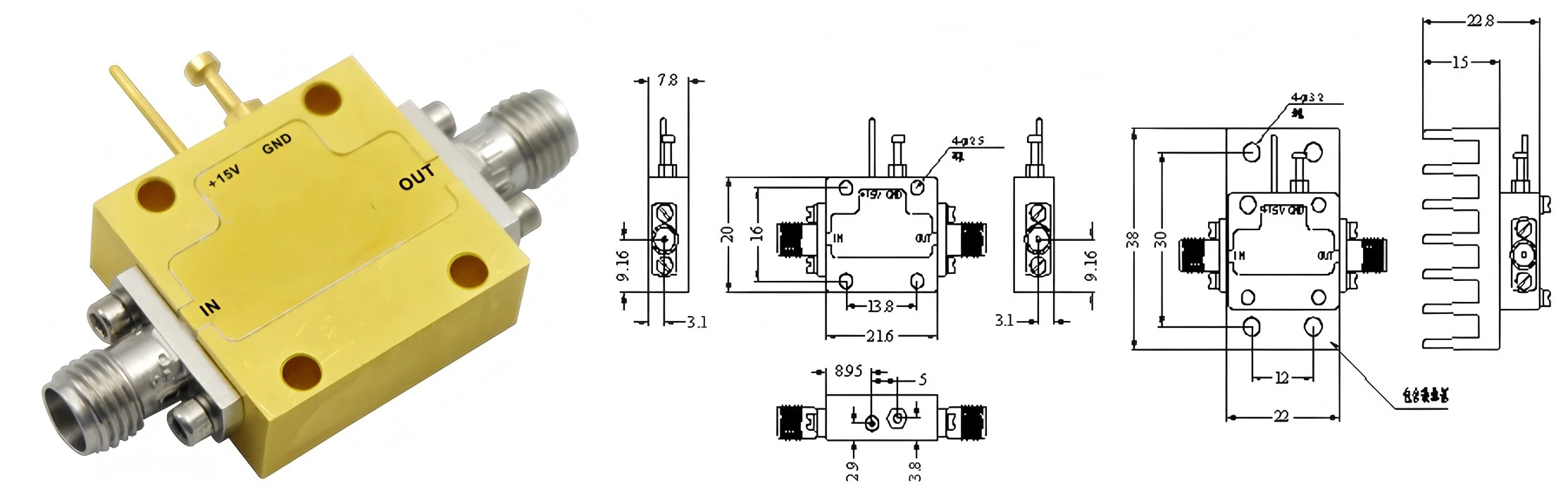
Huasen Microwave Technology Co., Ltd. Ultra Wideband Low Noise Amplifier Solutions
Huasen Microwave Technology Co., Ltd. has established itself as a premier China Low Noise Amplifier manufacturer, delivering high-performance RF and microwave solutions since 1993. As a leading China Low Noise Amplifier supplier and China Low Noise Amplifier factory, the company brings three decades of specialized expertise in designing and manufacturing advanced amplification systems for the most demanding applications. Our Ultra Wideband Low Noise Amplifier product line exemplifies this commitment to excellence, offering frequency coverage from 0.01GHz to 100GHz with gain ranging from 15dB to 50dB and noise figures as low as 1.3dB. These exceptional specifications position our amplifiers at the forefront of the industry, suitable for applications spanning automotive radar, telecommunications infrastructure, aerospace systems, and defense electronics.
The Huasen Ultra Wideband Low Noise Amplifier series leverages advanced Gallium Arsenide and Gallium Nitride semiconductor technologies, incorporating sophisticated thermal management designs that ensure stable performance across demanding operating environments. Our amplifiers feature precision impedance matching optimized for maximum signal transfer efficiency, with interface compatibility including N-type, SMA-type, K-type, and waveguide connectors to accommodate diverse system architectures. Product variants include standard low-noise amplifiers and AC low-noise amplifiers with built-in AC-DC power modules, providing flexibility for different installation and power distribution scenarios. Recognizing that many advanced applications require specialized solutions, we offer comprehensive customization services tailored to specific frequency ranges, gain requirements, and form factor constraints. This combination of standard product excellence and custom engineering capability makes us a preferred China Low Noise Amplifier wholesale partner for organizations worldwide.
Manufacturing Excellence and Testing Infrastructure
Huasen Microwave's manufacturing capabilities represent the foundation of our reputation for delivering high-quality Low Noise Amplifier solutions at competitive prices. Our 3,000-square-meter production facility houses advanced machining and assembly operations supported by over 200 skilled employees, including specialized RF engineers and experienced waveguide fitters. The technical office develops optimized production processes while the machining workshop utilizes CNC lathes, CNC milling machines, EDM, and wire cutting equipment to manufacture precision mechanical components. Our fitting workshop provides comprehensive assembly capabilities including silver brazing, aluminum brazing, vacuum furnace operations, TIG welding, and specialized waveguide processing techniques perfected over decades. The composite materials workshop produces carbon fiber reflectors and radomes with exceptional dimensional accuracy, while our carbonyl iron production capabilities deliver customized absorbing materials for L-band through W-band applications.
Quality control infrastructure includes three microwave anechoic chambers—21-meter, 9-meter, and 5-meter facilities calibrated by the Xi'an Electronic Engineering Research Institute Metrology Laboratory. These chambers enable comprehensive far-field antenna and component testing from 0.5GHz to 220GHz with measurement dynamic ranges up to 50dB. Our planar near-field measurement system covers 0.8GHz to 40GHz, while the 68-probe spherical field system characterizes patterns from 0.4GHz to 8GHz. External test sites extending to 2000 meters support measurements across 30MHz to 110GHz frequency ranges. The test equipment inventory includes 40 vector network analyzers, multiple signal generators, spectrum analyzers up to 320GHz, oscilloscopes, and specialized measurement instruments ensuring every product meets stringent specifications. Environmental testing capabilities encompass RoHS analysis, temperature shock chambers, humidity chambers, vibration testing, and precision dimensional measurement using coordinate measuring machines and optical inspection systems.
Customer Support and Global Distribution
As a nationally recognized High-Tech Enterprise, Huasen Microwave maintains ISO9001 certified manufacturing processes alongside Environmental Management System and Occupational Health and Safety Management System certifications, demonstrating our commitment to quality and responsible operations. Our Low Noise Amplifier for sale includes comprehensive technical documentation, application guidance, and one-year warranty coverage ensuring customer confidence. The engineering team provides expert consultation during product selection, helping customers identify optimal solutions for their specific requirements and assisting with system integration challenges. For organizations requiring custom amplifier designs, our experienced engineering staff works collaboratively from initial specification through prototyping, testing, and production ramp-up, ensuring solutions precisely match application needs.
Huasen Microwave Technology serves global markets through direct sales and authorized distribution channels, with our Import and Export License enabling seamless international transactions. Products ship in ESD-safe packaging with tracking and insurance protection, backed by responsive technical support addressing any installation or operational questions. Whether you need a single prototype for evaluation or high-volume production quantities, our flexible manufacturing capacity and commitment to customer satisfaction make us an ideal partner. Our competitive Low Noise Amplifier price structure, combined with uncompromising quality standards and technical expertise, delivers exceptional value for organizations across telecommunications, aerospace, defense, automotive, and scientific research sectors. To discuss your specific requirements and learn how our Ultra Wideband Low Noise Amplifier solutions can enhance your system performance, contact our sales team at sales@huasenmicrowave.com.
Conclusion
Cryogenic Low Noise Amplifier technology stands at the intersection of quantum computing advancement, astronomical discovery, and next-generation communications systems, where ultra-low noise performance enables previously impossible measurements and capabilities. The convergence of advanced semiconductor technologies, sophisticated thermal engineering, and precision RF design continues pushing performance boundaries toward fundamental quantum limits. Organizations seeking to implement cutting-edge systems must carefully evaluate amplifier specifications, integration requirements, and supplier capabilities to ensure optimal performance and long-term reliability in their demanding applications.
Cooperate with Huasen Microwave Technology Co., Ltd.
Partner with Huasen Microwave Technology Co., Ltd., your trusted China Low Noise Amplifier factory established in 1993, bringing 30 years of specialized expertise in high-frequency microwave and millimeter-wave component manufacturing. Our comprehensive product portfolio includes waveguide components, millimeter-wave and microwave antennas, coaxial devices, and active products serving telecommunications, radar, aerospace, and defense sectors globally. With our 3,000-square-meter R&D and production center equipped with advanced CNC machining, three calibrated anechoic chambers, and over 60 sophisticated test instruments, we deliver High Quality Low Noise Amplifier solutions meeting the most stringent performance specifications. Our ISO-certified processes and National High-Tech Enterprise designation demonstrate our commitment to excellence, while our experienced team of 200+ professionals ensures responsive support and reliable delivery. Discover why leading organizations worldwide choose Huasen Microwave as their preferred China Low Noise Amplifier supplier—contact our team at sales@huasenmicrowave.com to discuss your requirements and request detailed specifications for our Ultra Wideband Low Noise Amplifier solutions.
References
1. Pospieszalski, Marian W. "Extremely Low-Noise Amplification with Cryogenic FETs and HFETs: 1970-2004." IEEE Microwave Magazine, National Radio Astronomy Observatory.
2. Weinreb, Sander, Joseph C. Bardin, and Hamdi Mani. "Design of Cryogenic SiGe Low-Noise Amplifiers." IEEE Transactions on Microwave Theory and Techniques, California Institute of Technology.
3. Russell, David, et al. "Millimeter-Wave Cryogenically-Coolable Amplifier Technology for Next Generation Radio Astronomy Instruments." Proceedings of the IEEE International Symposium on Radio Astronomy Instrumentation.
4. Thoen, David J., et al. "High-Performance Cryogenic Low-Noise Amplifiers Using InP HEMT Technology." Journal of Low Temperature Physics, SRON Netherlands Institute for Space Research.
5. Bardin, Joseph C. "Optimum Noise Measure Terminations for Cryogenic Low-Noise Amplifiers in Quantum Computing Applications." IEEE Transactions on Applied Superconductivity, University of Massachusetts Amherst.
Send Inquiry