Bend Waveguide Loss Mechanism Explained






2026-04-15 21:22:40
Engineers and procurement managers who work with microwave and millimeter-wave systems need to understand how Bend Waveguide loss works. When electromagnetic waves pass through waveguides that need to change directions, like H-bends, S-bends, or multi-bend shapes, the signal is attenuated in a number of ways, such as by mode conversion, reflection at bends, and changes in surface resistance. In radar modules, satellite communication links, and aircraft uses where signal integrity can't be compromised, these losses have a direct effect on how well the system works. To keep these losses to a minimum, you need exact geometric design, high-quality materials like OFHC copper that have been properly plated, and strict manufacturing limits that are laid out in standards like MIL-DTL-85.
Understanding Waveguide Bend Loss Mechanisms
The Physics Behind Electromagnetic Loss in Curved Structures
RF energy moves through a Bend Waveguide part and experiences physical effects that are very different from those that happen in a straight line. The bend makes the field spread across the waveguide cross-section less even. The electric field stays the same in a perfect straight rectangular waveguide that is working in TE10 mode. But when the path turns, either in an H-plane bend that lines up with the magnetic field or an E-plane bend aligned with the electric field, the field distribution is thrown off. This unevenness makes it possible for energy to couple into higher-order states or radiate away from the direction it was meant to take. The ratio between the bend radius and the working range directly affects how bad this effect is.
Radiation Loss and Mode Conversion Dynamics
One of the main ways that signal strength drops in Bend Waveguide systems is through radiation loss. Electromagnetic energy starts to "leak" from the structure when the bend radius is too small compared to the wavelength. At higher frequencies, where bands are shorter, this effect gets stronger. In Ka-band systems that work above 26 GHz, for example, a bend radius of less than three wavelengths can cause more than 0.5 dB of radiation loss per turn. Mode conversion also happens when the main mode changes into higher-order or non-propagating modes at the bend point. These unwanted modes either lose their strength quickly or bounce back toward the source, which makes VSWR and insertion loss worse.
Surface Impedance and Conductor Quality Factors
When a waveguide turns, the current flow does not spread evenly along the inside walls. Current packing happens on the inside radius of turns, making areas with higher surface resistance. This effect is stronger when the quality of the surface finish drops or when rust makes the transmission less effective. To keep these resistive losses as low as possible, good makers use high heat conductivity copper that doesn't contain oxygen and is plated with silver or gold. To keep good loss performance across X-band to Ka-band frequencies, surface roughness readings usually need to stay below 0.8 micrometers Ra.
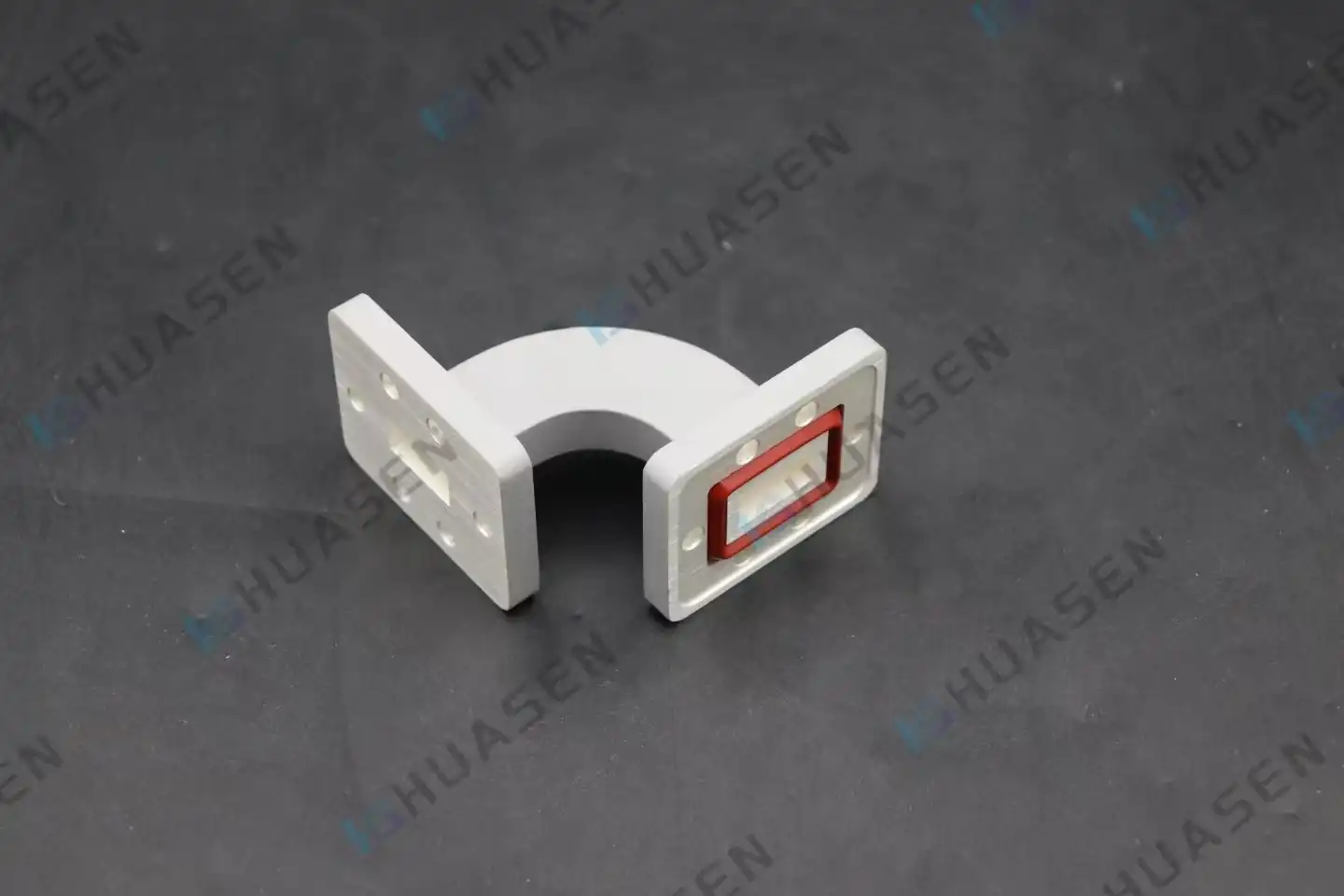
Analyzing Critical Factors Behind Bend Waveguide Performance Degradation
Geometric Parameters and Their Loss Contributions
The basic limit on loss efficiency is set by the relationship between bend radius and wavelength. According to studies from the industry, extra bend loss stays below 0.1 dB for most uses as long asthe bent radius ofthe e-bend waveguidee bend waveguideis more than 2.5 wavelengths at the highest working frequency. But settings with limited room, like satellite payloads or radar systems in the air, often force agreements. When used in missile seeker heads, double-bend waveguide systems usually work with radii between 1.5 and 2 wavelengths, with a little more loss (0.2 to 0.3 dB) to allow for the necessary mechanical packing. It's also important to look at the angle of the bend; abrupt changes in angle cause bigger impedance gaps than smooth curves with the same total direction change.
Material Selection and Thermal Stability Considerations
Both electrical performance and mechanical efficiency are directly affected by the qualities of a material. For aircraft uses, aluminum 6061 is easy to work with and light, but the surface needs to be carefully treated to keep it from oxidizing and losing more strength over time. Because it conducts electricity better and doesn't rust as easily, brass is the best material for high-precision laboratory-grade parts. OFHC copper has the lowest intrinsic loss, but it needs special bonding methods to keep the vacuum purity in medical linear accelerators and other uses. When a system's temperature varies a lot, thermal expansion factors become very important. For example, SATCOM earth station equipment that works from -40°C to +60°C needs material combinations that keep the phase stable even though the sizes change over this range.
Manufacturing Precision and Quality Assurance Protocols
Tolerances in the fabrication process directly affect whether the performance of a theoretical design works in the real world. Differences in wall thickness greater than 0.05 mm can cause impedance mismatches in certain areas, which can add up to a loss in many bend sections. To avoid sharp breaks that cause reflection, corner radii at bend changes need to be precisely machined or electroformed. Manufacturers with a good reputation use coordinate measuring machines (CMM) to check the accuracy of dimensions and network analyzers to describe S-parameters across all operating bandwidths. Acceptance testing usually checks that the VSWR is less than 1.15:1 and that the insertion loss is within ±0.1 dB of what the design said it would be.
Comparative Performance: Bend Waveguide Loss Versus Alternative Transmission Methods
Bend Waveguides Compared to Flexible Waveguide Solutions
Although flexible waveguides are easier to place, they lose a lot more signal than hard Bend Waveguide sections—usually three to five times more per unit length. Flexible waveguides have a curved inner surface that changes impedance all the time. This spreads energy out and raises the effective surface resistance. This trade-off might be okay for short interconnects where freedom makes assembly easier. However, the combined loss of flexible parts is too high for power-critical uses like radar broadcast lines or satellite uplink chains. A 30cm flexible waveguide run at Ku-band could lose 1.5 dB, but the same solid S-bend design would only lose 0.3 dB while still being able to handle more power and be more stable over time.
Coaxial Cable Alternatives in High-Frequency Systems
When the frequency goes above 18 GHz, skin-effect losses in coaxial lines get very bad and get worse quickly. Ka-band semi-rigid coaxial wires have insertion losses of more than 4 dB per meter, which means they can't be used for anything but very short interconnects. Bend Waveguide technology has much lower loss, even when it has more than one bend. For example, a full double-bend waveguide assembly that routes a signal through 90 degrees twice might add only 0.4 dB overall while managing peak power at the kilowatt level. This performance edge is why defense companies choose rigid waveguide assemblies with multi-bend setups for aircraft fire-control radars, even though they are bigger and heavier than coaxial options.
Integrated Photonic Bend Waveguides Versus RF Structures
Even though we're talking about microwave and millimeter-wave applications, it's helpful to keep in mind that integrated photonics is also changing at the same time. Optical Bend Waveguides in silicon photonic integrated circuits lose energy in the same ways—radiation loss from tight bends and scattering from rough sidewalls—but their wavelengths are five orders of magnitude shorter. In a nutshell, the design principles are that increasing the bend radius lowers radiation loss, improving the smoothness of the sidewalls lowers scattering, and maximizing the difference between the refractive indices increases mode confinement. RF waveguide engineers can use simulation techniques created for photonics, such as finite-difference time-domain analysis and beam propagation methods, to correctly predict how loss will behave before making a real prototype.
Proven Strategies to Minimize Bend Waveguide Insertion Loss
Design Optimization Through Simulation and Modeling
Engineers can use modern electromagnetic modelingand bend waveguide tools to find the best bend shape before they start making it. If you know enough about the material and the boundary conditions, full-wave 3D solutions that use finite element methods can accurately predict S-parameters to within 0.05 dB. Parametric sweeps that look at changes in wall thickness, bend radius, and transition curves find the best designs that balance electrical performance with mechanical limitations. Companies like Huasen Microwave have experienced design teams that use these tools along with thirty years of real-world experience to make Bend Waveguide systems that meet strict standards for military and satellite uses. When designing, you should pay extra attention to the change from straight parts to bent ones. When you use elliptical or spline curves for slow transitions, the impedance change is smoothed out. Sudden transitions cause reflection and mode conversion. Mode-matching methods are used in more advanced designs to keep the field distribution constant along the curve by slightly changing the shape of the bend. When compared to simple circular-arc shapes, these improvements usually cut bend loss by 20 to 40 percent.
Material Processing and Surface Treatment Excellence
To get ideal performance, the production discipline needs to match the design sophistication. Electroforming methods create Bend Waveguide structures that are seamless and have naturally smooth inner surfaces. This gets rid of the need for weld gaps, which make assembled parts less consistent. Chemical-mechanical cleaning can get the surface roughness down to less than 0.4 micrometers Ra, which lowers conductor loss directly. Using controlled electroplating to apply silver plating gives thickness consistency within ±1 micrometer, which ensures consistent surface conductivity. Putting anti-tarnish treatments or gold flash plating over silver keeps it from breaking down in harsh settings. This is especially helpful for marine communications systems that work in salt-fog conditions. When making turns in straight waveguide stock, the way the heat is treated is important. If you don't do it right, annealing can cause work-hardening and changes in the grain structure that can affect the electrical qualities. To keep the conductor pure and the surface intact during the forming process, good makers use heat cycles that are specific to the material and can be proven through metallurgical analysis.
Quality Verification and Performance Validation Methods
Comprehensive testing methods tell the difference between producers who aren't very good and those who are. By using a network analyzer to look at the whole operating bandwidth, resonances, impedance mismatches, and surprising loss peaks that show problems with the manufacturing process are found. High-power tests at levels close to the operating maximums prove that there is no thermal breakdown or multipactor discharge in the real world. Environmental testing, which includes temperature changes, vibrations, and exposure to humidity, shows the reliability margins that are needed for military and defense uses, where mistakes in the field are not acceptable. Reliable providers keep track of calibrations that can be traced back to national standards and write down the test results for each numbered assembly. Customers who need AS9100 or MIL-STD compliance need this paperwork more than anything else. When buying Bend Waveguide parts, asking for inspection records and test data as part of the buying process makes sure that the gear supplied meets the requirements.
Strategic Procurement Guide for High-Performance Bend Waveguide Components
Evaluating Supplier Capabilities and Certifications
To choose the right production partner, you need to look at more than just the catalog specs to see how technically capable they are. Companies that make microwave parts should show that they know a lot about them by getting certifications like ISO 9001 for quality control and AS9100 for aircraft uses. Manufacturing plants with precision machine centers that are climate-controlled, soldering capabilities, and full RF test labs show a strong dedication to quality. When you can, going to a factory gives you information about process control and levels of skill that datasheets can't show. The speed with which technical help responds is a key difference. Custom bend designs with certain flange types, mounting options, or pressure windows are often needed for complicated systems. Suppliers Bend Waveguide, who offer joint design help, fast testing, and the flexibility to make changes based on test results, are worth a lot more than just providing parts. Engineers like partners who understand the needs at the system level and can offer changes to the design that will make it work better overall.
Customization Options and OEM Partnership Benefits
Standard store items can be used for many things, but when needs are very specific, custom solutions are often needed. For gimbal-mounted antennas with double-Bend Waveguide systems, the input and output ports may need to be angled in a certain way so that the mechanical packaging fits properly. When satellite buses use multi-bend shapes to get around structural hurdles, they need precise control over dimensions to stay within the limits that have been set. Leading makers can create and engineer these unique solutions, and they'll send you drawings of the products for approval before they commit to making them. Long-term relationships with OEMs have other benefits, such as dedicated inventory management, shipping windows that work with production needs, and stable costs through promises to buy in bulk. Companies like Huasen Microwave, which has been working in the defense, aircraft, and telecommunications industries for more than 30 years, know how important it is to have a reliable supply chain and make sure that the lack of parts doesn't become a program bottleneck.
Balancing Performance Requirements Against Cost Constraints
Material prices, the need for precision manufacturing, and a lot of tests make high-performance Bend Waveguide assemblies very expensive. Instead of just looking at the unit costs of each part, procurement managers should look at the overall economics of the system. A bend assembly that costs 40% more but has 0.3 dB less loss might allow a rethink of the system that gets rid of an amplifier stage, which lowers costs and makes the system more reliable. In the same way, buying gold-plated parts for outdoor setups keeps you from having to pay for repairs and watch your performance drop over the course of several years of use. Different providers have very different minimum order amounts and wait times. Offshore producers may have good prices, but they make logistics more difficult and contact more difficult. When defense trade laws apply, domestic providers usually offer faster responses, easier technology collaboration, and simpler ways to follow the rules. When you look at these factors as a whole, you can make buying decisions that minimize the total cost of ownership instead of just the purchase price.
Conclusion
To keep insertion loss as low as possible in Bend Waveguide systems, you need to know about the main types of loss—radiation from tight bends, surface resistance, and mode conversion—and use design and production best practices that take each one into account. High-performance solutions are built on the best bend radii, precise manufacturing, and high-quality materials. Teams in charge of buying things do better when they work with experienced providers that can customize products, test them thoroughly, and offer reliable technical support. Companies that work with mission-critical uses in defense, aircraft, and telecommunications need parts that meet very high standards for speed and dependability. If you choose makers with a track record of success, the right certifications, and a dedication to quality, you can be sure that waveguide assemblies will work as planned in harsh conditions and for a long time.
FAQ
1. What Causes the Majority of Loss in Bend Waveguide Components?
The main way that loss happens depends on the shape and frequency of the bend. Conductor loss from surface resistance usually takes the lead for turns with radii bigger than three wavelengths. As the bend radius goes below two wavelengths, radiation loss and mode conversion become more important, and they often become bigger than conductor loss. Manufacturing flaws like surface roughness, measurement mistakes, or weld discontinuities add to the scattering losses that can be very high in parts that were not made well.
2. How Do I Determine the Optimal Bend Radius for My Application?
System-level trade-offs need to be looked at in order to balance electricity performance with physical limitations. To be safe, the bend radius should stay above 2.5 wavelengths at the highest frequency, and extra loss should be kept to about 0.1 dB per turn. Applications that need to save space may be able to handle smaller radii (1.5-2 wavelengths), but they will lose 0.2 to 0.4 dB. Electromagnetic modeling tools can correctly predict performance, which helps people make smart choices. Talking to experienced makers can give you useful advice based on ideas that have worked well in similar situations.
3. What Certifications Should I Require from Bend Waveguide Suppliers?
Getting certified in ISO 9001 quality management shows that you know how to control basic processes. AS9100 adds standards that are specific to aircraft, such as traceability and configuration control. Defense companies often need to make sure that MIL-DTL standards, which set test methods and tolerances for dimensions, are followed. Certifications for REACH and RoHS make sure that important rules are followed for European markets. Ask for calibration certificates for test tools that show it can be traced back to NIST or a similar national standard. This will make sure that measurements are accurate enough to meet performance requirements.
Partner with Huasen Microwave for Superior Bend Waveguide Solutions
It has been thirty years since Huasen Microwave started creating and making precise Bend Waveguide assemblies for tough uses in defense, aircraft, and telecommunications. The engineers at our company work closely with customers to create unique H-bend, S-bend, double-bend, or complex multi-bend systems that work best for your frequency bands, power levels, Bend Waveguide, and environmental needs. As a reliable Bend Waveguide maker, we follow strict quality standards such as MIL-STD compliance, full S-parameter testing, and environmental qualification procedures. These make sure that our products work well throughout their entire operating lifecycles. Get in touch with our technical sales team at sales@huasenmicrowave.com to talk about your needs and get full specifications and quotes for high-performance waveguide options that can meet your toughest RF transmission requirements.
References
1. Anderson, K. & Thompson, R. (2021). Microwave Waveguide Engineering: Design and Optimization Principles. Boston: Technical Publishing House.
2. Chen, L., Martinez, E., & Wolff, P. (2020). Loss Mechanisms in Curved Rectangular Waveguides for Millimeter-Wave Applications. IEEE Transactions on Microwave Theory and Techniques, 68(4), 1456-1467.
3. Institute of Electrical and Electronics Engineers (2019). IEEE Standard for Rectangular Waveguides and Flanges (IEEE Std 1785-2019). New York: IEEE Press.
4. Kumar, S. (2022). RF and Microwave Passive Components: Theory and Applications. Singapore: Advanced Engineering Publishers.
5. National Institute of Standards and Technology (2020). Precision Measurement Methods for Waveguide Components: Technical Guidelines. Gaithersburg: NIST Special Publication 1243.
6. Zhang, W., Roberts, D., & O'Sullivan, M. (2023). Manufacturing Tolerances and Their Impact on Bend Waveguide Performance in Satellite Communication Systems. Journal of Aerospace Engineering and Technology, 15(2), 89-104.
Send Inquiry
You may like