Why Quadridged Horn Antenna Is Preferred in Microwave Measurements






2026-07-24 16:24:39
Quadridged horn antennas have become the gold standard in microwave measurements because they solve a critical industry challenge: achieving ultra-wideband coverage while maintaining dual-polarization capability in a single device. Unlike conventional horn antennas that require multiple units to cover different frequency ranges or polarizations, quadridged designs deliver multi-octave bandwidth—often spanning 0.1 to 40 GHz—with stable gain and exceptional isolation between orthogonal polarization channels. This capability significantly reduces equipment costs, simplifies test setups, and accelerates measurement cycles in demanding applications such as 5G validation, radar calibration, and EMC compliance testing.
Introduction
Antenna technology has a big impact on how accurately microwave measurements are made. Signal distortion over wide frequency ranges, limited bandwidth that forces frequent equipment changes, and polarization mismatches that compromise data integrity are problems that engineers who test telecommunications, develop radar systems, and check electromagnetic compatibility have to deal with all the time. These problems directly affect how often tests can be done, how well systems work, and, in the end, when products can be certified.
Quadridged horn antennas solve these problems with a special four-ridged internal design that lets them handle both horizontal and vertical polarization at the same time and over many frequency ranges. These antennas have the bandwidth, polarization flexibility, and gain stability that current microwave measurements need. They can be used to test 5G base station components, calibrate satellite communication systems, or do radiated immunity testing according to MIL-STD-461. In this guide, we'll look at why purchasing managers at system integrators, test labs, and equipment manufacturers are asking for quad-ridged horn antenna designs more and more for their most important measurement tasks.
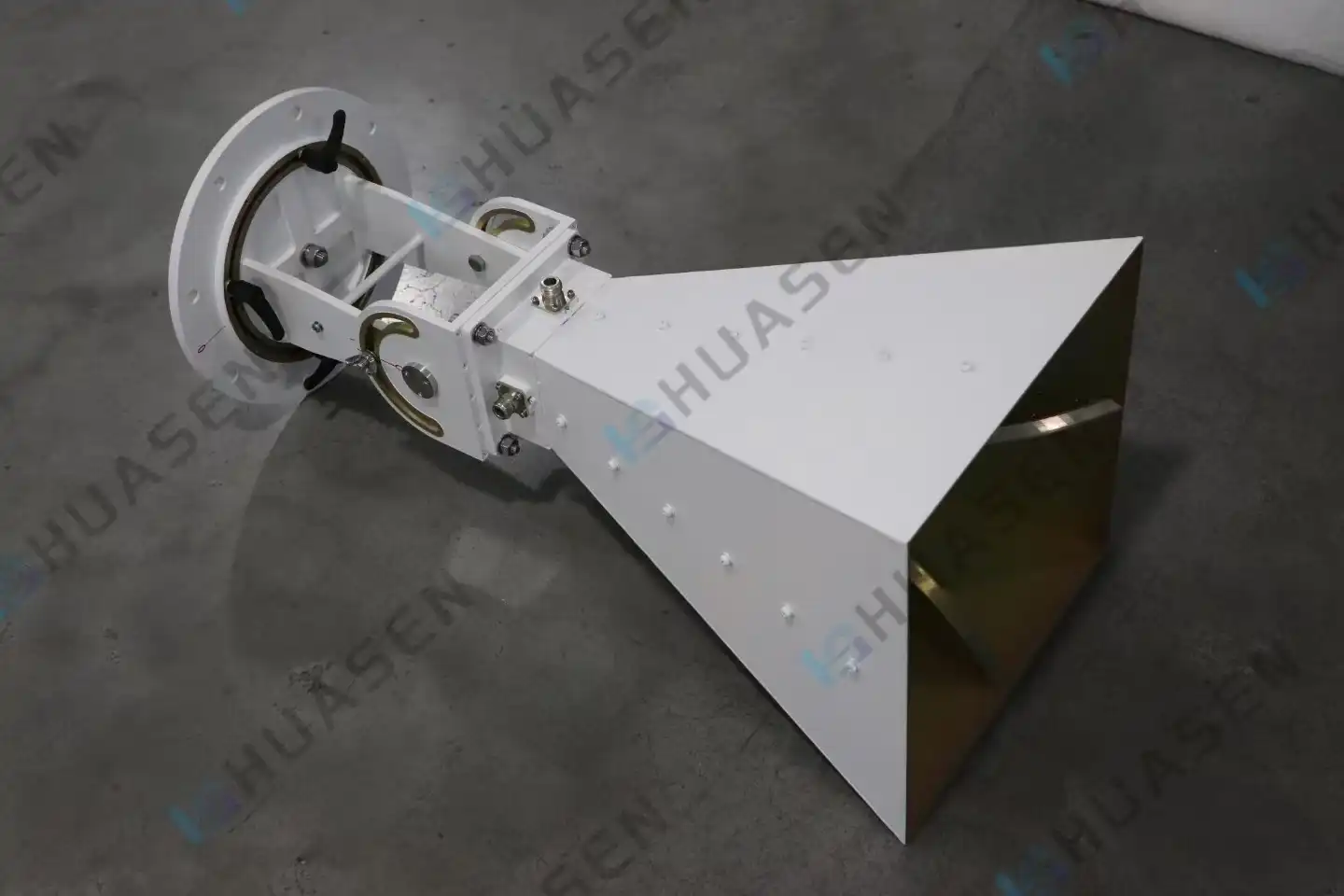
Understanding the Quadridged Horn Antenna
Design Architecture and Operating Principles
The quadridged horn antenna has four metal ridges that are arranged symmetrically inside a curved waveguide frame. This shape is very different from pyramidal or conical horns, which can usually only support one straight polarization. The ridges go along the tapered part of the horn, making a broadband impedance-matching network that keeps the VSWR low (usually less than 2.0:1) even when the frequency ratio goes over 10: 1.
Each pair of ridges that face each other links to a different port. This lets you control the horizontal and vertical electric field components separately. This two-port design lets you send and receive orthogonal linear polarizations at the same time with isolation levels higher than 20 dB, which is a key requirement for accurate measures of cross-polarization discrimination. As the impedance changes from the input connector through the aperture, the tapered ridge profile keeps the phase center stable across the operational bandwidth and minimizes reflections.
Frequency Coverage and Bandwidth Capabilities
The frequency ranges covered by modern quad-ridged horn antennas are astounding. The Ultra-Wideband Dual-Polarized Quadridged Horn Antenna Series (DPHA) and Boundary Open Dual-Polarized Quadridged Horn Antenna (DPOBHA) from Huasen Microwave cover frequencies from 0.1 GHz to 40 GHz. They can be used instead of six or more narrowband antennas in many situations. Because of this wide range, antenna swaps are not needed during swept-frequency readings, which saves a lot of time and makes the lab much more productive.
The bandwidth was reached by carefully adjusting the shape of the ridges. As the frequency goes up, the electromagnetic field moves along the ridges to keep the radiation pattern and impedance matching the same. Engineers can count on antenna factors that are reliable across the whole band. This makes calibration easier and makes sure that measurements can be traced back to national standards.
Polarization Versatility: Linear and Circular Options
The two ports automatically work with both horizontal and vertical linear polarizations. To make circular polarization, each port can be driven separately or all at once through external networks. The antenna can produce either left- or right-hand circular polarization when connected to a 90-degree hybrid coupler. This is necessary for testing satellite communications and measuring radar cross-section.
This polarization flexibility gets rid of a usual problem that comes up when testing in an anechoic room. Traditional antennas with only one polarization need to be mechanically rotated between measurement runs, which takes up valuable chamber time. Electronic polarization swapping or simultaneous dual-polarization gathering is possible with quad-ridged horn antenna designs. In many cases, this cuts test times by more than half.
Why Are Quadridged Horn Antennas Ideal for Microwave Measurements?
Gain Stability and Radiation Pattern Consistency
For measurements to be accurate, the antenna must work in a stable, predictable way. With a smooth gain progression across the band, quad-ridged horn antennas can produce gain ranging from 5 dB at low frequencies to 19 dB at high frequencies. This feature makes it easier to figure out antenna factors and lowers the uncertainty in calibration.
The radiation pattern stays the same in terms of beamwidth and sidelobe structure across frequencies. This is a very useful feature in the compact antenna test range (CATR), where the stability of the feed antenna pattern directly affects the consistency of the quiet zone. Log-periodic antennas have patterns that change a lot with frequency. Quadridged horn antenna designs, on the other hand, are repeatable enough for precise readings.
Superior Cross-Polarization Discrimination
How well an antenna separates orthogonal polarization components is measured by cross-polarization detection. Isolation levels above 30 dB on-axis are reached by high-quality quad-ridged horn antenna designs. This keeps signals meant for vertical polarization from messing up horizontal measurements. In antenna characterization, where cross-pol levels of -30 dB or less must be reliably detected, this performance has a direct effect on the accuracy of measurements.
Cross-polarization production is naturally kept to a minimum by the physical symmetry of the four-ridge arrangement. Tolerances in manufacturing are very important here, because tiny changes in how the ridges are aligned can make separation worse at higher frequencies. Production units meet the required isolation performance thanks to strict quality control measures such as laser-based measurement verification and full-band VNA characterization.
Application Performance Across Industries
The quad-ridged horn antenna measurement benefits have been proven in the real world:
- EMC/EMI Testing Labs: Quadridged Horn Antennas are used as both field generators and measurement tools in radiated immunity tests that are done in labs in line with CISPR or vehicle EMC standards. Being able to quickly change polarization without having to physically rotate tools cuts room occupancy time by 40–60%, which directly saves money and makes it possible to do more tests.
- 5G Base Station Validation: To figure out the base station radiation patterns, equipment makers use wideband dual-polarized reference antennas. This is because 5G networks use massive MIMO systems with complicated polarization schemes. The Quadridged Horn Antenna covers the 0.1–40 GHz range, covering all 5G FR1 and FR2 bands in a single device, making sure that measurements are made the same way across the whole spectrum.
- Radar System Calibration: When defense companies calibrate phased array radars, they need reference antennas that have stable, known properties across the radar's working bandwidth. The gain and pattern of the quadridged horn antenna can be predicted, which makes it possible to accurately calibrate the system. This helps with checking the sensing range and the rejection of clutter.
Table 1: Quadridged Horn Antenna vs. Alternative Technologies
| Parameter | Quadridged Horn | Log-Periodic | Standard Gain Horn |
|---|---|---|---|
| Bandwidth Ratio | 10:1 to 400:1 | 10:1 typical | 1.5:1 typical |
| Polarization | Two Linear/Circular | Single Linear | Single Linear |
| Gain Stability | ±1 dB across the band | ±3 dB typical | ±0.5 dB (narrow band) |
| Pattern Consistency | Very good | Moderate | Very good (narrow band) |
| Port Isolation | >25 dB | N/A | N/A |
| Size (relative) | Moderate | Large | Compact |
Procurement Considerations for Quadridged Horn Antennas
Matching Technical Specifications to Application Requirements
Setting measuring needs is the first step in making procurement choices. Managers of labs need to say what frequency range will work for current and future testing needs. You can be ready for new millimeter-wave uses in the future by choosing a quad-ridged horn antenna that works at 0.1 to 40 GHz. On the other hand, a model that works at 1 to 18 GHz may be able to meet your current 5G sub-6 GHz and radar testing needs for less money.
The test distance and signal strength determine how much gain is needed. When measuring far away, higher-gain antennas focus energy into narrower beams, which is good but could be a problem in close areas where wide, even lighting is needed. To choose the best antenna, you need to know how to balance gain, beamwidth, and measurement distance.
Connector type affects both frequency range and power handling. Precision K connectors can work up to 40 GHz, while SMA connectors can work up to 18–26 GHz with moderate power. When checking for high-power immunity, 7/16 DIN or N-type plugs can handle hundreds of watts but usually can only handle frequencies up to 18 GHz. Huasen Microwave's DPHA and DPOBHA series have a variety of connector configurations to meet the needs of a wide range of applications.
Evaluating Manufacturer Capabilities and Support
Comparing datasheets isn't the only way to find a reliable manufacturer. Professionals in procurement should look at a number of important factors. Companies that have been making things for a long time, like Huasen Microwave, which was formed in 1993 and has decades of experience in RF, have fine-tuned production methods that make sure that all production lots have the same quality and performance.
Having the ability to customize meets specific needs. A lot of system developers need different frequency bands, special mounting connections, or unique connector configurations. When a manufacturer does both design and production in-house, they can quickly prototype custom solutions, which shortens the time it takes to develop them. The technical team at Huasen Microwave can change the frequency, polarization, and mechanical parts to meet the needs of a particular system integration.
Total cost of ownership is affected by after-sales help in a big way. Deployment risk is lower when people have access to calibration data, individual unit test results that can be traced back to national standards, and quick expert help for problems with integration. Ask for sample calibration certificates and find out about recalibration services and turnaround time when you are looking at different suppliers.
Table 2: Huasen Microwave Quadridged Horn Antenna Series Specifications
| Model Series | Frequency Range | Gain | Polarization | VSWR | Isolation | Adjustment |
|---|---|---|---|---|---|---|
| DPHA | 0.1-40 GHz | 5-19 dB | Dual Linear | 2.0:1 | >20 dB | 6 axes of positioning |
| DPOBHA | 0.1-40 GHz | 5-19 dB | Dual Linear/Circular | 2.0:1 | >20 dB | 6 axes of positioning |
Supply Chain and Delivery Considerations
Project timelines are affected by how reliable the global supply chain is. When choosing makers, you should look at how they get their parts and how much they can make. Companies that have good ties with their suppliers and enough supplies can keep their delivery plans even when the markets for their parts change.
Lead time changes based on how much customization is needed. Standard catalogue items usually ship between 2 and 4 weeks, but engineering, testing, and production for unique designs can take up to 12 weeks. Early on in the project, procurement managers should share schedules so that delivery dates are in line with system integration milestones. Huasen Microwave keeps up with the demand for both standard and custom quad-ridged horn antenna designs, so they can meet the shipping needs of projects ranging from single lab sets to multi-site deployments.
Conclusion
Quadridged horn antennas provide the performance characteristics required for modern microwave measurements, including ultra-wideband coverage that eliminates the need to swap out multiple antennas, dual-polarization capability that enables electronic polarization control, and stable gain with consistent radiation patterns that ensure accurate measurement. Because of these benefits, equipment prices go down, test runs speed up, and measurement accuracy goes up. These benefits can be seen in a wide range of situations, from EMC compliance to 5G validation and radar calibration.
When making a purchase choice, technical specs should be weighed against what the application needs, what the maker can do, and how long the product will be supported. Knowing about VSWR, gain stability, polarization isolation, and calibration traceability helps you choose the right antenna. Huasen Microwave's 30 years of experience with radio frequency (RF) technology and wide range of products make it possible for measurement systems to be used successfully all over the world.
FAQ
1. What distinguishes quadridged horn antennas from pyramidal horn designs?
Pyramidal horns can only handle one linear polarization and usually work with bandwidth ratios of 1.5:1. Quadridged horn antennas have four ridges inside them that make them work as two ports at the same time, allowing for both horizontal and vertical polarization. They also have isolation levels of more than 20 dB and can achieve bandwidth ratios of 10:1 or higher. This stops antennas from rotating while testing and lowers the number of pieces of equipment needed.
2. Can quadridged horn antennas generate circular polarization?
Dual linear polarization is made by the antenna itself. To get circular polarization, either left-hand or right-hand, you need to connect a 90-degree hybrid coupler to both antenna ports. The coupler adds the phase shift needed to make circular polarization, which is important for testing satellite communications and some radar uses.
3. How often should the calibration be performed?
Laboratories that follow ISO 17025 usually do calibrations every 12 to 24 months. If the antenna experiences a mechanical shock or acts in a way that isn't expected during regular checks, it needs to be recalibrated right away. VSWR, gain, and antenna factors are checked for accuracy during calibration, which makes sure that measurements can be tracked back to their source.
4. What power handling limitations apply?
Power capacity depends on the type of connector and the distance between the internal ridge gaps. Most SMA connections can only handle 50–100W of continuous wave power, but 7/16 DIN sockets can handle 300–500W. For tests of high-power immunity that go beyond these levels, makers can ask for better plugs and wider ridge spacing to keep the voltage from dropping.
Partner with Huasen Microwave for Your Next Measurement Project
Huasen Microwave makes quad-ridged horn antenna solutions that are precisely engineered to meet your testing needs. Our DPHA and DPOBHA series work well in telecommunications, defense, and military uses around the world and cover frequencies from 0.1 GHz to 40 GHz. As a well-known company that makes quad-ridged horn antennas and has its own design and fabrication department, we can help with both standard configurations and custom developments. You can email our expert sales team at sales@huasenmicrowave.com to talk about your application needs, get calibration data, or get cheap quotes for buying in bulk.
References
1. Balanis, Constantine A. "Antenna Theory: Analysis and Design." 4th Edition, John Wiley & Sons, 2016.
2. Institute of Electrical and Electronics Engineers. "IEEE Standard for Definitions of Terms for Antennas." IEEE Std 145-2013, 2014.
3. American National Standards Institute. "American National Standard for Electromagnetic Compatibility—Radiated Emission Measurements in Electromagnetic Interference Control—Calibration of Antennas." ANSI C63.5-2017.
4. Milligan, Thomas A. "Modern Antenna Design." 2nd Edition, John Wiley & Sons, 2005.
5. European Telecommunications Standards Institute. "Electro-Magnetic Compatibility and Radio Spectrum Matters: Antennas and Antenna Systems for EMC Measurements." "ETSI TR 100 028-2 V1.4.1, 2001.
6. Society of Automotive Engineers. "Calibration of Electromagnetic Field Strength Above 1 GHz." SAE ARP 958D, 2014.
Send Inquiry