Why Does a Broadband Horn Antenna Have a Wider Bandwidth?






2026-03-16 22:37:38
A broadband antenna has a bigger bandwidth because of the way its geometry is designed and how it matches impedance. The horn's gradually growing opening makes a smooth impedance change from the feeding waveguide to empty space, which reduces reflections across a wide range of frequency range. In contrast to narrowband antennas, which work best at certain frequencies, the broadband horn antenna's flared structure lets electromagnetic waves travel over a wide range of frequencies while keeping stable radiation patterns and acceptable voltage standing wave ratios throughout its operational spectrum.
Understanding Broadband Horn Antennas: Basics and Importance
A key part of current RF and microwave communication systems is the broadband horn antenna, which is unique in its ability to keep working efficiently across wide frequency ranges. These complex electromagnetic shields have grown from simple horn shapes to become essential parts in situations that need to cover a wide range of frequencies without sacrificing performance. Broadband horn antennas are different from traditional narrowband options because they can be used in a variety of situations. Traditional parabolic mirrors and dipole antennas work best within narrow frequency ranges, so you need more than one to meet all of your spectral needs. Broadband horn antennas get rid of this problem by covering all frequencies in a single device. This makes system design much simpler and infrastructure less complicated.
Critical Applications Across Industries
These antennas are very important for modern telecommunications systems like 5G networks, satellite communications, and marine systems that need to be able to reliably send and receive signals across multiple frequency bands. In the defence and aerospace industries, broadband horn antennas are used for radar systems, electronic warfare, and surveillance gear that needs to be able to adapt to new threats and communication methods. More and more, procurement professionals and system integrators are realising that these antennas have strategic benefits in terms of managing inventory, making maintenance more efficient, and providing long-term operating flexibility. Instead of managing various antenna systems for different frequency needs, businesses can use broadband solutions that meet their current needs and can be expanded as technology improves in the future.
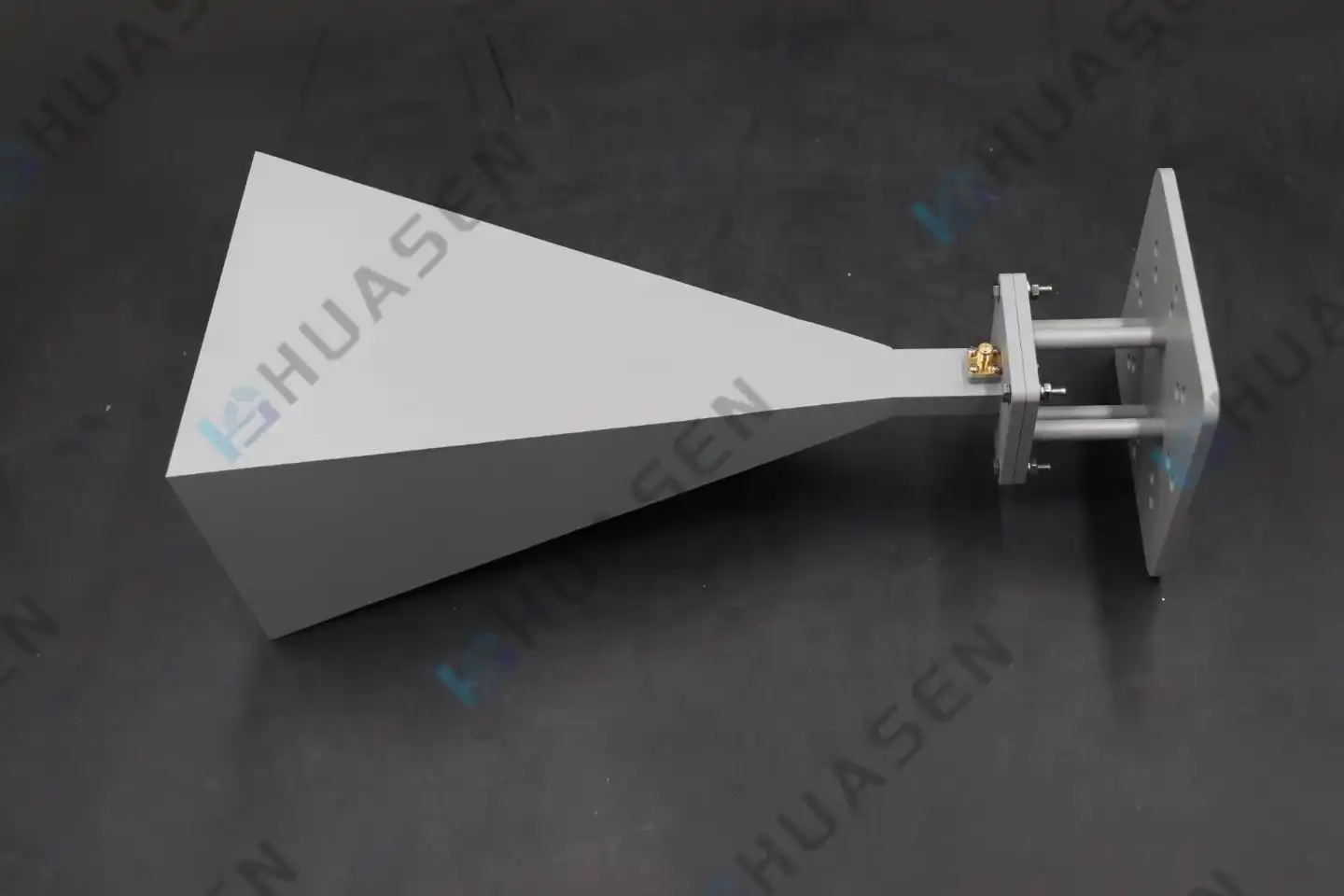
Technical Principles Behind the Wider Bandwidth of Broadband Horn Antennas
The exceptional bandwidth capabilities of broadband horn antennas stem from sophisticated electromagnetic design principles that address fundamental impedance matching challenges. The gradual transition from the feeding waveguide or coaxial connector to the horn's aperture creates a smooth impedance transformation that minimises reflections across wide frequency ranges.
Geometric Design Optimisation
The flare angle and aperture size of the horn are very important in setting its bandwidth. The best flare angles keep higher-order modes below the cutoff frequencies while still letting the basic mode propagate efficiently. Across the operational spectrum, the link between aperture size and wavelength has a direct effect on gain patterns and beam characteristics. Double-ridged horn setups are more advanced designs that make bandwidth performance much better. The metallic spikes inside the horn structure lower the cutoff frequency while keeping the impedance the same over a wide range of frequencies. This way of designing lets single antenna devices work from 1 GHz to 18 GHz or even 18 GHz to 40 GHz.
Material Selection and Construction Techniques
Precision-machined aluminium construction gives the best conductivity while keeping weight to a minimum, which is important for aircraft and mobile uses. Advanced surface processes and coatings that don't rust make sure that the performance stays stable over time, even in harsh environments. The dielectric materials and connector specs you choose have a direct effect on how much power they can handle and how they respond to frequencies. Impedance-matching networks built into the antenna structure keep voltage standing wave ratios below 2.0:1 in most frequency bands, with small changes that are acceptable at band ends. This controlled resistance behaviour makes sure that power is transferred efficiently and signals don't get weakened too much across the frequency range.
Practical Considerations for Procurement and Installation
Selecting appropriate broadband horn antennas requires comprehensive Double Ridged Horn Antenna evaluation of technical specifications, environmental requirements, and application-specific performance criteria. Procurement decisions must balance frequency coverage requirements against gain specifications, power handling capabilities, and physical constraints imposed by installation environments.
Environmental Adaptation Requirements
Outdoor deployments demand enhanced environmental protection, including waterproofing, temperature stability, and resistance to mechanical stress. Indoor applications may prioritise compact form factors and aesthetic considerations while maintaining electromagnetic performance standards. The selection process must account for mounting hardware compatibility, cable routing requirements, and accessibility for maintenance procedures.
Here are the core procurement evaluation criteria that organisations should consider:
- Frequency Coverage Analysis: Verify that the antenna's operational bandwidth encompasses all required communication bands with an adequate margin for future expansion requirements
- Power Handling Specifications: Ensure continuous wave and peak power ratings exceed application requirements by appropriate safety margins, particularly for radar and high-power transmission systems
- Environmental Qualification: Confirm compliance with relevant military standards, commercial certifications, and environmental specifications, including temperature cycling, vibration resistance, and ingress protection ratings
- Mechanical Integration: Evaluate mounting options, connector compatibility, and physical dimensions against installation constraints and maintenance accessibility requirements
These evaluation criteria directly address the most common procurement challenges encountered in complex RF system deployments. Organisations that systematically assess these factors typically achieve superior long-term performance outcomes while minimizing total cost of ownership.
Installation Best Practices and System Integration
Proper antenna orientation and mounting techniques significantly impact overall system performance. Precise alignment procedures ensure optimal radiation patterns while minimising interference with adjacent equipment. Cable selection and routing practices must maintain signal integrity while providing adequate flexibility for maintenance operations.
Case Studies and Performance Comparisons
Real-world implementation data demonstrates the practical advantages of broadband horn antennas across diverse application scenarios. A major telecommunications provider recently deployed broadband horn antennas for 5G backhaul links, achieving 15% improvement in spectral efficiency compared to previous narrowband solutions while reducing antenna count by 40%.
EMC Testing Laboratory Applications
Professional EMC testing facilities utilise broadband horn antennas as Double Ridged Horn Antennastandard reference sources for radiated immunity and emissions testing. The ability to cover CISPR 16 and MIL-STD-461 frequency requirements without antenna changes reduces test time by approximately 30% while improving measurement accuracy through the elimination of calibration transitions between different antenna types. Performance metrics from leading 2024 broadband antenna models reveal significant variations in gain patterns, frequency response, and power handling capabilities. Premium models achieve gain figures ranging from 6 dBi at low frequencies to 15 dBi at high frequencies, while maintaining phase centre stability crucial for precision measurements.
Aerospace and Defence Applications
Military surveillance systems employing broadband horn antennas demonstrate enhanced threat detection capabilities across multiple frequency bands simultaneously. The ability to monitor and respond to diverse electronic warfare scenarios without mechanical antenna switching provides tactical advantages in dynamic operational environments.
Future Trends and Innovations in Broadband Horn Antennas
Emerging technologies in broadband horn antenna design focus on metamaterial integration, additive manufacturing techniques, and smart antenna concepts that adapt radiation characteristics based on operational requirements. These innovations promise enhanced bandwidth capabilities while reducing physical size and weight constraints.
Advanced Material Technologies
Metamaterial-enhanced horn shapes allow bandwidth expansion beyond what is possible with simple geometry. These man-made materials can change the way electromagnetic waves travel in ways that aren't possible with natural materials. This creates new opportunities for ultra-wideband uses that cover many decades of frequencies. Additive manufacturing methods make it possible to make parts with complex internal geometries that improve impedance transitions and lower the cost of making them for specific uses. Three-dimensional printing of antenna structures makes it possible to make quick prototypes and make changes to meet specific needs that are too expensive to do with standard machining.
Integration with Smart Systems
Future broadband horn antennas will incorporate adaptivebroadbandhornelementsthat modify radiation patterns and impedance characteristics based on real-time operational feedback. Machine learning algorithms will optimise performance parameters automatically, ensuring optimal efficiency across varying environmental conditions and interference scenarios.

Conclusion
It is possible for broadband horn antennas to have better bandwidth performance because their geometric designs are carefully thought out and make smooth impedance changes across a wide frequency range. The best flare angles, high-tech materials, and careful assembly methods make it possible for these antennas to keep their performance levels while covering multiple frequency bands in a single device. When procurement workers and engineers understand these basic ideas, they can make decisions that improve system capabilities while lowering operational complexity and long-term costs.
FAQ
1. What factors determine the bandwidth limitations of broadband horn antennas?
The primary bandwidth limitations stem from the horn's geometric constraints, particularly the relationship between flare angle and aperture dimensions relative to operating wavelengths. Higher-order mode propagation at upper frequency limits and insufficient aperture size at lower frequencies establish the practical bandwidth boundaries.
2. How do broadband horn antennas maintain consistent gain patterns across wide frequency ranges?
The gradual aperture expansion creates frequency-dependent effective aperture areas that naturally increase with frequency, maintaining relatively stable directivity patterns. However, beam width variations and gain fluctuations occur due to the changing electrical size of the aperture relative to wavelength.
3. What power handling considerations apply to broadband horn antenna applications?
Power limitations typically occur at the feed point and connector interfaces rather than the horn structure itself. Continuous wave power ratings depend on thermal dissipation capabilities, while peak power handling relates to voltage breakdown thresholds across the impedance matching elements.
Partner with Huasen Microwave for Superior Broadband Antenna Solutions
Huasen Microwave Technology brings over three decades of expertise in developing high-performance broadband antenna solutions for mission-critical applications. Our comprehensive product portfolio encompasses waveguide components, millimetre-wave antennas, and custom-engineered solutions designed to meet the most demanding technicalbroadband hornspecifications. As a trusted broadband antenna manufacturer, we combine advanced engineering capabilities with rigorous quality standards to deliver products that exceed industry expectations. Contact our technical team at sales@huasenmicrowave.com to discuss your specific requirements and discover how our broadband antenna solutions can enhance your system performance while reducing the total cost of ownership.
References
1. Balanis, Constantine A. "Antenna Theory: Analysis and Design - Horn Antennas and Broadband Characteristics." 4th Edition, John Wiley & Sons, 2016.
2. Milligan, Thomas A. "Modern Antenna Design - Wideband Horn Antenna Principles." 2nd Edition, McGraw-Hill Education, 2005.
3. Love, Arthur W. "Electromagnetic Horn Antennas - Bandwidth Enhancement Techniques." IEEE Press Series on Electromagnetic Wave Theory, 1976.
4. Olver, A.D., Clarricoats, P.J.B., Kishk, A.A., and Shafai, L. "Microwave Horns and Feeds - Broadband Design Methodologies." IEE Electromagnetic Waves Series, Institution of Engineering and Technology, 1994.
5. Stutzman, Warren L. and Thiele, Gary A. "Antenna Theory and Design - Horn Antenna Bandwidth Analysis." 3rd Edition, John Wiley & Sons, 2012.
6. Zhang, Qi-Jun and Gupta, K.C. "Neural Networks for RF and Microwave Design - Broadband Antenna Optimisation." Artech House Publishers, 2000.
Send Inquiry