Where to Buy High-Precision Waveguide Power Dividers for Radar Systems?






2026-04-12 21:47:59
Procuring high-precision waveguide power dividers for radar systems requires partnering with manufacturers who understand the critical balance between signal integrity, power handling, and environmental resilience. Huasen Microwave Technology Co., Ltd., established in 1993, stands as a trusted source for these sophisticated microwave components. With facilities capable of producing double-ridge waveguide magic tees, in-phase dividers, and one-to-many splitters across the 0.32 GHz to 112 GHz spectrum, the company delivers directly to system integrators, defense contractors, and research institutions worldwide. Whether you're based in the Americas, Europe, Asia, or the Middle East, accessing reliable waveguide distribution solutions begins with identifying suppliers who combine technical expertise with robust quality assurance.
Why Global Sourcing of Waveguide Distribution Components Matters
A lot of specialised information is needed to work in the microwave and millimeter-wave industries. No matter if they are making AESA arrays for defence purposes or networks for watching the weather, radar system designers can't skimp on how precisely they distribute signals. If you don't match the power splitter properly, it can cause phase errors that spread through phased arrays, which lowers the accuracy of beam steering and target resolution. Buying from foreign markets has clear benefits. Established manufacturers in North America and Europe usually follow MIL-STD-202 and ETSI standards very closely. On the other hand, new suppliers in Asia offer reasonable prices without lowering performance standards. When procurement teams know what the region's strengths are, they can balance cost limits with technical needs. The hard part is making sure these needs are met. Waveguide components need to be tested in a lab, which is different from household electronics, where user reviews prove quality. You can't just look at something to figure out the insertion loss, isolation characteristics, or return loss across operating bandwidths. Because of this, choosing a supplier is more of a strategic choice than a simple purchase. Lead times and logistics are affected by geography. A project to place radar in Saudi Arabia benefits from suppliers who know how to deal with local customs and can send ruggedised parts that can handle the hot and cold temperatures of the desert. On the other hand, a European research lab might value closeness for rapid prototyping changes. Successful procurement plans take these details into account.
Understanding Waveguide Power Distribution Technology
Core Operating Principles
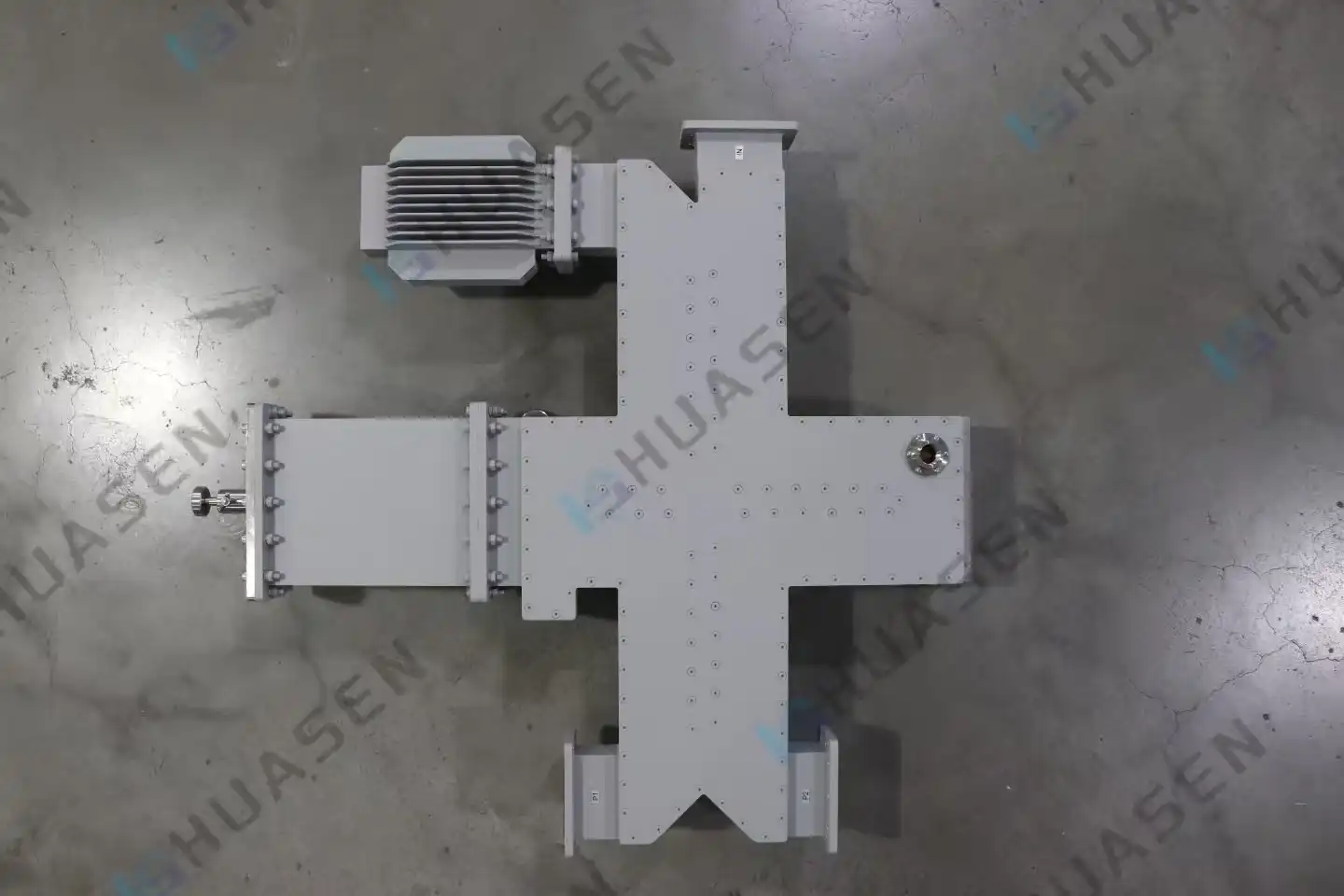
Power division in waveguide systems uses electromagnetic field manipulation in metal holes that have been carefully machined. Waveguide junctions work differently from coaxial splitters because they use air-filled cross-sections where the TE10 mode can travel with little loss. A magic tee structure gives you four ports and naturally separates arms that are collinear, which is important for monopulse radar comparators. The double-ridge variant increases the operational bandwidth by lowering the cutoff frequency while keeping single-mode propagation. This design solves the problem that radar systems have when they need to cover an octave without using moving parts. Manufacturers change the impedance of the broad walls by adding ridges. This makes the shift between different waveguide sections smooth.
Critical Performance Parameters
Radar range models are directly affected by insertion loss. For every extra 0.5 dB of loss, the actual radiated power goes down, which makes the detection envelope smaller. Precision CNC machining and electroless silver plating, which reduces surface resistance, are used to make high-quality dividers with loss figures below 0.3 dB across their operational band. Isolation between output ports stops signal leakage that messes up phase coherence in beamforming networks. A minimum separation level of 20 dB is often required by military standards. This makes sure that amplitude imbalances in one array element don't affect channels next to it. The magic tee shape naturally does this because its E-plane and H-plane junctions are symmetric. In phased arrays, phase balance is very important. Pointing mistakes that can be measured in milliradians can happen with just a 5-degree difference between the output arms. Manufacturers achieve sub-degree balance by using alloys that are stable at high and low temperatures and matched path lengths. This stops thermal expansion mismatches during changes in working temperature.
Application-Specific Variants
I-Type and U-Type Dividers: These are linear configurations that work well in feed networks where room is limited and small layouts are preferred. The U-type bends signal paths 180 degrees, which lets a lot of them fit into airborne radar pods where every cubic centimetre counts. X-Type and Y-Type Architectures: Splitting signals in more than one direction for company feed networks. Through cascaded T-junctions, an X-type arrangement splits one input into four outputs. Y-type configurations, on the other hand, offer three-way splits. Ground-based weather radars use these structures to send signals to parabolic dish arrays. YU-Type Hybrid Designs: These parts combine Y-junction functions with U-bend geometry to allow for creative routing in small spaces. This gives military ships' maritime radar systems the freedom to move around structural bulkheads without losing signal integrity.
Regional Supply Dynamics and Market Characteristics
Americas: United States and Canada
The North American market leads in defense and aerospace applications. Major radar system integrators in the United States maintain approved vendor lists requiring extensive qualification testing. Canadian suppliers often specialize in cold-weather variants, with components rated for Arctic deployment where temperatures plunge below -40°C. Procurement cycles follow fiscal year patterns, with government contracts creating predictable demand spikes. Commercial satellite communication providers in both countries drive innovation in Ka-band and V-band splitters for high-throughput payload architectures. Lead times from established manufacturers range from 8 to 16 weeks for standard catalog items, extending to 24 weeks for custom RF power divider waveguide bands. Domestic content requirements under Buy American provisions influence sourcing decisions for federally funded projects. This regulatory landscape favors partnerships with manufacturers who maintain U.S.-based fabrication facilities or have demonstrable domestic supply chains for raw materials and subassemblies.
Europe: Germany, France, and the United Kingdom
European manufacturers emphasize precision engineering and environmental compliance. German suppliers excel in waveguide flanges adhering to strict tolerance bands, critical for maintaining return loss specifications across mated connections. French aerospace contractors source components certified under EN standards for satellite communication payloads. The United Kingdom's focus on phased array radar for air traffic management creates demand for wide-bandwidth dividers operating across L-band and S-band simultaneously. Brexit introduced customs complexities, making delivery predictability a differentiator among suppliers. CE marking and RoHS compliance remain non-negotiable for commercial telecommunications infrastructure. European customers typically value comprehensive documentation packages including network analyzer sweeps, mechanical drawings with GD&T callouts, and material traceability certificates. This documentation-intensive approach aligns with ISO 9001 quality management systems prevalent across the continent.
Asia-Pacific: India, Japan, and South Korea
India's expanding defense modernization programs fuel demand for indigenously produced radar components. Local manufacturing partnerships help navigate offset obligations while meeting Make in India requirements. Suppliers with Indian subsidiaries or joint ventures gain preferential access to defense tenders. Japanese manufacturers bring semiconductor-grade precision to waveguide fabrication. Their expertise in millimeter-wave technology supports 5G backhaul infrastructure and automotive radar applications. South Korean demand centers on shipbuilding, where naval radar systems require salt-spray resistant coatings and shock-hardened mechanical designs. Lead times in Asia vary significantly. Established Japanese firms match Western delivery schedules, while Indian suppliers may require extended timelines for first articles as they validate manufacturing processes. South Korean companies often provide expedited options for prototyping, leveraging agile production lines.
Middle East and Africa: Saudi Arabia, UAE, South Africa
Infrastructure expansion across the Gulf states drives telecommunications demand. Terrestrial microwave links bridging urban centers require outdoor-rated power dividers sealed against sandstorm ingress and temperature extremes reaching 60°C. UAE's investment in satellite ground stations creates niche requirements for C-band and Ku-band splitters with high power handling. South African mining operations utilize radar systems for surveying and safety monitoring, demanding rugged components that withstand vibration and humidity. Regional suppliers often function as value-added resellers, integrating imported waveguide assemblies with locally manufactured mounting hardware and weatherproofing enclosures. Import duties and VAT structures influence total landed costs. Buyers in these markets prioritize suppliers offering Incoterms flexibility—DDP delivery simplifies budgeting by consolidating all fees into a single quote figure, eliminating surprise charges at customs clearance.
Comparing Procurement Channels
| Channel Type | Advantages | Disadvantages | Best For |
|---|---|---|---|
| Direct from Manufacturer | - Custom design support - Competitive unit pricing - Technical consultation - Quality traceability |
- Higher MOQs (often 10+ units) - Longer lead times - Language/time zone coordination |
Large defense contractors, system integrators with recurring needs |
| Authorized Distributors | - Lower MOQs (1-5 units) - Local inventory - Simplified logistics - Regional support |
- Price markup (15-30%) - Limited customization - Smaller product range |
Research labs, prototyping projects, urgent replacements |
| B2B Platforms | - Price transparency - Multiple vendor comparison - Escrow payment protection |
- Quality verification challenges - Variable supplier reliability - Limited technical depth |
Budget-conscious buyers, commercial applications |
| Trading Companies | - Consolidated shipping - Simplified export documentation - Multi-source coordination |
- Additional margin layer - Reduced direct communication - Uncertain origin traceability |
Multi-component procurements, complex logistics scenarios |
| E-Commerce Marketplaces | - Instant availability visibility - Consumer-grade convenience - Transparent reviews |
- Premium pricing - Limited stock for specialized bands - Minimal technical support |
Off-the-shelf components, non-critical applications |
Selecting the appropriate channel depends on project scale and technical complexity. A prototype radar demonstrator benefits from distributor flexibility, while a production run of 500 base station frontends justifies direct manufacturer engagement.
Practical Supplier Evaluation Framework
Technical Capability Assessment
Request network analyzer data showing S-parameters across the full operational bandwidth. Legitimate manufacturers provide swept measurements from 50 MHz below to 50 MHz above the specified range, demonstrating margin against band edges. Look for return loss better than 20 dB and insertion loss consistency within ±0.15 dB between output ports. Mechanical drawings should include tolerance specifications using ASME Y14.5 standards. Waveguide flange dimensions must comply with EIA or IEC standards to ensure mating compatibility with existing system infrastructure. Critical features like mounting hole patterns and waveguide centerline heights require tight tolerances—typically ±0.05 mm for millimeter-wave bands. Material certifications matter in harsh environments. Aluminum alloy 6061-T6 offers excellent strength-to-weight ratios for airborne applications, while stainless steel 316L provides corrosion resistance for maritime installations. Internal surface treatments—silver plating versus gold plating—affect both cost and long-term performance in high-humidity conditions.
Quality System Verification
ISO 9001 certification demonstrates RF power dividerprocess discipline, but doesn't guarantee microwave expertise. Probe deeper by asking about calibration intervals for vector network analyzers and mechanical inspection equipment. Manufacturers using outdated test gear cannot validate modern performance specifications. Request failure mode and effects analysis documentation for critical applications. Understanding how a supplier identifies potential failure mechanisms—thermal stress fractures, connector fatigue, silver migration—reveals their depth of reliability engineering. Defense contractors often require FMEA as part of qualification packages. Customer reference checks provide unfiltered insights. Contact previous buyers in similar applications and inquire about on-time delivery performance, responsiveness to technical questions, and handling of non-conformances. A supplier's reaction to quality escapes speaks volumes about their commitment to customer satisfaction.
Commercial Terms Negotiation
Minimum order quantities reflect production efficiency. Standard waveguide bands with established tooling may accept single-unit orders, while exotic frequencies requiring custom fabrication justify MOQs of 10 or more. Negotiate framework agreements for recurring purchases—committing to annual volumes often unlocks tiered pricing discounts. Payment terms vary by region and order value. Established manufacturers accept net-30 or net-60 terms for qualified customers with credit histories. New relationships typically require 50% deposits with the balance due before shipment. Letter of credit arrangements suit international transactions exceeding $50,000, providing security for both parties. Lead time variability stems from raw material availability and production queue depth. Inquire whether quoted times include procurement of waveguide stock or assume existing inventory. Rush fees—typically 30-50% premiums—can compress schedules but rarely improve quality outcomes. Plan projects with sufficient buffer to avoid emergency surcharges.
Red Flags and Risk Mitigation
Be wary of suppliers offering prices significantly below market—legitimate waveguide fabrication involves expensive machining centers and precious metal plating. Unrealistic cost proposals often signal shortcuts in materials or inadequate testing. Vague delivery commitments like "6-8 weeks" without firm date proposals indicate production uncertainty. Professional manufacturers provide Gantt charts showing fabrication milestones and inspection hold points, giving visibility into schedule risks. Reluctance to provide sample units for validation testing should terminate discussions immediately. Reputable firms understand that complex microwave components require buyer verification and facilitate sample programs with reasonable deposit structures.
Strategic Sourcing Recommendations
Building Dual-Source Strategies
Relying on a single supplier creates vulnerability to capacity constraints and geopolitical disruptions. Qualify at least two manufacturers for critical waveguide distribution components, even if one serves as a backup. The redundancy cost proves minimal compared to program delays when primary suppliers face unexpected challenges. Geographic diversity enhances resilience. Pairing a North American primary with an Asian secondary balances performance assurance against cost optimization. Ensure both sources undergo identical qualification testing to maintain interchangeability.
Engaging Early in Design Cycles
Involve waveguide component suppliers during system architecture phases. Early consultation reveals opportunities to standardize on catalog items rather than custom designs, compressing development timelines. Manufacturers often suggest alternative configurations that achieve identical performance at reduced cost. Prototype builds benefit from supplier-provided evaluation units. Many manufacturers loan sample dividers for bench testing, allowing validation of S-parameters within actual system contexts before committing to production orders. This try-before-you-buy approach minimizes integration risks.
Leveraging Technical Support Resources
Sophisticated suppliers offer more than components—they provide application engineering expertise. When designing feed networks for phased arrays, consult the manufacturer's application notes on impedance matching techniques and thermal management strategies. This collaborative approach accelerates development while avoiding common pitfalls. Request calibration data files compatible with simulation tools like HFSS or CST. S-parameter touchstone files enable system-level modeling where divider performance integrates with amplifiers, filters, and antennas. Accurate models predict system behavior before hardware fabrication, reducing costly design iterations.
Why Precision Matters in Radar Applications
Radar systems transform microwave energy into actionable intelligence—detecting aircraft, guiding missiles, measuring precipitation, or mapping terrain. The signal chain's fidelity determines mission success, and power distribution networks form critical junctions where performance degrades or excels. Consider a fire-control radar on a fighter aircraft. The transmitter generates 1 kW of pulsed power, routed through a waveguide corporate feed network containing multiple division stages. Each splitter introduces insertion loss and phase error. Cumulative losses reduce radiated power, shrinking detection range. Phase imbalances corrupt the sum and difference patterns in monopulse tracking, degrading angle accuracy. Military specifications impose stringent requirements because consequences extend beyond inconvenience. A radar that fails to detect an incoming threat jeopardizes missions and lives. Component reliability under shock, vibration, and thermal cycling becomes a matter of operational necessity rather than engineering preference. Weather radar networks face different but equally demanding challenges. Polarimetric radars measuring hydrometeor characteristics require precise phase relationships between horizontal and vertical polarization channels. Waveguide dividers feeding dual-polarized arrays must maintain phase stability across temperature variations to prevent differential phase corruption that would render precipitation estimates invalid.
Advanced Procurement Considerations
Custom Design Specifications
Standard catalog items suit approximately 70% of applications. The remaining 30% require custom geometries—modified flange patterns, unconventional frequency bands, or specialized power splitting ratios. Communicate design requirements using formal specification documents detailing electrical performance, mechanical constraints, and environmental exposures. Prototyping custom waveguide components involves non-recurring engineering charges covering tooling design and first article testing. These NRE fees range from $5,000 for simple variants to $50,000+ for complex multi-port assemblies. Clarify ownership of tooling and design data—buyers funding NRE typically retain rights to replicate components with alternative suppliers.
Supply Chain Transparency
Request disclosure of raw material sources and subcontractor relationships. Understanding where aluminum stock originates and which plating shops perform surface treatments reveals supply chain vulnerabilities. Conflict mineral declarations ensure compliance with Dodd-Frank requirements for components containing tantalum, tin, tungsten, or gold. Traceability becomes critical for defense applications. Military contracts often require complete material pedigrees traceable to the smelter level. Suppliers maintaining these documentation systems command premium pricing but provide audit-proof compliance with DFARS clauses.
Lifecycle Supportability
Radar systems operate for decades. Design components with obsolescence mitigation strategies—avoid relying on proprietary connectors or exotic materials with single-source suppliers. Establish depot-level maintenance agreements where manufacturers'waveguide powerdividersproviderefurbishment services for damaged units, extending asset lifespans. Spare parts provisioning requires forecasting based on reliability data. Request mean-time-between-failure statistics derived from accelerated life testing. Stock critical spares at levels justified by Poisson distribution models that balance inventory carrying costs against operational availability targets.
Emerging Trends Influencing Procurement
Additive Manufacturing Adoption
Metal 3D printing technologies now produce waveguide components with geometries impossible through traditional machining. Lattice-filled structures reduce weight while maintaining mechanical strength. Conformal cooling channels integrated into high-power dividers enhance thermal management. These capabilities expand design freedom but require validation of electrical performance equivalence. Procurement teams should monitor which suppliers invest in additive manufacturing platforms. Early adopters gain competitive advantages in rapid prototyping and low-volume custom production, though long-term reliability data remains sparse compared to conventional fabrication.
Digital Twin Integration
Advanced manufacturers provide digital models replicating physical component behavior across environmental conditions. These simulation assets integrate into system-level digital twins, enabling predictive maintenance by modeling degradation mechanisms. Procuring components with accompanying digital twins future-proofs assets for Industry 4.0 integration.
Sustainability Pressures
Environmental regulations increasingly influence material choices. Lead-free solder requirements extend to waveguide assemblies containing coaxial transitions. Chromate conversion coatings face restrictions under REACH, pushing suppliers toward trivalent chromium alternatives. Verify that proposed components meet emerging sustainability mandates to avoid mid-program redesigns.
Conclusion
Sourcing high-precision waveguide power dividers demands technical acumen and strategic supplier relationships. The complexity of microwave distribution networks—where sub-degree phase errors and tenths-of-dB losses impact system performance—requires procurement teams to evaluate more than price and delivery. Regional market dynamics across the Americas, Europe, Asia, and the Middle East offer diverse sourcing options, each with distinct advantages in compliance, cost, and capability. Successful buyers balance these factors through rigorous supplier qualification, emphasizing S-parameter validation, mechanical precision, and long-term supportability. Whether equipping defense radar arrays or commercial telecommunications infrastructure, the waveguide components you select ultimately define system effectiveness.
FAQ
1. What frequency ranges do waveguide power dividers cover?
Modern waveguide distribution components span 0.32 GHz through 112 GHz, supporting standard waveguide designations from WR-2300 down to WR-10. Manufacturers like Huasen Microwave provide catalog items covering major radar bands, including L, S, C, X, Ku, K, Ka, and V. Custom designs extend into W-band for emerging millimeter-wave applications. Bandwidth within each waveguide size typically reaches 10% of the center frequency, though advanced matching techniques achieve broader coverage.
2. How do I verify power handling specifications?
Request test reports documenting average and peak power ratings. Legitimate manufacturers perform high-power testing using directional couplers and dummy loads, measuring temperature rise and multipactor thresholds. Aluminum waveguide components typically handle 200W average and 2kW peak, while silver-plated copper variants reach higher levels. Environmental factors—altitude, humidity, cooling airflow—affect real-world capacity. Always derate published specifications by 20% for reliable operation.
3. Can waveguide dividers be used in outdoor installations?
Outdoor applications require environmental sealing against moisture ingress and UV degradation. Look for components with gasketed flanges, conformal coatings on internal surfaces, and pressure equalization vents preventing condensation. Stainless steel construction resists corrosion in coastal environments. Temperature cycling tests per MIL-STD-810 validate performance across seasonal extremes. Huasen Microwave designs dividers meeting IP65 ratings for telecommunications infrastructure exposed to weather.
4. What lead times should I expect for custom designs?
Custom waveguide power dividers require 12-20 weeks from purchase order to delivery. The timeline includes design validation, tooling fabrication, first article machining, and network analyzer testing. Expedited programs compress schedules to 8 weeks with premium charges. Complex multi-port configurations or unconventional frequency bands extend timelines to 24 weeks. Plan projects accordingly, initiating procurement during system design phases rather than waiting for production readiness.
Partner with Huasen Microwave for Reliable Waveguide Solutions
When radar system performance cannot tolerate compromise, Huasen Microwave delivers waveguide power dividers engineered for mission-critical applications. Our manufacturing expertise spans double-ridge magic tees, in-phase distribution networks, and one-to-many splitters across the full microwavewaveguide powerdividersspectrum. With average power handling exceeding 200W and peak capacity reaching 2kW, our components support high-power transmitters in defense and telecommunications infrastructure. Contact our applications team at sales@huasenmicrowave.com to discuss your project requirements. As a leading waveguide power divider manufacturer with three decades of RF innovation, we provide comprehensive technical support from concept through production, ensuring your signal distribution architecture achieves specified performance.
References
1. Balanis, Constantine A. Advanced Engineering Electromagnetics, 2nd Edition. Wiley, 2012.
2. Collin, Robert E. Foundations for Microwave Engineering, 2nd Edition. IEEE Press, 2001.
3. Pozar, David M. Microwave Engineering, 4th Edition. Wiley, 2011.
4. Rao, S. HFSS and Ansys Designer for Microwave Engineering. Scitech Publishing, 2016.
5. Skolnik, Merrill I. Radar Handbook, 3rd Edition. McGraw-Hill Education, 2008.
6. Bhat, B. and Koul, S.K. Stripline-like Transmission Lines for Microwave Integrated Circuits. New Age International Publishers, 1989.
Send Inquiry