What Is Dual Polarized Horn Antenna and How It Works?






2026-06-15 22:26:47
A Dual Polarized Horn Antenna is a very accurate radio frequency device that sends and receives electromagnetic signals at the same time across two orthogonal polarization lines, usually vertical and horizontal, through a single aperture. This antenna doesn't need mechanical spinning or multiple physical pieces because it uses an Orthogonal Mode Transducer (OMT) and a conical horn structure. This directly solves problems with cost, space, and calibration in tough wireless settings. Separating two linearly polarized waves within the waveguide is what makes it work. This makes sure that each channel works without interference, which improves signal integrity and system efficiency in radar, aircraft, and telecommunications.
Understanding Dual Polarized Horn Antennas
Core Architecture and Polarization Mechanism
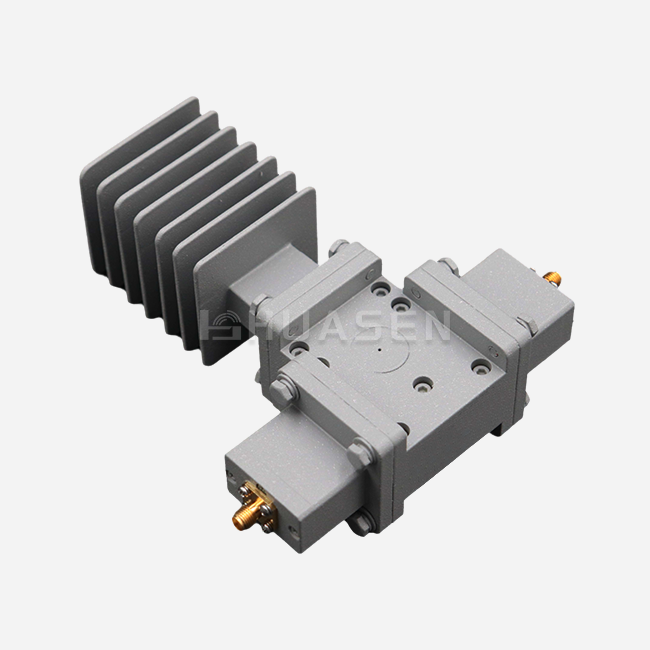
These antennas work because of the OMT, a passive waveguide part that separates or joins messages based on the direction of the electromagnetic field. When a signal comes in through the antenna, the OMT sends waves that are polarized in opposite directions to different ports. This keeps the channels separate. Single-polarization antennas can't do what this system does: real-time dual-channel transmission without having to change the way the antennas are set up physically. This means that infrastructure will be simplified and there will be fewer points of failure for system designers who run complicated 5G backhaul networks or satellite ground stations.
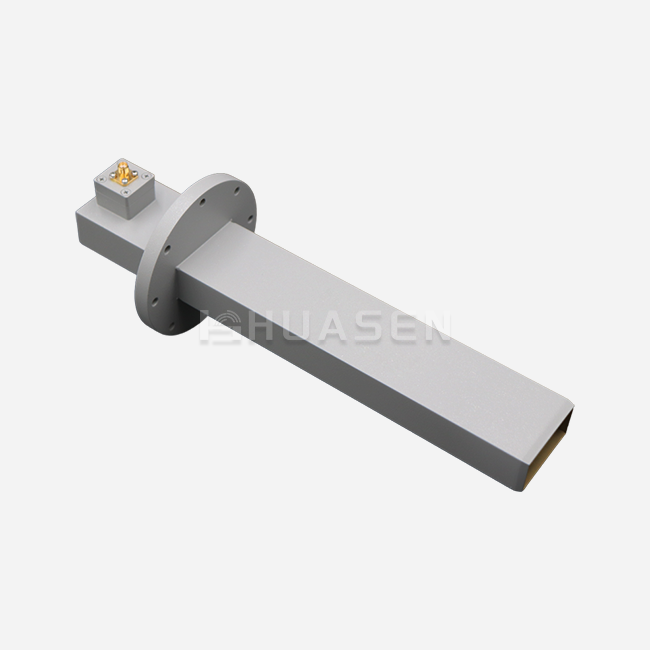
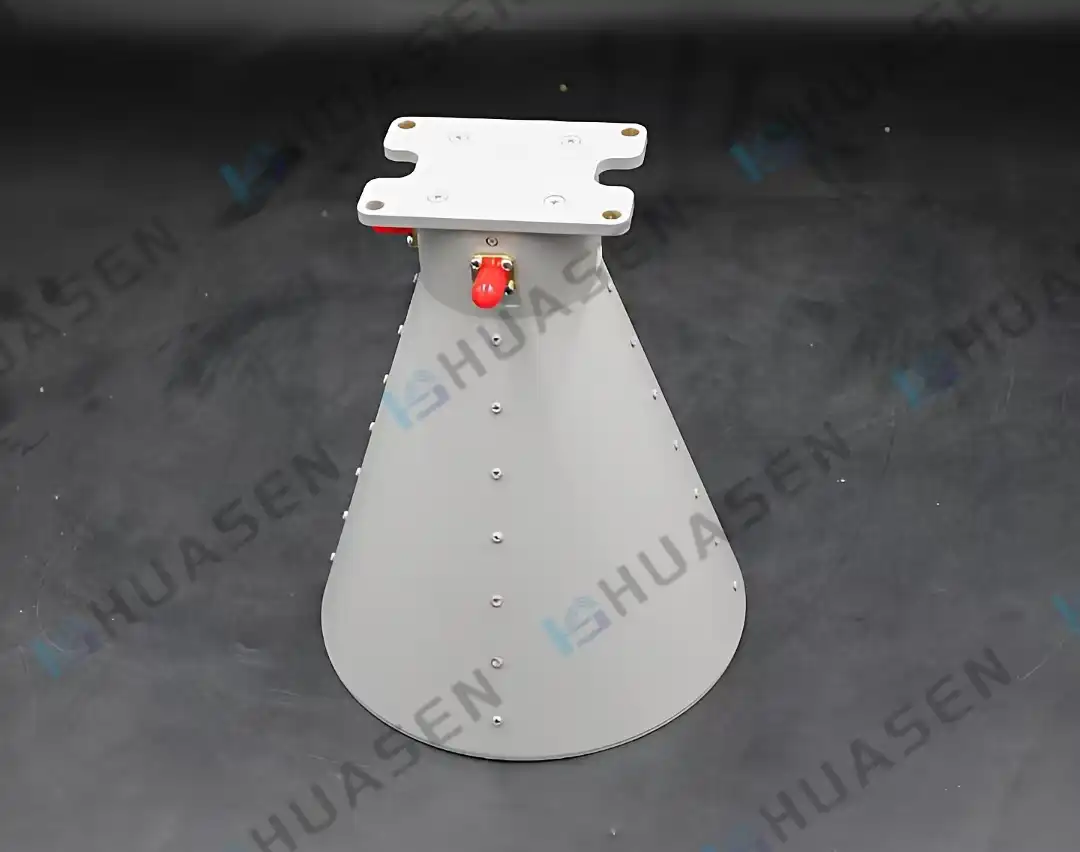
The Dual Polarized Horn Antenna from Huasen Microwave can be used with both standard and symmetrical feed OMT setups. For narrowband uses with bandwidths up to 5%, like fixed-frequency military communications or radar correction, conventional OMTs are easy to use and don't cost much. Even though they are harder to make, symmetrical feed OMTs allow for broad performance that covers up to 40% of the bandwidth. This is what multiband 5G systems and adaptive radar platforms need to be flexible. The antenna's cylindrical horn, which comes in either a round or a square shape, makes sure that the resistance changes smoothly from the waveguide to free space. This keeps reflections to a minimum and the radiation patterns stable across all frequency ranges.
Polarization, Diversity, and Signal Advantages
Diversity in polarization has real benefits for reducing fading and increasing capacity. In wireless lines, things like barriers and the weather can weaken signals in one polarization plane while not having much of an effect on the orthogonal plane. By getting both polarizations at the same time, the system can choose the stronger signal or combine them for better stability. This is very important for marine communications, where sea spray and moving ships cause signal fluctuations that happen very quickly. This feature also doubles the effectiveness of using spectrum in MIMO setups, allowing for faster data transfer without needing more spectrum—this is a crucial feature as global 5G and new 6G networks grow.
When engineers look at antenna specs, polarization separation should be the most important thing they look at. This is the measure that shows how well the two channels stay separate. The devices made by Huasen Microwave have polarization separation of more than 30 dB, which means that there is almost no crosstalk between the vertical and horizontal channels, even when high power is being sent. With a VSWR of less than 1.5, these antennas move power very efficiently, keeping the signal quality from the base station to the end-user equipment.
Technical Features and Performance Analysis
Radiation Characteristics and Frequency Coverage
Dual Polarized Horn Antennas have symmetrical, predictable radiation patterns and can be managed to have beamwidths that are usually between 20° and 60°, but can be different based on the frequency and shape of the horn. This focuses energy on the right targets, lowering crosstalk with channels next to it and making link budgets better in point-to-point microwave bridges. Instead of spreading energy out evenly like bidirectional antennas do, horn antennas offer gain levels ranging from 10 dBi to over 25 dBi, which is very important for increasing communication range in 5G deployments or long-distance satellite uplinks.
Microwave and millimeter-wave frequencies can be supported. Most popular versions cover L-band to Ka-band (1–40 GHz). Wideband types can handle whole frequency blocks used in the sub-6 GHz and mmWave bands for 5G New Radio, which lets operators use a single receiver for more than one carrier. Narrowband versions are made for specific uses, like GPS testing or X-band radar, where strict frequency control and low out-of-band emissions are required by rules like FCC Part 15 or ETSI EN 302.
Comparative Superiority Over Alternative Antenna Types
When compared to single-polarized horns, dual-polarization horns don't need extra hardware, which saves money and makes fitting easier. Patch antennas are small, but they have problems with cross-polarization and bandwidth, which means they can't be used for accurate RCS readings or polarimetric weather radar. Panel antennas have a lot of coverage, but they don't have enough gain or weather toughness. They also don't meet the MIL-STD-810 standards for vibration and shock, which are needed for placements in the air or on ships.
The precision-machined aluminum and available corrosion-resistant plating that make up the Dual Polarized Horn Antenna make it durable in harsh environments, from Arctic research posts to marine platforms in the tropical Pacific. Moisture getting into internal parts is a common way for outdoor RF systems to fail, but sealed designs with IP65 or higher grades keep this from happening. Thermal stability from -40°C to +85°C keeps the electrical performance stable without frequency shift, which is a problem with cheaper plastic-dielectric antennas that break down when they get hot from the sun.
Applications of Dual Polarized Horn Antennas in Industry
5G and Next-Generation Wireless Networks
As 5G networks are put in place, they need antennas that can handle large MIMO arrays, beamforming, and carrier aggregation across multiple fragmented frequency licenses. In over-the-air test rooms, where base station prototypes and user tools are put through compliance validation, Dual Polarized Horn Antennas are used as standards. Their stable gain and phase characteristics over wide bandwidths allow for accurate channel emulation, which ensures that devices work consistently in multipath settings that happen in real life. Manufacturers of network equipment rely on these antennas to make sure that beamforming algorithms properly guide nulls and peaks, which has a direct effect on how end users experience the network in crowded cities.
Dual polarization doubles link bandwidth in wireless backhaul, where gigabit-per-second data links connect cell sites to main networks without the need for extra spectrum licenses. The orthogonal channels work separately, sending different streams of data that are added together at the listener. This design is very useful in areas with limited spectrum where operators need to get the most output out of the frequencies they already have. Using polarization filtering to reduce interference also makes it easier for nearby operators to work together, which speeds up the process of network densification.
Radar and Defense Systems
Polarimetric radar devices use the polarization signal of targets to figure out what kind of object it is and even see through camouflage. By looking at depolarization ratios, weather radars can tell the difference between rain, hail, and debris. This makes forecasts more accurate and speeds up reaction times to disasters. Military radar finds low-observable airplanes by measuring the difference in reflectivity between polarizations. This shows internal details that regular radar systems can't see. Dual Polarized Horn Antennas are used as test targets and calibration sources in these situations. Their pure polarization makes it possible to check the system against written performance standards.
Electronic defenses work better when jamming signals change their polarization to match danger sources. This is called polarization adaptability. Dual-polarized antennas send out strong jamming waves in both directions at the same time, confusing enemy listeners no matter what their polarization filter settings are. Waveguide-based horns can handle a lot of power—often more than a thousand watts in pulsed operation—so they can be used for attacking electronic warfare tasks without getting too hot or distorting the signals.
Satellite Communications and Aerospace Testing
Ground stations that talk to geostationary satellites use dual polarization to recover frequency bands. They send uplink signals on one polarization and receive downlink signals on the orthogonal plane. This frequency reuse doubles the useful bandwidth without adding more orbital slots, which is a huge benefit as the number of satellite groups grows. The antenna's low sidelobe levels keep interference from neighboring satellites that are only a few degrees apart in orbital path. This keeps the link open even as space gets more crowded.
Aerospace companies put these devices on planes and unmanned aerial vehicles (UAVs) so that they can send and receive data from sensors for tracking. The small waveguide connectors, like SMA, K-type, or WR-series flanges, can fit on flying platforms that are limited in size and weight. Environmental conditions under DO-160 electronics standards make sure that the system works reliably through takeoff vibrations, changes in air pressure, and transients caused by lightning, all of which rule out many commercial antenna designs.
Procurement Guide — How to Choose and Buy Dual Polarized Horn Antennas?
Key Specification Criteria
Before you can choose the right antenna, you need to make sure that the frequency range, gain, and bandwidth are all in line with your system design. If your app uses more than one 5G band (n77, n78, or n79), a symmetrical feed OMT model with 40% bandwidth can cover 3.3–4.9 GHz constantly, so you don't have to keep track of multiple narrowband units. The amount of gain needed depends on the link budget. More gain focuses energy but narrows the beamwidth, which needs precise mechanical pointing. This is important for fixed backhaul links but not so important for test room applications, where controlled settings are more common.
Specifications for polarization separation have a direct effect on how well a system works. When checking MIMO throughput or calibrating a polarimetric radar, isolation levels higher than 30 dB stop channel leakage that messes up readings. VSWR below 1.5 across the working band ensures that very little power is reflected, which protects receivers and increases the efficiency of radiation. Connector compatibility is important for operations. WR-series waveguide flanges are the most common type for millimeter-wave uses because they have low loss. On the other hand, coaxial SMA or N-type connectors make integration easier in test sets for lower frequencies.
Supplier Evaluation and Customization Options
Companies that have been around for a long time, like Huasen Microwave, have decades of experience in RF engineering, which is important for figuring out how to balance bandwidth, size, and performance. Their standard OMT designs work well for projects that need a set frequency and are on a budget. On the other hand, their symmetrical feed designs meet broadband needs, even though they cost more per unit. Customization options go beyond just changing the frequency. They also include designing mounting brackets for odd-shaped installations, improving weather sealing for remote platforms, and making power handling better for EMP-hardened systems at high altitudes.
Getting things for defense and space projects is easier with certification paperwork. Quality management systems need an audit trail, which can be made up of MIL-STD-461 EMI/EMC test records, RoHS material compliance certificates, and traceable calibration data against NIST or similar standards. Lead times depend on how customized an item is. Catalog items ship within weeks, but custom designs that need electromagnetic modeling and prototype approval take months. Bulk price systems encourage bigger orders by giving savings based on the lower cost of setting up each unit for machining.
Installation and Maintenance Best Practices
Mounting and Environmental Considerations
When you place mechanical parts correctly, you protect the electrical performance and the structural stability. Using elastomeric dampeners in the mounting clamps will keep the antenna from moving when the tower or car moves. This will keep fatigue cracks from forming at the waveguide interfaces. Accurate orientation is very important. A 1-degree error in a 20-dBi antenna can lower the link margin by several dB, which could slow down data rates or stop service. During commissioning, alignment tools like laser points or GPS-synchronized pointing calculators make sure that the azimuth and elevation sets are correct.
Protecting the antenna from the environment makes it last longer in harsh environments. Radome covers protect the opening from ice, UV damage, and bird hits, but choosing the right material means balancing protection against RF transparency. Teflon and HDPE offer the least amount of entry loss. Connector weather boots and desiccant breathers stop moisture from condensing inside waveguide runs, which would increase loss and raise the risk of arcing at high power levels. When connected to tower earth systems, grounding straps spread out lightning spike currents, which protect electronics further down the line.
Maintenance Protocols and Troubleshooting
Planned inspections of the dual polarized horn find early signs of failure before they affect service. Visual checks show rust on flange surfaces, fastener loosening from temperature cycles, and mechanical damage from wind loads. Vector network testers are used for electrical tests to measure return loss and isolation decline, which can indicate internal contamination or connector wear. Isopropyl alcohol and lint-free swabs are used in cleaning routines to restore link integrity without scratching delicate surfaces.
Systematic debugging finds the root causes when performance drops without warning. A sudden rise in VSWR could mean that a connection is damaged or that there is moisture inside. Changing the jumper wires and resealing the interfaces usually fixes the problem. Polarization isolation degradation means that the OMT isn't lined up right or that the dielectric is contaminated, which needs to be fixed or replaced at the factory. Taking standard measures at installation gives you data to use for trend analysis, which lets you plan maintenance ahead of time and cut down on unplanned downtime.
Conclusion
Dual Polarized Horn Antennas are very useful in radar, wireless communications, and aircraft because they combine dual-channel capabilities into strong, high-performance packages. Huasen Microwave's OMT-based designs have the best polarization separation in the industry, at more than 30 dB, and VSWR below 1.5. They can be used for both narrowband and wideband uses and have been tested and proven to work in the field. Choosing the right antenna factors, such as frequency range, gain, bandwidth, and environmental ratings, is very important for the success of any system. This is true whether you are setting up 5G backhaul infrastructure, adjusting polarimetric radar, or trying a satellite link. Installing and maintaining things the right way can make them last longer, protect your purchases, and keep them working well in harsh conditions.
FAQ
Q1: What frequency ranges do Dual Polarized Horn Antennas typically cover?
These antennas work in frequencies from L-band to Ka-band, which is about 1 to 40 GHz. Some types are better for cellular bands (2.6 GHz and 3.5 GHz), satellite C/X/Ku bands, or radar use. By using symmetrical feed OMTs in wideband designs, 40% fractional bandwidth is reached, which means that the whole 5G frequency blocks can be covered by a single unit.
Q2: How do these antennas work better with 5G networks than single-polarized ones?
Dual polarization makes MIMO channel multiplication possible, which doubles spectral efficiency without adding more frequency. Polarization diversity reduces fading and keeps the link stable in situations where there isn't a clear line of sight, which is common in cities. Two different antennas can be replaced by a single dual-polarized antenna, which makes the tower lighter and lowers the lease costs.
Q3: What are typical lead times and pricing for bulk orders?
Standard stock models ship in two to four weeks, and if you buy more than 10 of them, you can get a discount. Lead times are extended to 8–12 weeks for custom designs that need modeling and prototype approval. Prices depend on factors like bandwidth, power handling, and environmental requirements. To make sure your budget is correct, ask for prices with full details.
Partner with a Trusted Dual Polarized Horn Antenna Manufacturer
Since 1993, Huasen Microwave has provided precise RF solutions to the military, defense, and telecommunications industries around the world. We have a range of conventional and symmetrical feed OMT Dual Polarized Horn Antennas that offer polarization separation of more than 30 dB and VSWR below 1.5 in both narrowband and wideband setups. Our engineering team can help you with everything from reviewing your specifications to integrating and testing the system in the field. This is true whether you need off-the-shelf parts that can be put together quickly or custom designs that work with the limitations of your system. You can talk to our experts about your project needs and get reasonable prices for Dual Polarized Horn Antenna supplier relationships by emailing sales@huasenmicrowave.com.
References
1. Balanis, Constantine A. Antenna Theory: Analysis and Design. 4th ed. Wiley, 2016.
2. Olver, A.D., et al. Microwave Horns and Feeds. IEE Electromagnetic Waves Series, 1994.
3. Uher, Jiří, Jens Bornemann, and Uwe Rosenberg. Waveguide Components for Antenna Feed Systems: Theory and CAD. Artech House, 1993.
4. IEEE Standard 145-2013. IEEE Standard for Definitions of Terms for Antennas. Institute of Electrical and Electronics Engineers, 2014.
5. Milligan, Thomas A. Modern Antenna Design. 2nd ed. Wiley-IEEE Press, 2005.
6. Pozar, David M. Microwave Engineering. 4th ed. Wiley, 2011.
Send Inquiry