What Is Circularly Polarized Microstrip Antenna?






2026-03-27 21:40:46
A Circularly Polarised Microstrip Antenna is a special kind of planar antenna technology that is made using printed circuit board methods. It sends out electromagnetic waves where the electric field vector spins continuously in a circle instead of moving back and forth in a flat plane. By carefully engineering two orthogonal modes with equal amplitude and a 90-degree phase difference, this advanced antenna configuration achieves circular polarisation. This effectively eliminates polarisation mismatch losses and provides better signal reliability in complex multipath environments where traditional linear antennas struggle with orientation dependencies.
Understanding Circularly Polarized Microstrip Antennas
The fundamental architecture of circularly polarized microstrip antennas distinguishes them significantly from their linearly polarized counterparts. These antennas operate on the principle of generating electromagnetic waves that maintain consistent signal strength regardless of receiver orientation, making them invaluable for applications where antenna alignment cannot be precisely controlled.
Basic Antenna Structure and Polarization Principles
A patch element placed above a ground plane and divided by a dielectric substrate is what makes microstrip antenna technology work. When the antenna creates two perpendicular electric field components with equal strengths but a precise 90-degree phase difference, the circular polarisation property shows up. In real life, the difference between linear and circular polarisation is very important. This arrangement makes an electric field vector that rotates and keeps the information intact in a variety of orientations. When the sender and receiver orientations are not aligned correctly, linear polarised antennas lose a lot of signal. In some cases, they lose the signal completely. This weakness is eliminated by circular polarisation, which keeps the signal receiving constant, no matter how the signal is positioned.
Single Feed and Dual Feed Implementation Methods
There are two main ways for engineers to achieve circular polarisation, and each has its own benefits for different uses. To make the necessary phase difference between orthogonal modes, single-feed methods use geometric changes inside the patch element, like cutting off corners or adding diagonal slots. This method allows for small design solutions, but it usually limits the bandwidth performance. Dual feed configurations use two separate feed points placed at right angles to each other on the patch, with external circuitry giving the necessary 90-degree phase shift. This method has better bandwidth performance and more accurate control over the purity of the polarization, but it needs more complicated feed networks. Which of these methods to use depends on the needs of the application, such as the amount of bandwidth needed, the size limitations, and the speed requirements.
Impact of Patch Geometry on Polarization Quality
The patch element's shape and size have a direct effect on its polarisation characteristics and the antenna's general performance. The most common way to get circular polarisation is to use square patches with corners cut off. The imbalance is created by carefully calculating the corner cuts. Different options include circular patches with off-center feeding points, which are useful for situations that need a wider bandwidth. The dielectric constant values of the substrate have a big impact on how the antenna behaves, affecting both the resonant frequency and the bandwidth. Higher dielectric constants make antennas smaller but usually narrow their bandwidth, while lower values make them more efficient but bigger.
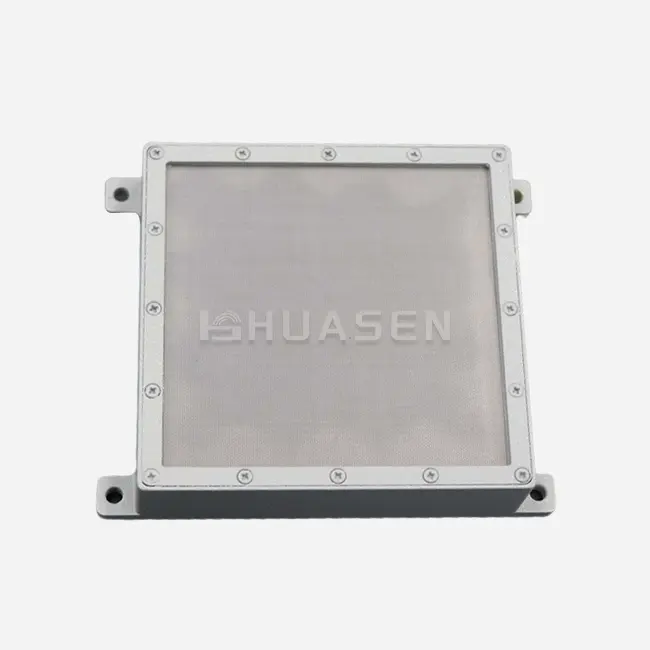
Key Design Considerations for Circularly Polarized Microstrip Antennas
Successful implementation of circularly polarized microstrip antennas requires careful attention to multiple design parameters that collectively determine overall system performance. These considerations directly impact signal quality, operational bandwidth, and long-term reliability in demanding industrial environments.
Axial Ratio Optimization Strategies
The axial ratio parameter serves as the primary metric for evaluating circular polarization quality, representing the ratio between major and minor axes of the polarization ellipse. Achieving axial ratios below 3 dB across the operational bandwidth ensures acceptable circular polarization performance, with values approaching 0 dB indicating ideal circular behavior. Design optimization involves precise control of patch dimensions, feed positioning,Microstrip Antenna, and substrate properties to maintain low axial ratios across the desired frequency range. Advanced simulation tools enable engineers to model electromagnetic behavior and optimize geometry before physical prototyping, reducing development time and ensuring performance specifications.
Bandwidth Enhancement Approaches
Traditional microstrip antennas exhibit inherently narrow bandwidth characteristics due to their resonant nature. Several techniques can expand operational bandwidth while maintaining circular polarization purity. Stacked patch configurations utilize multiple radiating elements at different heights to create a broader impedance bandwidth. Parasitic elements positioned near the main patch can enhance bandwidth through electromagnetic coupling effects. Substrate thickness optimization represents another approach for bandwidth enhancement, though this must be balanced against potential increases in surface wave losses and manufacturing complexity. Multi-layer designs incorporating multiple substrates can achieve exceptional bandwidth performance for applications requiring operation across multiple frequency bands.
Substrate Material Selection and Cost Analysis
The choice of substrate material significantly influences both electrical performance and manufacturing costs. Rogers RT/duroid series substrates offer excellent electrical properties with stable dielectric constants and low loss tangents, making them suitable for high-performance applications where cost considerations are secondary to performance requirements. Lower-cost alternatives such as FR-4 materials can provide acceptable performance for commercial applications where extreme precision is not required. However, these materials exhibit greater dielectric constant variation with temperature and frequency, potentially affecting long-term performance stability. The selection process must balance performance requirements against cost constraints and environmental operating conditions.
Applications and Industry Use Cases
Circularly polarized microstrip antennas find extensive application across multiple industries where signal reliability and orientation independence are paramount. These implementations demonstrate the practical value of circular polarization technology in solving real-world communication challenges.
Satellite Communication Systems
Modern satellite communication networks rely heavily on circular polarization to maintain reliable links despite satellite movement and ground station positioning variations. Geostationary satellites often experience small orbital perturbations that would cause significant signal fading with linearly polarized systems. Circular polarization maintains consistent link budgets regardless of these variations. Low Earth Orbit satellite constellations present even greater challenges due to rapid movement and changing orientations. Circularly polarized ground terminals ensure continuous communication throughout satellite passes without requiring precise mechanical tracking systems. This capability proves essential for applications ranging from weather monitoring to global internet services.
RFID and Wireless Sensor Networks
Radio Frequency Identification systems benefit tremendously from circular polarization implementation. In warehouse automation environments, RFID tags attached to packages arrive at readers in random orientations as items move through conveyor systems. Linear polarized readers would miss tags oriented perpendicular to the antenna polarization, resulting in incomplete inventory tracking. Circularly polarized RFID systems achieve near-perfect read rates regardless of tag orientation, enabling reliable automated inventory management. This capability extends to retail environments where merchandise positioning cannot be controlled, ensuring accurate point-of-sale operations and inventory tracking.
Aerospace and Defense Applications
Military communication systems require a Microstrip Antenna with robust performance in challenging environments where antenna positioning may be compromised by vehicle movement or tactical considerations. Circularly polarized antennas maintain communication links for aircraft, maritime vessels, and ground vehicles without requiring constant antenna repositioning. Unmanned Aerial Vehicle communication represents a particularly demanding application where aircraft attitude changes constantly during flight operations. Circular polarization ensures reliable telemetry and control links regardless of aircraft orientation, enhancing operational safety and mission reliability.
Supplier Selection and Procurement Guide
Selecting appropriate suppliers for circularly polarized microstrip antennas requires careful evaluation of technical capabilities, quality standards, and support services. Professional procurement teams must consider multiple factors to ensure successful project outcomes and long-term supply chain reliability.
Evaluation Criteria for Manufacturer Selection
When evaluating possible suppliers, technical knowledge is the most important thing to think about. Manufacturers must show that they have worked with circular polarisation design before and that they can meet certain performance standards. This includes the ability to optimise the axial ratio, control the bandwidth, and connect to customer systems. Quality management systems show that the maker is dedicated to ensuring consistent performance and dependability. ISO 9001 certification is a basic way to make sure of quality, but AS9100 or other industry-specific standards may be needed for aerospace and defence uses. Evaluations of manufacturing capabilities should include visits to the facility and tests of samples to make sure that the real production capabilities are being met.
Customization Options and Design Flexibility
In many situations, antenna options need to be specially made to meet the needs of the system. In addition to frequency optimisation, polarisation setup, and mechanical integration features, Huasen Microwave also lets you make a lot of other changes. Their hybrid waveguide-microstrip transmission network technology lets them achieve high gain while keeping the weight of the device very low. Array configurations that range from simple single patch elements to complicated 8x8 arrangements let them meet a wide range of gain needs. There are different types of polarisation, such as single linear, single circular, dual linear, and dual circular. This lets you find the best setup for your system. For specific radar and communication needs, custom versions with monopulse and beam shaping features are available.
Quality Assurance and Testing Requirements
Tough testing procedures make sure that the antenna's performance meets requirements for its entire useful life. Measurements of the axial ratio over the operational bandwidth confirm the quality of the circular polarisation, and tests of return loss and radiation pattern confirm the impedance matching and beam characteristics. Environmental testing, such as temperature cycling, humidity exposure, and vibration testing, confirms performance in real-world settings. These tests make sure that the system will work reliably in harsh industrial settings where an antenna failure could stop the whole system from working.
Comparing Circularly Polarized and Linearly Polarized Microstrip Antennas
Understanding the fundamental differences between circular and linear polarization enables informed decision-making for antenna selection. Each polarization type offers distinct advantages depending on application requirements and operational constraints.
Technical Performance Analysis
Linearly polarised systems suffer from polarisation mismatch losses, but circularly polarised antennas don't have these problems. If the antennas on the sender and receiver are not aligned straight by 90 degrees, linearly polarised systems lose all of their power, but circularly polarised systems keep working the same way. This benefit is very important for mobile apps where the antenna orientation can't be changed. Another important benefit of circular polarisation is that it blocks multipath interference. Circularly polarised antennas can tell the difference between direct and reflected signals because reflected signals have their polarisation reversed. This feature makes signal quality better in cities and indoor settings where multipath transmission is a problem.
Cost and Availability Considerations
Linearly polarised antennas usually have lower production costs because they have fewer design needs and more suppliers to choose from. Adding more complexity to make circular polarisation work raises the cost of production, but the big operational benefits often make up for the extra cost. The market for circularly polarised solutions has grown a lot as more and more applications need this technology. Specialised companies like Huasen Microwave have come up with effective ways to make their products that keep performance high while minimising extra costs.
Decision Framework for Antenna Selection
When choosing acircularly polarized microstripantenna, you should base your choice on the needs of the application, taking into account the operational environment and performance goals. Even though it costs more, circular polarisation is usually better for mobile apps, satellite connections, and RFID systems. Linearly polarised solutions may work well for fixed point-to-point links where the antenna orientations can be controlled. Reliability needs for signals must be set against cost and system complexity. Circular polarisation technology should be used in situations where a failure in communication could have serious effects. In business settings that don't need to be as reliable, linearly polarised methods might work fine.
Conclusion
Circularly polarised microstrip antennas are a high-tech option for uses that need strong signal performance, no matter which way the antenna is pointing. They are very useful for satellite communications, RFID systems, and mobile apps because they can block multipath interference and get rid of polarization mismatch losses. Implementation costs more than linear options, but practical benefits like higher system reliability and lower maintenance needs often make the investment worth it. Knowing about design factors, application needs, and provider abilities helps procurement teams make smart choices that meet their communication needs while also being cost-effective and providing the best performance.
FAQ
1. What makes circular polarization superior to linear polarization in microstrip antennas?
Circular polarization eliminates the orientation dependency that affects linearly polarized systems. When antennas are misaligned, linear systems can experience complete signal loss, while circularly polarized antennas maintain consistent performance regardless of rotational positioning. This advantage proves critical for mobile applications and satellite communications, where precise antenna alignment cannot be maintained.
2. How does the axial ratio affect antenna performance?
Axial ratio measures the quality of circular polarization, with values below 3 dB indicating acceptable performance. Lower axial ratios produce better circular polarization, reducing signal variations caused by orientation changes. Poor axial ratio performance can degrade circular polarization benefits, making careful design optimization essential for achieving specified performance levels.
3. What frequency ranges are suitable for circularly polarized microstrip antennas?
Microstrip antenna technology operates effectively from L-band through Ku-band frequencies, with specific performance characteristics varying based on design parameters and substrate selection. Huasen Microwave offers customizable solutions across this range, enabling optimization for specific frequency requirements while maintaining circular polarization performance.
4. Can these antennas be integrated into array configurations?
Modern circularly polarized microstrip antennas readily adapt to array configurations for enhanced gain and directivity. Common arrangements include 2×2, 4×4, and larger arrays up to 8×8 configurations. Array implementations must maintain proper phase relationships between elements to preserve circular polarization characteristics across the combined radiation pattern.
5. What environmental factors affect antenna performance?
Temperature variations, humidity, and mechanical stress can influence antenna performance through substrate property changes and dimensional variations. Quality substrates and proper mounting techniques minimize these effects, while environmental testing during development ensures reliable performance across operational temperature ranges and humidity conditions.
Partner with Huasen Microwave for Advanced Antenna Solutions
Huasen Microwave Technology delivers cutting-edge circularly polarized microstrip antenna solutions that address the most demanding communication challenges. Our hybrid waveguide-microstrip transmission network technology achieves exceptional gain performance up to 23dB while maintaining ultra-lightweight construction ideal for aerospace and mobile applications. With comprehensive customization capabilities spanning frequency optimization, array configurations, and polarization types, we serve as your trusted circularly polarized microstrip antenna manufacturer.
Our engineering team provides complete support from initial design consultation through production delivery, ensuring optimal performance for your specific requirements. Contact our technical specialists at sales@huasenmicrowave.com to discuss your project needs and discover how our advanced antenna technology can enhance your communication systems.
References
1. Balanis, Constantine A. "Antenna Theory: Analysis and Design." 4th Edition, John Wiley & Sons, 2016.
2. Kumar, Girish and Ray, K.P. "Broadband Microstrip Antennas." Artech House Publishers, 2003.
3. Pozar, David M. "Microwave Engineering." 4th Edition, John Wiley & Sons, 2012.
4. Waterhouse, Rod. "Microstrip Patch Antennas: A Designer's Guide." Springer Science & Business Media, 2003.
5. IEEE Standard for Definitions of Terms for Antennas. "IEEE Std 145-2013." Institute of Electrical and Electronics Engineers, 2014.
6. Stutzman, Warren L. and Thiele, Gary A. "Antenna Theory and Design." 3rd Edition, John Wiley & Sons, 2012.
Send Inquiry