Waveguide Straight Section in High Power Systems






2026-04-27 22:22:57
When engineers design radar arrays or satellite ground stations, they always have to deal with the problem of how to send kilowatts or even megawatts of microwave power over long distances without damaging the signal or causing catastrophic arcing. The waveguide straight section solves this basic issue by giving us a hollow metal tube that sends electromagnetic waves through internal reflection instead of dielectric materials that easily break. Coaxial cables have trouble with frequencies above 10 GHz, but these precision-machined tubes can handle frequencies from 320 MHz to 220 GHz with insertion losses measured in hundredths of a decibel per meter. This makes them essential for applications where reliability must be maintained, such as in defense systems, scientific instruments, and telecommunications infrastructure.
Understanding Waveguide Straight Sections in High-Power Systems
What Defines a Waveguide Straight Section?
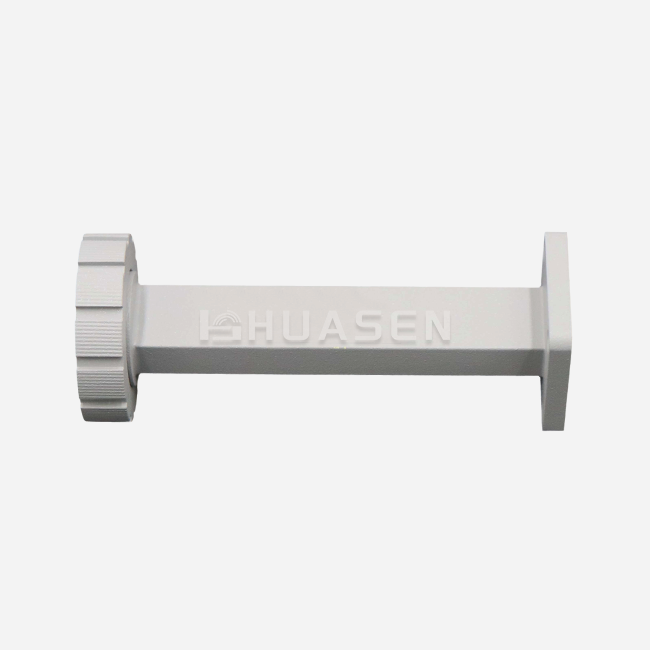
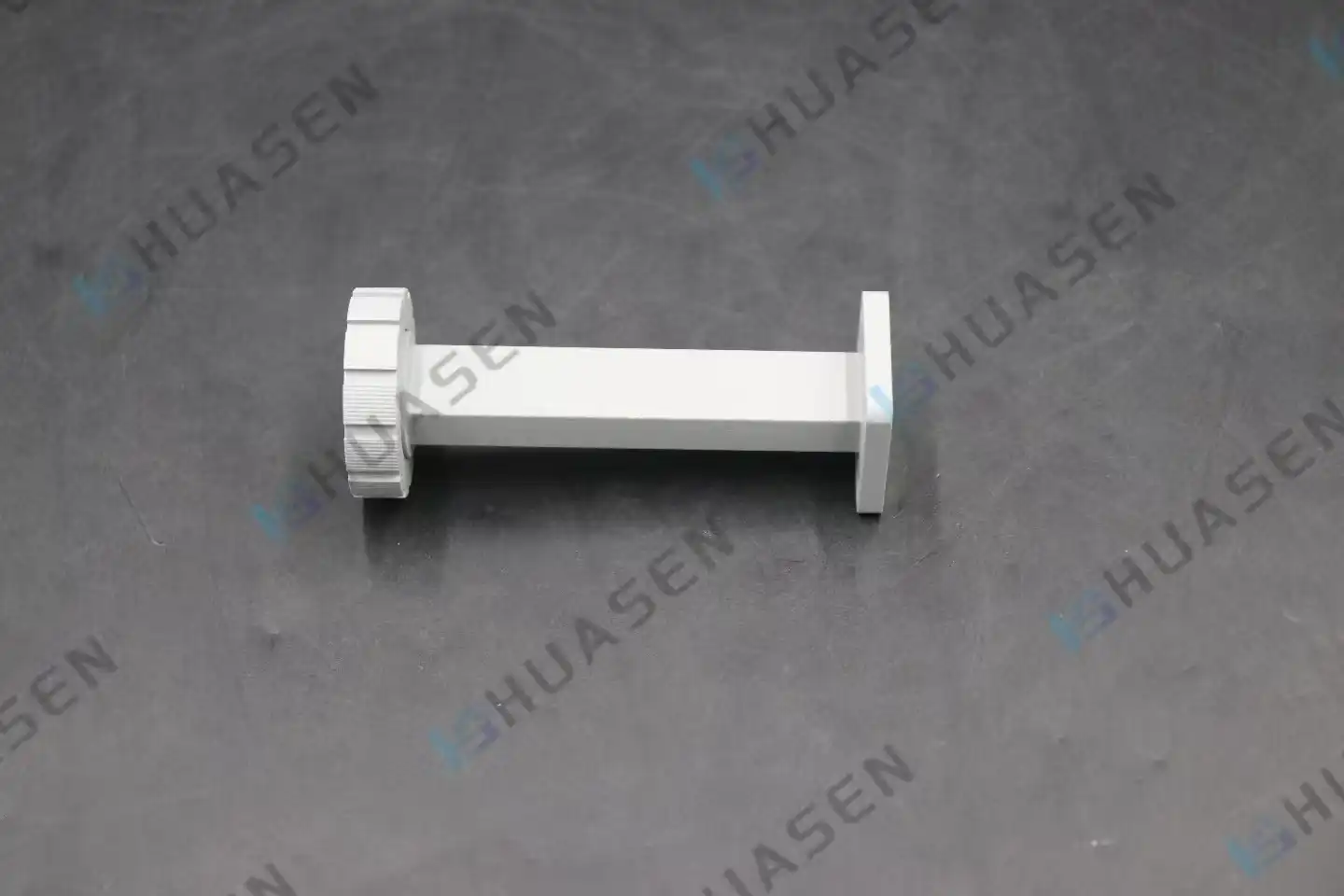
A waveguide straight section is made up of a tube made of conductive metals that can be rectangular, circular, or have a different shape. The part sends out electromagnetic energy in certain modes, usually TE10 for rectangular designs, where the electric and magnetic fields move in a way that is perpendicular to the direction of travel. When there are no center conductors, dielectric losses that happen in coaxial systems at millimeter-wave frequencies don't happen.
Material Selection and Performance Impact
Power handling and signal fidelity are directly affected by the choice of material. Aluminum 6061-T6 has a great strength-to-weight ratio for aerospace uses, but copper is a better conductor of electricity. As part of our manufacturing process, we carefully electroplate with silver or gold layers, which lowers the skin-effect resistance at high frequencies. The specification for surface roughness is important: a finish greater than 63 microinches causes measurable loss in the Ka-band and above. Copper waveguides plated with silver have conductivity close to 95% of pure silver at a fraction of the cost. This is a good compromise between performance and cost for large-scale deployments.
Frequency Band Correlation with Dimensional Precision
Each waveguide standard, with numbers WR-28 through WR-2300, is matched to a certain frequency range based on its internal dimensions. Cutoff frequency accuracy must be kept at or below 0.001 inches for both broad wall dimension "a" and narrow wall dimension "b." A WR-90 section working at X-band (8.2-12.4 GHz) has an internal size of 0.900" × 0.400". Deviations lead to impedance mismatches, which show up as VSWR degradation. Our dual-ridge designs increase operational bandwidth by up to two times when compared to standard rectangular profiles. This meets customer needs for single components that cover multiple bands.
Power Handling and Thermal Management
The breakdown voltage in the waveguide medium determines the peak power capacity. Sections that are full of air can handle an X-band peak of about 1 MW before ionization occurs. Adding 15 PSI of dry nitrogen pressure raises this threshold by 40%, which is very important for pulsed radar transmitters. In long runs, thermal expansion coefficients are important. Copper expands 17 ppm/°C, while aluminum expands 13 ppm/°C. This difference is important when connecting metals that are not the same across temperature gradients that you might find in outdoor installations or on spacecraft that go through thermal cycling from -40°C to +85°C.
Comparing Waveguide Straight Sections with Alternative Solutions
Waveguide Versus Coaxial Cable Performance
Coaxial cables make installation more flexible, but they have problems at higher frequencies. A standard 1/2" coaxial line loses 0.3 dB/meter at 10 GHz, while an equivalent WR-90 waveguide straight section measures 0.03 dB/meter—ten times better. This difference gets bigger over distance: a 20-meter run loses 6 dB in coax and 0.6 dB in waveguide, which means that 75% of the signal is lost and 87% is retained. Power handling makes the difference even bigger: semiflex coax can handle up to 500 W continuously, while pressurized waveguide can handle 50 kW without any heat stress.
The trade-off shows up in mechanical installation, where coaxial assemblies have to work around obstacles while rigid waveguide sections need to be precisely aligned and have custom bends made as separate parts. Vibration environments favor rigidity—aerospace specifications list 20G shock resistance—while coax relies on flexible dielectrics that wear out after repeated bending.
Straight Versus Flexible Waveguide Configurations
Flexible waveguide designs have walls that are corrugated, which lets them bend with radii as small as 6 inches. This makes routing easier in equipment racks that aren't very big. However, this flexibility comes with insertion loss penalties of 0.15 to 0.30 dB/meter, which are higher than the 0.03 dB/meter for waveguide straight sections. The corrugations also lower power ratings by about 30% because the fields concentrate at the ridges.
When electrical performance is more important than ease of installation, waveguide straight sections are the best choice. For example, base station antenna feeds that run vertically up towers benefit from the rigidity that stops wind-induced swaying while keeping the best VSWR. Laboratory calibration standards require phase stability that can only be achieved with temperature-compensated waveguide straight sections that show phase drift below 0.5° across 0–50°C ranges.
Cost Analysis Across Transmission Options
Waveguide straight sections cost $80-$300 per meter, depending on frequency band and plating specification, while equivalent coaxial assemblies cost $40-$120. However, the total cost of the system must include the amplifier power needed to make up for transmission losses. For example, to make up for the 5.4 dB extra loss in a 20-meter coax run, you need 3.5× transmitter power; this amplifier upgrade usually costs more than $15,000 in high-power systems, which is a lot more than the $2,400 waveguide premium.
Procurement and Sourcing Strategies for Waveguide Straight Sections
Evaluating Manufacturer Credentials
Checking the supplier's certifications is the first step in qualifying them as a supplier for the Waveguide Straight Section. MIL-DTL-85 compliance means that the supplier meets important standards for dimensional tolerances and flange planarity in defense applications. ISO 9001:2015 certification shows that the supplier has quality management systems in place, but buying managers shouldn't just rely on certifications; they should also ask for batch test data showing actual VSWR measurements across the operating band.
Manufacturing capability assessment includes examining CMM inspection reports to make sure that the tolerances for internal dimensions of the straight waveguide are met. A trustworthy supplier will provide vector network analyzer sweep data for every production lot, showing that the return loss is less than 25 dB (VSWR < 1.12) across 110% of the rated bandwidth. Whether electroplating is done in-house or by a third party affects lead times and consistency from batch to batch.
Customization Options and Technical Specifications
Standard catalog lengths range from 100 mm to 2000 mm, but custom sizes can be made to fit specific system layouts. Our engineering team often creates waveguide straight sections with built-in flange transitions, such as CPR grooves for pressurized systems or choke flanges that create quarter-wave traps that stop RF leakage. In addition to aluminum and copper, we also offer brass for cost-effective uses where the weight exceeds 10 kg and stainless steel for harsh marine environments.
Dual-ridge geometries allow for wider bandwidth, but they need to be machined by someone with a lot of experience. These designs keep VSWR ≤1.15 across frequency ranges from 0.32 GHz to 40 GHz in a single unit, so there's no need to keep multiple standard bands in stock. Inflatable waveguide systems, which use flexible metallized polymer sections that are inflated to keep their shape, are used by satellite communication earth stations that need to set them up quickly and store them compactly.
Lead Time Management and Bulk Pricing
Standard configurations ship within two to three weeks, while custom designs need six to eight weeks for engineering validation and tooling fabrication. Volume pricing becomes more appealing when ordering more than fifty units, and discounts reach 25% for orders of 200 or more pieces. Blanket purchase agreements lock in prices for a year while allowing call-offs based on predicted demand, which reduces supply chain volatility.
When buying waveguide straight sections from other countries, you have to think about compliance. For example, RoHS certification makes sure that manufacturing without lead is in line with EU rules. Waveguide parts above 40 GHz are controlled for export under EAR classifications; having the right paperwork stops customs delays. Our logistics partners specialize in RF hardware and use foam-lined crates to keep flanges from getting damaged during transcontinental shipping.
Design and Application Best Practices in High-Power Systems
Surface Treatment and Conductivity Enhancement
The internal surface finish has a direct effect on the attenuation coefficients. Standard mill finishes of 125 microinches are fine below 18 GHz, but electropolishing to 32 microinches or better is needed for millimeter-wave applications. Silver plating has the best conductivity (6.3×10^7 S/m), but it tarnishes and needs regular maintenance or protective gold flash layers. Anodized aluminum is good for maritime applications because it doesn't rust, but it loses 0.01 dB/meter more than bare metal.
The thickness of the plating is important because layers thinner than 0.0002" have pinholes that let base metal show, creating places where galvanic corrosion can happen. X-ray fluorescence measurements show that our standard calls for 0.0005" silver with a 0.00005" gold overplate. According to MIL-STD-810G, this combination can withstand being exposed to salt spray for 1000 hours and still conduct electricity at a level similar to that of pure silver.
Radar System Integration Case Study
In a recent upgrade to an S-band surveillance radar, old coaxial feeds were swapped out for WR-284 waveguide straight sections. Over the 18-meter run between the transmitter and antenna, the installation cut insertion loss from 4.2 dB to 0.8 dB. This made it possible for the klystron peak power to drop by 30%, from 2.5 MW to 1.75 MW. Because there were no longer any coax dielectric breakdown failures, system availability went from 94% to 99.2%. Before, there were an average of three failures per year.
The Waveguide Straight Section units were pressurized with nitrogen at 12 PSI, and the pressure was monitored by pressure transducers that were built in. At 5-meter intervals, temperature sensors fed a thermal management algorithm that changed the duty cycle of the transmitter during the hottest parts of summer to stop thermal runaway. This instrumentation added $8,000 to the $45,000 cost of installing the waveguide, but it got rid of the need to spend $120,020 a year on maintenance to replace the coax.
Millimeter-Wave Test System Optimization
When lab equipment makers make VNA calibration kits, they include straight waveguides and waveguide straight sections because phase stability is what determines how accurate the measurements are. To keep its calibration validity, a WR-15 reference section (50–75 GHz) must have phase drift below 0.3° from 0°C to 50°C. This needs to be built out of an Invar alloy that has a thermal expansion coefficient of 1.2 ppm/°C, which is a tenth of that of aluminum.
For these uses, flange planarity tolerances get tighter to 0.0005"; deviations cause air gaps that lead to measurable VSWR degradation above 60 GHz. To check for flatness, our inspection protocol uses optical flats under monochromatic light and counts interference fringes. Mating torque specifications, which are usually 15 to 25 in-lbs for millimeter-wave flanges, keep them from being overtightened, which deforms the flange face, while also ensuring close metal-to-metal contact.
Future Trends and Innovations in Waveguide Straight Sections
Additive Manufacturing Revolution
Metal 3D printing can now make waveguide straight section parts with built-in cooling channels and complicated internal shapes that can't be made any other way. Direct Metal Laser Sintering (DMLS) of the aluminum alloy AlSi10Mg produces a surface that is 8–12 microinches rough after post-processing, which is similar to electropolished finishes. This lets one-piece designs include both straight and curved parts, getting rid of flange losses and cutting the number of parts needed by 60% in multi-stage assemblies.
This technology works especially well for dual-ridge and multi-ridge waveguide straight sections, since traditional machining needs a lot of different setups and fixtures. With additive manufacturing, these are made all at once, and the geometric tolerances are kept to within 0.002" throughout the structure. For simple geometries, material costs are still 40% higher than with billet machining, but above 20–30 units, complex designs break even.
Smart Waveguide Systems with Embedded Sensing
By putting MEMS sensors inside the waveguide straight section walls, faults can be found and monitored in real time. At 2-meter intervals, miniature directional couplers collect samples of forward and reflected power. This data is sent to centralized network management systems for analysis, which find VSWR degradation before it affects system performance. IoT connectivity sends this data to distributed antenna installations for remote diagnosis.
When temperature and humidity sensors are combined with accelerometers, they can pick up on environmental stresses. Sudden vibration spikes can mean that a mounting bracket has failed, and temperature changes outside of the design limits set off alarm protocols. This instrumentation raises the cost of the parts by about 15%, but it cuts down on unplanned downtime by allowing condition-based maintenance scheduling instead of fixed-interval servicing.
Emerging Market Demands in 5G and Satellite Communications
Rolling out 5G millimeter-wave infrastructure increases the need for small waveguide straight section components that work in the 28 GHz and 39 GHz bands and have strict passive intermodulation (PIM) requirements below -155 dBc. Base station installations need weatherproof assemblies that can withstand 180 km/h wind loads and 50 mm/hr rainfall while keeping their electrical performance between -40°C and +65°C. To do this, they need advanced sealing technologies that use conductive elastomer gaskets to protect the environment and keep the RF signal going.
Low Earth Orbit (LEO) satellite constellations need waveguide straight section components that meet space qualification standards, such as outgassing rates below 1% TML under ASTM E595, radiation tolerance to 100 krad total ionizing dose, and mechanical integrity through launch vibration profiles exceeding 14.1 Grms. To meet these standards, material science needs to make progress in high-conductivity alloys that are more stable in vacuum and better at matching thermal expansion.
Conclusion
Waveguide straight sections remain essential in high-power RF systems where signal integrity and power handling capabilities cannot be compromised. Their fundamental advantages—ultra-low loss transmission, exceptional power capacity, and immunity to electromagnetic interference—position them as the optimal solution for radar networks, satellite ground infrastructure, and millimeter-wave test equipment. Material science innovations, additive manufacturing techniques, and smart sensing integration continue advancing performance boundaries. Procurement professionals benefit from evaluating suppliers based on manufacturing certifications, customization capabilities, and demonstrated expertise in precision RF component fabrication. Selecting the appropriate waveguide configuration demands careful analysis of frequency requirements, environmental conditions, and total system cost considerations that extend beyond initial component pricing to encompass long-term reliability and maintenance factors.
FAQ
1. What frequency ranges can waveguide straight sections support in high-power applications?
Modern waveguide straight section designs come in a range of shapes and sizes, covering frequencies from 0.32 GHz to 220 GHz. They are usually labeled with rectangular sections that cover the L-band to the W-band using standard EIA numbers (WR-2300 to WR-3). Dual-ridge geometries increase the operational bandwidth by up to 2:1 compared to standard rectangular profiles. For millimeter-wave applications above 110 GHz, circular or elliptical cross-sections are used to reduce mode conversion losses.
2. How do I verify compatibility with existing radar system components?
Checking for compatibility involves three things: making sure the flange type matches (UG/CPR/choke standards), making sure the frequency band overlaps with other equipment, and making sure the power rating is enough for the output of your transmitter. Ask suppliers for VNA test data that shows how well the VSWR performs across your operating band. The planarity specifications of the flanges must match; mating a precision-ground flange to a cast flange lowers the VSWR. When connecting different metals across temperature gradients, the thermal expansion coefficients of the Waveguide Straight Section should match.
3. What lead times should I expect for customized waveguide orders?
Standard catalog items from reputable suppliers usually ship within two to three weeks. Custom lengths or flange configurations add four to six weeks for engineering validation and tooling preparation. Timelines can go up to eight to ten weeks for complex dual-ridge designs or specialized plating needs. Orders of more than fifty units can benefit from dedicated production runs, which may lower lead times for each unit through batch processing. Maintaining a strategic inventory of standard waveguide straight sections can help avoid project delays when custom parts need longer manufacturing periods.
Partner with Huasen Microwave for Superior Waveguide Solutions
Huasen Microwave brings three decades of specialized expertise in precision RF component manufacturing, delivering Waveguide Straight Sections that meet the exacting demands of high-power telecommunications, defense radar, and aerospace applications. Our engineering team collaborates with system integrators to optimize custom designs—from dual-ridge ultra-wideband configurations covering 0.32-220 GHz to pressurized sections handling megawatt peak power levels. Every component undergoes rigorous VNA testing with documented VSWR ≤1.15 (≤1.2 at millimeter-wave frequencies), backed by MIL-STD compliance certifications and ISO quality standards. As a proven Waveguide Straight Section manufacturer, we maintain competitive pricing through vertical integration while offering adjustable lengths from 0.1mm to 2000mm in aluminum oxidation or copper with silver/gold plating. Contact our technical sales team at sales@huasenmicrowave.com to discuss your specific frequency requirements, environmental specifications, and volume pricing for your next radar modernization or satellite ground station project.
References
1. IEEE Standard 149-1979 (R2021), "IEEE Standard Test Procedures for Antennas," Institute of Electrical and Electronics Engineers, 2021.
2. Pozar, David M., "Microwave Engineering, Fourth Edition," John Wiley & Sons, 2011, Chapter 3: Transmission Lines and Waveguides.
3. Saad, Theodore S., "Microwave Engineers' Handbook, Volume 1," Artech House Publishers, 1971, Sections on Waveguide Design and Fabrication.
4. Military Standard MIL-DTL-85, "Waveguides and Waveguide Assemblies, Rigid, Rectangular and Circular, General Specification For," U.S. Department of Defense, 2015.
5. Marcuvitz, Nathan, "Waveguide Handbook," MIT Radiation Laboratory Series Vol. 10, McGraw-Hill, 1951, reprinted by IET, 1986.
6. Collin, Robert E., "Foundations for Microwave Engineering, Second Edition," Wiley-IEEE Press, 2001, Chapter 4: Rectangular and Circular Waveguides.
Send Inquiry