Ultra-Wideband Performance Enabled by Quadridged Horn Antenna






2026-07-08 22:23:46
In today's demanding RF world, ultra-wideband performance is no longer a nice-to-have; it's a must. The quad-ridged horn antenna has become a game-changing option for businesses that need to cover multiple decades of frequencies and dual polarization at the same time. This antenna design, which has four equally placed metallic ridges inside a flared waveguide opening, gets rid of the need for multiple narrowband devices, which greatly cuts down on test cycle times and the cost of buying new equipment. This technology gives you the bandwidth, polarization purity, and mechanical accuracy that current RF engineering needs, whether you're checking 5G base stations for compliance, aerospace radars, or EMC immunity.
Understanding the Fundamentals of Quadridged Horn Antennas
As its main idea, the Quadridged Horn Antenna uses a symmetrical ridge design to change resistance over a very large frequency range. The four-ridge design allows both horizontal and vertical polarization modes at the same time, while traditional pyramidal horns can only handle a single octave. It also has isolation levels above 20 dB. This new design solves a long-standing problem: how to keep radiation patterns stable and low voltage standing wave ratios high across bandwidths from 0.1 to 40 GHz without having to physically switch antennas in the middle of a test.
Core Design and Operational Principles
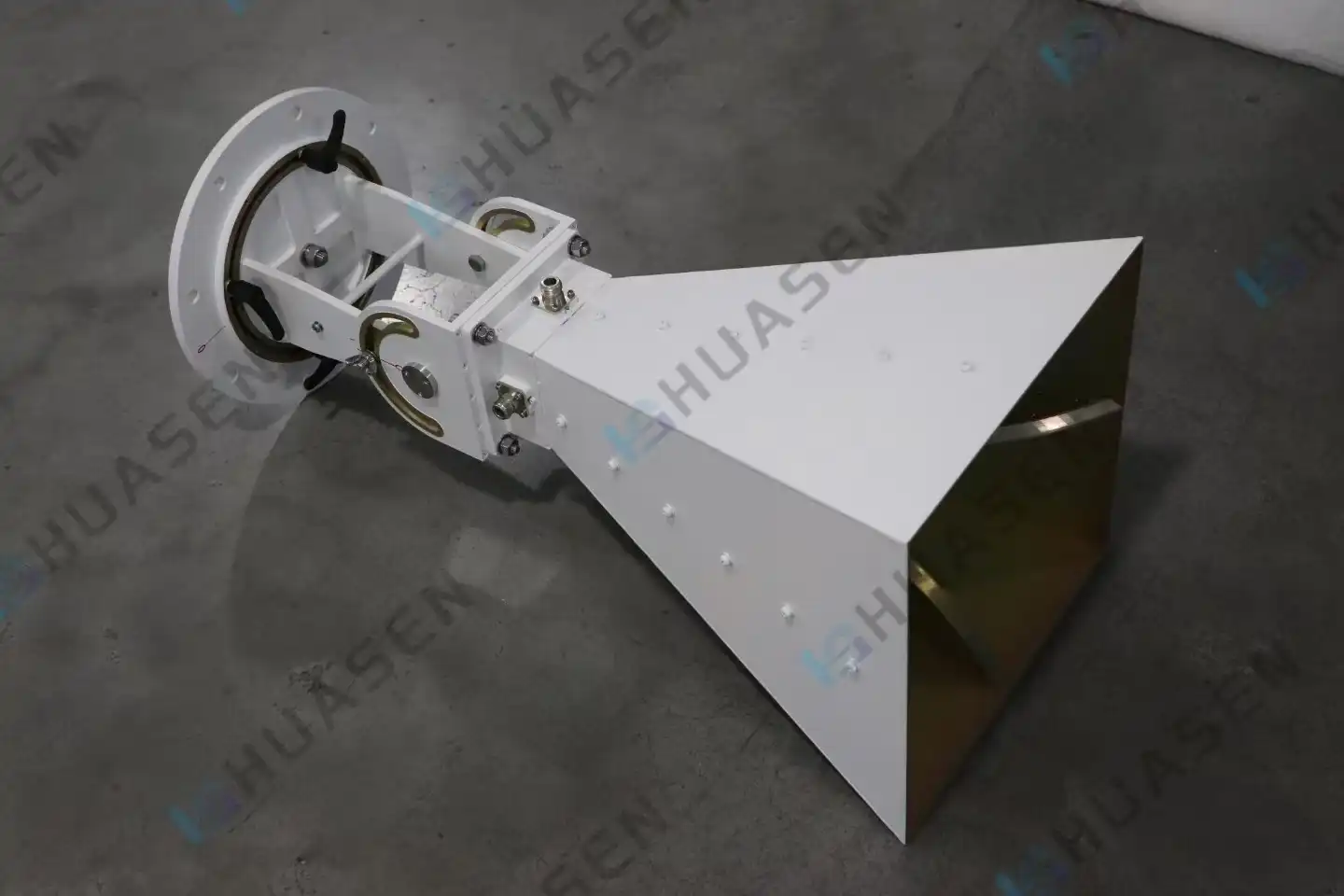
The antenna has a case made of precisely machined aluminum or brass that has four tapered grooves that go from the throat to the opening. Ridge tapering manages the change in resistance from the coaxial or waveguide feed to empty space, which keeps echoes to a minimum. The VSWR of high-quality units stays below 2.0:1 throughout their whole working range. The choice of material has a direct effect on temperature stability and power handling. For example, aluminum alloys are strong and lightweight, making them ideal for portable test sets, while brass is better at conducting electricity, making it ideal for lab reference standards.
Ultra-Wideband Frequency Capabilities
These days, quadridged horn antenna designs usually cover 10:1 bandwidth rates. The DPHA and DPOBHA lines from Huasen Microwave show this power, covering frequency bands from 0.1 GHz to 40 GHz. Lower bands (0.1–6 GHz) are used for testing 5G/6G base stations and marine radar. Mid-bands (6–18 GHz) are used for verifying satellite uplinks and communication systems in the air. Upper bands (18–40 GHz) are used for millimeter-wave backup lines and testing of electronic defenses. This complete coverage combines inventory needs, making system integration easier for businesses and study institutions with a lot of computers.
Polarization Types and Radiation Patterns
The ability to use dual-linear polarization is a major benefit. Each of the two coaxial ports creates an electric field in two different directions. This lets you measure both vertically and horizontally at the same time without having to turn the device mechanically. When connected to a 90-degree hybrid coupler, the antenna creates circular polarization, which is very important for GPS tests and satellite transmission ground stations. Patterns of radiation are usual for horns: moderate gain (5–19 dB based on frequency and aperture size) and beamwidths that are fairly wide, running from 30 to 80 degrees. A stable phase center across the band allows for reliable readings at far distances in small antenna test ranges.
Impedance Matching and Design Challenges
To get wideband impedance matching, the ridge shape needs to be carefully optimized. Modeling field patterns with computer-aided electromagnetic simulation tools gets rid of resonances and keeps the input resistance constant. At millimeter-wave frequencies, where tiny ridge misalignment hurts high-frequency performance, manufacturing tolerances become very important. Precision CNC machines and laser measuring systems make sure that the dimensions are correct to within ±0.02 mm. Choosing the right connection can also affect how much power is handled. For example, Type-N and 7/16 DIN interfaces can handle higher continuous wave power for immunity tests, while 2.92 mm and K-connectors can handle 40 GHz operation in a lab setting.
Comparing Quadridged Horn Antennas with Other Antenna Types
The choice of antenna depends on the trade-offs that need to be made between bandwidth, polarization freedom, and gain traits. Knowing these differences makes it easier to make purchases and avoid costly design mismatches.
Double-ridged horns have the same benefits in terms of capacity, but they can only handle one linear polarization. They work great for low-cost tasks that don't need polarization variety, like measuring radiated emissions that only go in one direction. The omnidirectional shapes of conical and biconical antennas make them good for general EMI screening, but they lose gain and directivity in the process. Log-periodic arrays have a very wide bandwidth and directed patterns, but they are spread out, which makes time-domain pulse readings more difficult. Patch antennas have small sizes that make them useful for integrated uses, but they only work over very small fractional bandwidths. Standard gain horns are used as measuring standards because their properties are well known. However, because they only cover one octave, the antenna has to be switched during multi-band tests.
It is only the Quadridged Horn Antenna design that can handle a wide bandwidth, the ability to work with two different polarizations, and a moderate gain. When testing complicated systems like phased arrays or MIMO base stations, this mix is very helpful because polarization purity and frequency agility have a direct effect on measurement accuracy. When procurement workers are looking at antenna investments, they should compare these performance factors to budget and lab room limits.
Applications and Benefits of Quadridged Horn Antennas in Ultra-Wideband Scenarios
Because Quadridged Horn Antenna technology is so flexible, it can be used in many high-stakes areas where accurate measurements and following the rules are very important.
EMC and EMI Testing
The aerospace and automotive businesses use these antennas to test for radiated protection in line with CISPR 25 and MIL-STD-461 guidelines. Being able to light up a device being tested with both polarizations at the same time cuts the time that the anechoic room is occupied in half, which saves a lot of money when hourly rates are more than a few thousand dollars. Cross-polarization discrimination better than 30 dB makes sure that immunity limits are a good reflection of electromagnetic conditions in the real world. When defense contractors look at communication security systems, they really like how fast polarization switching is made possible by electronic port selection. This lets them model threat situations without having to make any mechanical changes.
Broadband Radar and Wireless Communication Systems
For next-generation radar systems, antennas need to keep their gain and beamwidth the same over a wide range of frequencies. Airborne phased arrays that work from S-band to Ka-band can be characterized using quad-ridged horn antenna feeds in small antenna test areas. These are used by companies that make maritime guidance radar to check antenna patterns in both weather and ocean search modes. The antenna's ability to look at both co-polarized and cross-polarized signal components is useful for wireless point-to-point links and bridges. This is especially important for reducing multipath interference in busy urban deployments.
Scientific Research and Spectrum Monitoring
Quad-ridged horn antennas are used as wideband receivers for ionospheric sounding and radio astronomy by research centers that study electromagnetic propagation events. Their stable phase centers let unified signal processing happen over many octaves of bandwidth. Regulatory agencies that keep an eye on spectrum compliance, like how a single device can cover a number of approved bands, from VHF broadcast to millimeter-wave point-to-multipoint licenses. Huasen's DPHA series has a mechanical six-degrees-of-freedom adjustment that lets you precisely line up with high test stands or outdoor measurement ranges. The X, Y, and Z axes all stay within 0.5 mm of their original positions.
These real-world uses show a real return on investment by cutting down on test times, combining tools, and improving measurement accuracy. When companies switch from narrowband standard gain horns to widerband ones, they report 40–60% less time spent handling antennas and, correspondingly, fewer human mistakes during test setup.
Procurement Guide for Quadridged Horn Antennas
Successful sourcing demands systematic evaluation of technical specifications, supplier credentials, and post-delivery support infrastructure. Structured selection processes help procurement managers balance the need for success with the realities of the budget for Quadridged Horn Antennas.
Essential Selection Factors
The most important criterion is frequency range. It is recommended that buyers match the test bands they need with available antenna types, leaving a 10–15% margin above the standard working frequencies to account for VSWR decline at the band edges. Gain needs change based on measurement distance and sensor sensitivity. For example, 6–12 dB gain is usually needed for near-field EMC scanning, while 15+ dB gain may be needed for far-field pattern measures to keep signal-to-noise ratios that are good. Specifications for polarization isolation must match measurement standards. For example, most military and automobile test plans call for >25 dB port-to-port isolation.
Because of things like mounting flange sizes, weight, and connector types, early testing must be done using current test tools. For defense and aircraft contracts, certification paperwork is very important. Every package should have an ISO 17025 calibration certificate, a MIL-STD compliance statement, and a RoHS declaration. Lead times go from the standard 4–6 weeks to 10–14 weeks for custom changes like weatherproof radomes for outdoor installations or special mounting adapters for robotic positioners. This means that project plans need to be planned ahead of time.
Supplier Evaluation and Pricing Strategies
Well-known names like ETS Lindgren, Rohde & Schwarz, and Keysight Technologies have large product catalogs, including quadridged horn antennas, and service networks that reach people all over the world. These top suppliers are great at making a lot of things and putting together test systems all at once. Specialized makers, like Huasen Microwave, give you a competitive edge by letting you customize your order and giving you direct technical support. Huasen was founded in 1993 and has more than 30 years of experience making RF components. They provide precision-engineered solutions to the aircraft, radar, and telecoms industries around the world.
When you buy in bulk, you should talk about unit prices, calibration data sets, and guarantee terms. When you buy more than ten units, you can often get 15–25% off, and you may even get extra plugs or safe cases for free. In order to figure out the total cost of ownership, you have to include the costs of periodic calibration. Depending on the frequency range and licensing standards, each antenna needs to be recalibrated once a year for $800 to $2,000. When planning international operations, things like export classification reviews for frequencies above 18 GHz, customs bond arrangements, and shipping insurance for valuable RF assets are things that need to be thought about.
Optimizing Ultra-Wideband Antenna Performance: Best Practices and Troubleshooting
Even quad-ridged horn antenna transmitters that were perfectly designed won't work well if they aren't properly installed or kept. Adopting regular optimization practices makes measurements more accurate and increases the useful life of assets.
Common Performance Bottlenecks and Solutions
VSWR problems are often caused by contaminated connectors or incorrect force application. Visual checks should be done once a month to look for damage to the center pin, dielectric cracks, and worn-out O-rings. To avoid damaging connectors by overtightening them, use torque wrenches that are set to the manufacturer's specs (12–15 in-lbs for SMA and 25 in-lbs for Type-N). Cross-polarization degradation is often caused by ridge misalignment after mechanical shocks; drop-test methods require rapid recalibration if accelerations are more than 50 g.
Impedance Matching and Simulation Tools
For more advanced users, vector network analyzers are used to describe S-parameters across working bandwidths and find resonance frequencies that need external matched networks. CST Microwave Studio and Ansys HFSS let engineers predict performance before installation so they can model how antennas and chambers interact before making expensive changes to the range. When a single-ended to differential converter uses a balun, it's important to pay close attention to the common-mode rejection ratios. Ferrite chokes on coaxial lines stop unwanted currents that mess up radiation patterns.
Maintenance and Calibration Best Practices
Accredited labs that follow ISO 17025 guidelines should use three-antenna methods or replacement techniques to do gain and pattern calibrations every two years, Quadridged Horn Antenna. Corrosion can be avoided by storing things in climate-controlled areas; desiccant packs inside protected cases keep the relative humidity below 40%. Moving things from one building to another is less likely to damage them when they are transported in hard foam-lined cases with shock-mounted inserts. New technology trends include software-defined polarization synthesis, in which digital signal processing replaces mechanical hybrid couplers, and metamaterial-enhanced ridge shapes that promise 30% smaller sizes with the same level of performance.
Conclusion
The Quad-ridged Horn Antenna technology is a stable but always changing way to solve ultra-wideband RF problems. When dual-polarization, multi-decade bandwidth, and mechanical precision come together, they solve important problems in the defense, aircraft, and telecoms sectors. The DPHA and DPOBHA lines from Huasen Microwave are the best of the best. They cover frequencies from 0.1 to 40 GHz, have separation levels above 20 dB, and can be placed in any way you want using six axes. As 5G turns into 6G and radar systems move into millimeter-wave bands, the choices we make today about what to buy will affect our ability to measure for the next ten years. These flexible platforms are very useful for businesses that want to combine their tools, test more quickly, and keep track of their calibrations.
FAQ
1. What frequency ranges do quadridged horn antennas typically cover?
The spectrum for Quadridged Horn Antennas is usually split into three main bands: low (0.1–6 GHz), mid (6–18 GHz), and high (18–40 GHz). For specific millimeter-wave study uses, custom designs can make the range go up to 110 GHz. In Huasen's catalogue, there are choices for overlapping bands that let you keep measuring across neighboring frequency blocks.
2. How do quadridged designs differ from double-ridged horn antennas?
Double-ridged horns have two ridges that are opposite each other and support a single linear polarization. Quadridged designs, on the other hand, have four ridges that support dual-orthogonal polarization at the same time. This difference gets rid of the need for motorized spinning during EMC testing, which cuts measurement time in half and makes it easier to repeat. Quality quad-ridged units have port separation that is higher than 25 dB, which makes sure that there isn't much noise between polarization channels.
3. What criteria matter most when selecting suppliers for bulk procurement?
Check the company's expert help, factory quality systems (ISO 9001 certification), and calibration accreditation (ISO 17025 compliance). Before placing a large order, ask for example units with full S-parameter data so that they can be tested for validity. Predictable lead times and the supply of spare parts are very important for keeping test plans. Read over the guarantee terms that cover mechanical damage, worn connectors, and changes in electrical parameters at certain times.
Partner with a Proven Quadridged Horn Antenna Manufacturer
Every project that Huasen Microwave works on is backed by their more than thirty years of experience designing high-frequency microwave parts. As required by ANSI C63.5 standards, our DPHA and DPOBHA series Quadridged Horn Antenna units go through strict quality control checks, such as full-band VSWR verification and cross-polarization discrimination tests. Our engineering team works directly with your sourcing and RF testing groups, from reviewing the specifications for the first time to providing tuning support after delivery. Orders of more than five units qualify for volume savings, and fast production can meet the needs of projects with tight deadlines. Get in touch with our technical sales experts at sales@huasenmicrowave.com to discuss your ultra-wideband measurement needs and get specific information that fits your needs.
References
1. Balanis, Constantine A. Antenna Theory: Analysis and Design, 4th Edition. John Wiley & Sons, 2016.
2. Turrin, Richard H. "Dual-Mode Small-Aperture Antennas." IEEE Transactions on Antennas and Propagation, vol. AP-15, no. 2, 1967, pp. 307–308.
3. Kerr, Jeremy L. "Short Axial Length Broad-Band Horns." IEEE Transactions on Antennas and Propagation, vol. AP-21, no. 5, 1973, pp. 710–714.
4. Love, Alan W. Electromagnetic Horn Antennas. IEEE Press, 1976.
5. Milligan, Thomas A. Modern Antenna Design, 2nd Edition. Wiley-IEEE Press, 2005.
6. Rudge, Alan W., et al. The Handbook of Antenna Design, Volume 1. Peter Peregrinus Ltd., 1982.
Send Inquiry