The Role of Corrugated Horns in Radio Astronomy and Deep Space Exploration?






2019-02-25 14:24:00
Corrugated horn antennas play a crucial role in radio astronomy and deep space exploration, serving as the eyes and ears of our most advanced telescopes and spacecraft. These specialized antennas, characterized by their distinctive ridged interior surfaces, are essential for capturing faint radio signals from distant celestial objects and facilitating communication across vast cosmic distances. The unique design of corrugated horn antennas allows for exceptional performance in terms of beam symmetry, low sidelobes, and wide bandwidth – qualities that are paramount in the challenging fields of radio astronomy and deep space communications. By efficiently collecting and transmitting electromagnetic waves, these antennas enable scientists to peer into the farthest reaches of the universe and maintain vital links with interplanetary probes, advancing our understanding of the cosmos and pushing the boundaries of human exploration.
Why are corrugated horn antennas used in radio astronomy and deep space?
Corrugated horn antennas have become indispensable tools in radio astronomy and deep space exploration due to their superior performance characteristics. These antennas excel in capturing weak signals from distant cosmic sources, making them ideal for radio telescopes and space-based observatories. The corrugated structure of these antennas offers several advantages that are particularly beneficial in these applications:
Enhanced Beam Pattern and Symmetry
One of the primary reasons for using corrugated horns in radio astronomy is their ability to produce highly symmetric and well-defined beam patterns. This symmetry is crucial for accurate mapping of celestial objects and precise determination of their positions in the sky. The corrugations help to suppress unwanted modes of propagation, resulting in a clean, Gaussian-like beam shape that minimizes distortions and improves overall data quality.
Low Sidelobe Levels
Corrugated horns are renowned for their exceptionally low sidelobe levels. In radio astronomy, where extremely faint signals are being detected, minimizing sidelobes is essential to prevent interference from nearby strong sources. The corrugated structure effectively reduces sidelobes, allowing astronomers to isolate and study weak signals with greater accuracy and sensitivity.
Wide Bandwidth Capabilities
Another significant advantage of corrugated horns is their ability to operate over a wide frequency range while maintaining consistent performance. This wide bandwidth capability is particularly valuable in radio astronomy, where observations across multiple frequencies are often necessary to gather comprehensive data on celestial objects. In deep space communications, the broad bandwidth allows for more efficient data transmission and reception over vast distances.
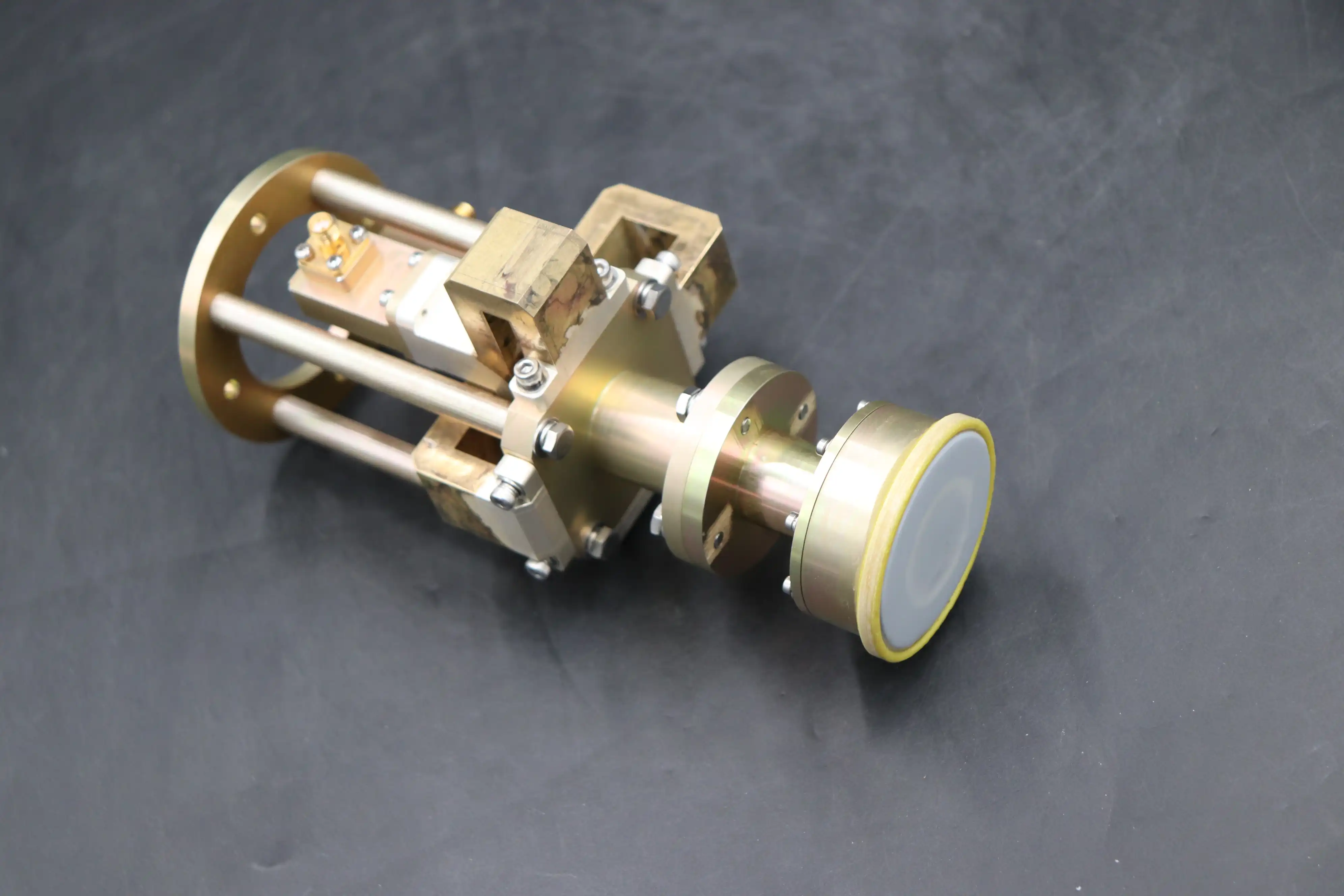
Corrugated horn design: how corrugations improve performance
The design of corrugated horn antennas is a testament to the ingenuity of microwave engineering. The corrugations, which are carefully engineered grooves or ridges along the interior surface of the horn, are not merely cosmetic but serve a vital function in enhancing the antenna's performance.
Controlling Surface Impedance
The primary function of corrugations is to control the surface impedance of the horn's interior. By creating a series of alternating high and low impedance regions, the corrugations effectively modify the boundary conditions for electromagnetic waves propagating through the horn. This impedance modulation helps to suppress unwanted higher-order modes and promotes the propagation of the desired hybrid mode, typically the HE11 mode.
Optimizing Corrugation Parameters
The design of corrugated horns involves careful optimization of several parameters: - Corrugation depth: Typically set to approximately λ/4 (where λ is the wavelength) to create a high-impedance surface - Corrugation width and spacing: Adjusted to control mode conversion and achieve desired performance across the frequency band - Horn flare angle: Influences the trade-off between gain and beamwidth - Overall horn length: Affects the phase error and ultimately the antenna's efficiency
Advanced Design Techniques
Modern corrugated horn designs often employ sophisticated techniques such as: - Profile shaping: Optimizing the horn's profile for improved performance - Variable depth corrugations: Enhancing bandwidth and reducing return loss - Dielectric loading: Further improving bandwidth and reducing size - Computational modeling: Using advanced electromagnetic simulation software for precise design and optimization
Deep-space communications: horn antenna requirements and challenges
Deep-space communications present unique challenges that push the limits of antenna technology. Corrugated horn antennas used in this field must meet stringent requirements to maintain reliable links across astronomical distances.
Extreme Sensitivity and Gain
For deep-space missions, the ability to detect and transmit extremely weak signals is paramount. Corrugated horns used in these applications must offer: - High gain: To focus energy in the desired direction and increase effective radiated power - Excellent efficiency: To maximize the use of limited power resources on spacecraft - Ultra-low noise: To detect faint signals from distant probes
Environmental Resilience
Space-based antennas must withstand harsh conditions: - Thermal stability: Maintaining performance across extreme temperature variations - Radiation resistance: Withstanding high levels of cosmic radiation - Mechanical robustness: Surviving launch vibrations and long-term space operations
Size and Weight Constraints
Space missions often have strict limitations on size and weight. Engineers must balance performance requirements with: - Compact designs: Fitting within spacecraft dimensions - Lightweight materials: Minimizing launch costs and fuel requirements - Deployable structures: For larger antennas that must be compactly stowed during launch
Future Developments
Ongoing research in corrugated horn technology for deep-space applications includes: - Advanced materials: Exploring metamaterials and 3D-printed structures for enhanced performance - Adaptive systems: Developing antennas that can reconfigure their characteristics in response to changing mission needs - Integration with other technologies: Combining corrugated horns with phased arrays or other antenna types for improved versatility
As we continue to push the boundaries of space exploration, the role of corrugated horn antennas in radio astronomy and deep-space communications remains pivotal. These remarkable devices, with their precisely engineered surfaces, enable us to listen to the whispers of distant galaxies and maintain tenuous links with our robotic emissaries in the solar system and beyond.
Conclusion
Corrugated horn antennas have proven to be indispensable tools in the fields of radio astronomy and deep space exploration. Their unique design characteristics enable them to capture faint signals from the cosmos and facilitate communication across vast distances with unparalleled efficiency. As technology advances, these antennas will continue to play a crucial role in unraveling the mysteries of the universe and extending humanity's reach into space.
For those involved in cutting-edge research, telecommunications, or aerospace projects requiring high-performance microwave and millimeter-wave components, Huasen Microwave Technology Co., Ltd. offers a range of advanced solutions. With decades of expertise in RF and microwave technology, we provide custom-engineered corrugated horn antennas and other specialized components tailored to meet the exacting demands of scientific and industrial applications. Our commitment to innovation and quality ensures that we can support your most challenging projects with reliable, high-performance products.
FAQ
1. What is the typical frequency range for corrugated horn antennas in radio astronomy?
Corrugated horn antennas used in radio astronomy typically operate in frequency ranges from a few gigahertz to several hundred gigahertz, depending on the specific application and celestial objects being studied.
2. How do corrugated horns compare to smooth-walled horns in terms of performance?
Corrugated horns generally offer superior performance compared to smooth-walled horns, particularly in terms of beam symmetry, sidelobe suppression, and bandwidth. This makes them preferable for applications requiring high precision and sensitivity.
3. Can corrugated horn antennas be used in other fields besides astronomy and space exploration?
Yes, corrugated horn antennas find applications in various fields, including telecommunications, radar systems, terrestrial microwave links, and scientific instrumentation, where high-performance antennas are required.
4. What materials are commonly used in the construction of corrugated horn antennas for space applications?
Corrugated horns for space applications are often constructed using lightweight, thermally stable materials such as aluminum alloys, electroformed copper, or composite materials. The choice depends on specific mission requirements and environmental conditions.
Enhance Your Deep Space Communication Capabilities | Huasen Microwave
Ready to elevate your radio astronomy or deep space communication projects with state-of-the-art corrugated horn antennas? Huasen Microwave Technology Co., Ltd. offers custom-engineered solutions tailored to your specific requirements. Our team of experts is prepared to assist you in selecting the ideal corrugated horn antenna for your application, ensuring optimal performance and reliability. Contact us today at sales@huasenmicrowave.com to discuss your project needs and discover how our advanced microwave and millimeter-wave components can propel your research or mission to new heights.
References
1. Olver, A. D., Clarricoats, P. J. B., Kishk, A. A., & Shafai, L. (1994). Microwave Horns and Feeds. IEE Electromagnetic Waves Series 39.
2. Granet, C., & James, G. L. (2005). Design of corrugated horns: a primer. IEEE Antennas and Propagation Magazine, 47(2), 76-84.
3. Goldsmith, P. F. (1998). Quasioptical Systems: Gaussian Beam Quasioptical Propagation and Applications. IEEE Press.
4. Kitsuregawa, T. (1990). Advanced Technology in Satellite Communication Antennas: Electrical & Mechanical Design. Artech House.
5. Teniente, J., Gonzalo, R., & Del-Río, C. (2002). Choked Gaussian antenna: extremely low sidelobe compact antenna design. IEEE Antennas and Wireless Propagation Letters, 1, 200-202.
6. Kraus, J. D., & Marhefka, R. J. (2002). Antennas for All Applications. McGraw-Hill.
Send Inquiry