Low Noise Amplifier vs Power Amplifier: Which Do You Need?






2026-07-15 17:26:26
You can choose between a power amplifier and a low-noise amplifier based on where it is in your signal chain and the performance goal you want to reach. If your application needs to boost very weak data at the receiving front end, you will need a low-noise amplifier. That is something that could happen in radar detection systems, 5G base station receivers, or satellite ground stations. It keeps the information pure by amplifying it with little noise, which makes your system more sensitive. There are, however, times when you need to boost RF signals to very high levels in order to send them. This can happen in military communication stations, radio towers, or wireless backup lines. It lets you send enough power to get to users far away, even if the path is lost.
Introduction
These days, the most important part of RF and microwave devices is the amplifier. They can both send and receive signs. It is important to understand how different kinds of boosters work if you want to build a next-generation 5G base station, set up satellite communication links, or add tracking systems to robots that fly in the air. Low-noise amplifiers and power amplifiers are the two main types of amplifiers. Both boost signals, but they are made in very different ways, measure success in very different ways, and are used in very different ways. More and more, system experts and people who buy things for businesses have to pick parts that are a good mix of performance, cost, and dependability over the long term. There are differences between these types of amplifiers that you might not know about. This could cause your system to not work as well as it could, your budget to go overboard, or even the project to fail. This guide talks about the technical and useful differences between LNAs and PAs. It can be used in many areas, from telecommunications to flight. This is what we want to do: give you the information you need to make decisions that are good for your business and its needs.
Understanding Low Noise Amplifiers (LNAs)
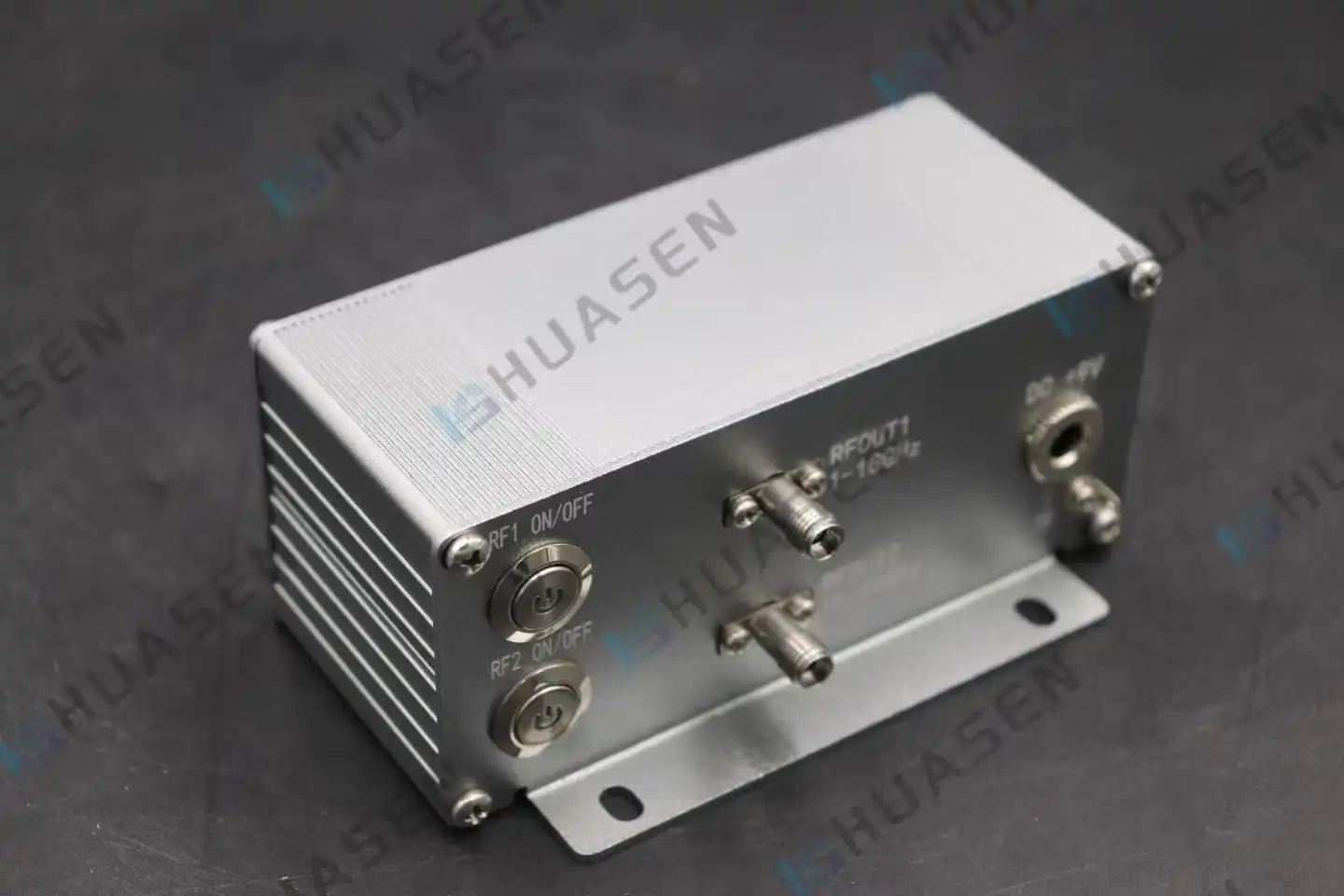
It is the purpose of low-noise amplifiers to boost very weak signals with as little extra noise as possible. When building a receiver, the LNA comes right after the antenna in the early stages. No matter if it's a satellite dish picking up signals from geostationary orbit, a maritime communication system picking up on weak distress beacons, or a 5G base station processing uplink data from phones, this is always the case. Its major job is to boost the signal that comes in before it hits parts of the line that lose signal strength, like mixers, filters, or ADCs.
The Role of Noise Figure in LNA Performance
The noise figure of an amplifier tells you how much noise it adds to the signal. When you measure noise in decibels, a smaller number means the machine is more sensitive. There is a difference between a receiver with an LNA noise figure of 1.3 dB and one with an amplifier noise figure of 3 dB. The difference is several decibels. This difference is very important in fields like electronic warfare, where picking up on weak enemy signals can mean the difference between winning and losing, and in astronomy, radio telescopes, where you need to be very sensitive to pick up whispers from very far away. Changes in the noise figure also happen in the signal-to-noise ratio. This ratio controls how much data can be sent and how often mistakes happen in digital systems.
Gain and Bandwidth Characteristics
LNAs can have gains of 15 dB to 50 dB, depending on the design and frequency band. The gain should be high enough to keep the signal above the next stage's noise floor, but not so high that it makes the signal unstable or saturates. Another important thing is bandwidth. Narrowband LNAs are better at handling noise but are less adaptable because they are only made to work with certain frequencies. When you don't need to use a lot of different amplifiers, ultra-wideband LNAs, which work from 2 GHz to 18 GHz, make system design easier. However, in exchange for their flexibility, they often give up peak noise performance. In more advanced designs, GaAs or SiGe semiconductor technologies are used to make electrons move around more easily. This leads to low noise and high linearity over a wide frequency range.
Applications Driving LNA Demand
Applications that use LNA need LN. Many fields need to make sure the signal stays strong and is picked up accurately. In satellite communications, ground units use LNAs to boost broadcast signals that are weaker because they have to go through a lot of air and travel a long way. LNAs pick up return echoes from targets that are far away or hidden in radar systems, mostly in defense and aviation. It is the job of LN As to handle weak inbound signals from users at the edges of cells for communication devices like 5G massive MIMO base stations. Research labs and calibration centers also use precision LN. To look at the spectrum, test antennas, and describe RF components. It's important for all applications to get the best data clarity with the least amount of noise.
Understanding Power Amplifiers (PAs)
At the other end of the data chain are power amps. They give off a lot of power, which is needed to send signals over long distances or in places where they are hard to reach. PAs can take in signals from milliwatts to multi-watts and boost them to watts to kilowatts. LNAs, on the other hand, can only handle sources at the microvolt level. Lack of power can lead to signal loss, poor coverage, or even the failure of the link in military communications, satellite uplink stations, broadcast transmitters, and point-to-point microwave links. This feature is very important in these places.
Power Output and Efficiency Trade-offs
PAs can work in different ways, with different operating classes like Class A, B, AB, C, and more, often in conjunction with a low-noise amplifier. There is a different trade-off between speed, confusion, and consistency for each class. It is possible to use Class A amplifiers in cases where signal distortion is low because they are straight. They usually lose less than 25% of their heat, though, so they're not very efficient. Base stations for telecommunications often use Class AB designs because they are a good mix of being moderately efficient and having good linearity. Even though Class C amplifiers work very well, they cause a lot of distortion, so they can only be used in situations where signal integrity is not very important, like FM broadcasting. Class E and F designs, which are often made with solid-state and GaN technologies, are more than 70% more efficient. This helps fix issues with how small, high-power systems use power and deal with heat.
Linearity and Signal Integrity Challenges
It is very hard for engineers to keep linearity at high power levels. Not straight lines cause intermodulation distortion and harmonic content. These break the rules of spectral space and mess up transmission signals. Error Vector Magnitude gets worse in modulation methods like 256-QAM or OFDM, which are used in 5G and Wi-Fi 6E, when it's hard to tell what will happen. This slows things down and increases the number of packet errors. Some things that engineers can do to make these problems less severe are predistortion, feedforward change, and picking the bias points with care. If you choose a PA with enough output power headroom (working a few decibels below its compression point), the linearity will stay the same, but the efficiency will go down. This is an example of how PA design is always a balance.
Typical PA Applications
Most apps that deal with Gearbox are made by PAs. As part of wireless infrastructure, like cell phone base stations and microwave backhaul links, PAs make sure that signals always get to users or relay points. Broadcast stations need high-power amplifiers to send signals over long distances. This is true for TV, FM radio, and satellite uplinks. Tough power amplifiers are used in radars on ships, communication pods in the air, and electronic countermeasure gear. These are all places where mission-critical high-power transmission is needed. In addition to medical MRI systems, PAs are also used in RF heating systems for industry and to make plasma. These systems don't use normal channels of communication, but they still need to send RF power in a certain way.
Low Noise Amplifier vs. Power Amplifier – Core Differences
The technical and military differences between LNAs and PAs need to be known by people who work on system development and buying. Different types of amplifiers perform differently, have different design priorities, and are used in different ways. Each type of amplifier fits into the larger signal chain in a different way because of these differences.
Noise Figure vs. Output Power Priority
What makes LNAs and PAs different is the main performance metric that tells them apart. Because they want to keep the noise level as low as possible—often below 1.5 dB—LN As keep weak messages that are being received. However, PAs don't care much about noise figure. Instead, they try to get the most output power, which is generally given in dBm or watts. This kind of LNA might have a noise figure of 1.3 dB, an output power of +10 dBm, and a gain of 30 dB. The total power of a PA could be +40 dBm, the gain could be 15 dB, and the noise figure could be more than 10 dB. This has nothing to do with what the PA is supposed to do. LNAs are at the beginning of the sensitive receiver, while PAs are at the end of the strong emitter. This is the main difference between them.
Gain and Frequency Response
There is a gain in both types of amplifiers, but they are used for very different things. An LNA's gain is only 15 to 50 dB, and its job is to raise weak signals above the noise floors further downstream without overloading. Most PAs have a gain of 10 to 20 dB, but they have much higher absolute power levels. They can boost driving messages from milliwatts to watts or more. The way you react to rhythm also changes. LNAs can cover very narrow or very wide bands, based on what the receiver needs. In order to keep things simple and straight, PAs usually have smaller bandwidths. That being said, there are broadband PAs for multi-band transmitters that give up peak efficiency in exchange for operational flexibility.
| Parameter | Low Noise Amplifier (LNA) | Power Amplifier (PA) |
|---|---|---|
| Primary Objective | Minimize noise figure | Maximize output power |
| Typical Gain | 15 dB to 50 dB | 10 dB to 20 dB |
| Noise Figure | 1.3 dB to 3 dB | >10 dB (not critical) |
| Output Power | +5 dBm to +15 dBm | +30 dBm to +50 dBm or higher |
| Signal Chain Position | Immediately after the antenna (receiver) | Before the antenna (transmitter) |
| Key Challenge | Minimizing added noise | Managing linearity and efficiency |
When to Choose LNA or PA?
If you want the piece to be as sensitive as it can be, choose an RF LNA. It can be used to find weak signals by radar monitors, spectrum analysers, satellite ground stations, and any other system. Choose a PA if you need to be sure you have enough sending power to cover lawyer fees, link costs, or service areas. PA can be used in transmitters, base station outputs, broadcast systems, and RF test signal generators, among other places. These two types of amplifiers are often used together today: As for inputs and outputs, RF LNAs are in charge of them. It was done with care so that they won't mess with each other.
Procurement Considerations for LNAs and Power Amplifiers
It's not enough to just make sure that the amplifier's frequency and power numbers match when you buy it. The people whose job it is to buy things need to look at performance measures, read datasheets properly, decide how reliable a seller is, and compare how much something costs now to how much it will be worth in the long run. You can use the tips in this section to find amps that meet your technical needs and keep your business running.
Critical Evaluation Criteria
The noise figure is the most important thing to look at when comparing LN. Because it has a direct effect on how sensitive the receiver is. It is possible to measure how much more efficient something is when the noise number is lower. Gain must raise messages just enough so they are stable and don't use too much power. Input and output return loss, which is often written as VSWR or S11/S22, can change both the efficiency of power transfer and the matching of impedances. What kind of application can use it is based on the frequency range. Make sure the coverage includes your operating band plus some space in case you need to tune or drift. When you look at PAs, pay close attention to the power output at the 1 dB compression point (P1dB). This is where the linear output is highest. Third-order intercept point (IP3) checks for regularity, which is very important in systems with thick modulation or many carriers. The amount of efficiency, which is shown as power-added efficiency, changes the temperature design and the cost of running the machine.
Interpreting Datasheets and Specifications
The datasheets for many makers are thin and hard to understand. Read more than the top numbers to get a sense of how the tests were done. A noise number that says "at 25°C with 50-ohm source impedance" might not be very accurate in real life, where antennas are not matched, and temperatures can be very different. The performance stays the same if the gain doesn't change across a certain band. It might be harder to tune the system if it has peaks and dips. Power supply sensitivity tells you if noise or changes in voltage from the power supply hurt performance. This is easy to forget. You can use an N-type, SMA, K-type, or waveguide connection, and your system's ports should be able to handle it. You won't have to make your own wires or buy pricey adapters this way.
Supplier Reliability and Customisation
If you need a lot of different things, some big names in the business world, like Mini-Circuits, Analogue Devices, and Qorvo, might not be able to do it all. It is possible to change frequency bands, link settings, power handling, and weather resistance with the help of experts like Huasen Microwave. There needs to be customisation when there are special technical needs, non-standard frequency bands, or bad weather. How long does it take for suppliers to respond to requests for technical support? How many units do they need as a minimum order? Will they send you sample units to test? By building long-term relationships with companies that offer design help, testing data, and support after the sale, you can lower your risk and get the project done faster.
| Huasen Microwave Low Noise Amplifier | Specifications |
|---|---|
| Operating Frequency Range | 0.01 GHz to 100 GHz |
| Gain Range | 15 dB to 50 dB |
| Noise Figure | As low as 1.3 dB |
| Connector Types | N-type, SMA, K-type, Waveguide |
| Product Series | Standard LNA / AC LNA (Built-in AC-DC module) |
| Customization | Fully supported |
Cost and Bulk Purchasing Strategies
Amplifier pricing for wideband LNA reflects design complexity, performance tier, semiconductor technology, and production volume. High-performance GaAs LNAs with sub-1.5 dB noise figures cost significantly more than commercial-grade alternatives. Volume purchases typically unlock tiered pricing discounts, reducing per-unit costs by 20% to 40% for orders exceeding hundreds or thousands of units. Negotiate framework agreements with suppliers for predictable pricing and priority allocation during component shortages. Consider the total cost of ownership, including integration effort, testing, and potential redesigns if initial selections underperform. Investing in higher-quality components upfront often reduces downstream costs associated with field failures, warranty claims, or performance shortfalls.
Conclusion
Selecting between a low noise amplifier and a power amplifier hinges on your signal chain position and performance objective. LNAs excel at preserving weak incoming signals with minimal noise addition, making them indispensable at receiver front-ends. PAs deliver the high output power essential for transmission over distance or through challenging environments. Understanding their distinct roles, performance metrics, and application contexts empowers procurement professionals and engineers to specify components that optimise system performance while controlling costs. Whether your project involves 5G infrastructure, satellite communications, radar systems, or aerospace platforms, choosing the right amplifier type is foundational to success.
FAQ
1. Can an LNA replace a PA in a transmitter design?
No. LNAs are designed for low-power, low-noise operation, typically outputting +5 to +15 dBm. PAs deliver tens to thousands of watts, a power level that LNAs cannot achieve without immediate saturation and catastrophic failure. Their design objectives and semiconductor implementations are fundamentally incompatible.
2. Why is the noise figure so critical for LNAs but irrelevant for PAs?
Noise figure measures how much noise an amplifier adds to the signal. In receivers, weak incoming signals sit near the noise floor; even small noise additions degrade sensitivity. PAs process already-amplified signals at high power levels, where their added noise is negligible compared to signal strength, making noise figure non-critical.
Partner with Huasen Microwave for Your Low Noise Amplifier Needs
Huasen Microwave stands as a trusted Low Noise Amplifier manufacturer with over three decades of expertise in high-frequency microwave and millimeter-wave component development. Our comprehensive LNA portfolio spans 0.01 GHz to 100 GHz, delivering gain from 15 dB to 50 dB and noise figures as low as 1.3 dB. We support N-type, SMA, K-type, and waveguide connectors, offering both standard and AC-integrated models with built-in AC-DC power modules. Customization is our strength; whether you require unique frequency coverage, specialized mechanical packaging, or environmental hardening to MIL-STD specifications, our engineering team collaborates closely to deliver tailored solutions. Contact our sales team at sales@huasenmicrowave.com to discuss your project requirements, request technical datasheets, or arrange sample evaluations with competitive bulk pricing and reliable delivery schedules.
References
1. Gonzalez, G. (1997). Microwave Transistor Amplifiers: Analysis and Design. Prentice Hall.
2. Pozar, D. M. (2011). Microwave Engineering (4th ed.). Wiley.
3. Cripps, S. C. (2006). RF Power Amplifiers for Wireless Communications (2nd ed.). Artech House.
4. Ludwig, R., & Bogdanov, G. (2009). RF Circuit Design: Theory & Applications (2nd ed.). Pearson.
5. IEEE Microwave Theory and Techniques Society. (2020). Design considerations for ultra-wideband low-noise amplifiers in 5G applications. IEEE Transactions on Microwave Theory and Techniques, 68(8), 3456-3468.
6. Razavi, B. (2011). RF Microelectronics (2nd ed.). Prentice Hall.
Send Inquiry