How to Integrate Lens Horn Antenna Into Test and Measurement Setups






2026-06-18 17:10:26
To use a Lens Horn Antenna in test and measurement setups, you need to make sure that the antenna's capabilities match up with the needs of the system. These special antennas use dielectric lenses and horn structures to change circular wavefronts into flat outputs. They do this by getting high gain and directivity in small spaces. To do integration right, you need to match frequency bands, make sure the hardware is stable, follow calibration methods, and check the quality of the signal to meet strict measurement standards in fields like millimeter-wave radar assessment and validating 5G base stations.
Understanding Lens Horn Antenna Fundamentals for Test Setups
In modern test settings, you need precise tools that can make measurements that are accurate and don't cause any interference. Lens Horn Antennas fix the phase error problems that come with regular designs by using insulating materials that fix the way electromagnetic waves travel.
Operating Principles Behind Lens-Enhanced Horn Designs
Standard horn antennas make spherical phase wavefronts by nature, which lowers the efficiency of the opening and boosts sidelobe transmission. At the opening, these antennas put a hyperbolic or plano-convex lens, which is usually made of Rexolite, PTFE, or a special kind of TPX. This lens bends the outgoing signals into flat waves. This phase correction makes it possible for higher gain numbers without making the cables longer, which is very useful when installation room is limited, and performance needs to be high.
Key Characteristics for Measurement Applications
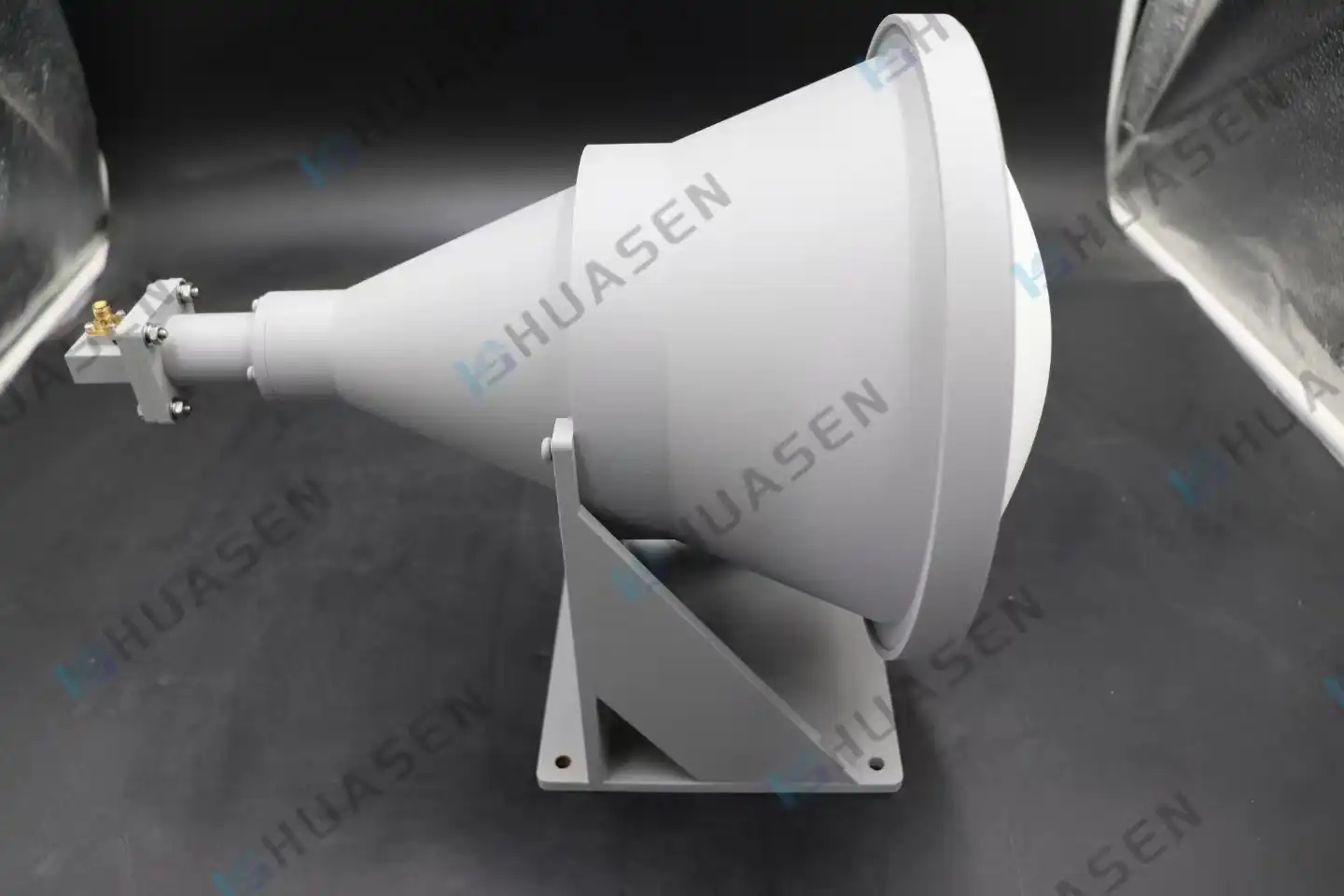
Several versions of the system handle different types of tests. For dual-polarization readings, conical Lens Horn Antenna configurations produce rotationally symmetric patterns, and pyramidal Lens Horn Antenna configurations make rectangular waveguide compatibility better. Feed-illuminated lens designs put the lens at exact focal distances from feed sources, and point-focus lens antennas (PLHA) focus energy for uses that need a small beamwidth. Sidelobe reduction should be less than -15 dB in the E-plane, and -26 dB in the H-plane, and opening efficiencies should be more than 60%. The small axial dimensions—often half the length of normal horns that are the same size—make test bench setups a lot easier.
Comparison With Alternative Antenna Technologies
When buying, teams look at different measurement antenna choices; it's important to know how performance trade-offs work. Parabolic reflector antennas have a high gain, but they need a lot of room to be mounted and are sensitive to surface flaws. Standard horn antennas are easy to use and reliable, but they need to be longer to get the same amount of gain. Patch antenna arrays let you control the beam electronically, but they are more complicated because they need feed networks and have a smaller bandwidth. Waveguide slot antennas work well with linear arrays, but they don't cover a wide range of frequencies, which is needed for many modern uses. Lens-corrected horn designs are the best because they offer better gain-to-length ratios, better pattern control, and built-in environmental safety through the lens radome function.
Key Considerations for Integrating Lens Horn Antenna Into Your Test Setup
For deployment to go well, technical needs must be carefully matched with Lens Horn Antenna specs and external factors that affect how accurate measurements are made.
Frequency Matching and Gain Optimization
Different types of tests need different frequency bands, like K-band at 18–26 GHz for testing satellite uplinks, Ka-band at 26–40 GHz for validating 5G backhaul, or W-band at 75–110 GHz for testing car radar. The antenna that is chosen must cover the whole operating span with as little VSWR loss as possible. How much gain is needed depends on how much bandwidth is available and how much signal-to-noise is wanted. Higher gain focuses energy into smaller beamwidths, which makes measurements more accurate but requires more precise alignment. Customization choices, such as focal length and aperture size changes, let you get the best results for specific testing methods.
Mechanical Stability and Environmental Considerations
Measurement accuracy is affected by vibrations from nearby equipment, thermal expansion from changing temperatures, and air getting in. The mounting gear must be able to keep the antenna in place rigidly and with micrometer-level steadiness. Beam drift can't happen during long test runs when the materials have low thermal expansion factors. The dielectric lens naturally keeps out dust and wetness, but conductive particles or water buildup on the surface can change the way radiation patterns work and throw off the VSWR. In places where the temperature isn't managed, these risks can be lessened by hydrophobic coatings or additional radome covers.
Calibration Protocols and Signal Management
Calibration makes sure that the antenna's performance matches the written specs before tests start. Network analyzer sweeps confirm the presence of return loss across the operational band, and measurements of the anechoic chamber pattern confirm the amounts of boresight gain and sidelobes. Connector quality has a big effect on measurement error. For example, precision SMA, K-type, or waveguide connectors need to keep the phase stable and reduce reflections as much as possible. When moving cables, you need to be aware of electromagnetic coupling. To stop unwanted signals from entering, ferrite suppressors and protected assemblies are used. During tuning, time-domain gating methods separate antenna reactions from fixture reflections.
Comparative Analysis: Lens Horn Antenna vs. Alternative Antenna Solutions
Comparing success objectively across a wide range of technical and economic dimensions can help people make better investment choices. A comparison of the Lens Horn Antenna and other antenna options provides the necessary data for procurement teams to align their technical requirements.
Performance Parameter Evaluation
Lens-corrected horns have gain levels ranging from 20 dBi to 45 dBi, based on the size of the aperture and the frequency. They perform better than parabolic mirrors while taking up much less space. Through the antenna equation, beamwidth is directly related to gain. Typical 3-dB beamwidths are between 5 and 20 degrees, which lets devices being tested be focused and lit up. Cross-polarization discrimination is more than 30 dB in good implementations, which is important for characterizing MIMO systems and testing polarization-sensitive radar. In some designs, bandwidth can cover octave ranges. Other technologies, like Vivaldi antennas, offer ultra-wideband coverage but give up boost and pattern control.
Design Complexity and Integration Footprint
Standard conical horns only need waveguide manufacturing, which makes them cheap for basic uses. Adding a lens makes production more difficult through precise dielectric machining and adds to the cost of the materials, but in labs with limited room, the smaller size often makes the investment worthwhile. Parabolic systems need exact reflector shaping and feed setting, and they are sensitive to alignment, which makes them harder to set up in the field. Electronic turning is possible with phased arrays, but they need complicated RF distribution networks and digital control systems that aren't useful for many test situations.
Cost-Effectiveness and Procurement Alignment
The price per unit takes into account the cost of materials, the tolerances for manufacturing, and the licensing criteria. Lens-enhanced designs cost more than basic horns, but their performance benefits lower system costs by getting rid of the need for extra gain stages or making anechoic chambers smaller. When you buy a lot of something, makers offer tiered pricing systems that help you save money. Lead times range from being able to ship normal catalog items right away to taking anywhere from 6 to 12 weeks for custom orders that need to use specific frequency bands or interface plugs.
Sourcing and Procurement Strategy for Lens Horn Antennas
Strategic procurement combines technical requirements with the abilities of suppliers and practical issues that can affect project timelines and staying within budget. Teams must develop a clear plan for where to find and buy Lens Horn Antennas.
Supplier Vetting and Quality Assurance
The first step in judging a maker is to check their certifications. These include ISO 9001 for quality management, MIL-STD for military uses, and RoHS for environmental standards. Precision CNC cutting for metal horn structures, controlled dielectric lens manufacturing processes, and a full testing infrastructure with vector network analyzers and far-field ranges should all be part of the production capabilities. Check technical datasheets to see which performance claims are based on confirmed specifications and which ones are based on usual claims. Pay close attention to measurement conditions and reference standards. Before placing a large order, ask for sample evaluation units. This will allow you to test the product in-house against your unique application needs.
Customization Capabilities and Technical Support
Standard stock items cover most testing needs, but custom solutions are often needed for unique situations. Some important customization options are non-standard frequency ranges, different polarization setups made possible by waveguide phase changers, changed mounting interfaces that work with existing fixtures, and weather hardening for use in harsh temperatures or high humidity. When a supplier offers engineering consulting services, they help choose the right antenna, run electromagnetic simulations, and suggest the best ways to integrate based on test goals. A lot less risk is involved in deployment when there is responsive technical help during the installation and calibration stages.
Pricing Structures and Delivery Logistics
Clear price models show base unit costs, modification fees, and discount levels for large orders. When project plans call for quick deployment, expedited manufacturing choices cut down on wait times but cost more. When you ship things internationally, you have to think about things like customs paperwork, tax classifications, and shipping insurance for fragile, precise equipment. Clients in the U.S. gain from having goods held in the U.S., which cuts down on shipping times and makes warranty service easier. After-sales support policies should spell out how long a calibration certificate is good for, what the guarantee covers, and how long it will take to fix something.
Step-by-Step Integration Process: From Selection to Verification
Lens Horn Antennas work as intended in test setups when they are set up in a methodical way, which cuts down on the number of times they need to be fixed. The integration process moves from choosing the right hardware to checking final signal integrity.
Initial Installation and Interfacing
When you get the equipment, check the packaging for damage from shipping and make sure that the extras match the packing lists. Attach the antenna to the positioning hardware using the right screws that have been torqued to the specifications. Make sure that the alignment mechanisms can be easily accessed for later adjustments. Connect the waveguide or coaxial interface to the test equipment, making sure that the connecting threads are properly torqued and that the gasket is compressed to ensure proper protection against the environment. Make sure that the wires you use have enough service loops and strain relief, and that they meet the minimum bend radius standards to keep the phase stable.
System Alignment and Calibration Techniques
For coarse alignment, mechanical markers or laser alignment tools are used to point the antenna's boresight toward the device being tested. To get the best coupling efficiency, fine adjustment includes positioning over and over again while keeping an eye on the received signal strength or reflection factors. Use the right error correction models and do a full two-port network analyzer calibration through the antenna reference plane. Check the antenna gain by measuring it against measured standards or by comparing it to gain data provided by the maker for the entire frequency range of operation. Write down standard data so that you can do a drift study later.
Troubleshooting Common Integration Issues
If the VSWR is too high, it's likely that there are broken connectors or strange objects inside the waveguide sections. Take the interfaces apart and clean them with the right solvents. Pattern confusion means that the lens surface is breaking down or isn't aligned correctly. Check for cracks, delamination, or loose attachment hardware. It's possible for sidelobe levels to be higher than predicted if they are scattered by nearby metal objects or fixture interactions. To fix this, put absorbent materials on shiny surfaces in the antenna's near-field area. Check the insertion loss of all connection components to see if the low actual gain is caused by cable losses or bad system calibration.
5G Millimeter-Wave Test Framework Case Study
A company that makes telecom equipment needed accurate over-the-air readings of antenna arrays to make sure that 5G base station components worked at 28 GHz. Pyramidal Lens Horn Antenna units with a 25 dBi gain and a 10-degree beamwidth were used to precisely light up each array piece inside their small, noise-free room. The short axial length allowed for close spacing between the broadcast and receive spots, and the high level of sidelobe suppression (below -20 dB) kept multipath interference to a minimum. Stable calibration over week-long test sessions cut measurement error to ±0.3 dB, which directly led to successful first-pass approval and sped up product release dates.
Conclusion
When implemented with structured planning, adding Lens Horn Antennas to test and measurement settings substantially improves performance. Understanding basic working principles helps choose the right technology, and paying close attention to frequency matching, mechanical stability, and calibration methods makes sure that measurements are accurate. Comparative research against other antenna options helps make sure that investment choices are in line with technical needs and budget limits. Reliable component buying is set up by strategic procurement that focuses on supplier skills, customization options, and logistics planning. Following methodical integration procedures from installation to verification lowers release risks and speeds up the time it takes for key testing infrastructure to be up and running.
FAQ
Q1: Why choose lens-corrected designs over standard gain horns?
Standard gain horns with the same level of directivity need much longer physical lengths to keep the phase even across the opening. When lenses are integrated, spherical wavefront flaws are fixed in a small space. This usually cuts the axial length by 40–50% while also improving sidelobe reduction and aperture efficiency. This combination is very useful in labs with limited room and on mobile test systems.
Q2: What frequency ranges suit these antenna types?
When it comes to microwave and millimeter waves, which usually range from 18 GHz to 110 GHz, Lens Horn Antennas work at their best. Specific versions aim to test K-band satellite communications, validate Ka-band 5G infrastructure, and evaluate W-band car radar. Custom designs make the range go up to D-band frequencies to help with new 6G study projects.
Q3: What effect does the dielectric lens have on how power is handled?
Materials like PTFE have lower breakdown levels than air dielectric, which limits the amount of power that can be sent continuously. It works fine for normal measurement tasks using milliwatt-to-watt-level signals, but for high-power transmission situations topping 10 watts, thermal analysis and maybe ceramic lens materials are needed to keep the dielectric from breaking down or deforming under long-term loads.
Partner With Huasen Microwave for Your Lens Horn Antenna Solutions
Huasen Microwave Technology can help you with your test infrastructure problems because they have been working with RF and millimeter waves for 30 years. As a reputable Lens Horn Antenna maker, we offer custom-engineered options such as conical Lens Horn Antenna designs, pyramidal shapes, and point-focus versions that are made to fit your needs. Our certified goods meet strict MIL-STD and ISO standards, and we offer full technical help from the time you choose a product until it is calibrated. Our engineering team is available to help you get the most accurate measurements, whether you need things from our stock list that can be sent right away or custom frequency coverage and polarization configurations. Contact our specialists at sales@huasenmicrowave.com to discuss your application needs and get full product specs that fit your buying goals.
References
1. Balanis, Constantine A. Antenna Theory: Analysis and Design. Fourth Edition. Hoboken: John Wiley & Sons, 2016.
2. Olver, A.D., P.J.B. Clarricoats, A.A. Kishk, and L. Shafai. Microwave Horns and Feeds. IEEE Press Series on Electromagnetic Wave Theory. New York: IEEE Press, 1994.
3. Milligan, Thomas A. Modern Antenna Design. Second Edition. Hoboken: John Wiley & Sons, 2005.
4. IEEE Standard 149-2021. IEEE Recommended Practice for Antenna Measurements. New York: Institute of Electrical and Electronics Engineers, 2021.
5. Stutzman, Warren L., and Gary A. Thiele. Antenna Theory and Design. Third Edition. Hoboken: John Wiley & Sons, 2012.
6. Collin, Robert E. Foundations for Microwave Engineering. Second Edition. IEEE Press Series on Electromagnetic Wave Theory. Hoboken: Wiley-IEEE Press, 2001.
Send Inquiry