How Log Periodic Antenna Maintains Stable Radiation Across Bands






2026-05-14 21:42:02
The self-scaling geometric form of a Log Periodic Antenna, in which dipole elements are grouped in a logarithmic path, makes it stable across a number of frequency bands. This one-of-a-kind design makes an "active region" that moves along the boom as the frequency changes. This keeps the impedance matching and radiation patterns the same across the whole operating range. This design is different from narrowband antennas that need to be physically swapped to cover different bands. Instead, it provides reliable performance across multiple octaves, usually from 30 MHz to 3 GHz or higher. This makes it essential for spectrum monitoring, EMC testing, and tactical communications, where being able to switch frequencies quickly is needed.
Understanding Log Periodic Antenna Theory and Design Principles
The mathematical accuracy with which log-periodic dipole arrays are built is what makes them stable over a wide frequency range. There are two main design ratios that show how each part of the building connects to its neighbour: the scaling factor (τ) and the spacing factor (σ). These factors control how the spacing between elements changes and their lengths drop along the boom. This makes a pattern that repeats itself at different sizes.
The Self-Scaling Geometry Behind Frequency Independence
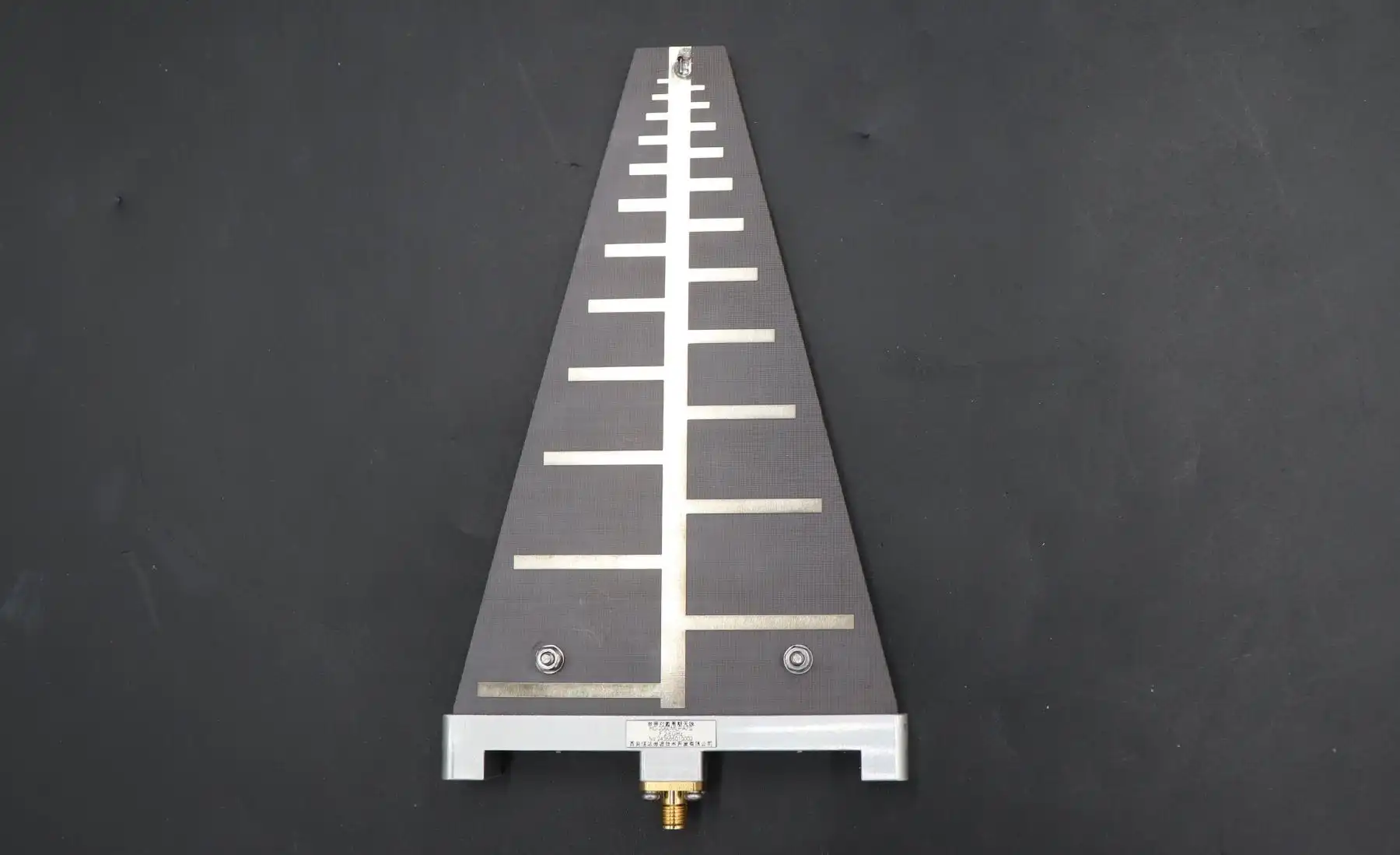
It is clear that each dipole element is shorter than the one before it by a constant ratio when we look at the physical structure. Because of this scaling connection, the Log Periodic Antenna "looks the same" electronically across a range of frequencies. Longer parts near the back of the grid become active at lower frequencies. The active area moves forward to shorter elements as the frequency goes up. This smooth change gets rid of the sharp resonance peaks and nulls that come with single-element or narrowband designs.
How Element Spacing and Length Ratios Control Impedance
How electromagnetic energy moves from one dipole to the next is directly affected by how far apart the elements are. With the right amount of space between them, only a small group of elements adds greatly to radiation at any given frequency, while the others stay mostly inactive. A steady 50-ohm input impedance is maintained throughout the whole bandwidth by this managed contact. Most of the time, engineers choose τ values between 0.7 and 0.95. Lower values give greater bandwidth but make the cable longer.
Comparing LPDA Architecture to Yagi and Dipole Designs
Typical Yagi antennas have a high gain because of parasitic interaction between a driven element, a reflector, and several directors. The setup does, however, work well only in a small frequency range (10–20% bandwidth), though. Simple dipoles reverberate at certain frequencies that are set by their length. When compared to optimised Yagis, log periodic designs give up some peak gain, but they keep working the same way across bandwidths greater than 10:1. This trade-off makes them perfect when covering more than one band is more important than having the best directivity at a single frequency.
Key Advantages of Log Periodic Antennas for Multi-Band Stability
Log-periodic structures solve a number of important problems that system designers and equipment makers face when they work with different frequency allocations.
Broadband Coverage Reduces System Complexity
Monitoring or sending across wide frequency bands without having to change antennas is very helpful for organisations that are building communications infrastructure. A single Log Periodic Antenna that covers 200 MHz to 6 GHz can be used instead of several specialised antennas. This makes towers lighter, wire runs easier, and switching networks unnecessary. Testing labs that do measures for EMC compliance can run ongoing automated sweep tests from VHF to microwave bands without having to change how they are set up. This speeds up the certification process and cuts down on the time that the room is occupied, which directly lowers running costs.
Consistent Radiation Patterns Ensure Predictable Performance
The stable phase centre and radiation pattern form across frequency is one of the most useful properties for radar warning devices and systems that find your way. The active area moves along the boom, but the electrical phase centre stays mostly the same, and the beamwidth changes slowly instead of dramatically as it does in frequency-switched antenna arrays. For accurate angle-of-arrival estimates and triangulation in spectrum policing and electronic warfare, this reliability is a must.
Stable VSWR Maintains Signal Integrity Across Bands
Voltage Standing Wave Ratio below 2.0:1 throughout the operating bandwidth ensures that the emitter and antenna can send and receive power efficiently. Good designs keep VSWR below 1.5:1 for most of the range. This keeps reflected power to a minimum, which can hurt emitters or mess up readings. The antenna factor, which is the ratio between the strength of the incoming field and the voltage received, changes linearly with frequency. This makes it easy to calibrate for measurement purposes. This feature is especially useful for spectrum analysers and field strength metres that are used to make sure that regulations are being followed.
Real-World Performance in Demanding Industrial Scenarios
Log-periodic designs are used in maritime communications systems that work across HF, VHF, and UHF bands to stay in touch through different propagation modes as conditions change. Microstrip versions are used in airborne electronic warfare pods so they can survive high-G manoeuvres and find threat radars in the S-band to Ku-band range. Broadcasting experts who are looking into interference use portable LPDAs to find unauthorised broadcasts over cellular, WiFi, and satellite frequency allocations. This way, they don't have to bring multiple antennas to faraway places.
Installation and Maintenance Best Practices to Preserve Performance
The right way to install and take care of an antenna directly affects how well it works over its entire working life.
Mounting Orientation and Structural Considerations
It is important to make sure that the boom is perfectly lined up with the desired azimuth heading, since the end-fire radiation pattern focuses energy along the boom axis. The mounting gear has to be strong enough to handle wind loads without rotating or sagging, which would make the pattern less symmetrical. When placing near metal buildings, keep at least one wavelength of space between them and the lowest operating frequency to keep reflections from distorting the pattern. It's important to pay close attention to ground plane effects when using vertical polarisation, and you need to make sure that horizontal fixing is high enough above the ground to avoid low-angle nulls.
Minimising Interference and Environmental Factors
Pay close attention to how you route your coaxial feedline. Return currents flow through the outer wire, and uneven routing can cause the pattern to be off-centre. Common-mode currents can't run on the outside of the transmission line if ferrite cores or current baluns are used at the feedpoint. Corrosion defence makes things last longer in seaside or industrial settings. Marine-grade aluminium metals with protective coatings and stainless steel gear with anti-seize compounds on threaded connections are used by good makers.
Periodic Inspection and Troubleshooting Protocols
Visual checks should be done regularly on the LPA to look for physical harm to parts, loose hardware, and the state of connectors. By measuring VSWR with a network analyser or antenna analyser at multiple spot frequencies across the band, problems in the LPA can be detected before they cause system failures. When VSWR increases rapidly, it usually indicates corrosion or damage to an element. Moisture entering joints or feedpoint systems is a common culprit. Maintaining thorough baseline measures from the first installation provides critical data for diagnosing performance drops years later.
Procurement Guidance: Selecting and Buying the Right Log Periodic Antenna
To choose the right model, you have to compare technical specs to application needs and look at what the seller can do.
Matching Frequency Range to System Requirements
Before starting to look at suppliers, procurement teams should write down exactly what frequency coverage they need. For example, an EMC lab that needs coverage from 80 MHz to 6 GHz and a cellular backup application that needs coverage from 698 MHz to 2700 MHz will need different specs. Wider bandwidth antennas are longer and heavier, which affects how much it costs to place. Figuring out the needed speed ratio helps cut down the list of vendors to more likely choices. Applications that need to be able to send data must check the power handling requirements, which are usually given in watts CW or peak pulse power for radar use.
Evaluating Gain and Directivity Specifications
Most Log Periodic Antenna systems have front-to-back ratios of more than 20 dB and gain levels of 6 to 8 dBi. There are examples with higher gains, but they are bigger and cost more. Maximum gain is good for satellite communications and point-to-point links, but pattern stability is more important for spectrum tracking uses than peak directivity. Specifications for beamwidth affect how well you can find your way; smaller beams give you better angular precision but cover less ground. When buyers understand these trade-offs, they don't over-specify features that add cost without adding value.
Supplier Assessment Beyond Product Specifications
Manufacturers you can trust give you a lot of information about how well their products work, like VSWR plots, gain curves, and radiation patterns across the stated bandwidth. Documentation showing compliance with MIL-STD-810 environmental testing, ISO 9001 quality systems, and RoHS material limits shows a dedication to following the rules set by the industry. The terms of the warranty show that the maker trusts the product to work well. When designing for unusual frequency ranges or mechanical limitations, quick expert help is very important. Suppliers who have their own engineering teams can change standard goods or make unique ones that meet particular needs for mounting, polarisation, or power handling.
Balancing Cost Considerations with Long-Term Reliability
While comparing prices is important, the total cost of ownership also takes into account how hard it is to install, how often it needs to be maintained, and how often it needs to be replaced. A cheaper antenna that needs to be replaced every three years might cost more over its lifetime than a more expensive one that lasts ten years. When buying in bulk for big deployments, it makes sense to ask for volume discounts and set up framework deals to ensure a steady supply. When an OEM works with a component producer, they can get access to custom specs and priority production schedules that distributors can't get.
Conclusion
Log Periodic Antenna arrays have a self-scaling physical form that makes them stable in terms of radiation patterns and impedance matching across frequency ranges that would need more than one regular antenna. This feature simplifies system designs, makes operations simpler, and opens the door to a wide range of uses, from tracking the wideband spectrum to multi-band combat communications. Engineers and buying workers can choose the right models for their needs if they understand the basic rules of design. The right way to place these antennas and follow the care instructions will make sure they work reliably for a long time. When you judge providers based on their technical skills, quality standards, and support services, you can make purchases that meet both performance needs and price limits.
Frequently Asked Questions
1. What frequency ranges can log periodic antennas typically cover?
Most commercial designs have ratios between 3:1 and 10:1. Common ranges include 80 MHz to 1 GHz for VHF/UHF use, 200 MHz to 6 GHz for wideband testing, and special HF types that cover 2-30 MHz. For electronic warfare weapons, microstrip models used in the air usually cover 1 to 18 GHz. With the right scaling factors, custom Log Periodic Antenna designs can get even bigger bandwidths.
2. How does performance compare to Yagi antennas for specific bands?
Within their narrow working bandwidth, Yagi designs offer 3–5 dB more gain, but they lose performance outside of that range. Log periodic types have a gain that stays the same across their whole range, which makes them better for multi-band uses, even though their peak performance at any one frequency is slightly lower.
3. Can these antennas handle both transmission and reception?
Of course. When it comes to sending and getting, LPDAs work just as well for each other. The amount of power an element can handle depends on its diameter and the materials it is made of. Ratings range from a few watts for measurement devices to kilowatts for streaming. When choosing models for transmission use, you should always check the send power specs.
Partner with Huasen Microwave for Your Wideband Antenna Solutions
Huasen Microwave Technology offers high-performance Log Periodic Antenna models that are made to your exact specs by combining thirty years of experience in RF engineering with advanced production skills. Our engineering team works with testing sites, system designers, and equipment makers to come up with solutions that meet exact standards for frequency coverage, power handling, and environmental factors. We offer full technical help from the initial proposal all the way through production and delivery, whether you need standard models that can be used right away or custom designs that are made for specific uses. Get in touch with our sales team at sales@huasenmicrowave.com to talk about your project needs and get full details on our Log Periodic Antenna seller options, which come at a reasonable price when you buy in bulk.
References
1. Balanis, Constantine A. "Antenna Theory: Analysis and Design," Fourth Edition, John Wiley & Sons, 2016.
2. Isbell, D.E. "Log Periodic Dipole Arrays," IRE Transactions on Antennas and Propagation, Volume 8, Issue 3, May 1960.
3. Carrel, Robert L. "The Design of Log-Periodic Dipole Antennas," IRE International Convention Record, Volume 9, Part 1, 1961.
4. IEEE Standard 145-2013, "IEEE Standard for Definitions of Terms for Antennas," Institute of Electrical and Electronics Engineers, 2014.
5. Stutzman, Warren L. and Thiele, Gary A. "Antenna Theory and Design," Third Edition, John Wiley & Sons, 2012.
6. IEC 61000-4-3:2020, "Electromagnetic Compatibility (EMC) - Testing and Measurement Techniques - Radiated Radio-Frequency Electromagnetic Field Immunity Test," International Electrotechnical Commission, 2020.
Send Inquiry