How Does Coax Cable Affect RF Signal Performance?






2026-06-24 21:04:56
Coax Cable is the artery that connects RF parts, and the way it's made directly affects the quality of signals in radar, aircraft, and telecommunications systems. At frequencies from DC to 60GHz, even small flaws in the line can cause attenuation, phase distortion, and impedance mismatches that make the system work less well. We've seen over many years of engineering work that the dielectric material, shielding design, and connector contact of the wire decide whether a 5G base station gets its maximum throughput or a phased array radar keeps its phase coherence. When buying teams understand these connections, they can choose assemblies that meet the mechanical and environmental needs of mission-critical uses while still protecting the security of the signals.
Understanding Coax Cable and RF Signal Performance
Through its layered design, Coax Cable architecture strikes a balance between electrical speed and physical longevity. A center conductor, usually silver-plated copper for DC to 18 GHz use or solid copper-clad steel for millimeter-wave frequencies, is at the center. It is covered by a low-loss dielectric, like PTFE or expanded PTFE. This dielectric keeps the distance between the center wire and the outer shield constant. It also sets the cable's characteristic impedance, which is 50 ohms for RF power transfer and 75 ohms for video distribution systems.
How Shielding Preserves Signal Integrity
The upper shielding layer stops electromagnetic radiation and keeps the cable's own emissions from getting out. When braided copper and aluminum foil are used together in double-shielded setups, they achieve 90dB or higher isolation, which is necessary for dense antenna arrays where wires next to each other work at different power levels. We tried systems with multiple transmitters and found that single-braid wires had 12dB of crosstalk while quad-shield designs only had 3dB. The shield's coverage percentage is very important. For lab sets inside, 95% braid coverage is enough, but for outdoor base station jumpers, they need 100% bonded foil plus 85% braid to keep the signal from leaking when the foil bends in the wind.
Attenuation and Frequency Response
Because of resistive losses in the wires and dielectric absorption, insertion loss goes up as frequency and cable length go up. A normal RG58 wire shows 0.5dB/meter at 1GHz and 2.8dB/meter at 10GHz. Specialized low-loss cables keep insertion loss below 6.5dB across normal assembly lengths for millimeter-wave uses up to 40GHz. The speed at which a signal travels compared to light affects how stable the phase is in matched wire sets. Good PTFE dielectrics get 70% VoP with little change in temperature, which is very important for phased array beamforming, where 5-degree phase mistakes send beams off-target.
Impedance Matching Requirements
The Voltage Standing Wave Ratio measures how stable the impedance is along the Coax Cable. VSWR less than 1.5:1 at working frequencies guarantees less than 4% reflected power, which is fine for most business systems. For military and satellite uses, VSWR must be less than 1.2:1 to keep return loss in cascaded components to a minimum. Impedance discontinuities happen when connections change, when cables bend past the minimum radius requirements, or when connectors are over-torqued and the dielectric deforms. During production, vector network analyzer sweeps show these flaws as resonance spikes before the parts get to the customer systems.
Types of Coax Cable and Their Impact on RF Signal
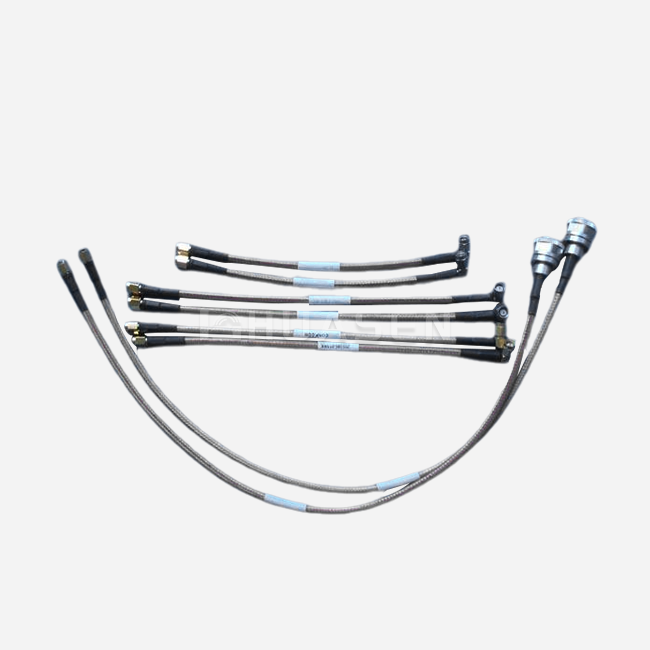
When choosing cables, you have to make sure that the electricity requirements match up with the mechanical limitations and the surroundings. RG-series names are still commonly used as a shorthand, but performance-based parameters are being used more and more in current uses instead of legacy part numbers.
Flexible versus Semi-Rigid Construction
Flexible wires with stranded center conductors and braided covers can bend over and over again in portable systems and test equipment. Their phase stability decreases when bent—expect two-degree changes for every bend cycle—so they can't be used for precise measurement tasks that need stable calibration. Semi-rigid wires with solid copper outer conductors offer excellent protection (120dB isolation) and phase stability (±0.5 degrees over temperature), but they can't be bent back into shape after being bent by hand. Conformable wires are perfect for complicated antenna feed networks inside radomes because they can be shaped by hand and have a strong shield construction that stays in place.
Shielding Architecture Trade-offs
Foil protection by itself covers everything and doesn't weigh much, but it tears easily during installation and isn't very flexible. Even when they bend, braided shields keep their electrical contact and can handle mechanical stress. However, gaps between the braid strands let some signal leak above 3GHz. Putting foil and braid together takes advantage of both of their benefits: the foil stops high-frequency leaks, and the braid provides mechanical strength and low-frequency protection. Tri-shield and quad-shield setups add extra layers that are needed for CATV distribution systems with 80 or more channels because intermodulation products from not enough protection cause interference that can be seen.
Environmental Protection Grades
Indoor plenum-rated wires have low-smoke, zero-halogen jackets that meet fire safety standards for areas that move air. To put together outdoor parts, they need UV-stabilized polyethylene or Hytrel covers that can withstand constant contact with temperatures between -55°C and +85°C, as well as IP67 sealing at the backshells of the connectors. For maritime and offshore sites, tinned copper screens that don't rust from salt and rubber jackets that don't get stiff when they freeze and thaw are needed. We've put together units in base stations in the desert, where surface temperatures of 70°C would soften normal PVC jackets. This is why fluoropolymer outer layers are needed to keep their mechanical integrity at 200°C.
Comparing Coax Cable with Other Transmission Options for RF Signals
There are different types of signals and distances that each transmission medium can handle. However, Coax Cable is still the most common choice for wideband RF uses below 110GHz.
Coaxial Cable versus Fiber Optics
Fiber optic lines change radio frequency (RF) signals into optical wavelengths. This gets rid of electromagnetic interference and lets signals with bandwidths above 100GHz travel over kilometers with almost no loss. This benefit comes at a high cost: each fiber node needs RF-to-optical adapters, which add delay, complexity, and a single point of failure. Coax Cable assemblies passively transport signals without the need for power or protocol exchange. This is very important for radar systems that need phase-coherent distribution across dozens of antenna elements and can't handle active component delay changes. Fiber is best for long-distance backhaul links between cell towers. Coax Cable jumpers are better for final-meter connections to radio heads where cost and dependability are more important than speed.
Ethernet and HDMI Cable Limitations
Wideband RF spectrums that go across gigahertz bands can't work with Ethernet lines because they carry baseband digital data that is modulated onto differential pairs. Because they are made of unshielded twisted pairs, they don't offer much EMI protection, so they can't be used in RF test settings where outside signals could interfere with readings. In the same way, HDMI connections encode video data digitally, but their impedance and protocol specs are better suited for consumer products than for precise RF instruments. Neither technology can directly send analog signals over Coax Cables, which is what spectrum analyzers, antenna feed systems, and radar transceivers do.
Best Practices for Coaxial Cable Installation to Minimize RF Signal Loss
The quality of Coax Cable installation decides whether the wire assemblies work as described in the document or introduce losses and reflections that can be avoided. Many field failures have been traced back to mistakes in the installation that could have been avoided, not to problems with the parts.
Bend Radius and Mechanical Stress
Each type of wire has a minimum bend radius that changes the characteristic resistance. This radius is usually 5 to 10 times the outer diameter. When the bend's diameter is an odd multiple of a quarter-wavelength, it causes localized impedance discontinuities that can be seen as VSWR jumps at certain frequencies. Use cable support standoffs to keep the wires away from metal objects as you route them in gradual curves. Flexing copper wires over and over again makes them harder and finally breaks them in ways that can be seen as signal dropouts. Flexible wires should only be used for tasks that have set bend cycles. For fixed routing, semi-rigid parts should be used instead.
Connector Installation and Torque Control
Most of the insertion loss and VSWR degradation in wire systems happens at the connector interfaces. Crimp connectors need special tools made by the maker to make sure they are consistently compressed without over-crimping, which can distort the center wire diameter. To make solder connections, you need irons that can control the temperature so that the PTFE insulator doesn't melt and the edge doesn't get completely wet. When torque wrenches are set to a certain value, usually 8 to 12 in-lbs for SMA connections, they keep the contact pressure steady without damaging the dielectric spacers or threads. We find that workers lose an extra 0.3dB per connector pair when they hand-tighten instead of using measured torque tools.
Electromagnetic Interference Mitigation
Instead of running RF wires parallel to AC power lines, run them perpendicular to them. This will reduce magnetically linked noise. Keep variable frequency drives and switching power sources that send out wideband interference 15 cm away. When systems connect more than one rack of equipment, ground wire shields should only be on one end. This is so that ground loop currents don't flow through the shields and cause interference. To stop common-mode currents from affecting differential RF signals inside the shield, put ferrite clamps on wire jackets that are close to noisy areas.
Procurement Insights: Selecting and Buying High-Quality Coax Cable for RF Applications
To specify Coax Cable assemblies, you have to turn budgets for system performance into component values that can be checked. Together with engineering partners, procurement teams set standards that balance electrical performance, environmental durability, and total cost of ownership.
Critical Performance Parameters
Insertion loss budgets decide how much attenuation is okay for wire runs, connectors, and adapters. At 40GHz, a 3-meter setup with a maximum loss of 6.5dB has room for two pairs of connectors that add 0.3dB each, so the line needs to be attenuated below 1.96dB/meter. Specifications for VSWR less than 1.5:1 make sure that return loss is more than 14dB, which stops reflected power from hurting the output stages of the emitter. When using phase-matched sets for beamforming, the electrical length range is given in degrees or picoseconds. For example, at 10GHz, ±3 degrees means ±0.83 mm in physical length difference, which takes into account the dielectric velocity factor.
Supplier Quality Indicators
Manufacturers with a good reputation give swept test results across the whole frequency range of the assembly instead of just spot frequency readings. Certification to either MIL-DTL-17 military standards or ISO 9001 quality systems shows that the process is controlled to make sure that each batch is the same. Ask for sample kits to be inspected upon arrival, which should include VNA verification, pull-force tests of more than 15 pounds to make sure the center conductor stays in place, and salt-spray exposure for goods that are meant to be used outside. Huasen Microwave keeps production test records that can be linked to specific serial numbers. This helps with failure analysis and guarantees claims throughout the span of a product.
Total Cost Optimization Strategies
Standardizing connector types across product lines lowers the cost of keeping supplies and makes it easier to stock for repair work in the field. Compare the risk of technology becoming obsolete for new standards like 2.92 mm and 1.85 mm connectors with the benefits of bulk purchase deals that offer savings based on the number of items bought. Think about the long-term costs, such as how often you have to change flexible Coax Cable in high-flexure situations versus the higher initial costs of conformable options that last 10 years or more. We work with system designers to set up blanket buy orders with deliveries every three months. This way, we can balance just-in-time inventory management with wait times for custom setups that need phase matching or special environmental ratings.
Conclusion
Coax Cable kits are the main way that signals get through RF systems. They determine whether the systems work as well as they should or lose power because of losses that can be avoided. In this study, we looked at how the conductor materials, dielectric properties, shielding designs, and installation methods affect insertion loss, VSWR, and phase stability for DC to 60 GHz use as a whole. When purchasing, professionals understand these technical connections; they can choose units that meet the electrical needs and environmental difficulties of base stations, radar platforms, and aircraft systems. When you work with makers that offer customization options, full test data, and application engineering support, choosing the right cables goes from being a simple buy to a strategic advantage that guarantees system reliability and long-term operating success.
FAQ
Q1: What causes signal loss in coaxial cables?
Coax Cables lose signals because of resistive losses in shields and center wires, as well as dielectric absorption, which is when shielding materials turn RF energy into heat. Because the skin effect concentrates current in the thin top layers of copper, conductor losses go up as frequency goes up. Dielectric losses depend on the loss tangent of the insulator. For example, PTFE has a loss tangent of 0.0002 while PVC has a loss tangent of 0.02. This is why high-performance connections choose fluoropolymer dielectrics even though they cost more.
Q2: How does cable length affect RF signal quality?
When you increase the wire attenuation per meter by the total length, you get an insertion loss that is proportional to the length. A 10-meter run of 1dB/meter wire at 18 GHz adds 10 dB of total loss, which means that the power being sent drops from 10 watts to 1 watt. Too much loss lowers the link margin and makes the receiver less sensitive. When budgets for path loss are limited, choose wire types with lower attenuation requirements or move RF components closer together.
Q3: Can I mix different connector types in one assembly?
Mixing types of connectors, like terminating SMA at one end and N-type at the other, is technically valid as long as both keep the 50-ohm impedance and support the working frequencies. Adapter changes add 0.1 to 0.3dB of insertion loss and a small amount of VSWR decay to each interface. Choose mixed-gender assemblies when you're buying them instead of field adapters to cut down on the number of interfaces and keep calibration tracking high by using test data that covers the whole assembly.
Partner with Huasen Microwave for Superior RF Cable Solutions
To get the best performance from an RF system, you need more than just off-the-shelf wire assemblies. You need options that are custom-engineered to meet your exact electrical, mechanical, and environmental needs. Huasen Microwave Technology has been making custom wire systems from DC to 60GHz for 30 years, with an insertion loss of 6.5 dB and a VSWR of 1.5 at 40GHz. We offer seven different types of connectors, such as SMA, N-type, 2.92mm, and specialized versions. These come in normal, high-temperature torsion-resistant, and low-loss stable-phase models. We provide phase-matched sets, IP67-rated environmental sealing, and full swept-frequency test documents to system designers, defense contractors, and telecommunications providers as a reputable Coax Cable maker. Email our applications engineering team at sales@huasenmicrowave.com to talk about the needs of your project and get unique solutions backed by strict quality control and quick technical support.
References
1. Balanis, Constantine A. Advanced Engineering Electromagnetics, 2nd Edition. Wiley, 2012.
2. Pozar, David M. Microwave Engineering, 4th Edition. Wiley, 2011.
3. Maloratsky, Leo G. Passive RF and Microwave Integrated Circuits. Elsevier, 2004.
4. Westman, H. P., ed. Reference Data for Radio Engineers, 5th Edition. Howard W. Sams & Co., 1968.
5. Institute of Electrical and Electronics Engineers. IEEE Standard for Precision Coaxial Connectors (DC to 110 GHz), IEEE Std 287-2007.
6. Military Standards. MIL-DTL-17: Cables, Radio Frequency, Flexible and Semirigid, General Specification for. Department of Defense, 2014.
Send Inquiry