Helical Antenna Benefits for GPS and Satellite Systems






2026-07-01 23:33:21
The antenna you choose is more important than you might think when your satellite link drops during important tasks or your GPS device has trouble with multipath interference. From marine guidance to aircraft telemetry, Helical Antennas provide excellent circular polarisation and dependable performance. These RF parts work better than linear polarisation antennas, picking up signals consistently no matter which way the emitter is facing. Helical designs solve real-world connection problems that affect system uptime and data security. They cover frequencies from 200 to 5000 MHz and usually gain between 3 and 12 dB.
Understanding Helical Antenna Technology: Principles and Performance
Because of how they work, Helical Antennas are not like other antennas. These parts send electromagnetic waves along a wound wire, which makes radiation properties that are perfect for use in space and tracking.
Axial Mode versus Normal Mode Operation
When the helix diameter gets close to one wavelength, the antenna's greatest radiation is directed along its centre axis. This is called the axial mode function. This arrangement produces the circular polarisation that is needed for satellite communications, since the direction of the signal is always changing. In normal mode, on the other hand, the radiation is perpendicular to the helix axis and has linear polarisation. This mode is good for short-range uses but not so good for GPS and satellite work. When looking for antennas for tracking devices, earth stations, and spacecraft, procurement teams should ask for axial mode designs.
Circular Polarisation and Signal Resilience
Circular polarisation is one of the most important benefits of satellite technology. When misplaced, linearly polarised signals lose 20 to 30 dB of their strength, but circularly polarised waves keep their signal strength the same, no matter how the antenna moves or how the spaceship tumbles. This quality is very useful on platforms that are moving, like aeroplanes banking through turns, ships pitching in rough seas, or UAVs moving quickly. The axial ratio standard shows the precision of the polarisation; values below 3 dB ensure true circular behaviour, while bigger numbers indicate elliptical polarisation with worse performance.
Design Parameters Affecting Performance
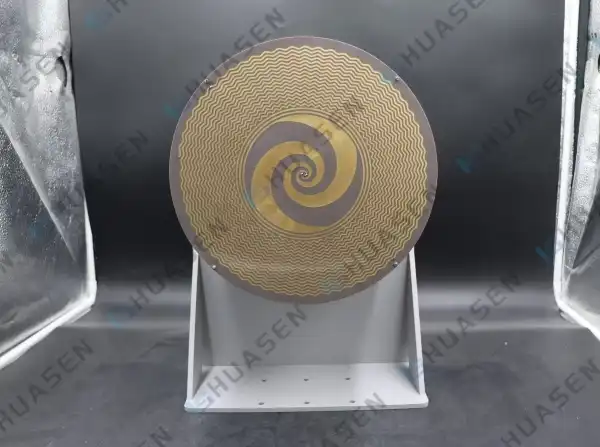
The shape of the helix has a direct effect on the frequency and bandwidth of operation. Resonance traits are based on the number of turns, the pitch angle, and the diameter of the wire. Circumference (C) is related to wavelength (λ) by the formula C = λ at the centre frequency. Adding more turns raises the strength (each extra turn adds about 1 dB), but it also lowers the bandwidth. Modern Helical Antennas can cover more than one satellite band with a 20% fractional bandwidth and a VSWR of 1.5 or less. Huasen Microwave's designs work with frequencies from 200 to 5000 MHz and can handle L-band GPS (1575 MHz), S-band data (2200-2400 MHz), and C-band satellite communications (3700-4200 MHz) by carefully adjusting the helix parameters.
Advantages of Helical Antennas in GPS and Satellite Communications
System engineers choose helical forms over other options because they perform better. These antennas fix certain problems that make link budgets and operating stability less reliable in tough settings.
Superior Gain and Transmission Efficiency
Axial-mode Helical Antennas offer 10-15 dBi gain in small packages, working 3-5 dB better than patch antennas of the same size. This gain advantage directly leads to longer range or lower emitter power needs, which is very important for IoT devices and remote terminals that run on batteries. Well-designed Helical Antennas show less than 0.5 dB loss across their operating band. Low insertion loss features maintain signal strength. When it comes to feeding parabolic mirrors, helical elements work much better than waveguide feeds because they capture more of the dish opening.
Environmental Durability and Lifecycle Value
Strong mechanical design can handle the rough conditions that are common in marine, aerospace, and outdoor infrastructure uses. These gadgets are useful in difficult deployment situations because they do the following:
- Weatherproof enclosures protect the spiral conductor from water, salt spray, and UV damage. IP67-rated systems can handle direct water jets and short-term immersion. This is important for installations on ships and offshore sites where equipment is constantly exposed to environments that corrode it.
- Temperature stability keeps electrical performance the same from -40°C to +85°C, thanks to temperature consistency. The matching of the thermal coefficient of expansion between the helix wire and the support structure stops detuning when the environment changes. This is a typical way for patch antennas to fail because substrate expansion changes the resonance frequency.
- Vibration resistance ensures material integrity in the event of shock loads and constant shaking. When planes and cars move quickly, they put high G-forces on antennas on board. Well-designed helix systems can handle these stresses without losing their connections or getting worn out, which would lower the signal quality.
Because these qualities last a long time, the total cost of ownership is much lower. Evaluations of purchases should figure out how often things need to be replaced and how much it will cost to maintain them over a 10-year period of time. In contrast to phased arrays, which need frequent alignment, Helical Antennas usually don't need to be calibrated or adjusted in the field. When technology breaks down and costs thousands of dollars an hour, this dependability means lower running costs and better system availability.
Application Versatility and Customisation Flexibility
Helical designs can be used for a wide range of communication needs because their layout is flexible. Hemispherical coverage patterns help GPS navigation devices keep their signal lock even when the car is moving or when they are operating in an urban canyon. Satellite uplink stations use the narrow beamwidth and high gain to make point-to-point connections with geostationary satellites. Conformal helix shapes allow for lightweight construction and aerodynamic curves that are used in telemetry systems on UAVs and missiles.
Customisation features meet the unique needs of each system. To meet the needs of satellite transponders, changing the direction of the turning creates either left- or right-handed circular polarisation. Dual-helix circuits let two different polarisations be received at the same time, which can be used for diversity joining or full-duplex operation. Frequency setting in the 200–5000 MHz range works with regional GPS bands, private satellite networks, and multi-band SDR systems by making changes to the design parameters instead of making all new tools.
Comparing Helical Antennas with Alternative Solutions for Effective Procurement
To make smart buying choices, you need to know the pros and cons of each antenna technology. Common choices have very different performance standards, cost structures, and suitability for different applications.
Helical versus Patch Antennas
Microstrip patch antennas are used in most consumer GPS devices because they are small and can be integrated into PCBs. However, their narrow bandwidth (usually only 2-5%) means that they need exact frequency control and can't work with more than one band at a time. Patch elements work less well when they are attached to electrical surfaces because they need to be isolated from the ground plane, which adds weight and complexity. In professional and military systems, Helical Antennas explain their slightly larger dimensions by offering 4x wider bandwidth and maintaining performance when fixed directly to metallic structures.
Comparing Gain and Beamwidth Characteristics
Yagi and parabolic antennas have higher gains than helix forms, but they don't cover all directions. With a 40-degree beamwidth and 15 dBi gain, a 12-element Yagi can't be used on mobile platforms because it needs to be pointed very precisely. Helical Antennas have a gain of 10 to 12 decibels and a beamwidth of 60 to 80 degrees, which makes the links strong even when they are slightly misaligned. This feature is very important for tracking systems and vehicle-mounted satellite stations that need to stay connected while moving.
Evaluating Supplier Capabilities and Compliance
Besides unit price (quadrifilar helix antenna), procurement teams should look at other factors when judging makers. Published radiation pattern data, observed axial ratio across frequency bands, and long-term outdoor test results are all signs of a good product. Meeting the requirements of MIL-STD-810 for shock and vibration, IP67 or IP68 for water protection, and RoHS material limits ensures that defence contracts and foreign projects can be completed.
With application notes, simulation models, and engineering help during integration, well-known suppliers show that they know how to build things. Because Huasen Microwave has been making RF components for 30 years, they have the technical knowledge to make unique frequency allocations, power handling specs, and mechanical interface requirements that set professional-grade antennas apart from catalogue components.
How to Procure the Best Helical Antenna for Your GPS and Satellite Systems
Strategic buying makes sure that technology needs, business terms, and ties with suppliers are all taken into account. A methodical strategy lowers the risk of buying and raises the total cost of ownership.
Defining Precise System Requirements
To begin, figure out the link budget by finding the lowest possible antenna gain and polarisation purity. This will ensure that the system works reliably. GPS devices usually need -130 dBm sensitivity. The antenna gain standard takes into account wire losses, atmospheric attenuation, and margin. Operating frequency ranges should include all satellite bands that are used, such as L1/L2 for GPS, GLONASS bands for devices that work with multiple constellations, or specific payload frequencies for networks that use their own satellites.
Instead of using general grades, environmental standards must be based on real deployment conditions. A boat mount in the North Atlantic needs different thermal performance than a location on a roof in Phoenix. Record the amounts of shock and vibration from the platform specs, and include the weatherproofing needs for the connectors based on the conditions they will be exposed to.
Assessing Total Cost Beyond Unit Price
Volume pricing models have a big effect on the costs of a project. When you buy more than 100 units, you can often get savings of 20 to 30 per cent. When possible, buyers should combine purchases from different programs. The costs of custom tools for specific frequencies or mechanical connections are spread out over many production runs. You can expect NRE charges of $5,000 to $15,000, which become almost invisible when you go over 500 units.
Lifecycle costs include the costs of calibration, repair, and removal. Compared to cheaper options that need to be replaced every 5 years, Helical Antennas with 15-year service lives and no upkeep are more affordable. Use sensible discount rates and failure odds from source dependability data to figure out the present value of total ownership.
Establishing Direct Manufacturer Relationships
Working directly with antenna makers gives you access to technical information and more customisation options than working with resellers. During development, engineering teams can look over plans, suggest changes that would work better in certain situations, and get samples before they are made to test and make sure they are correct. Just-in-time shipping that fits with production plans is also possible through direct relationships, which lowers the cost of keeping inventory on hand.
Dual-source methods keep prices low while reducing risk in the supply chain. Choose two makers whose specs are similar, and then split the amount 60/40. This method keeps the negotiating power on prices while ensuring continuation if one provider has capacity issues or quality problems.
Future Trends and Innovations in Helical Antenna Technology
Helical Antenna designs are always changing because of new technologies and business needs. Keeping up with the paths of development helps buying teams plan for changes in capabilities and avoid becoming obsolete.
Advanced Materials Enhancing Performance
Low-loss dielectric surfaces make it possible for smaller forms to be more efficient. When compared to other materials, PTFE composites with ceramic fillers have lower circuit losses by 0.3 to 0.5 dB and keep their dielectric constants fixed across a wide range of temperatures. Carbon fibre support structures are 5 times stronger per gram than aluminium ones. This is very important in aircraft use, where every gram affects how much fuel is used and how much weight can be carried.
Adding metamaterials (aquadrifilar helix antenna) creates fake dielectric characteristics that make antennas smaller. Researchers have shown that they can cut the size of something by 40% while keeping the same bandwidth and gain. This is a big step forward for setups on small satellites and portable systems that don't have a lot of room. As production methods get better, these new ideas will be available to everyone in two to three years.
Bandwidth Expansion and Multi-Band Integration
Next-generation satellite systems use a bigger range of frequencies, which increases the need for antennas that can cover more than one band at the same time. By changing the pitch and diameter of the antenna along its length, tapered helix designs can handle octave bandwidths (2:1 frequency ratios). When four or more conductors wind around a shared plane, this is called a multifilar setup. It allows for dual-band operation with separate polarisation control for each band.
The push for 5G backup and LEO satellite internet creates opportunities for hybrid antenna systems. When you mix helical elements with phased array technology, you can move the beam for tracking satellites while keeping the purity of the polarisation and the ease of use of helical feeds. When planning infrastructure changes with 5–10 year service horizons, procurement requirements should take these skills into account.
Integration with Software-Defined Systems
Antennas that can handle dynamic frequency selection and adjustable polarisation are needed for software-defined radios and cognitive communication systems. Electronically switchable helical arrays let them quickly change from left-hand circular polarisation to right-hand circular polarisation, reacting in milliseconds to link conditions or interference settings. This adaptability is useful for both military communications security and business systems that need to work in a crowded band.
By working with companies that are investing in SDR-compatible designs, you can make sure that you have access to these features as they move from study to production. Huasen Microwave's plan for growth includes tunable matching networks and integrated amplifiers that allow frequency-agile operation across the entire 200–5000 MHz range. This addresses worries about the future that affect long-term purchasing plans.
Conclusion
The better circular polarisation, wide bandwidth, and weather resistance of Helical Antennas translate into quantifiable benefits for GPS and satellite uses. Their standards for 3–12 dB gain, sub-3 dB axial ratios, and 20% bandwidth meet important performance needs that have a direct effect on system reliability and running costs. Total lifecycle value, not original unit price, should be used to make purchasing choices. This includes upkeep, replacement frequency, and the ability to make changes as needed. New materials and multi-band features are being added to the technology all the time to support next-generation satellite networks and software-defined systems. When you work with experienced manufacturers, you get access to the technical knowledge and quality control methods that set professional-grade parts apart from consumer goods.
FAQ
1. Are helical antennas suitable for all GPS applications?
Vehicle guidance, marine tracking, flight systems, and handheld receivers are all uses that benefit from Helical Antennas' circular polarisation and hemispherical coverage. Because they are bigger than patch antennas, they don't work as well with thin consumer electronics like smartphones. In professional tools where signal trustworthiness is more important than looks, the performance benefits make up for the smaller size.
2. What distinguishes axial mode from normal mode in practical use?
In axial mode, circular polarisation is created along the helix axis, and the gain is equal to the length of the antenna. This makes it perfect for GPS and satellite transmissions. Normal mode sends out waves that are perpendicular to the plane and have linear polarisation. It is mostly used for short-range links on land. Choose the axial mode for any use involving spaceships, satellites in orbit, or Doppler-shifted data where stable polarisation is important.
3. Can manufacturers customise helical antennas for specific frequency bands?
Yes, trustworthy companies change the helix pitch, girth, and turn count to get the best performance across specific frequency bands. Huasen Microwave makes antennas that cover particular frequencies in the 200–5000 MHz range. These antennas are made to meet the needs of clients who need them for private satellite networks, regional GPS bands, or devices that work with more than one constellation. For custom designs, testing, and engineering advice on integration needs usually take 6 to 8 weeks.
Contact Huasen Microwave for High-Performance Helical Antenna Solutions
The engineers at Huasen Microwave have been working with radio frequency (RF) for 30 years, which helps them develop and make Helical Antennas. Our products have a gain of 3 to 12 dB between 200 and 5000 MHz and an axial ratio of less than 2 dB for circular polarisation purity. These specs have been used successfully in aircraft, marine, and defence uses around the world. We change the frequency response, mechanical connections, and environmental protection to fit the needs of your system exactly. This is backed up by full RF characterisation data and MIL-STD compliance tests. If you need a few prototypes to test or a lot of them to build a reliable Helical Antenna system, our sales engineers will help you with the technical side of buying and putting them together. Send an email to sales@huasenmicrowave.com to talk about your GPS or satellite transmission problems and get full product specs for all of our products.
References
1. Kraus, J.D. & Marhefka, R.J. (2002). Antennas: For All Applications, Third Edition. McGraw-Hill Education, Chapter 7: Helical Antennas.
2. Balanis, C.A. (2016). Antenna Theory: Analysis and Design, Fourth Edition. John Wiley & Sons, Section 10.3: Axial-Mode Helical Antennas.
3. Kilgus, C.C. (1975). "Resonant Quadrifilar Helix Design." The Microwave Journal, Vol. 18, No. 12, pp. 49-54.
4. IEEE Standard 145-2013. IEEE Standard for Definitions of Terms for Antennas. Institute of Electrical and Electronics Engineers, Antenna Standards Committee.
5. Nakano, H., Takeda, H., Honma, T., Mimaki, H., & Yamauchi, J. (1996). "Extremely Low-Profile Helix Radiating a Circularly Polarized Wave." IEEE Transactions on Antennas and Propagation, Vol. 39, No. 6, pp. 754-757.
6. Stutzman, W.L. & Thiele, G.A. (2012). Antenna Theory and Design, Third Edition. John Wiley & Sons, Chapter 9: Frequency-Independent Antennas and Arrays.
Send Inquiry