Advanced Uses of Pyramidal Horn Antenna in Communication Systems






2026-06-17 21:24:56
Pyramidal Horn Antennas are still very important in current communication systems because they provide accuracy, direction, and dependability in a wide range of situations. Through a carefully planned curved structure, these devices change waveguide impedance to free-space impedance, reducing echoes while increasing power transfer. Pyramidal Horn Antennas help system designers solve important problems every day related to measuring accuracy and signal integrity. These problems can be found in everything from calibrating next-generation 5G infrastructure to serving military radar and satellite ground stations.
Understanding Pyramidal Horn Antennas: Principles and Key Features
Basic Structure and Design Parameters
The Pyramidal Horn Antenna has a waveguide that is rectangular and gradually grows in both the E-plane and H-plane directions, making a Pyramidal Horn Antenna opening. This shape lets you control how electromagnetic waves move from the throat to the aperture. At the aperture, the flare angles decide how the waves are spread out across the radiating surface. Gain characteristics, which usually range from 10 dBi to 25 dBi, are directly affected by the aperture size and flare length. The actual measurements of the device must still be doable for test benches and field operations.
Technical Specifications That Matter
Depending on the size and features of the waveguide, the frequency bands that can be used are from L-band to W-band and even below terahertz. When made of high-quality metal, copper, or brass and plated with silver or gold, skin effect losses are kept below 0.5 dB across all working bandwidths. Values of Voltage Standing Wave Ratio (VSWR) usually stay below 1.5:1, which ensures that power is transferred efficiently with little back-reflection. Cross-polarization detection can go as low as -20 dB to -30 dB, which keeps the signal pure in polarization-sensitive systems like satellite communications and electronic warfare.
Impedance Matching and Radiation Characteristics
The problem of impedance mismatch that comes with open-ended waveguides is fixed by the slow change from waveguide mode to free-space radiation. By carefully balancing the flare length with the opening size, engineers make sure that phase error stays within acceptable limits, which are 90 degrees in the E-plane and 180 degrees in the H-plane. This improvement makes the radiation patterns reliable and the Half Power Beam Widths (HPBW) clear, which makes these antennas perfect for use as standards. The one-way pattern efficiently focuses energy, which helps with both long-range sensing and accurate measurement.
Comparative Advantages Over Alternative Designs
Pyramidal Horn Antenna configurations are better than sectoral horns at controlling gain in both planes at the same time, so you don't have to do different optimizations for the E-plane and the H-plane. In contrast to conical horns, which need waveguide changes from circular to rectangular, Pyramidal Horn Antenna designs work perfectly with standard rectangular waveguide infrastructure, keeping the signal's linear polarization purity all the way through. This compatibility cuts down on system complexity, the number of parts needed, and installation times. These are all very important for large-scale operations and labs where quick change supports a variety of test procedures.
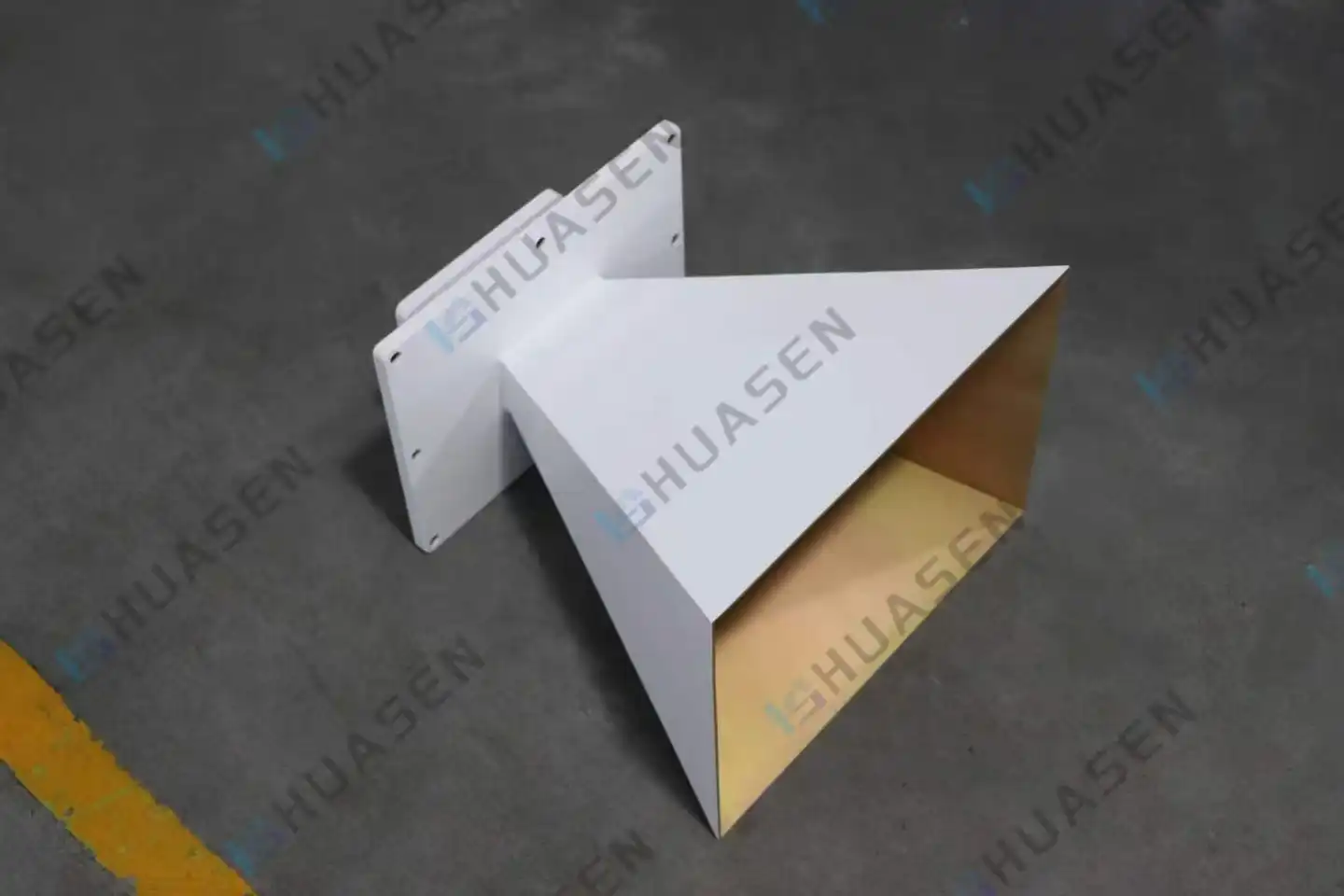
Advanced Applications of Pyramidal Horn Antennas in Communication Systems
5G and Next-Generation Wireless Infrastructure
Millimeter-wave 5G networks that work in the 24 GHz, 28 GHz, and 39 GHz bands need accurate antenna analysis when setting up the base station and making the network work better. When measuring beam patterns from phased array panels, Pyramidal Horn Antennas are used as standards to make sure that beamforming is done correctly and that sidelobe suppression rates are high. Their stable gain curves and predictable phase centers make readings repeatable across multiple test sites. This helps equipment makers and mobile network providers with their quality assurance programs. Scaled Pyramidal Horn Antenna designs will continue to be used as measurement standards for new transmission structures as 6G research moves into terahertz frequencies.
Satellite Ground Stations and Reflector Feeds
Pyramidal Horn Antennas are the main parts that feed parabolic mirror sections in satellite uplink and downlink systems. The controlled beamwidth makes sure that the light spreads evenly across the reflector's surface, matching the efficiency of the opening with the loss of light that leaks through. To handle dual-polarization transponder designs, this application needs precise cross-polarization control. Co-channel interference has a direct effect on data throughput in these systems. Maritime communication stations on ships need to be able to withstand harsh environments and vibrations. This can be easily achieved with a rugged waveguide design and the right combination of radomes.
Radar Systems and Electronic Countermeasures
Pyramidal Horn Antennas are used in both the send and receive tracks of military and aerospace radar systems. In many designs, they can handle more than 10 kW of peak power and 1 kW of average power. Not having any internal dielectrics stops heat breakdown and multipactor effects when pulse compression and frequency modulation are used. Electronic warfare systems use the patterns that can be predicted to find their way and gather signal data. The accuracy of the antenna factor directly affects how accurate the positioning is. Unmanned aerial vehicles and satellites can use the small size and light weight of the structure to meet strict weight limits while still performing well in RF environments.
EMC Testing and Antenna Calibration
Standard gain horns, a type of Pyramidal Horn Antenna, are used in anechoic rooms around the world to test for electromagnetic compatibility and electromagnetic interference (EMC/EMI) according to IEC, CISPR, and MIL-STD standards. During radiated immunity testing and emissions measurements, these antennas set standard field strengths. This makes it possible to track calibration chains back to national metrology centers. Integrating a network analyzer through precision waveguide flanges allows S-parameter measurements with very little connector error. This is very important when testing prototype RF parts or finding problems with impedance mismatches in complicated systems.
Material Characterization and Non-Destructive Evaluation
Pyramidal Horn Antennas are used in free-space measurement sets by industrial quality control systems to find out the dielectric properties of building materials, composites, and plastics. The focused RF beam tests samples of materials without touching them. This makes it possible to integrate high-speed production lines for finding moisture in paper manufacturing or making sure that composites are drying properly in aircraft manufacturing. This app blends frequency agility with mechanical stability, so a single fixture can support multiple test frequencies by using waveguide adapter connections.
Comparing Market Options: Choosing the Right Pyramidal Horn Antenna for Your Needs
Performance Metrics and System Compatibility
Before choosing the right Pyramidal Horn Antenna, you need to know the operating frequency, the gain that is needed, and the allowed VSWR across the working span. Applications that need broad coverage may be willing to settle for slightly lower peak gain in return for octave or multi-octave performance, which makes managing inventory easier. On the other hand, single-band designs that are designed for maximum directivity work best for narrowband radar or point-to-point lines. Specifications for the radiation pattern, such as the main lobe beamwidth, sidelobe levels, and front-to-back ratio, must match interference reduction needs and nearby channel rejection goals.
Off-the-Shelf Versus Custom Engineering
Catalog items from well-known brands make it easy to set up devices quickly for common frequency bands with standard performance requirements. When you buy these antennas, they come with calibration data and certified test results that help you meet the paperwork needs of regulated businesses. Delivery lead times usually run from when the item is in stock to a few weeks, which lets projects stay on schedule when a lot of items are bought.
Custom-designed solutions, such as a pyramidal antenna, are made to meet the specific needs of each system, such as those with strange frequency combinations, specialized polarization configurations, or extreme environmental conditions that go beyond standard rates. Electromagnetic modeling, prototype manufacturing, and validation testing are all part of the engineering process. These steps take longer than usual but result in better performance that isn't offered in normal catalogs. OEM relationships with experienced makers make it easier for designers to work together on designs, making sure that cost and manufacturability goals are met from the idea stage to the production ramp.
Procurement Guide: How to Source High-Quality Pyramidal Horn Antennas
Identifying Reputable Manufacturers and Suppliers
Pyramidal Horn Antennas can be bought from a wide range of companies around the world, from test equipment experts to military contractors. Companies like Keysight Technologies, Flann Microwave, and ETS-Lindgren have been making products for decades and have a wide range of products that cover bands from microwaves to millimeter waves. Regional providers often offer regional support and faster reaction times, which can be helpful when installing or replacing something quickly. Baseline goals for performance are set by checking the manufacturer's certifications, such as ISO 9001 quality management and AS9100 aircraft standards.
Evaluating Pricing Models and Delivery Schedules
The price per unit changes a lot depending on the frequency band, the building materials used, and the approval standards. Standard catalog items at popular frequencies like X-band or Ku-band have low prices because of economies of scale in production. Specialized millimeter-wave designs or MIL-STD-qualified units cost more because they are harder to make and have to pass strict validation tests. Orders of more than one machine qualify for volume discounts, which can help you save money while building out your infrastructure or expanding your lab.
Lead times depend on how complicated the product is to make and how much their suppliers can supply. Items that are in stock usually ship within days, but goods that are made to order can take weeks or months, based on how busy the production line is. Custom building adds even more time to the shipping schedule, and each version of the prototype takes an extra few weeks. Setting up a framework deals with chosen suppliers, locks in prices and capacity, which protects project plans from changes in the market and problems in the supply chain.
Quality Assurance and Certification Requirements
Professional-grade antennas are different from cheaper ones because they go through strict quality control processes. Vector Network Analyzer (VNA) tests check VSWR performance over certain bandwidths. Values below 1.3:1 or 1.5:1 are usually needed for acceptance, based on how important the application is. Accuracy within ±0.5 dB is guaranteed by gain testing using the three-antenna method or NIST-traceable standards. This is important for measurement reference uses. Dimensional measurement checks the shape of the opening and the smoothness of the flange. This stops RF leaks and mode conversion problems during installation.
High-power testing makes sure that the device can handle its full power without dielectric breakdown or arcing, which is very important for send uses in radar and communications. Environmental testing, such as changing temperatures, humidity levels, salt fog, and vibrations, shows that the product is reliable under working stress circumstances. Following the rules for ROHS and REACH protects the environment and people in foreign markets, making it easier to get goods through borders and get them approved by end users.
Optimizing Performance and Ensuring Long-Term Value
Installation Best Practices and Impedance Tuning
For a proper installation to start, the flange joints must be tightened to a certain torque. This makes sure that there is close metal-to-metal contact that keeps the electricity flowing and stops RF leaks. In precise applications, alignment limits are important. For example, axial offset hurts phase center accuracy, and rotating misalignment causes cross-polarization mistakes. Precision alignment supports and optical tools are used to keep the quality of the installation consistent across multiple antenna sites.
Verification after installation using spread frequency readings finds resonances or impedance problems that weren't expected and need to be fixed. Small mismatches can be fixed with stub tuners or waveguide transformer sections, which will bring the VSWR performance back to the required level. Extreme temperatures, high or low humidity, and contamination can all affect how well electrical equipment works. Knowing this helps protect it by installing radomes or environmental shelters in places where it will be used in difficult conditions.
Maintenance Programs and Spare Parts Strategy
Regular checks look at the state of the inside surface, seeing if there is oxidation, dust buildup, or physical damage that would affect conduction. Cleaning methods that use allowed agents and non-abrasive methods bring back the finish of the surface without making scratches that make insertion loss worse. Flange contacts need to be checked for gasket tension and fastener integrity on a regular basis to keep the electrical sealing performance from slowly decreasing.
Strategic stocking of extra parts weighs the costs of keeping them on hand against the risk of downtime. For infrastructure uses that are very important, having extra antennas is a good idea. For setups that aren't as important, however, sellers may offer fast replacement services. By periodically recalibrating and keeping an eye on performance trends, you can spot slowing down before it breaks down, which lets you replace it before it breaks down and avoids unplanned outages.
Future-Proofing Communication Infrastructure
Modular system designs let technology change without having to update the whole infrastructure. If you choose Pyramidal Horn Antennas with adapter interfaces that handle different waveguide bands, you can change the frequency of your array as the spectrum is allocated. Upgrading from older systems to newer platforms is easier with mechanical mounting systems that are made to work with a variety of antenna types. Following new standards, like the 3GPP specs for 5G and beyond, ensures that devices will work together in the future as communication environments change.
Conclusion
In conclusion, Pyramidal Horn Antennas are very useful for transmission, radar, and testing because they are built with strong metal and follow tried-and-true electromagnetic design principles. Their job includes setting standards for calibration in labs and building practical infrastructure. They help technology move forward from 5G rollout to new terahertz systems. To choose the right models, you have to weigh performance requirements against system limitations, purchase issues, and expected lifetime value. Working with well-known manufacturers and putting in place disciplined repair plans will help you get the most out of your investment and make sure that the equipment keeps working well for decades.
FAQ
Q1: How Does Flare Length Affect Performance?
The length of the flare has a direct effect on how the phase mistake is spread across the antenna opening. When the flare length is too short compared to the opening size, phase error gets worse, which lowers gain and changes beam patterns by making sidelobe levels higher. The best designs find a balance between the limitations of mechanical length and the needs for electromagnetic performance, getting maximum gain within suitable physical dimensions. In general, longer flares work better, but they add weight and wind loads to outdoor setups.
Q2: What Determines the Lower Frequency Limit?
The bottom realistic limit is set by the connecting waveguide's cutoff frequency. A WR-90 waveguide has a limit frequency close to 6.5 GHz. Below this frequency, electromagnetic fields disappear, and radiated efficiency drops by a huge amount. As the working frequency gets closer to the cutoff, the antenna's performance quickly gets worse, with higher VSWR and less gain. If you choose the right waveguide size for the frequency bands you want to work with, you can be sure that it will work well above the cutoff frequency where stable performance traits exist.
Q3: Can These Antennas Handle High-Power Applications?
The air-dielectric design of Pyramidal Horn Antennas makes them great for high-power situations because it gets rid of internal parts that are easily damaged by heat or voltage. Power handling limits rely on the air breakdown voltage in the waveguide feed and across the aperture. In properly built units, these limits should be able to handle peak powers of more than 10 kW and average powers of more than 1 kW. Pulse applications benefit from good transient reaction without having to worry about multipactor issues that can affect designs that are loaded with dielectrics.
Q4: Why Choose Pyramidal Over Conical Configurations?
Linearly polarized systems like Pyramidal Horn Antenna designs, because they easily switch from rectangular waveguides, which are the most common type of transmission line in microwave systems, to other shapes without the need for complicated mode changers. This straight compatibility keeps the purity of the polarization and makes system integration easier than with conical horns, which need circular waveguide connectors. Rectangular openings also let you set the E-plane and H-plane beamwidths separately, which gives you more design options than circularly symmetric configurations.
Partner With Huasen Microwave for Your Pyramidal Horn Antenna Needs
People who work in procurement and system integration who need trusted Pyramidal Horn Antenna providers can benefit from Huasen Microwave's 30 years of experience making antennas for microwave and millimeter-wave frequencies. Our tech team works together to make unique designs that meet specific needs for frequency, gain, and environment while still meeting tight delivery times. Our ISO-certified output guarantees consistent quality backed by detailed calibration paperwork, whether we're setting up EMC compliance facilities, upgrading radar systems, or putting in place 5G test infrastructure. We back OEM partnerships by offering flexible minimum order quantities and expert help during the entire product creation process. Get in touch with our sales team at sales@huasenmicrowave.com to talk about your waveguide antenna needs and get price information that is specific to your project. As a well-known company that makes Pyramidal Horn Antennas for the defense, aerospace, and telecommunications industries, we offer solutions that combine tried-and-true electromagnetic design with strong mechanical engineering to ensure long-lasting field performance.
References
1. Balanis, Constantine A. "Antenna Theory: Analysis and Design, Fourth Edition." John Wiley & Sons, 2016.
2. Kraus, John D. and Marhefka, Ronald J. "Antennas: For All Applications, Third Edition." McGraw-Hill Education, 2002.
3. IEEE Standard 149-2021. "IEEE Recommended Practice for Antenna Measurements." Institute of Electrical and Electronics Engineers, 2021.
4. Olver, A.D., Clarricoats, P.J.B., Kishk, A.A., and Shafai, L. "Microwave Horns and Feeds." Institution of Engineering and Technology, 1994.
5. Milligan, Thomas A. "Modern Antenna Design, Second Edition." John Wiley & Sons, 2005.
6. Silver, Samuel. "Microwave Antenna Theory and Design." MIT Radiation Laboratory Series Volume 12, McGraw-Hill, 1949.
Send Inquiry