Why Parabolic Antenna Is Preferred for Long-Distance Links?






2026-06-11 21:05:13
Parabolic antennas are always the best choice for engineering teams trying to communicate over tens of kilometres between remote base stations, satellite ground stations, or offshore platforms. These reflector-based devices circumvent free-space route loss that weakens signal power over long distances by concentrating radio frequency energy into small, highly focused beams. These antennas boost transmission power and receiver sensitivity by focusing electromagnetic waves to a single feed point using an accurate parabolic shape. Long-haul wireless networks' key issue is sustaining signal-to-noise ratio despite air attenuation and distance-related losses that would render other antenna designs useless.
Understanding Parabolic Antennas and Their Core Design Principles
How Parabolic Reflectors Focus Electromagnetic Energy?
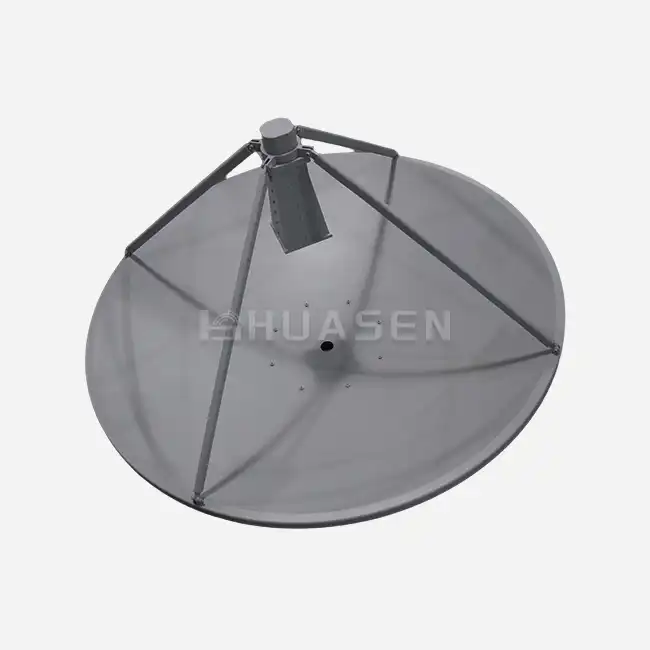
Curved reflector geometry makes parabolic antenna systems work well. A feed horn at the focus point creates spherical radio waves, which the parabolic surface reflects into parallel plane waves in one direction. Radiated power along the antenna's boresight axis is greatly increased by this change. The process reverses during reception: plane waves bounce off the reflector and converge at the feed position, concentrating weak signals for detection. These antennas perform better than omnidirectional or somewhat directional ones because of their bidirectional focusing mechanism.
Frequency Compatibility and Beamwidth Characteristics
Modern high-frequency wireless systems from 6 GHz to 80 GHz benefit greatly from parabolic antenna designs. At higher frequencies, wavelengths shorten, allowing small reflector diameters to provide beamwidths of less than 2 degrees. This tight beam concentration reduces adjacent channel interference and maximises frequency reuse in dense deployments. System designers may compute exact link budgets and comply with ETSI sidelobe suppression regulations since dish diameter, operating frequency, and gain follow predictable electromagnetic principles.
Evolution Towards Dual-Polarisation Capabilities
New technology enables dual-polarised feed systems to send and receive two orthogonal polarisation states simultaneously: vertical/horizontal or slant ±45 degrees. This invention doubles spectral efficiency in the same antenna footprint, helping mobile network operators install 5G backhaul infrastructure despite spectrum shortages. The cross-polarisation interference cancellation (XPIC) technique increases throughput without spectrum licensing expenses by creating distinct data streams on similar frequencies. This feature turns single-polarisation restrictions into powerful MIMO-enabled wireless communications with fibre-like capacity.
Why Do Parabolic Antennas Excel in Long-Distance Communication?
Superior Gain Overcomes Path Loss Challenges
Long wireless transmissions degrade exponentially due to free-space route loss, which rises with distance and frequency. This physical fact is countered by parabolic antennas' 35-45 dBi gain, depending on diameter and frequency range. This gain amplification offers the connection margin needed for dependable connectivity over 50+ kilometre rural backhaul and offshore communication lines. Yagi arrays and flat panel designs plateau around 15-20 dBi, making them unsuitable for extended-range applications where every decibel of gain affects system viability.
Directivity Reduces Interference and Enhances Security
The pencil-beam radiation pattern of parabolic antennas has benefits beyond raw gain. In densely populated metropolitan areas with several wireless systems, a narrow beamwidth prevents off-axis interference from nearby transmitters. Directional selectivity reduces signal spillage that unauthorised receivers may intercept, improving communication security. Military and government applications, as well as commercial operators handling sensitive data transfer via point-to-point microwave lines, value this confinement feature. Eavesdropping poses operational concerns.
Environmental Durability for Mission-Critical Deployments
Long-distance communication infrastructure is usually located on towers, roofs, mountainsides, or offshore platforms, where it faces harsh temperatures, winds, precipitation, and corrosive atmospheres. Quality parabolic antenna systems have aluminium alloy reflectors with UV-stabilised radomes, stainless steel mounting hardware, and sealed feed assemblies for severe environments. In extreme weather, survival wind values of 200 km/h ensure structural integrity. Telecom and critical infrastructure operators need 99.999% availability, and mechanical robustness provides it.
Selecting the Right Parabolic Antenna for Your Business Needs
Matching Frequency Bands to Application Requirements
B2B purchases must match antenna specs to system frequencies. Cellular backhaul uses licensed microwave bands (6/11/18/23 GHz), whereas satellite communications use Ku-band (12-18 GHz) and Ka-band (26-40 GHz). 5.8 GHz unlicensed bands are ideal for wireless ISP installations to save spectrum expenditures. Higher frequencies provide better bandwidth but more rain fade, needing bigger reflector diameters to sustain gain and overcome air absorption during precipitation events.
Diameter Trade-offs Between Gain and Physical Constraints
While antenna diameter directly affects gain at a given frequency, physical size affects installation difficulty, wind loads, and mounting structure requirements. A 1.2-metre parabolic reflector antenna at 18 GHz has 38 dBi gain, while a 0.6-metre parabolic reflector antenna has 32 dBi. This 6 dB discrepancy results in 4x power fluctuation in link budget estimates. Installation sites with space or aesthetic constraints may need smaller diameters, necessitating system designers to increase transmit power or lower the connection margin. Managing these engineering constraints requires tight communication between procurement and technical consultants.
Customisation and Feed System Options
Many long-distance applications benefit from tailored specifications. XPIC technology doubles capacity with dual-polarised feeds, and specialised cross-polarisation discrimination (XPD) performance over 35 dB isolates channels for high-order modulation schemes. Standard gain feedhorns suit typical applications, whereas high-performance low-VSWR ones reduce insertion loss in sensitive receiver chains. N-type, SMA, and waveguide flange connectors must match the transceiver equipment. Instead of only supplying off-the-shelf components, experienced vendors lead these configuration decisions to optimise system integration.
Installation, Alignment, and Maintenance Best Practices
Precision Mounting and Alignment Procedures
Installation must be precise to achieve theoretical antenna performance. Wind-induced oscillation misaligns thin beams; therefore, mounting structures must be robust. Alignment tolerances for high-gain systems are frequently within 0.1 degrees using azimuth and elevation adjustments during commissioning. Spectrum analysers, signal generators, and optical sighting devices help technicians maximise RSSI measurements. Documenting final alignment settings helps troubleshoot and re-optimise following maintenance or environmental changes.
Routine Inspection and Performance Monitoring
Link quality and operational longevity are preserved by proactive maintenance. Radome inspections should look for fractures or UV damage that might let moisture in. Water intrusion causes corrosion and insertion loss; therefore, feed assembly seals must be checked regularly. Thermal cycling loosens fasteners; therefore, mounting hardware torque parameters must be verified. Remote monitoring systems tracking RSSI trends detect slow performance degradation before catastrophic breakdowns, allowing regular maintenance rather than emergency repairs during service interruptions that affect revenue and customer happiness.
Supplier Support and Warranty Considerations
The total cost of ownership includes warranty coverage, technical assistance, and spare parts. Reliable manufacturers provide multi-year warranties and service networks that can quickly despatch new parts. Commissioning time and contractor labour expenses are reduced by factory calibration data and installation documentation. Design support from suppliers during system planning helps minimise costly specification problems during implementation. By mitigating risk and fostering long-term partnerships, these value-added services set professional manufacturers apart from commodity suppliers.
Reliable Procurement and Supplier Insights for Parabolic Antennas
Evaluating Manufacturer Credentials and Specialisation
Supplier selection is difficult for B2B customers in worldwide marketplaces with different quality standards, particularly for a parabolic reflector antenna. Certified manufacturers have ISO 9001 quality management systems, RoHS environmental compliance, and product-specific requirements like ETSI EN 302 217 for point-to-point equipment. Long-standing suppliers have engineering knowledge and dependability histories, indicating market popularity. Compared to diverse electronics businesses considering antennas as peripheral product lines, manufacturers specialising in high-frequency microwave components do better.
Balancing Cost and Long-Term Value
Procurement specialists naturally optimise cost, yet unit pricing might hurt long-distance communication infrastructure. Premium parabolic antennas with precision-formed reflectors, optimal feed illumination, and strong mechanical construction improve link capacity and dependability by showing greater gain, smaller sidelobes, and improved cross-polarisation discrimination. Through lower total cost of ownership, reduced maintenance frequency and prolonged operating lifespans, the balance greater initial investment. Instead of catalogue claims, rigorous supplier comparison should examine independently tested performance standards.
Customisation Capabilities for Specialised Applications
Most deployment situations can be met with standard catalogue goods, but many long-distance linkages require tailored solutions. Specific frequency ranges, mounting interfaces, lightning protection, or environmental ratings above standards may justify development cooperation with qualified manufacturers. Companies with in-house RF engineering, mechanical design, and precision manufacturing can quickly prototype and test project-specific designs. This flexibility is crucial for aerospace, defence, and critical infrastructure applications where COTS limits prevent mission accomplishment.
Conclusion
Parabolic antenna technology is the best long-distance wireless communication option for cellular backhaul and satellite ground stations because of its gain, directivity, and dependability. Through precise reflector design, its physics-based advantages concentrate electromagnetic energy, overcoming route loss and interference issues that restrict other antenna systems. Technology, environmental durability, and supplier capabilities are balanced in B2B procurement decisions to guarantee infrastructure investments operate across several years. Dual-polarisation feeds and precise manufacturing keep parabolic reflector designs competitive as wireless systems increase frequencies and capacity.
FAQ
1. How does antenna diameter affect long-distance link performance?
Larger reflector diameters increase gain at any frequency, boosting link budget margin. At 18 GHz, a 0.6 m to 1.2 m diameter increases gain by 6 dBi, quadrupling transmit power. Larger dishes reduce beamwidth, decreasing interference but requiring more accurate installation alignment.
2. Can parabolic antennas support both 5G backhaul and satellite communications?
Are parabolic antennas suitable for 5G backhaul and satellite communications? With proper frequency-specific setups. Cellular backhaul uses licensed microwave channels (6-42 GHz), whereas satellite lines use Ku/Ka bands (12-40 GHz). Dual-band or wideband feed systems allow multi-application flexibility, although optimised single-band solutions perform better for devoted use.
3. What maintenance schedules maximise operational lifespan?
Most failures are prevented by annual visual examinations of the radome, feed seal, and mounting hardware. Biennial RSSI monitoring reveals a performance decline that needs correction. Semi-annual comprehensive inspections ensure reliability in harsh weather or corrosive sites.
Partner With Huasen Microwave for Superior Long-Distance Connectivity
For any high-frequency communication difficulty, Huasen Microwave Technology applies over 30 years of RF technical knowledge. Our precision-formed reflector Parabolic Antennas provide industry-leading gain and cross-polarisation from 6 GHz to millimetre-wave bands. Since we specialise in Parabolic Antennas, we offer technical help from system design to post-deployment optimisation to maximise long-distance connection throughput and dependability. Our engineering team works with integrators, carriers, and equipment manufacturers to tailor feed configurations, polarisation schemes, and environmental parameters to project needs. Talk to our experts at sales@huasenmicrowave.com about your communication infrastructure needs and how our proven solutions can improve network performance.
References
1. Balanis, Constantine A. Antenna Theory: Analysis and Design. 4th ed. Hoboken: John Wiley & Sons, 2016.
2. Collin, Robert E. Antennas and Radiowave Propagation. New York: McGraw-Hill Education, 1985.
3. European Telecommunications Standards Institute. ETSI EN 302 217: Fixed Radio Systems; Characteristics and Requirements for Point-to-Point Equipment and Antennas. Sophia Antipolis: ETSI, 2017.
4. Rappaport, Theodore S. Wireless Communications: Principles and Practice. 2nd ed. Upper Saddle River: Prentice Hall, 2002.
5. Silver, Samuel. Microwave Antenna Theory and Design. MIT Radiation Laboratory Series. New York: McGraw-Hill, 1949.
6. Stutzman, Warren L., and Gary A. Thiele. Antenna Theory and Design. 3rd ed. Hoboken: John Wiley & Sons, 2012.
Send Inquiry