What Is Lens Horn Antenna and How It Enhances Antenna Gain?






2026-06-17 21:24:54
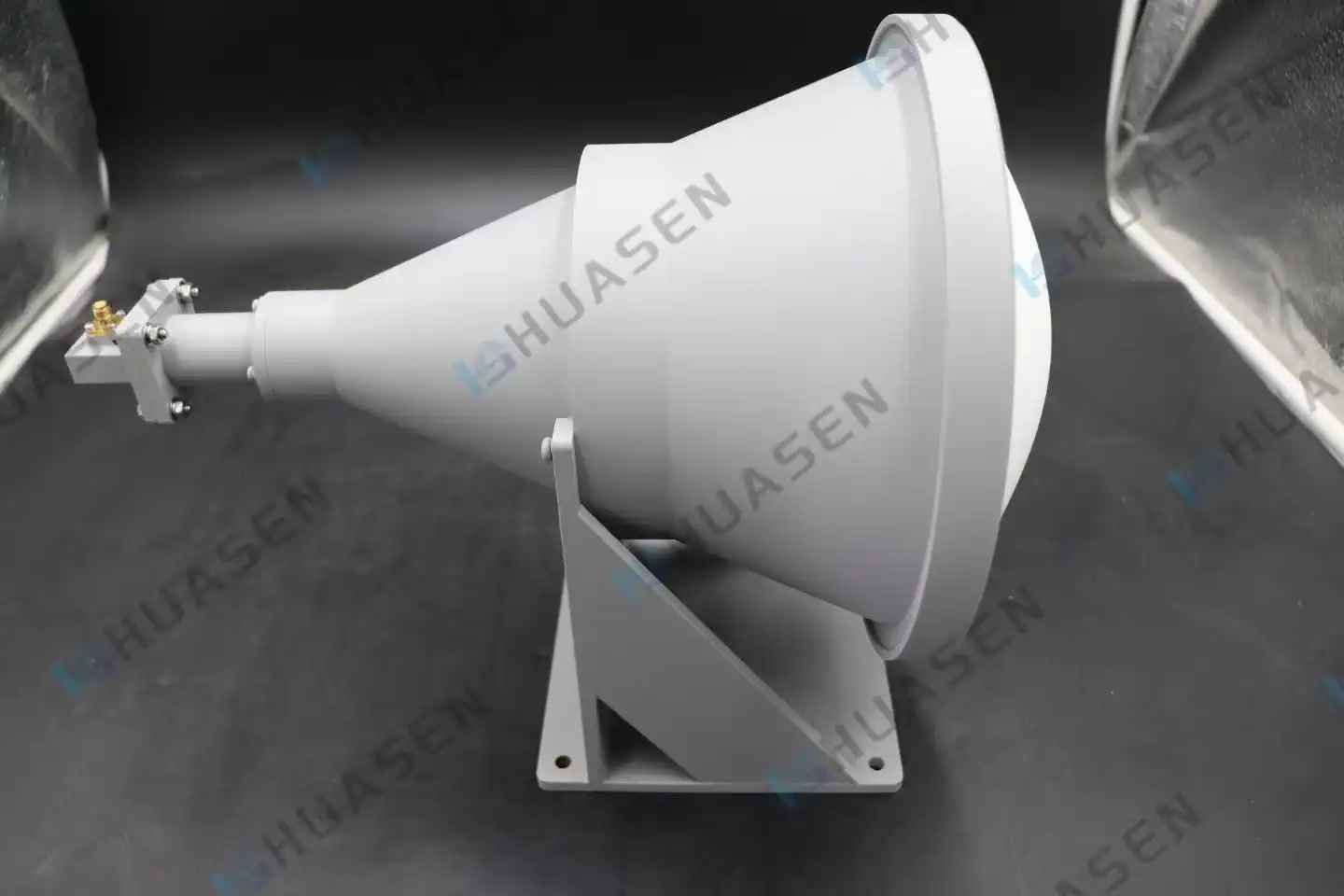
A Lens Horn Antenna is a special kind of high-gain radio device that has a precision-engineered dielectric lens built into the opening of a normal horn structure. This antenna doesn't use a normal horn, which makes spherical wavefronts that cause phase mistakes and low gain. Instead, it uses a hyperbolic or plano-convex lens made from low-loss materials like PTFE or Rexolite to focus electromagnetic waves. At the aperture exit, this process changes spherical wavefronts into flat ones. This greatly improves directivity while keeping the dimensions small. The design solves important problems in millimeter-wave uses where signal efficiency and limited space are very important.
Understanding Lens Horn Antenna: Definition and Working Principles
This type of antenna's basic structure blends traditional horn feeding structures with modern lens optics to get around the problems that come with traditional designs.
Core Structural Components
The antenna is made up of a waveguide feed that changes into either a conical or pyramidal horn. At the aperture opening, there is a carefully shaped dielectric lens. The choice of lens material depends on the frequency bands that will be used. For example, PTFE is often used for Ka-band uses, while Rexolite is better for E-band and W-band systems that need higher frequencies. Manufacturing accuracy is very important—the lens surface tolerance has a direct effect on the accuracy of phase correction and the total gain performance. Standard connectors, such as WR-series flanges, can usually fit into the waveguide interface. This makes it compatible with current RF equipment.
Wave Propagation and Phase Correction Mechanism
Because the waveguide feed is a point source, electromagnetic energy automatically grows with a curved phase front as it moves through the horn section. Parts of the emitted energy arrive at the aperture plane with different phase angles because of this spherical wavefront. This creates damaging interference patterns that lower the effective aperture efficiency. To make up for these changes in phase, the dielectric lens creates different path lengths across its shape, making it thicker in the middle and smaller at the edges. Energy moving through the lens center has a longer electrical path than energy moving along the edges. This evens out the phase distribution across the whole aperture. This fix turns the wavefront into a flat wave, which boosts positive interference in the main beam direction.
Operational Frequency Ranges and Material Considerations
These antennas work great in microwave and millimeter-wave bands, which usually go from 18 GHz in the K-band to 26.5 GHz in the Ka-band, 50 GHz to 75 GHz in the V-band, 60 GHz to 90 GHz in the E-band, and up to 110 GHz in the W-band. For 6G study purposes, new designs are even going as low as sub-terahertz frequencies. At higher frequencies, where dielectric losses rise, the choice of material becomes even more important. Loss vector values below 0.001 are needed to keep the signal from getting weaker and the lens structure from getting too hot. Some more advanced designs use zoned lenses with stepped thickness profiles to cut down on weight and material absorption while still being able to fix phase over certain frequency ranges.
Lens Horn Antenna Vs. Other Antennas: Making Informed Choices
System makers and people who buy things can better choose parts for tough jobs if they know how different antenna technologies compare in terms of performance measures.
Performance Comparison with Standard Horn Antennas
Standard pyramidal or conical horns can only get high gain by being very long, which takes up a lot of room and makes setups heavier. A regular horn might need to be 300–400 mm long to hit 25 dBi gain at Ka-band, but a lens-integrated design can do the same job in 150–200 mm, which cuts the vertical dimensions by around 40%. This small size is very helpful for platforms that need to save room, like UAVs, small antenna test areas, and thick tower placements. It's also much easier to get rid of side lobes. Lens designs can get E-plane side lobes below -15 dB and H-plane levels below -26 dB, whereas normal horns usually get -12 to -18 dB. This better radiation pattern cuts down on crosstalk in places with multiple antennas and makes measurements more accurate in test situations.
Advantages Over Parabolic Reflector Systems
Parabolic dishes have great gain, but they need to be precisely aligned mechanically and take up a lot of space because their feed systems are offset. Lens-based designs get rid of the problem of feed blockage that comes with front-fed parabolic systems, making the aperture lighting better. When used in mobile or vibration-prone situations, like marine communications or vehicle-mounted radar, a lens antenna's single structure is more stable than reflector systems that have many parts that need to be lined up correctly. The covered lens aperture also protects the waveguide feed from the air, so there is no need for a radome.
Comparison with Planar Array Technologies
Electronic beam steering is possible with phased arrays and patch antenna arrays, but they are more complicated because they need active phase shifters and corporate feed networks. Each part and power divider in an array adds to insertion loss, and networks that are combined can lose 2 to 4 dB of performance. Lens Horn Antenna designs can reach similar gain levels with only passive parts, so they don't need DC power and don't have to worry about heat escape. The ease of use and dependability of lens horn technology make it a great choice for fixed-beam high-gain uses in point-to-point lines or measurement standards. When compared to multi-element arrays that need a lot of precise parts, modest production numbers still have lower manufacturing costs.
Procurement Guide: How to Source High-Quality Lens Horn Antennas
To get reliable, performance-tested parts, you need to know what the seller can do, how to customize them, and how to check the quality.
Identifying Reputable Suppliers and Manufacturers
Companies should give more weight to suppliers who have experience with precision cutting and processing dielectric materials. The electrical performance is directly affected by the quality of the manufacturing process. Roughness on the lens surface, concentricity with the horn opening, and dielectric homogeneity all have an effect on the accuracy of phase correction. Ask for full details, like measured gain patterns, VSWR data for the whole working band, and paperwork for the side lobe level. Manufacturers with a good reputation give test results based on readings taken in an anechoic chamber instead of just theoretical models. Certifications that show environmental compliance, like RoHS, and quality management systems, like ISO 9001, show that a business is mature and has good process control.
Customization Capabilities and OEM Considerations
For many uses, custom solutions are needed that go beyond what is listed in a store. Some important customization options are the frequency bands that can be used, the type of polarization (linear, dual-linear, or circular), the gain goals, the beamwidth requirements, and the mechanical interface needs. There are four main product configurations: Conical Horn Lens designs with circular symmetry, Pyramidal Horn Lens variants with rectangular apertures for specific coverage shapes, Feed-Illuminated Lens configurations that make the best use of reflector illumination, and Point-Focus Lens architectures that get the most gain in the least amount of space. Suppliers that have their own electromagnetic modeling and fast development facilities can quickly make changes to designs. During the design phase, talk about changing the focal length, the aperture diameter, and the beamwidth to make sure the supplied goods meet the needs of the system.
Pricing Structures and Bulk Procurement Strategies
Prices per unit vary a lot depending on the frequency band, gain level, and lens width. Ka-band units with 20–25 dBi gain can cost anywhere from a few hundred dollars to over a thousand dollars, based on the level of precision and the type of plug used. Higher-frequency W-band devices cost more because they are made with more precise standards and special materials. Costs can be lowered by buying in bulk. When you commit to buying 10 or more units, you can usually get a 15–25% discount. If you need to make more than 50 units, you may need to invest in special tools that lower the cost per unit even more. Set up outline deals for purchases that will be made again and again. This will lock in prices and make sure that long-term projects can keep getting supplies.
Installation, Maintenance, and Support Best Practices
The right way to set up antennas and keep them in good shape will protect your infrastructure investment and make them work better for longer.
Mounting Techniques and Alignment Procedures
To get the desired gain and pattern features, the mechanical fitting must be done perfectly. Use sturdy clamps to mount the antenna so that it doesn't bend when the wind blows or when it vibrates. For narrow-beam high-gain units like Lens Horn Antennas, alignment accuracy is especially important—a 30 dBi antenna with a 3-degree beamwidth loses 3 dB of signal for every 1.5 degrees it is out of place. To get the best aiming, use visual alignment tools or RF signal strength meters during installation. To keep external seals and reduce passive intermodulation, make sure that all waveguide flange connections are tightened to the right torque levels. When installing an antenna outside, make sure that the fixing structures won't collect water or ice that could physically or electrically overload the antenna.
Calibration and Performance Verification Methods
Verification after placement makes sure the radio works as expected in your system. Using a vector network analyzer, check the VSWR across the working bandwidth. Values should stay below 1.5:1 throughout the given range, and most production units get below 1.3:1. Gain, beamwidth, and side lobe levels can be checked with far-field pattern measures or near-field scans, if they are available. Alternative ways of verification are useful because many groups don't have access to anechoic chambers. To find possible problems, compare the link budget calculations with the system performance measurements. During operation, thermal imaging can show hotspots that mean there is too much dielectric loss or a bad connection fitting.
Routine Maintenance and Technical Support Access
The lens surface needs to be checked and cleaned every so often because dirt and other particles hurt performance. When dust builds up, it adds dielectric charge that changes the resonant frequency and makes VSWR higher. Patterns are badly messed up, and gain is low when water films or ice forms. Clean the lens's surface with liquids that are suitable for the dielectric material. For example, isopropyl alcohol is a good cleaner for PTFE, but you may need a different cleaner for Rexolite. Check any waveguide pressurization systems that are set up and make sure they are keeping a positive dry air or nitrogen purge going to keep humidity from building up inside. Build a connection with technical support teams that understand your application. Quick engineering help is essential for fixing system-level performance problems where antenna behavior affects other RF components.
How Lens Horn Antennas Enhance Antenna Gain: Technical Insights and Applications
Understanding the electromagnetic principles behind increasing gain helps you choose the right antenna and make the best use of your system.
Electromagnetic Theory of Gain Enhancement
Antenna gain is the measure of the amount of energy that is focused in a certain direction compared to the amount that is focused in all directions. Gain is based on two things: aperture efficiency, which shows how well the antenna turns input power into radiated energy, and directivity, which shows how precise the radiation pattern is. The lens fixes phase mistakes that would otherwise make some parts of the aperture spread out of phase, which makes both factors better at the same time. The lens reduces off-axis radiation while increasing positive interference in the boresight direction by making the phase uniform across the opening. This phase correction raises the aperture efficiency from the normal 50–60% range in regular horns to 70–80% in designs that have had their lenses adjusted. Because lens integration allows for short vertical dimensions, this efficiency is kept without the length losses that come with other designs.
Real-World Applications Demonstrating Performance Benefits
These antennas can be used as small feed horns for bigger reflector systems or as stand-alone terminals for VSAT use in satellite ground stations that work at Ka-band and higher frequencies. Their low side lobes make disturbances from geostationary satellites that are only 2 to 3 degrees away less noticeable. They are used as reference antennas in automotive radar test systems in small antenna test ranges, where their flat wavefront production mimics conditions in far-field areas that are confined and don't have any noise. This makes it possible to accurately calibrate 77 GHz and 79 GHz ADAS radar devices without having to test them at distances that are too far away to be useful. Wireless backup links in 5G networks use E-band Lens Horn Antennas for high-capacity point-to-point connections. Their high gain, narrow beamwidth, and small size make it possible to install dense networks on shared tower infrastructure. A normal E-plane side lobe level of -15 dB and an H-plane level of -26 dB keep co-channel interference between links that are next to each other to a minimum.
Future Trends in Lens Antenna Technology
New material sciences are opening up new ways to improve efficiency. Engineered electromagnetic qualities in metamaterial lenses allow for phase correction over a wider span and possibly flatter, lighter designs. Adding active parts makes antenna systems smarter. For example, putting low-noise amplifiers right behind the lens or using digitally controlled phase shifters lets devices with set patterns do some beam steering. Using additive manufacturing, like gradient-index profiles and multi-band optimization, it is now possible to make lenses with complicated shapes that could not be made with standard machining. As studies into 6G move into D-band frequencies above 110 GHz, lens horn designs offer tried-and-true ways to get the gains needed in small packages that can be used in crowded cities.
Conclusion
Lens Horn Antennas are a mature technology that is still changing, but they are very important for current wireless infrastructure, test instruments, and military uses. They are perfect for demanding millimeter-wave operations because they have a high gain, are small, have great pattern features, and can be customized in many ways. When compared to standard horns with the same gain, lens integration's built-in phase correction system works better and takes up a lot less room. When engineering teams and procurement professionals understand the technical principles, application considerations, and best practices for procurement listed here, they can make choices that improve system performance and project economics.
FAQ
Q1: What frequency ranges do lens horn antennas cover effectively?
The best frequency range for these antennas is between 18 GHz and 110 GHz, which is in the microwave and millimeter wave range. When it comes to lens merging, the best results are seen in K-band to W-band uses. Upper frequency limits are set by the material used and the shape of the lens. Specialized low-loss dielectrics allow operation into sub-terahertz ranges for new 6G uses.
Q2: How do they compare with parabolic dishes for satellite communications?
Lens Horn Antennas are useful in small spaces where mounting room limits the width of the dish. A 30 dBi lens antenna takes up a lot less space than a parabolic reflector with the same gain. Dishes work best when you need a very high gain, above 35 dBi, where lens sizes are too small to be useful. Lens horns are often used as improved feeds for bigger reflector antennas in many systems. This combines technologies to get the best performance.
Q3: What environmental protection features should outdoor installations include?
The lens itself has a covered opening that keeps rain and other things from getting into the waveguide. Hydrophobic layers on the outside of the lens keep water from building up and affecting its performance. Make sure that the waveguide flanges have the right O-ring seals and that the mounting tools won't rust in naval or industrial settings. Waveguide pressurization systems provide extra safety in tough settings by keeping a positive dry gas flow going to stop condensation from forming inside.
Partner with Huasen Microwave for Superior Lens Horn Antenna Solutions
Every project that Huasen Microwave works on is backed by more than 30 years of specialized experience in high-frequency component engineering. Our wide range of products includes the Conical Horn Lens, the Pyramidal Horn Lens, the Feed-Illuminated Lens, and the Point-Focus Lens. These are made for tough jobs in the defense, aerospace, and telecommunications industries. We offer designs with short axial dimensions and excellent side lobe suppression. E-plane values of -15 dB and H-plane performance hitting -26 dB make sure that your systems have very little interference. As a well-known company that makes Lens Horn Antennas, we can make a lot of changes to meet your particular needs, including changing the focal length, aperture size, beamwidth, and orientation. Get in touch with our engineering team at sales@huasenmicrowave.com to talk about your needs and get specific technical offers backed by performance data that has been measured.
References
1. Balanis, Constantine A. "Antenna Theory: Analysis and Design, Fourth Edition." John Wiley & Sons, 2016.
2. Milligan, Thomas A. "Modern Antenna Design, Second Edition." IEEE Press, 2005.
3. Olver, A.D., Clarricoats, P.J.B., Kishk, A.A., and Shafai, L. "Microwave Horns and Feeds." IEEE Press, 1994.
4. Silver, Samuel. "Microwave Antenna Theory and Design." MIT Radiation Laboratory Series Volume 12, McGraw-Hill, 1949.
5. Rudge, Alan W., Milne, K., Olver, A.D., and Knight, P. "The Handbook of Antenna Design, Volumes 1 and 2." Peter Peregrinus Ltd., 1986.
6. IEEE Standard 145-2013. "IEEE Standard for Definitions of Terms for Antennas." Institute of Electrical and Electronics Engineers, 2014.
Send Inquiry