What Defines a Planar Helical Antenna?






2019-02-10 13:05:01
The Planar Helical Antenna is a new type of antenna that combines the best parts of helical antennas with a low-profile shape. This new type of antenna has a flat, spiral-shaped conductor etched onto a dielectric substrate, usually in a circle or rectangle. Planar helical antennas are different from regular helical antennas in that they keep their helical shape while fitting within a two-dimensional plane. This unusual design makes it possible for them to work in a wide range of frequencies and have circular polarization, all in a small package. This makes them perfect for current communication systems when space is limited. A planar helical antenna is defined by its very thin profile, the ability to polarize in a circle, and a wide frequency range, usually from 0.2 to 18 GHz. These antennas work best when they need to send signals in all directions, and they are especially useful in places where signals can bounce around a lot. The flat shape of the antenna not only takes up less room, but it also makes it easier to fit into a wide range of devices and systems, such as IoT devices and satellite communication gear.
How does a planar helical differ from a conventional 3-D helical antenna?
The primary distinction between planar helical antennas and their conventional 3-D counterparts lies in their physical structure and the resulting electromagnetic characteristics. Traditional helical antennas consist of a conductor wound into a helix shape, extending outward from a ground plane. This three-dimensional configuration often results in a larger form factor, which can be prohibitive in space-constrained applications.
Planar helical antennas, on the other hand, compress the helical structure into a flat spiral pattern. This design innovation offers several advantages:
Compact Profile
The most obvious benefit is the significantly reduced height. Planar helical antennas can be as thin as a few millimeters, making them suitable for integration into slim devices or for surface-mount applications where protruding antennas are impractical.
Fabrication and Integration
Planar helical antennas can be manufactured using standard printed circuit board (PCB) techniques, which simplifies production and reduces costs. This flat shape also makes it easy to connect with other electronic parts and circuits on the same board.
Bandwidth and Gain Tradeoffs
While planar helical antennas generally offer good bandwidth, they may have slightly lower gain compared to their 3-D counterparts. However, this tradeoff is often acceptable given the significant space savings and integration benefits.
Radiation Pattern Variations
The radiation pattern of a planar helical antenna tends to be more omnidirectional in the plane perpendicular to the antenna surface, whereas conventional helical antennas typically have a more directional beam along their axis.

Polarization and radiation pattern characteristics of planar helical designs
Planar helical antennas are well-known for their distinctive emission and polarization patterns, which make them useful in many types of communication systems. Engineers and designers who want to use these antennas correctly need to know about their features.
Circular Polarization
One of the most significant features of planar helical antennas is their inherent circular polarization. This trait is very helpful in reducing multipath fading and improving signal reception, no matter how the antenna is pointed. The direction of polarization (left-hand or right-hand circular polarization) is determined by the winding direction of the helical pattern.
Radiation Pattern
The radiation pattern of a planar helical antenna is typically characterized by:
- A broad beamwidth in the hemisphere above the antenna plane
- Relatively uniform coverage across a wide angle
- Reduced back radiation due to the ground plane or cavity backing
This pattern makes planar helical antennas suitable for applications requiring wide-angle coverage without the need for precise pointing.
Axial Ratio
The axial ratio is a critical parameter in assessing the quality of circular polarization. Planar helical antennas can achieve excellent axial ratios, often below 3 dB over a broad frequency range, indicating good circular polarization purity.
Frequency Response
Planar helical antennas exhibit a wideband frequency response, typically covering multiple octaves. This feature lets one antenna work well in a wide range of frequency bands, which means that multi-band systems don't need as many antennas.
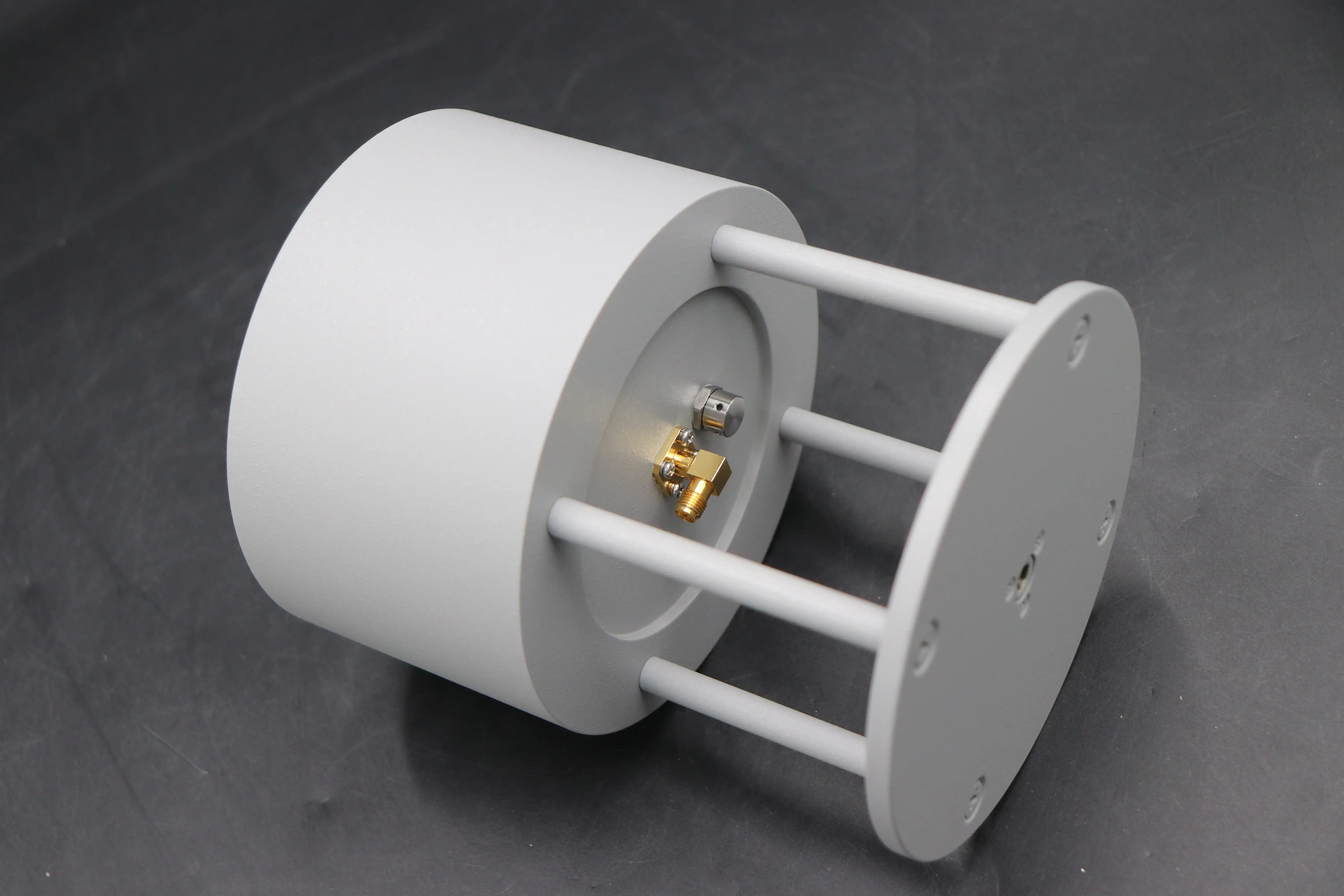
Typical applications: compact circular-polarized modules for GPS, IoT, and small satellites
The unique properties of planar helical antennas make them ideal for a wide range of applications, particularly where size constraints and circular polarization are critical factors. Let's explore some of the most common and innovative uses for these antennas:
Global Positioning System (GPS) Receivers
Planar helical antennas are extensively used in GPS modules due to their circular polarization and compact size. These characteristics allow for improved satellite signal reception regardless of the device's orientation, making them perfect for handheld GPS units, vehicle navigation systems, and wearable technology.
Internet of Things (IoT) Devices
The IoT revolution has created a demand for small, efficient antennas that can be easily integrated into various devices. Planar helical antennas meet this need by providing:
- Low profile design for discreet integration
- Wideband operation for multi-protocol support (e.g., Wi-Fi, Bluetooth, LoRa)
- Circular polarization for improved signal reception in cluttered environments
Small Satellite Communications
The space industry, particularly the CubeSat and small satellite sector, has embraced planar helical antennas for their:
- Lightweight and compact form factor
- Ability to provide circular polarization for stable earth-to-space links
- Wide bandwidth to support various communication protocols
Wireless Medical Devices
In the medical field, planar helical antennas are utilized in implantable and wearable medical devices. Their small size and efficient performance make them suitable for applications such as:
- Wireless patient monitoring systems
- Implantable medical devices requiring external communication
- Telemedicine equipment
RFID Systems
Radio-Frequency Identification (RFID) technology benefits from planar helical antennas in both readers and tags. The circular polarization ensures reliable tag reading regardless of orientation, while the compact design allows for integration into various form factors.
Unmanned Aerial Vehicles (UAVs)
Drones and other UAVs utilize planar helical antennas for their communication and navigation systems. The low profile of these antennas minimizes aerodynamic impact while providing reliable GPS reception and data links.
In conclusion, planar helical antennas represent a significant advancement in antenna design, offering a unique combination of compact size, circular polarization, and wideband performance. These characteristics make them invaluable in numerous applications across various industries, from consumer electronics to aerospace technology.
For those seeking high-performance planar helical antenna solutions, Huasen Microwave Technology Co., Ltd. stands at the forefront of innovation. With over three decades of expertise in RF and microwave technology, we offer cutting-edge antenna designs tailored to meet the most demanding specifications. Our team of experienced engineers is dedicated to providing customized solutions that address the unique challenges of your application, whether it's in telecommunications, aerospace, or IoT development.
Don't let antenna limitations hold back your project's potential. Contact Huasen Microwave today to explore how our advanced planar helical antennas can elevate your system's performance and reliability. Our commitment to quality, coupled with our extensive industry experience, ensures that you'll receive not just a product, but a comprehensive solution backed by expert support.
FAQ
1. What frequency range do planar helical antennas typically cover?
Planar helical antennas typically cover a wide frequency range, often spanning from 0.2 to 18 GHz. However, the exact range can vary depending on the specific design and application requirements.
2. Can planar helical antennas be customized for specific applications?
Yes, planar helical antennas can be customized to meet specific frequency ranges, polarization requirements, and form factors for various applications in telecommunications, IoT, aerospace, and more.
3. What are the main advantages of using a planar helical antenna over other antenna types?
The main advantages include compact size, circular polarization, wide bandwidth, and ease of integration into flat surfaces or PCBs, making them ideal for space-constrained applications requiring reliable performance.
4. How does the gain of a planar helical antenna compare to traditional helical antennas?
Planar helical antennas typically have slightly lower gain compared to traditional 3D helical antennas. However, they offer comparable performance in a much more compact form factor, with gains typically ranging from -5 to 5 dB.
Enhance Your RF Performance with Planar Helical Antennas | Huasen Microwave
Ready to take your wireless system to the next level? Huasen Microwave's planar helical antennas offer the perfect blend of compact design and high performance for your cutting-edge applications. Whether you're developing next-generation IoT devices, upgrading your telecommunication infrastructure, or pushing the boundaries of aerospace technology, our expert team is here to provide you with tailored antenna solutions that meet your exact specifications.
Don't settle for off-the-shelf components that limit your system's potential. Contact us today at sales@huasenmicrowave.com to discuss your project requirements and discover how our advanced planar helical antennas can give you the competitive edge you've been looking for. Let Huasen Microwave be your partner in innovation, driving your success in the rapidly evolving world of RF and microwave technology.
References
1. Chen, Z. N., & Luk, K. M. (2019). Antennas for Base Stations in Wireless Communications. McGraw-Hill Education.
2. Balanis, C. A. (2016). Antenna Theory: Analysis and Design (4th ed.). Wiley.
3. Kraus, J. D., & Marhefka, R. J. (2002). Antennas for All Applications (3rd ed.). McGraw-Hill.
4. Volakis, J. L. (Ed.). (2007). Antenna Engineering Handbook (4th ed.). McGraw-Hill Education.
5. Stutzman, W. L., & Thiele, G. A. (2012). Antenna Theory and Design (3rd ed.). Wiley.
6. Garg, R., Bhartia, P., Bahl, I., & Ittipiboon, A. (2001). Microstrip Antenna Design Handbook. Artech House.
Send Inquiry