What is Circularly Polarized Horn Antenna and How Does It Work?






2026-06-26 17:01:09
A circularly polarised horn antenna is a special aperture antenna designed to send and receive electromagnetic waves where the electric field vector spins around in a circle as the waves travel. These devices have internal polarisers, like septum polarisers or orthomode transducers, that change linear waveguide modes into circular polarisation states. This is different from regular linear antennas, which need to be perfectly aligned in terms of angle. This technology solves important problems in radar, 5G backhaul systems, and satellite tracking, where the orientation of both the emitter and receiver changes constantly. The rotational motion gets rid of polarisation mismatch losses and protects against Faraday rotation effects that happen in ionospheric communications. This is why these antennas are essential for wireless links that need to work properly.
How Does a Circularly Polarised Horn Antenna Work?
Technical Architecture and Internal Mechanisms
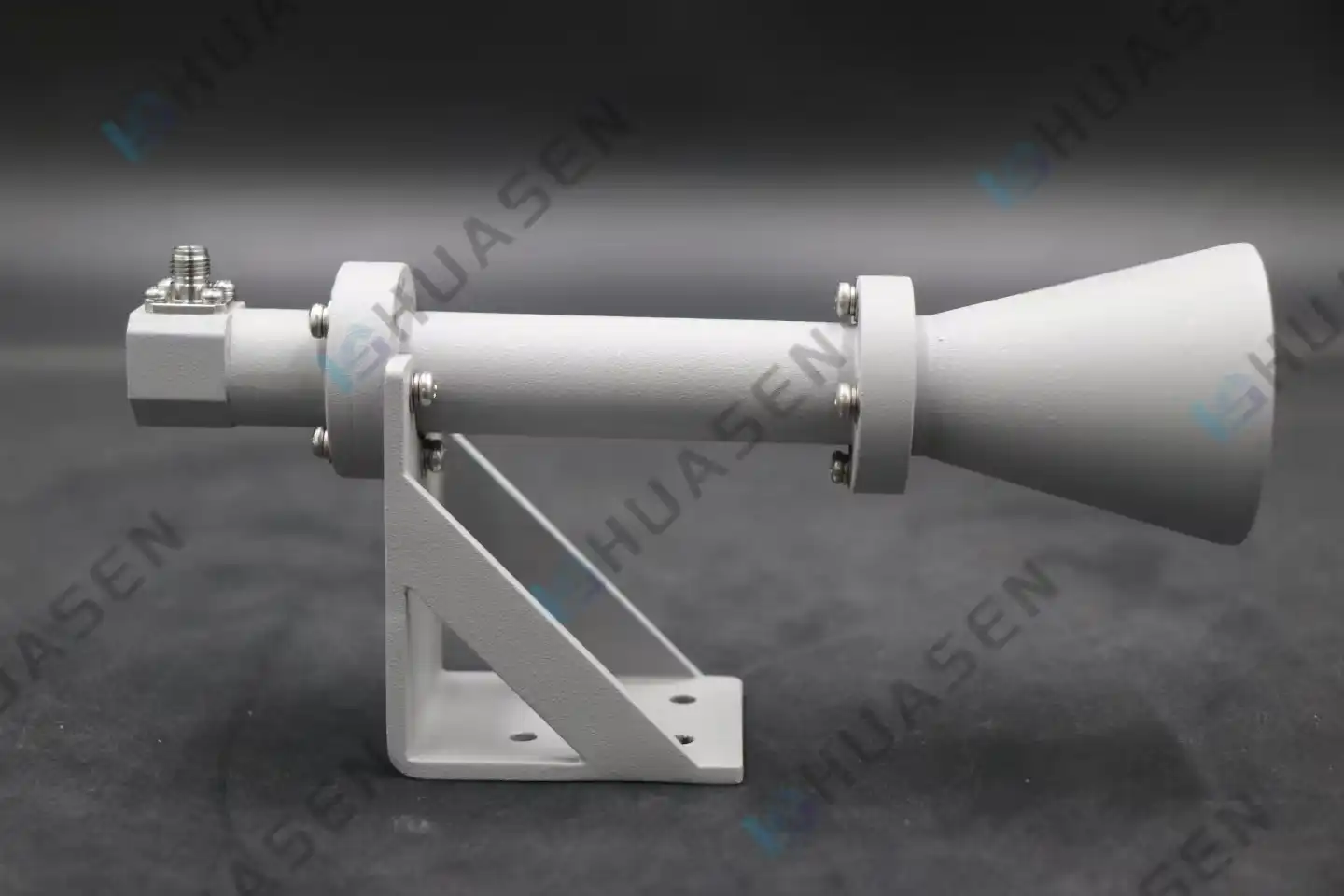
The circularly polarised horn antenna must be curved to function. Starting with a square or round waveguide, the structure eventually grows toward the opening. This curve converts tightly packed waveguide modes into circular waves that radiate while maintaining impedance matching, minimising reflections.
Huasen Microwave uses cone-shaped horns for broadband performance. Beamwidth and gain depend on cone angle. Narrower angles direct the beam but require longer lengths. The main transition region of this horn structure contains the polarisation converter. Step diaphragm designs add thin impediments at carefully timed intervals, each changing phase slightly. Coverage rates above 60% are possible with this spread-out method's broader bandwidth than single-step polarisers.
Millimetre-wave performance depends on material choice. Copper conducts better for high-power ground systems, while aluminium is preferable for lightweight flying platforms. Surface treatments matter as much as materials. Gold or silver electroplated coats minimise ohmic losses, especially above 40 GHz when the skin is shallow. Inside walls are precision-cut to reduce surface roughness. Stops scattered losses that lower the axial ratio.
Performance Metrics That Define Quality
The axial ratio best measures circular polarisation strength. This measurement shows how near the projected wave is to perfect circular motion. An increasing axial ratio indicates elliptical distortion. Premium models keep the axial ratio below 1.5 dB throughout the working band and high-precision models 0.5 dB or better. According to Huasen Microwave, the axial ratio must be ≤ 0.5 dB. Internal polariser form and manufacturing limits are optimised to achieve this.
A Voltage Standing Wave Ratio (VSWR) indicates a resistance match. Values below 1.5:1 ensure power flows smoothly from gearbox lines to radiating sections. Poor matching wastes send power and causes amplitude ripple in received signals, lowering signal-to-noise ratio. Overall VSWR performance depends on horn taper design and polariser impedance engineering.
Cross-polarisation discrimination measures how efficiently the antenna separates circular and orthogonal polarisations. Values above 25 dB stop crosstalk in frequency-reuse ssent power and causes amplitude ripple in received signals, lowering them. Satellite companies utilise this approach to maximise spectrum consumption; each polarisation doubles channel capacity without increasing bandwidth.
Frequency Coverage and Gain Characteristics
Gain selection balances beamwidth with real-world constraints. A 10 dBi horn with a 60-degree beamwidth is excellent for short-range multipoint distribution. To improve long-haul satellite uplinks, use a 25 dBi horn with a 10-degree beamwidth. Huasen can handle a wide range of connection costs without unique designs with a gain range of 10 to 25 dB. Standard catalogue goods reduce wait times and make inventory management easier than completely customised options; thus, procurement teams prefer this independence.
Be aware of bandwidth requirements. Optimising a single frequency improves the axial ratio in narrowband devices with 5% fractional bandwidth. These designs suit fixed-channel satellite interfaces. Broadband units that cover 67% of the axial ratio perform poorer when system frequencies change, but they require fewer antennas. It depends on the application. Dedicated radar sites demand narrowband precision, while multifunction test systems need wide frequency range.
Comparing Circularly Polarized Horn Antennas with Other Antenna Types
Performance Against Linearly Polarized Horn Antennas
Linearly polarised horns have the same aperture shape but no polarisation devices. Linear horns are suitable for fixed installations with angles since they are cheaper and easier to produce. Linear polarisation works as well as circular designs if the sender and listener stay together.
When the station changes or installation is uncertain, the negative appears. In extreme circumstances, aircraft turning, satellite rotation, or mounting faults can produce 20–30 dB polarisation mismatch losses. Circularly polarised horn antennas eliminate this sensitivity by closing the link regardless of direction. Circular designs entail less installation effort because field workers don't have to line up polarisation angles, according to purchasing research. This reduces deployment and order errors.
Advantages Over Patch and Microstrip Antennas
Microstrip patch antennas are most common in household electronics because they have low profiles and can be built into PCBs. Through dual-feed configurations or asymmetric patch shapes, these flat devices can achieve circular polarisation. Patch antennas are smaller than horn designs, but they have a shorter bandwidth and can't handle as much power.
Horn antennas have higher gain density, which means they have better directivity from smaller opening areas. A 15 dBi patch array might have a 30 cm circle, but a horn of the same size would only be 12 cm across. This small size is important for places with limited room, like aeroplane pods or radomes on ships. Power handling differences are also important—horns can usually handle both kilowatts of constant power and megawatts of peak pulses, which is necessary for radar emitters and electronic warfare systems. Patch antennas usually have a maximum of tens of watts before the base gets too hot and breaks.
Operational Differences from Helical Antennas
Due to the spiral shape of their conductors, helical antennas produce circular polarisation. These arrangements have a very wide bandwidth—single patterns can cover more than one octave. The helical method works well for tasks that need coverage in all directions, like ground-based satellite receivers that track LEO systems.
Horn antennas send energy in a specific direction and let you control the width of their beam. This directionality increases gain and lowers the chance of crosstalk, which are both very important in settings with a lot of signals. Base station front-ends can separate wanted signals while rejecting off-axis interferences with horn antennas. Ultimately, the choice between helical and horn architectures depends on the covering pattern needs: horns are better for pencil-beam directionality, while helical designs are better for hemispherical patterns.
Applications and Procurement Insights
Satellite Communications and Ground Terminals
For many uses, geostationary satellite uplinks are the best option. To close link costs, ground stations that send data to satellites 36 km above the equator need high-gain antennas. Because satellite attitude control devices allow for a certain amount of rotating drift, circularly polarised horn antennas are necessary. When the direction of a satellite changes, linear antennas would lose their signals from time to time. But circular polarisation keeps working properly during orbiting station-keeping cycles.
Low Earth Orbit (LEO) constellations add to the difficulties. As satellites move quickly across the sky, their altitude and direction are always changing. Tracking devices have to keep the antennas pointed correctly while also dealing with Doppler changes and polarisation rotation. By removing one variable, circular polarisation makes this tracking problem easier to solve at the ground station and in the control system.
5G and Millimeter-Wave Backhaul Networks
Backhaul lines with a lot of bandwidth are needed for fifth-generation wireless networks to connect cell towers to core networks. Millimetre-wave bands above 24 GHz can handle multiple gigabits of data per second thanks to their large channel sizes. Attenuation and rain fade at these frequencies are very high, so high-gain antennas are needed to keep link margins.
In more than one way, circular polarisation makes transport more reliable. Multipath reflections from buildings and cars happen in cities. Circular polarisation's ability to reject reflections makes signals clearer. When it rains a lot, the clouds take on uneven forms that change the polarisation of the signals. Circular polarisation is more resistant to this depolarisation effect than linear types. When network providers use circular polarisation in places where propagation is difficult, availability goes up by 15 to 20 per cent.
Radar Systems and Their Uses in Defense
Target identification and tracking must be done very accurately for weather radar, air traffic control, and military surveillance systems to work. Circular polarisation makes polarimetric radar methods possible. Sending one polarisation sense and getting both RHCP and LHCP returns shows what the target is made of. Spherical targets, like raindrops, reflect polarisation without changing it, but uneven targets, like aeroplanes, change the polarisation when they reflect. By looking at these changes in polarity, you can tell the difference between clutter and real targets.
Circular polarisation is used in military electronic countermeasure devices to make it harder for enemies to receive signals. Because circular signals have a different polarisation, jamming devices that are set for linear polarisation don't work as well against them. Communication security apps use this feature to make links more resistant to interference that is meant to harm them.
Procurement Considerations and Supplier Selection
You must consider more than technical parameters to get these specialised items. Lead times vary. Famous companies like Huasen Microwave ship standard catalogue items in two to four weeks, but custom designs take eight to twelve weeks. Project schedules should include these gaps, especially when combining systems from several manufacturers.
Unit economics are greatly affected by volume savings. Depending on frequency and effectiveness, a sample can cost $800–$2,500. Prices drop 30–40% when more than 50 units are produced. Volume-promised annual contracts save more. Procurement strategy should integrate project needs to maximise numbers.
Certification affects provider selection. Defence businesses must follow MIL-STD-810 weather testing and MIL-STD-461 electromagnetic compatibility criteria. ISO 9001 and RoHS standards apply to commercial telecoms infrastructure. Reviewing a supplier's credentials during seller qualifying prevents legal issues.
Technical support distinguishes premium providers from basic ones. Experienced antenna engineers can match system topologies with the appropriate frequency choices, gain parameters, and port interfaces for complex applications with pre-sale design advice. After-sales support, such as calibration data, radiation pattern measurements, and problem-solving, speeds integration and reduces starting delays.
Future Trends and Practical Recommendations
Emerging Technologies in Antenna Design
More advanced study into materials promises better performance. With additive manufacturing, it is possible to make parts with complex internal shapes that were not possible with traditional cutting. By making metal structures in three dimensions, it is possible to make polarisers with better forms that increase both bandwidth and axial ratio. These changes are making cutbacks on costs while giving designers more freedom.
Through sub-wavelength structures, metamaterial technology adds fake electromagnetic qualities to materials. By combining metamaterial lenses with horn openings, radiation patterns can be changed, which allows for higher gain in smaller spaces. Research samples show gains of 2-3 dB without getting bigger, which is useful for aircraft uses that need to keep weight down.
Integration with Next-Generation Networks
Terahertz bands above 100 GHz are the goal of sixth-generation wireless devices that are still being developed. These very high frequencies allow data rates of more than 100 Gbps, but they have a hard time spreading. Antenna makers have to think about how to handle atmospheric absorption, exact beam direction, and heat. Circularly polarised horn antennas work in these bands, keeping their main benefits but having to deal with new material and manufacturing problems.
Another new technology is reconfigurable intelligent surfaces (RIS). These reflectors can be controlled electrically and change the way signals travel, which improves range and capacity. Careful control of polarisation is needed for RIS to work at its best. Circular polarisation makes RIS design easier by removing the need to align polarisation between surfaces and endpoints.
Strategic Recommendations for Procurement Managers
Efficiency and price restrictions must be balanced by systematic study. Determine the link's cost first. Calculate antenna gain based on route loss, broadcast power restrictions, and receiver sensitivity. If you don't characterise the gain appropriately, coverage may fail or prices may rise. A cost-effective design benchmark can be created by finding the lowest gain that works using extensive propagation modelling.
As with bandwidth specs, read them carefully. Wideband designs are more expensive but protect sites from frequency fluctuations. Although narrowband equipment is initially cheaper, it must be changed if its frequencies change. This decision is based on cost and frequency change likelihood. Government organisations that aim to re-arm the spectrum pick broadband flexibility, whereas satellite firms that need to coordinate frequencies over time select narrowband accuracy.
Standardising connectors simplifies system integration and maintenance. Waveguide flanges are standardised. Different manufacturers' products function together thanks to WR-series measurements. Coaxial connections follow the same rules as SMA, N-type, and 2.92 mm precision connectors. Setting standard ports reduces specialised adapters and allows multi-source buying to strengthen the supply chain.
Check warranty conditions and long-term support together with technical specs. Industrial antennas face extreme temperatures, vibration, and water ingress. Longer warranties indicate that manufacturers trust their designs and production. Multi-year guarantees reduce total cost of ownership by reducing repair costs while the product works.
Building relationships with long-standing providers pays off in many ways. Suppliers who understand your application can advise you on new technologies and obsolescence. Huasen Microwave has made RF components for 30 years; thus, their experience helps customers fulfil evolving needs. These relationships transform suppliers from transactional vendors into strategic partners who help the programme thrive.
Conclusion
By reducing polarisation mismatch sensitivity and improving multipath rejection, circularly polarised horn antennas address some of the most important issues in modern wireless communications. They are used in radar systems, satellite stations, 5G backhaul infrastructure, and military communications. When making a purchase choice, the person in charge should weigh technical needs like frequency coverage, axial ratio specifications, and power handling against practical ones like lead times, certification compliance, and the ability of the provider to provide support. With industrial experience gained since 1993help solven Microwave's wide range of products meets a wide range of application needs by letting users choose their own bandwidth, gain, and connectors. As communications move toward higher frequencies and tougher propagation conditions, circular polarisation technology will stay an important part of making sure that wireless links are reliable and work well.
FAQ
1. What axial ratio specification should I require for my application?
For most business satellite communications, an axial ratio below 3 dB is enough to ensure good circular polarisation uniformity. For high-precision tasks like radar polarimetry or radio astronomy, an axial ratio of less than 1 dB is best to get the best cross-polarisation separation. Through improved septum polariser designs, Huasen Microwave is able to reach a 0.5 dB axial ratio, which is good for measurement systems that need to be very accurate in a circularly polarised horn antenna.
2. How does bandwidth affect antenna cost and performance?
Narrowband designs with a fractional bandwidth of 5–10% have better axial ratio performance thanks to single-frequency tuning, and they usually cost 20–30% less than their broadband counterparts. Broadband antennas with a 50–67% bandwidth can work with frequency-agile systems, but their internal polariser designs need to be more complicated. When system needs call for frequency changes or multi-band operation, the money spent on broadband solutions pays off for any circularly polarised horn antenna.
3. Can circular polarisation improve performance in rain or fog?
When it comes to depolarisation effects caused by rain, circular polarisation is more resistant than linear options. The uneven forms of raindrops make linear polarisation spin in unpredictable ways, which weakens signals. When the weather is bad, circular signals keep their polarisation integrity better, which makes the link more available. Field tests show that using circular polarisation instead of linear polarisation improves supply by 10 to 15 per cent in areas with a lot of rain.
Partner with Huasen Microwave for Your Circular Polarization Needs
Huasen Microwave makes horn antennas that are precisely designed to meet the strict needs of military systems, 5G infrastructure, and satellite communications. We can make things from 0.5 GHz to 110 GHz, and our axial ratio performance is up to 0.5 dB. We also offer customisation services for bandwidth, gain, and socket specs. As a reputable circularly polarised horn antenna maker since 1993, we offer full technical support, testing data, and quick-response help after the sale to make sure a smooth integration. Get in touch with us at sales@huasenmicrowave.com to talk about your unique needs and find out how our circular polarisation options can help your system work better.
References
1. Balanis, Constantine A. "Antenna Theory: Analysis and Design." Fourth Edition, John Wiley & Sons, 2016.
2. Milligan, Thomas A. "Modern Antenna Design." Second Edition, IEEE Press, 2005.
3. IEEE Standard 145-2013. "IEEE Standard for Definitions of Terms for Antennas." Institute of Electrical and Electronics Engineers, 2014.
4. Orfanidis, Sophocles J. "Electromagnetic Waves and Antennas." Rutgers University Press, 2016.
5. Volakis, John L. "Antenna Engineering Handbook". Fifth Edition, McGraw-Hill Education, 2019.
6. Rudge, Alan W. "The Handbook of Antenna Design, Volume 1." Institution of Engineering and Technology, 1986.
Send Inquiry