Waveguide Power Divider Selection Tips for High-Frequency Applications






2026-06-02 20:44:47
It takes more than just looking at the specs to choose the right waveguide power divider for high-frequency systems. Engineers and acquisition teams that work with frequencies from L-band to W-band know that insertion loss, power handling, and reliability in harsh environments all have a direct effect on how well a system works. When making 5G base station frontends, satellite ground terminals, or phased array radar, it's important to know how these passive parts split signals while keeping phase coherence. Not knowing this can mean the difference between a successful project and one that needs to be redone at a high cost. This guide gives you useful information to help you understand technical details, what your provider can do, and how to apply it in the real world.
Understanding Waveguide Power Dividers: Fundamentals and Design Principles
What Makes Waveguide Technology Essential for High-Frequency Systems?
Waveguide power dividers are most common in millimeter-wave uses because they spread electromagnetic energy through hollow metal structures instead of solid dielectrics. Instead of dielectric losses above 18 GHz that happen with coaxial or microstrip designs, these devices send signals through the TE10 mode within carefully made metal holes. Being physically separate from lossy materials makes it possible to work at frequencies between 0.32 GHz and 112 GHz with very little loss. This design gets around the thermal and electrical problems that come with planar transmission lines for system builders working with Ka-band satellite links or V-band wireless backup.
Core Design Architectures and Their Performance Characteristics
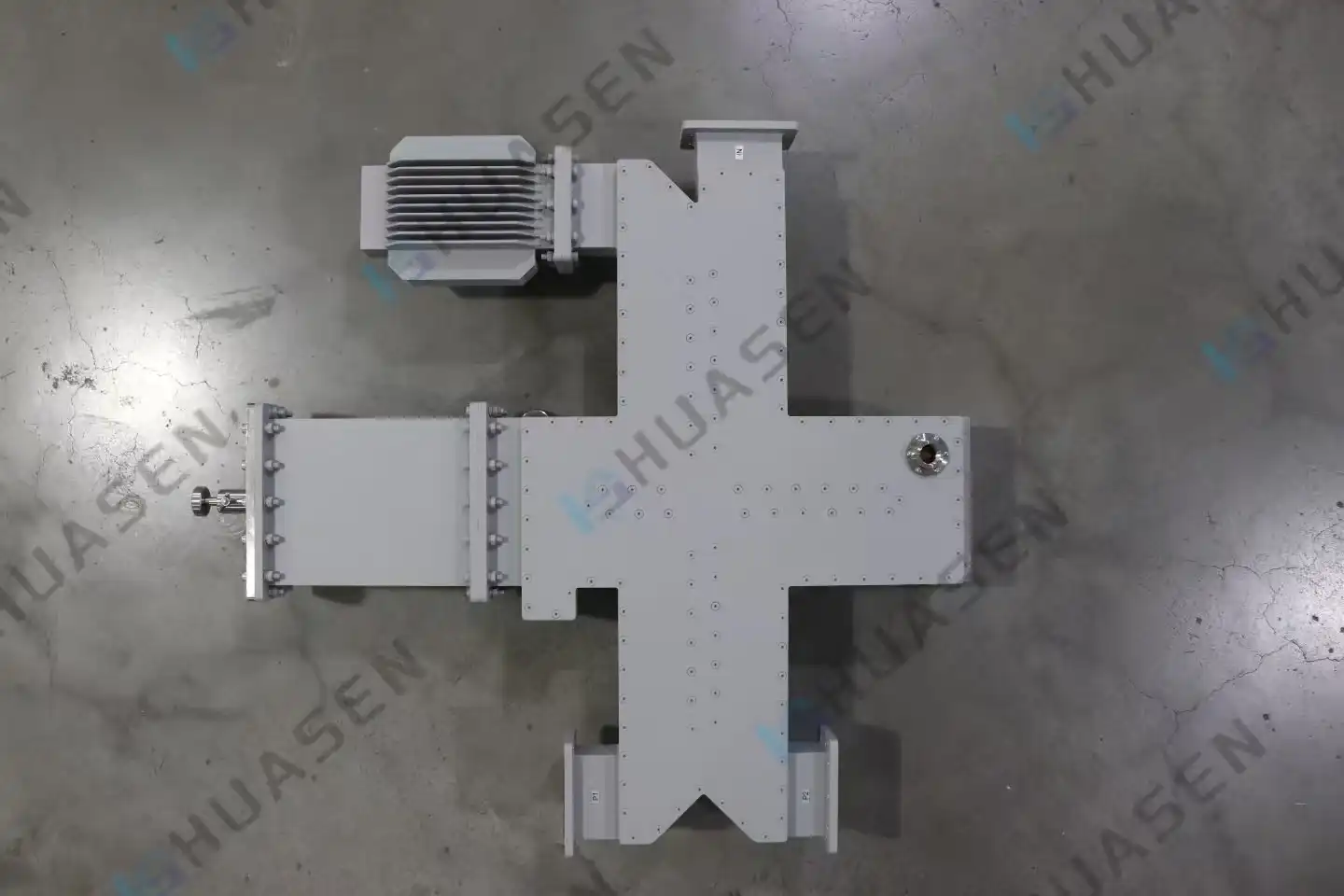
There are different splitting structures that are used for different practical needs. Magic Tee designs divide power evenly and have high port-to-port separation of more than 30 dB. This makes them perfect for monopulse radar comparators where signal purity determines how well they can tell the difference between targets. It is very important for beamforming networks in phased arrays that in-phase dividers keep the amplitude balance within ±0.2 dB and the phase consistency within ±2 degrees across all output arms. When you use a double-ridge design, the bandwidth goes beyond what is possible with a normal rectangular waveguide. This means that you can use multi-band systems without having to buy extra parts.
The different types of structures—I-type, U-type, X-type, Y-type, and YU-type—meet different needs for signal transmission and space limitations. When there isn't much room on the floor, in equipment racks, or in airborne enclosures, small folded shapes keep the electrical performance while lowering the mechanical footprint. Knowing these changes in architecture can help you choose the right divider design for your installation space and signal distribution needs.
Key Parameters That Define Operational Boundaries
A waveguide standard agreement is based on the frequency range. BJ22 waveguides work with smaller microwave bands, and BJ320 waveguides cover millimeter-wave spectrums. To keep VSWR below 1.20:1, the operating bandwidth usually stays within 10% of the center frequency. This makes sure that the power flow is efficient. Signal strength stays the same through many steps of the delivery networks when insertion loss is less than 0.2 dB. Power handling specs are very important. Average rates above 200W and peak capacities above 2kW keep voltage breakdown and multipactor effects from happening in high-power radar emitters and electronic warfare systems.
Critical Selection Criteria for High-Frequency Waveguide Power Dividers
Defining Application-Specific Requirements
Your choosing process should start with clear rules for how things will work. Communication testing labs need a wide range of frequencies to test parts on a number of different bands, while base station builders put power handling for continuous wave transfer at the top of their list of priorities. For aerospace uses, buildings must be rugged and meet MIL-STD-810 for shock and vibration. Benchtop test sets, on the other hand, focus on measuring accurately and making sure connectors work with each other. Keeping track of working temperature ranges, humidity exposure, and altitude placement shapes the choice of materials and protection coatings.
Performance Metrics That Impact System Integration
Return loss shows how well the splitter fits the impedances of the source and load. When the value is less than -20 dB across the working span, reflected power can't make amplifiers unstable or cause standing waves. In multi-channel systems, isolation between output ports stops crosstalk. For radar uses, isolation needs to be higher than 25 dB to keep receiver lines separate. Beamforming accuracy is directly affected by phase and amplitude balance. For example, satellites that use phased arrays for spot beam shape need to match the phase within 3 degrees to keep the coverage patterns.
Comparing Transmission Line Technologies
For frequencies below 10 GHz, coaxial dividers are flexible and smaller, but the insulating materials they are made of cause losses that get worse when networks are linked together. Waveguide power divider systems get rid of dielectric loss processes, which makes them better for runs longer than a few wavelengths. When temperatures change, precision-machined metal structures keep working the same way, unlike PCB-based designs that can fail because the foundation expands. At millimeter-wave frequencies, where skin depth is close to surface roughness measurements, silver-plated or gold-plated waveguide innards are better at conducting electricity, which lowers ohmic losses that hurt coaxial options.
Environmental and Mechanical Considerations
When deployed outside, they have to deal with UV damage, wetness getting in, and high temperatures. When you pressurize waveguide systems with dry nitrogen or dehumidified air, moisture doesn't form, which stops rust and dielectric breakdown. Mounting options need to be able to handle thermal expansion without putting too much stress on the flange surfaces, as this can damage electrical contact and cause passive intermodulation products. To avoid expensive adapters that add more loss and reflection points, connector specs must match the current infrastructure. This is true for UG-series flanges, WR-standard grooved flanges, and custom interfaces.
Market Solutions and Brand Insights: Choosing Trusted Waveguide Power Divider Suppliers
Evaluating Manufacturer Capabilities and Track Records
Established sellers show their knowledge by offering a wide range of products in both standard and custom designs. When defense or aerospace uses need it, look for manufacturers that have ISO 9001 quality control systems and can provide MIL-STD compliance paperwork. To make sure that all production lots have the same electrical performance, fine CNC machining errors should be within 0.001 inches. Companies that have their own testing labs with standardized vector network analyzers can provide S-parameter data that checks for insertion loss, return loss, and separation over certain frequency ranges.
Huasen Microwave Technology has been improving the production of waveguide power divider components since 1993. We sell in-phase power splitters, double-ridge Magic T divides, and one-to-many distribution networks that work with BJ22 through BJ320 standards. Before it is shipped, every unit goes through a series of strict tests to make sure it works properly with VSWR and power. This quality base serves infrastructure for telecommunications, radar sites, and aerospace systems where the dependability of parts is a must.
Customization, Flexibility, and Technical Support Services
Off-the-shelf parts can be used in common situations, but custom solutions are often needed for system improvement. When standard products make sacrifices, suppliers who offer custom power splitting ratios, changed flange configurations, and frequency tuning for particular applications give businesses an edge. Being able to make prototypes of unique designs with acceptable lead times—usually 4-6 weeks for complex geometries—shortens development times and lowers the risk of integration problems.
The standard of the technical paperwork shows how much the supplier wants the customer to succeed. Full datasheets should have full two-port S-parameters, mechanical drawings with precision details, lists of materials, and suggested mounting methods. According to pre-sales tech support, specifications can be better understood, and applications can be made that work with them. Helping with merging issues and making sure the system works well after delivery adds long-term value to the relationship that goes beyond just supplying components.
Procurement Strategies for Optimal Value
Buying in bulk lowers the cost per unit, but you need to be able to accurately predict demand so that your inventory doesn't become useless as system designs change. Stocking deals with flexible call-off dates strike a balance between low costs and the risk of running out of supplies. For unique designs where demand isn't clear, ask for quotes that include non-recurring planning costs along with the price of a production unit to get a better idea of the total program costs. When you compare wait times from different suppliers, you can find supply chain risks and make plans for what to do if something goes wrong with key path components.
In regulated sectors, certification standards determine which suppliers are chosen. Defense companies need domestic manufacturing that is ITAR-compliant, but business telecommunications projects need to find cost-effective foreign sources that meet RoHS and REACH standards. Checking the quality standards of your suppliers and asking for proof of agreement with every shipment makes sure that your supply chain is traceable and compliant.
Practical Tips for Ensuring Optimal Performance and Longevity
Installation Best Practices for Minimal Signal Degradation
When flanges are properly mated, gaps that cause echoes and passive intermodulation don’t happen, including in an RF power divider. Before putting the parts together, clean the mating areas with isopropyl alcohol to get rid of rust and dust. Follow the manufacturer's instructions and apply even force across the mounting bolts in a star pattern. For normal rectangular flanges, this is usually 20 to 30 inch-pounds. This will make sure that the contact pressure is the same and the part doesn't warp. When you can, use alignment pins to keep things from moving out of place laterally, which can damage the electrical contact.
In long waveguide power divider runs, mechanical stress from heat expansion needs expansion joints or flexible parts to keep the flanges from coming apart. Support structures should limit movement that is perpendicular to signal transmission while letting the structure expand along its length. When switching from waveguide to coaxial connections, check the adapter's VSWR specs across the full working bandwidth and include extra insertion loss in link budgets.
Environmental Protection and Routine Maintenance
Outdoor installations benefit from protective covers that keep waveguide parts dry by blocking direct rain while letting pressure adjustment keep water out of small holes. When the humidity sign changes color, desiccant breathers in pressure systems need to be replaced on a regular basis. At regular times, inspections should include looking for rust, especially where two different types of metal meet, and making sure that the mounting hardware is still properly torqued.
Monitoring performance with regular Vector Network Analyzer runs finds declines before they become major problems. When you do a comparison, you can use the baseline measures that were taken during the original installation. Gradual rises in return loss or reduced separation are signs of contamination, corrosion, or mechanical stress that need to be fixed through upkeep. By setting acceptance conditions, like return loss above -18 dB or isolation below 22 dB, which would lead to a review, proactive action can be taken.
Real-World Deployment Insights
For interferometry purposes, a satellite base station working at 32 GHz had to send power to sixteen receiving channels that had to be perfectly phase-matched. In this case, cascaded waveguide dividers were used in a company feed network. Each splitting stage added less than 0.15 dB of insertion loss. Temperature-controlled shelters kept the array's temperature stable within ±2°C, which kept the phase coherence. The first tests showed passive intermodulation products from a single flange connection that wasn't torqued enough. Retorquing to specification got rid of the unwanted signals. This case shows how important it is to carefully follow installation steps and do thorough acceptance testing.
Future Trends and Innovations in Waveguide Power Divider Technology
Advanced Materials and Fabrication Methods
Additive manufacturing methods make it possible to make parts with complex internal shapes that weren't possible with traditional machining. There are fewer parts in distribution networks when three-dimensional printed waveguide power divider structures with built-in matched networks and improved power division profiles are used. New materials, like copper-silver alloys that are better at conducting electricity and preventing corrosion, improve performance and operating lifetime longer in harsh settings. These improvements in manufacturing cut down on the cost of prototyping and sped up the iteration cycles for unique designs.
Integration with Next-Generation Communication Systems
5G is now available in millimeter-wave bands, and an early 6G study is happening above 100 GHz. This increases the need for wideband power distribution that can support massive MIMO designs. Waveguide power dividers with tunable phase shifters allow beam direction without active parts, which lowers the need for power and makes heat management easier. Hybrid integration methods that combine waveguide power distribution with planar antenna arrays improve performance while keeping the ability to make a lot of them.
Strategic Supplier Partnerships for Competitive Advantage
Getting manufacturers involved early in the design process is better for procurement teams than leaving the choice of components, such as an RF power divider,as a last-minute application item. When providers work together, they can suggest different designs that meet performance needs while also lowering costs and speeding up delivery times. When suppliers spend money on modeling tools and fast prototyping infrastructure, they can quickly change designs, which shortens the time it takes to create new products. Setting up agreements with chosen suppliers that include volume promises promotes investment in specialized tools and process optimization, which is good for everyone.
Conclusion
When choosing a waveguide power divider, it's important to find a mix between electrical performance, mechanical limitations, longevity in harsh environments, and provider dependability. If you understand basic design concepts, you can choose systems that work well with your frequency range and power needs. Performance measures must be carefully evaluated to make sure that the system works together without affecting the quality of the signals. When you work with experienced makers who offer full technical help and flexible customization options, you can lower the risks of procurement while still coming up with new solutions. When you set and maintain things the right way, they last longer, and the system works better. You can safely choose waveguide power distribution solutions that meet the needs of demanding high-frequency applications by using these selection criteria and placement strategies.
FAQ
1. What frequency ranges do waveguide power dividers typically cover?
Standard waveguide power dividers work in clear bands that match waveguide standards, ranging from WR-975, which covers 0.75 to 1.15 GHz, to WR-10, which covers 75 to 110 GHz. Broadband designs that use double-ridge or ridged waveguide architectures can operate over a wider range of frequencies than rectangular waveguides can. For the best VSWR performance, the working bandwidth should stay within 10% of the center frequency. However, some custom designs can achieve wider ranges with acceptable performance losses. The right waveguide standard and division setup are based on the frequency of your application.
2. How do waveguide dividers compare to coaxial alternatives in high-frequency applications?
Waveguide systems get rid of the insulation losses that make coaxial work less well above 18 GHz. This means that they have lower insertion loss and can handle more power. The transmission environment, which is either full of air or gas, stops the dielectric breakdown that happens in coaxial wires when they are exposed to high power levels. Waveguides are better for fixed installs than flexible coaxial systems because they are more stable mechanically and thermally. For lower frequencies, where their loss is still okay, coaxial dividers are better because they are smaller, lighter, and allow for more route options. Depending on the needs of the system, the crossing point strikes a balance between electricity performance and mechanical limitations.
3. What factors most significantly impact waveguide power divider insertion loss?
Loss processes are mostly controlled by the surface conductivity of the internal walls. Silver plating works best, while gold plating is better at resisting rust but has a little more loss. Loss changes depending on the splitting topology. Simple T-junctions add only a small amount of extra loss on top of the theoretical division loss, but complicated corporate networks build up losses over many steps. Precision in manufacturing affects loss by making the surface rough and changing the field distribution through measurement errors. Loss is affected by the operating frequency in relation to the waveguide cutoff frequency. Performance gets worse near the lower cutoff frequency, where the waveguide becomes too big.
Partner with Huasen Microwave for Reliable High-Frequency Solutions
Every Waveguide Power Divider that Huasen Microwave Technology makes is backed by 30 years of technical know-how. Our wide range of products, which includes Magic T parts, in-phase dividers, and multi-way splitters, can be used with a wide range of system designs from 0.32 GHz to 112 GHz. We help you with the buying process by giving you full technical paperwork, letting you change power ratios and connection interfaces, and providing quick engineering support during integration. If you need a provider that will guarantee quality and on-time delivery, email our team at sales@huasenmicrowave.com. We can give you application-specific advice and quotes that are perfect for your project.
References
1. Pozar, David M. Microwave Engineering, 4th Edition. Wiley, 2011.
2. Matthaei, George L., Leo Young, and E.M.T. Jones. Microwave Filters, Impedance-Matching Networks, and Coupling Structures. Artech House, 1980.
3. Saad, Theodore S. Microwave Engineers' Handbook, Volume 1. Artech House, 1971.
4. Marcuvitz, Nathan. Waveguide Handbook. IET Electromagnetic Waves Series, 1986.
5. IEEE Standard 1488-2020. IEEE Recommended Practice for Waveguide Flanges.
6. Collin, Robert E. Foundations for Microwave Engineering, 2nd Edition. Wiley-IEEE Press, 2000.
Send Inquiry