Pyramidal Horn Antenna Frequency Range and Application Scope






2026-03-19 21:55:08
Pyramidal Horn Antenna technology is one of the most important tools in current RF and microwave engineering. It has great frequency coverage from L-band frequencies up to 220 GHz, including millimetre waves. These antennas were carefully designed and manufactured to work very well in a wide range of industrial settings, such as 5G infrastructure, satellite communications, EMC tests, and radar systems. Pyramidal horn designs are very flexible, so they can be easily integrated into complicated RF systems. They also have great gain characteristics, low VSWR performance, and great directional properties that meet strict requirements in the defence, aircraft, and telecommunications sectors.
Understanding Pyramidal Horn Antenna Basics
Pyramidal horn antennas are very advanced aperture antennas that change electromagnetic energy from waveguide structures into patterns of radiation that can travel through space. The basic design includes a flared waveguide structure that grows in both the E-plane and the H-plane directions. This makes the pyramid shape that is typical of this type of antenna. This physical shape acts as an impedance-matching transformer, slowly changing the waveguide's characteristic impedance to the 377-ohm free-space impedance.
Frequency Range Fundamentals
The frequency range that pyramidal horn antennas can work with is mostly determined by the waveguide's size and the material's features. Standard designs usually work between 1 GHz and 220 GHz, with frequency bands set by the size of the waveguides that connect them. WR-90 waveguides work with X-band frequencies (8.2-12.4 GHz), while WR-28 waveguides work with Ka-band frequencies (26.5-40 GHz). The lower frequency limit is the same as the waveguide cutoff frequency. Below this frequency, electromagnetic waves stop moving, and radiation efficiency drops by a huge amount.
Radiation Pattern Characteristics
When the pyramids are set up, they make very precise radiation patterns with known beamwidth properties. Depending on the size of the opening and the frequency of operation, the half-power beamwidth is usually between 15 and 60 degrees. These antennas are great for directional uses that need to focus signals very precisely because their gain ranges from 10 dBi to 25 dBi. Side lobe suppression usually works at -20 dB to -25 dB levels, which makes sure that interference in channels next to it is kept to a minimum.
Core Design Principles and Performance Characteristics
Waveguide measurements are very important for figuring out the frequency response and how well an antenna works overall. To get the least amount of phase error across the radiating surface, the flare length and opening size must be carefully chosen. To get the most gain, the best plans keep phase error below 90 degrees in the E-plane and 180 degrees in the H-plane.
Impedance Matching and VSWR Performance
Pyramidal horn antennas are different from other types of antennas because they have better impedance-matching properties. As the waveguide gives way to free space, reflections are kept to a minimum, and the VSWR stays below 1.5:1 for the whole working bandwidth. This performance directly leads to better signal transmission efficiency and lower system noise levels, which are very important for high-performance RF uses.
Material Selection and Construction
High-grade aluminium, copper, and brass construction ensures excellent electrical conductivity and mechanical stability. Silver or gold plating on internal surfaces minimises skin effect losses in the pyramidal antenna and prevents oxidation over extended operational periods. The robust metallic construction enables high power handling capabilities limited primarily by air breakdown voltage rather than material thermal limitations.
The advantages of pyramidal horn antennas become evident when comparing performance metrics with alternative antenna technologies:
- Linear Polarisation Purity: Cross-polarisation isolation typically reaches -20 dB to -30 dB, surpassing many competing designs and ensuring signal integrity in polarisation-sensitive applications.
- Broadband Performance: Frequency coverage often exceeds 50% bandwidth with consistent gain and pattern characteristics, reducing the need for multiple antenna systems.
- Power Handling: Excellent thermal management and absence of dielectric materials enable kilowatt-level power handling in transmit applications.
- Environmental Durability: All-metal construction provides superior resistance to temperature extremes, vibration, and electromagnetic interference compared to dielectric-loaded alternatives.
- These performance advantages directly address common procurement challenges related to system reliability, maintenance costs, and operational flexibility across diverse deployment environments.
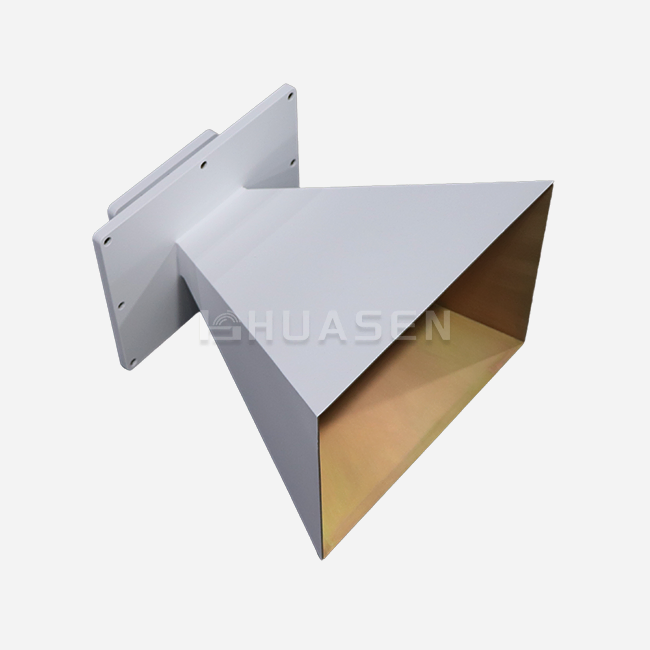
Application Scope of Pyramidal Horn Antennas in Industry
Pyramidal horn antennas serve essential functions across multiple B2B sectors, with applications spanning from precision measurement systems to mission-critical communications infrastructure. The versatility of these antennas enables deployment in environments ranging from laboratory test setups to harsh outdoor installations.
EMC Testing and Compliance Verification
EMC testing laboratories rely heavily on pyramidal horn antennas as standard gain horns for calibration and measurement activities. These antennas provide the reference standard for radiated immunity testing according to IEC 61000-4-3 and emissions testing per CISPR standards. The predictable gain characteristics and linear polarisation enable accurate field strength measurements essential for regulatory compliance verification. Test frequencies typically span from 1 GHz to 40 GHz, covering most commercial electronic devices and automotive systems.
Satellite and Radar Feed Applications
Ground station operators utilise pyramidal horn antennas as feed elements for parabolic reflector systems in satellite communication and radar applications. The controlled beamwidth ensures optimal reflector illumination while minimising spillover losses that degrade system efficiency. Ku-band and Ka-band satellite terminals frequently employ these feed horns to achieve the precise gain and pattern characteristics required for reliable satellite links. Military radar systems leverage the high power handling capability and environmental ruggedness for target detection and tracking applications.
5G Infrastructure and Millimetre Wave Communications
The emergence of 5G networks has created significant demand for millimetre-wave pyramidal horn antennas operating in the 24-28 GHz and 37-40 GHz frequency bands. Base station manufacturers integrate these antennas into beamforming arrays for enhanced coverage and capacity. The directional characteristics enable spatial pyramidal antenna multiplexing and interference reduction essential for dense urban deployments. Point-to-point backhaul links also benefit from the high gain and narrow beamwidth characteristics for reliable gigabit data transmission.
Material Characterisation and Industrial Sensing
Pyramidal horn antennas are used in manufacturing facilities for quality control purposes in devices that characterise materials without touching them. The focused beam makes it possible to measure the dielectric qualities of plastics, ceramics, and composite materials accurately without touching them. These antennas are used by moisture detection systems in the food processing and pharmaceutical businesses to keep an eye on things in real time while they're being made. The frequency selectivity lets you tell the difference between different features of a material based on how it reacts to electromagnetic waves.
Procurement Considerations for Pyramidal Horn Antennas
Successful procurement requires careful evaluation of supplier capabilities, product specifications, and long-term support requirements. The complexity of RF system integration demands vendors with proven expertise in both antenna design and manufacturing quality control processes.
Supplier Evaluation Criteria
Leading manufacturers keep their ISO 9001 certification and use full quality control systems that check designs, keep track of materials, and test products' performance. Well-known companies like Amphenol, TE Connectivity, and microwave makers offer a wide range of products in both standard and custom configurations. Certification that meets MIL-STD-461 for electromagnetic compatibility and RoHS for environmental safety shows a dedication to quality and following the rules.
Customisation Capabilities and Engineering Support
For many uses, custom frequency ranges, connector interfaces, or mechanical setups are needed that aren't available in standard catalogue items. If a supplier has their own design team, it can change the flare angles, aperture sizes, and mounting interfaces to fit the needs of a particular system. Providing engineering support services like electromagnetic modelling, prototype development, and test data validation helps make sure that new systems work well with current RF systems. Sample programs let you check how well they work before committing to large amounts for production.
Cost Optimisation and Volume Pricing
Strategies for buying in bulk can cut unit costs by a lot while still making sure that products are always available. Price protection and priority allocation during times of high demand are common parts of annual agreements with chosen suppliers. Shipping costs, customs fees, pyramidal antenna and possible tooling fees for custom setups should all be added to the total cost of ownership. Long-term relationships with dependable providers lower the chances of disruptions in the supply chain and allow groups to work together to cut costs.
To make sure that the program works reliably in the setting it's meant for, quality assurance programs need to look at both electrical performance and mechanical specifications. Before they are shipped, thorough testing procedures check the VSWR's performance, gain accuracy, and pattern characteristics.
Future Trends and Innovations in Pyramidal Horn Antenna Technology
Pyramidal horn antenna design and production methods are always changing because of new technologies and changing application needs. As 6G communications and advanced radar systems move toward higher frequencies, they need more accurate measurements and new ways of working with materials.
Advanced Manufacturing Techniques
With additive manufacturing technologies, it's possible to make parts with complex internal geometries and built-in cooling features that weren't possible with standard machining. Rapid prototyping of custom configurations is possible with 3D printing, and the cost of tools for low-volume speciality uses is cut down. Computer numerical control (CNC) machining has made it possible to get closer to the dimensions that are needed for consistent millimetre-wave performance. Using advanced plating methods to improve surface finishing makes surfaces more electrically conductive and resistant to corrosion.
Multi-Band and Reconfigurable Designs
To cut down on hardware complexity and installation costs, system designers are asking for antennas that can work across more than one frequency band. Stepped horn designs and hybrid setups make it possible to cover a wider range of frequencies while still delivering good performance across the board. Electronically changeable antennas that use PIN diode or varactor tuning are new ways to choose the right frequency based on the needs of the operation.
Environmental and Sustainability Considerations
Environmental laws and business sustainability efforts, such as Pyramidal Horn Antenna, affect the choices made about materials and the ways they are made. Environmental compliance requirements are met by plating choices without lead and materials that can be recycled. Manufacturing methods that use less energy and strategies for getting goods from nearby stores lower carbon emissions and strengthen the supply chain. Optimising packaging cuts down on waste while still protecting items well during shipping and storage. As software-defined radio systems and cognitive communications become more common, they open up new uses for smart antenna systems that can automatically adjust to changing interference and transmission conditions. Because of these changes, procurement tactics will change to focus on integrated solutions instead of separate parts.
Conclusion
Pyramidal horn antennas work very well in a wide range of frequencies and situations, which is why they are an important part of current RF systems. Their excellent impedance matching, directional characteristics, and strong construction meet important needs in testing, aircraft, and telecommunications. These antennas are effective for demanding business-to-business uses because they cover a wide range of frequencies, from L-band to millimetre waves, can handle a lot of power, and can last in harsh environments. As 5G and future 6G technologies push for higher frequency needs, pyramidal horn antennas will continue to change to meet new performance requirements while keeping the main benefits that have made them so popular across many industries.
FAQ
1. What frequency ranges can pyramidal horn antennas cover?
Pyramidal horn antennas typically operate from 1 GHz to 220 GHz, with specific ranges determined by waveguide dimensions. Common bands include S-band (2-4 GHz), X-band (8-12 GHz), Ku-band (12-18 GHz), and millimetre wave frequencies up to W-band (75-110 GHz). The lower frequency limit corresponds to the waveguide cutoff frequency, while the upper limit depends on manufacturing precision and material losses.
2. How do pyramidal horn antennas compare to parabolic reflector antennas?
Pyramidal horn antennas offer compact size, simple construction, and excellent impedance matching compared to parabolic reflectors. They provide moderate gain (10-25 dBi) suitable for many applications without requiring complex feed systems. Parabolic reflectors achieve higher gain but require more space and precise alignment. Horn antennas excel in laboratory environments and moderate-range communications, while reflectors suit long-distance links requiring maximum gain.
3. Are ruggedised versions available for outdoor deployment?
Yes, ruggedised pyramidal horn antennas incorporate weatherproof construction with sealed flanges, corrosion-resistant materials, and radomes for environmental protection. These versions meet IP65 or IP67 ingress protection ratings and operate across extended temperature ranges from -40°C to +85°C. Military-grade versions comply with MIL-STD-810 environmental testing for vibration, shock, and salt fog resistance, suitable for harsh deployment conditions.
4. What factors affect the gain performance of pyramidal horn antennas?
Gain depends primarily on aperture size, flare length, and operating frequency. Larger apertures generally provide higher gain, while optimal flare length minimises phase error across the radiating surface. Frequency affects gain through the electrical size relationship, with gain typically increasing with frequency for fixed physical dimensions. Manufacturing tolerances and surface finish quality also influence gain consistency across the frequency band.
5. How important is VSWR performance in system applications?
VSWR performance directly impacts transmission efficiency and system noise figure. Pyramidal horn antennas typically achieve VSWR below 1.5:1, ensuring greater than 96% power transfer efficiency. Lower VSWR reduces signal reflections that can cause measurement errors in test applications or degrade communication link quality. Consistent VSWR across the operating bandwidth maintains predictable system performance and simplifies RF system design.
Partner with Huasen Microwave for Premium Pyramidal Horn Antenna Solutions
Huasen Microwave Technology combines three decades of Pyramidal Horn Antenna of RF expertise with cutting-edge manufacturing capabilities to deliver exceptional Pyramidal Horn Antenna solutions tailored to your specific requirements. Our comprehensive product portfolio spans L-band through millimetre wave frequencies, featuring industry-leading VSWR performance, superior gain stability, and robust construction suitable for demanding environments. Whether you need standard catalogue products or custom-engineered solutions, our experienced team provides complete technical support from initial specification through delivery and beyond. Connect with our application engineers at sales@huasenmicrowave.com to discuss your pyramidal horn antenna requirements and discover why leading manufacturers worldwide choose Huasen Microwave as their trusted supplier for mission-critical RF components.
References
1. Balanis, Constantine A. "Antenna Theory: Analysis and Design, Fourth Edition." John Wiley & Sons, 2016.
2. IEEE Standard for Definitions of Terms for Antennas. IEEE Std 145-2013 (Revision of IEEE Std 145-1993).
3. Milligan, Thomas A. "Modern Antenna Design, Second Edition." McGraw-Hill Professional, 2005.
4. Love, A.W. "Electromagnetic Horn Antennas." IEEE Press Selected Reprint Series, 1976.
5. Olver, A.D., P.J.B. Clarricoats, A.A. Kishk, and L. Shafai. "Microwave Horns and Feeds." Institution of Engineering and Technology, 1994.
6. Silver, Samuel. "Microwave Antenna Theory and Design." MIT Radiation Laboratory Series Volume 12, Boston Technical Publishers, 1964.
Send Inquiry